Choosing the right receiver can transform a living room into a true theater. This short guide explains why modern gear matters for daily use: easier surround setups, multiroom streaming, and app control without sacrificing flexibility or sound quality.
We focus on models sold in the U.S. market and value reliable connectivity, room correction, and practical features over only big specs. Expect mentions of Denon, Yamaha, Integra, Onkyo, Marantz, Sony, and Anthem as examples of roles they play in a system.
“Wireless” is an umbrella term here. It covers wireless surrounds like MusicCast, streaming ecosystems like HEOS and Sonos, and Bluetooth for headphones—each behaves differently and often requires brand compatibility.
What follows: quick picks by budget, ecosystem comparisons, HDMI 2.1/eARC notes, calibration systems, and compact living recommendations. We’ll flag price-to-performance standouts and when virtual height processing can replace full Atmos installs.
At a Glance: Today’s best wireless-ready AV receivers for home cinema
This quick guide highlights receivers that deliver the best sound quality and real-world value for home cinema.
Quick picks by budget and use case
Entry/value: Sony STR-DH590 is a solid 5.1 starter. Denon AVR-S760H is our best overall value with Atmos and DTS:X support. Onkyo TX-NR696 brings a rich 7.2 feature set at a fair price.
Midrange: Denon AVR-S970H offers warm musical tuning. Sony STR-AN1000 pairs power with a refined UI. Yamaha RX-V4A is the top pick for MusicCast surround setups.
Enthusiast: Denon AVR-X3800H is future-proof with HDMI 2.1/8K. Marantz Cinema 50 supports 9 channels plus four discrete sub outs. Anthem MRX 740 and Sony STR-AZ5000ES serve high-end multiroom and cinema builds.
How we evaluated: sound quality, features, and wireless performance
We rated units on sound in real rooms, feature completeness, and ecosystem stability. Key features include HDMI 2.1, eARC, VRR, and robust calibration tools.
Trade-offs matter: published power figures rarely match multichannel use. We favor devices with clear on-screen setup, reliable mic calibration, and stable control apps.
| Use Case | Top Pick | Why |
|---|---|---|
| Entry 5.1 starter | Sony STR-DH590 | Simple setup, solid sound for the price |
| Best overall value | Denon AVR-S760H | Good sound quality, Atmos/DTS:X, strong feature set |
| Wireless surrounds | Yamaha RX-V4A | MusicCast integration and easy surround pairing |
| Sonos-friendly | Integra DRX-3.3 | Sonos-ready networking and stable integration |
| 11-channel/High-end | Sony STR-AZ5000ES | Robust build and high channel count for large rooms |
Buyer’s Guide essentials: what “wireless” really means for an AV receiver
Not all cord-free features are the same. Some products cut only rear speaker cabling while others focus on streaming music through apps. Know the difference to pick the right setup for your room.
Wireless surrounds work inside specific ecosystems like Yamaha MusicCast. They still need power at each surround and you must wire front speakers and subs. That reduces cable runs but does not remove basic speaker wiring needs.
Streaming systems (HEOS, MusicCast, AirPlay 2, Spotify Connect) give app control and whole‑house playback. They are separate from surround links; streaming does not create untethered multichannel home theater channels.
Many models can transmit Bluetooth to headphones for late‑night listening. This is handy for quiet viewing without changing your primary audio chain.
Pick MusicCast (for example, Yamaha RX‑V4A) when you want cable‑lite surrounds. Choose HEOS on Denon gear if multiroom streaming and app stability matter most. For Sonos, use a Sonos‑friendly AVR like Integra DRX‑3.3 or add a Sonos Port to compatible units.
Connectivity matters: prefer eARC for TV apps and consoles. Use 5 GHz for less interference when possible, but remember router placement affects range. Plan your ecosystem first, then buy matching devices and speakers for a seamless system.
- Setup expectation: front stage wired, rear surrounds may be wireless within an ecosystem.
- Control: app stability (HEOS, MusicCast, Sonos) affects daily use more than raw features.
- Latency: expect small sync issues; run calibration to align timing.
Wireless ecosystems compared: HEOS, MusicCast, Sonos, and more
Ecosystem choice shapes daily streaming behavior, speaker pairing, and how easily rooms stay in sync. Pick a platform and most future gear will follow that path, so plan before buying.
Denon HEOS powers multiroom streaming on models like the AVR-S760H, AVR-S970H, and AVR-X2800H. HEOS gives broad app grouping, casting support, and handy Bluetooth TX for late-night headphone listening.
Yamaha MusicCast stands out for pairing MusicCast 20/50 surrounds and the Sub 100 with the RX-V4A. Aventage models such as the RX-A6A use the same platform for higher-end builds and robust surround links.
Sonos paths include native integration on Integra DRX-3.3 or using a Sonos Port with an Onkyo TX-RZ50 to add full Sonos app control across zones. The TX-RZ50 also includes Dirac Live, which helps align timing and frequency when mixing wired fronts with networked rears.
| Platform | Strength | Notable models |
|---|---|---|
| HEOS | Multiroom, app grouping, Bluetooth TX | Denon AVR-S760H / S970H / X2800H |
| MusicCast | Easy wireless surrounds, reliable pairing | Yamaha RX-V4A, RX-A6A |
| Sonos | Best app UX for casting; native or Port path | Integra DRX-3.3, Onkyo TX-RZ50 + Port |
- Practical difference: multiroom streaming focuses on whole‑home playback; surround links focus on speaker placement and low-latency rear channels.
- Stability: MusicCast typically wins for surround reliability; HEOS is flexible but has mixed app reviews.
- Tip: Commit to one ecosystem to reduce compatibility hassles and plan speaker purchases around that choice.
wireless av receiver options across price tiers
This tiered guide breaks the market into clear price bands so you can match capability to room size and budget.
Entry and value tiers
Entry models give solid home sound for tight budgets. Consider the Sony STR-DH590 for a straightforward 5.1 setup with 4K passthrough.
The Denon AVR-S540BT adds twin subwoofer outs for deeper bass control. The Onkyo TX-NR696 steps up to 7.2 and Zone 2 for multiroom playback in small spaces.
Midrange sweet spots
Midlevel gear balances features and price. The Denon AVR-S760H often wins for price-to-performance thanks to Atmos/DTS:X support and steady app control.
The AVR-S970H brings a warmer musical tuning. Sony STR-AN1000 offers raw power and a clean UI, while Yamaha RX-V4A is the practical pick for MusicCast surround setups.
High-end and enthusiast
Enthusiast units add processing headroom and advanced sub management. Denon AVR-X3800H and Marantz Cinema 50 deliver 11-channel processing and robust HDMI 2.1 support for future-proofing.
Sony STR-AZ5000ES is built for longevity and 11-channel layouts. NAD T 778 favors audiophile ergonomics, and Anthem MRX 740 shines with superior room calibration.
Practical tip: Pair your tier choice with the intended speaker layout (5.1.2 vs 7.1.4) and room size to get the right power and processing mix.
| Tier | Representative models | Key trade-offs |
|---|---|---|
| Entry / Value | Sony STR-DH590, Denon AVR-S540BT, Onkyo TX-NR696 | Lower channel count, basic terminals, strong affordability |
| Midrange | Denon AVR-S760H, AVR-S970H, Sony STR-AN1000, Yamaha RX-V4A | Better room correction, app ecosystems, higher power |
| High-end / Enthusiast | Denon AVR-X3800H, Marantz Cinema 50, Sony STR-AZ5000ES, NAD T 778, Anthem MRX 740 | Advanced processing, multi-sub support, premium calibration |
- Buyer’s note: weigh warranty, firmware history, and app support along with upfront price to judge total ownership value.
- System fit: choose based on planned speaker layout and room size, not just headline features.
Sound quality priorities: power per channel, speaker matching, and subwoofer output
How a system delivers power and bass matters more than headline watts when you press play. Two‑channel ratings (like Sony STR-AN1000 at 165W/8Ω or Denon AVR-S760H at 75W/8Ω) describe peak performance in a simple test. They do not predict sustained output across all channels in a real home theater.
Robust power supplies and cooling let a unit keep dynamics during dense passages. That avoids clipping and preserves dialog clarity.
Match amplifier power to speaker sensitivity and impedance so the system reaches desired listening levels without strain. Leave about 20–30% headroom to prevent compression during action scenes.
Subwoofer output matters for even coverage. Budget models with dual‑sub support (Denon AVR‑S540BT) help bass balance. Marantz Cinema 50’s four discrete outs let you tune subs independently for smoother bass across seats.
Room correction and crossover management are as critical as raw power. Proper EQ, phase alignment, and crossover settings yield tighter bass and clearer midrange than a small power bump.
- Large rooms need extra current and headroom; pick higher sustained power or plan for external amplification later.
- Warm‑leaning units (Denon/Marantz) can tame bright speakers; neutral units (Yamaha/Anthem) suit detailed, analytical speakers.
- Pre‑outs on models like Onkyo TX‑RZ50, Denon AVR‑X3800H, and Marantz Cinema 50 let you add power amplifiers to raise performance ceilings.
| Model | Two‑ch Power (8Ω) | Sub Outputs |
|---|---|---|
| Sony STR-AN1000 | 165W | Single sub out |
| Denon AVR-S760H | 75W | Single sub out |
| Onkyo TX-RZ50 | 120W | Dual sub outs / pre-outs |
| Denon AVR-X3800H | 105W | Dual sub outs / pre-outs |
| Anthem MRX 740 | 140W | Dual sub outs |
| Marantz Cinema 50 | — (high‑current chassis) | Four discrete sub outs |
Finally, measure results with the included mic and, if desired, third‑party tools. Often moving a subwoofer or adjusting phase yields more audible gain than chasing a few extra watts.
Surround sound formats: Dolby Atmos, DTS:X, and virtual height tech
Object-based formats place sound elements in three-dimensional space so effects and dialogue can move above the listener. This creates a more immersive movie experience when your setup includes proper height channels.
Dolby Atmos and DTS:X are object-based formats that add height information to mixes. They show clear benefits with layouts such as 5.1.2 or 7.1.4, good ceiling height, and careful calibration.
Virtualizers like Dolby Atmos Height Virtualizer and DTS Virtual:X simulate height without in-ceiling or upfiring speakers. They work well in small rooms, rentals, or when running cables is not possible.
Model notes: many Denon units support both dolby atmos and DTS:X and include virtualizer modes. Some models, such as the NAD T 778, support Atmos but omit DTS:X. Yamaha’s RX‑V4A targets surround setups but lacks Atmos/DTS:X support.
- Content: streaming services and discs increasingly carry immersive audio; eARC helps pass true object-based audio from TV apps to your system.
- Upmixers: Dolby Surround and DTS Neural:X can expand stereo or 5.1 mixes to use more speakers.
- Practical tip: wireless surround platforms may not carry height channels, so virtualizers are a pragmatic compromise in cable-lite rooms.
For large rooms and cinephile builds, prioritize true height channels and plan wiring now. For compact or multipurpose spaces, accept virtual height for convenience. Finally, check firmware and HDMI 2.1 fixes to ensure consoles and players deliver stable immersive audio.
Connectivity that counts: HDMI inputs, 8K, eARC, and gaming features
Modern home systems need clear rules about HDMI lanes and eARC. Pick gear that keeps pace with consoles and 4K/120 sources so your setup lasts.
HDMI 2.1 matters for 4K/120 gaming and high refresh rates. VRR reduces tearing, and ALLM ensures low-latency gameplay when the console wakes the display.
Compare hdmi inputs: Denon AVR-X3800H, Sony STR-AZ5000ES, Marantz Cinema 50, and Onkyo TX-RZ50 each offer six 8K-capable hdmi inputs with eARC on the main output. Marantz NR1711 brings a slimline HDMI 2.1 path and VRR for small living spaces.
eARC vs ARC: eARC carries full-bandwidth, uncompressed Dolby Atmos back to the unit for the best audio path. ARC may pass compressed Atmos and is fine for many households without audiophile needs.
Decide your switching strategy: connect consoles to the TV and use eARC, or route devices through the unit for simpler input management. Check firmware maturity, use Ultra High Speed HDMI cables, and enable TV VRR/ALLM settings.
- Plan ports: multiple 8K-capable inputs avoid future shortages as you add devices.
- Ease of use: robust CEC and app control simplify daily switching and multi‑zone setups.
Room correction and calibration: Audyssey, Dirac Live, Sony DCAC, Anthem ARC
Proper measurement and correction bring predictable, repeatable sound to any home theater.
Why it matters: calibration fixes room-induced peaks and nulls, aligns speaker distance and level, and integrates subwoofers for smooth bass. That delivers consistent clarity across seats and improves perceived audio quality without raising amplifier power.
Dirac Live, included on the Onkyo TX-RZ50, excels at time-domain correction and selectable target curves. It shapes frequency and phase for tighter imaging and better bass control.
Audyssey vs Dirac and other engines
Audyssey MultiEQ and MultEQ XT (found on Denon and Marantz models) automate EQ over multiple mic positions and give reliable level matching. MultEQ XT adds finer resolution, which helps complex rooms.
Marantz Cinema 50 ships with MultEQ XT and offers an optional Dirac Live upgrade for owners who want deeper time correction and advanced target-curve tuning.
Anthem ARC Genesis (Anthem MRX 740) is a reference-grade toolkit. It offers deep customization and superior bass integration for multichannel setups.
Sony’s DCAC on ES models uses dense measurement grids to map a 3D picture of the room. That detailed data improves immersion and imaging for large and irregular rooms.
- Perform multiple mic positions at listening height and avoid noise during sweeps.
- Save profiles for different layouts (with/without surrounds or dual subs).
- Re-run calibration after moving furniture, changing speakers, or adding treatment.
- Power users: use a calibrated mic like the MiniDSP UMIK for more precise Dirac fits.
| Platform | Notable models | Strength | Upgrade path |
|---|---|---|---|
| Dirac Live | Onkyo TX-RZ50 | Time-domain correction, advanced target curves | Built-in on select models |
| Audyssey (MultiEQ / XT) | Denon AVR-S770H, AVR-X2800H, Marantz Cinema 50 | Multi-position averaging, easy setup | Marantz: optional Dirac upgrade |
| Anthem ARC Genesis | Anthem MRX 740 | Reference-grade bass control, deep customization | Included with unit |
| Sony DCAC | Sony STR-AZ5000ES | High-resolution measurement mapping, imaging focus | Factory ES feature set |
Best picks for wireless surrounds and cable-lite setups
For living rooms and rentals where cable runs are a hassle, a few systems let you tuck the rears out of sight. These builds keep front channels hard-wired for stability while freeing rear placement and simplifying daily use.
Yamaha RX-V4A + MusicCast 20/50 and Sub 100
Yamaha RX-V4A pairs cleanly with MusicCast 20/50 speakers and the Sub 100 to limit rear cabling. The result is neater placement, easy app grouping, and fewer visible wires in a small home theater.
Note: the RX-V4A drops Atmos and DTS:X support to prioritize a cable‑lite approach. Pair it with a virtual height mode if you want some three‑dimensional sound without ceiling speakers.
Sonos-centric alternatives and Onkyo paths
Prefer Sonos? The Integra DRX-3.3 integrates natively for smooth app control and multiroom audio. For full processing and Dirac Live, add up to three Sonos Ports to an Onkyo TX-RZ50.
- Trade-offs: front speakers remain wired; rear freedom depends on the chosen ecosystem.
- Interference tips: favor 5 GHz, place extenders wisely, and avoid crowded channels.
- Setup advice: calibrate to time-align rears, test positions with temporary stands, and confirm firmware for ecosystem stability. eARC still helps simplify TV app and device switching.
Top-rated for music and stereo performance within home theaters
For listeners who value tonal balance and imaging, a few models stand out as true music-focused amplifiers within a theater setup.
NAD T 778 pairs audiophile ergonomics and a refined sound that rewards careful speaker choices. It offers crisp detail and a tactile touchscreen, though it omits DTS:X for some cinematic mixes.
Anthem MRX 740 brings authoritative musical weight and precise imaging. ARC Genesis tightens bass response in difficult rooms and helps a two-channel stage sit naturally with the rest of your system.
Denon AVR-S970H leans warm and forgiving, making long music sessions pleasant across genres. The Sony STR-AN1000 adds high two-channel power and DSD playback for high-res libraries as a strong music-forward value pick.
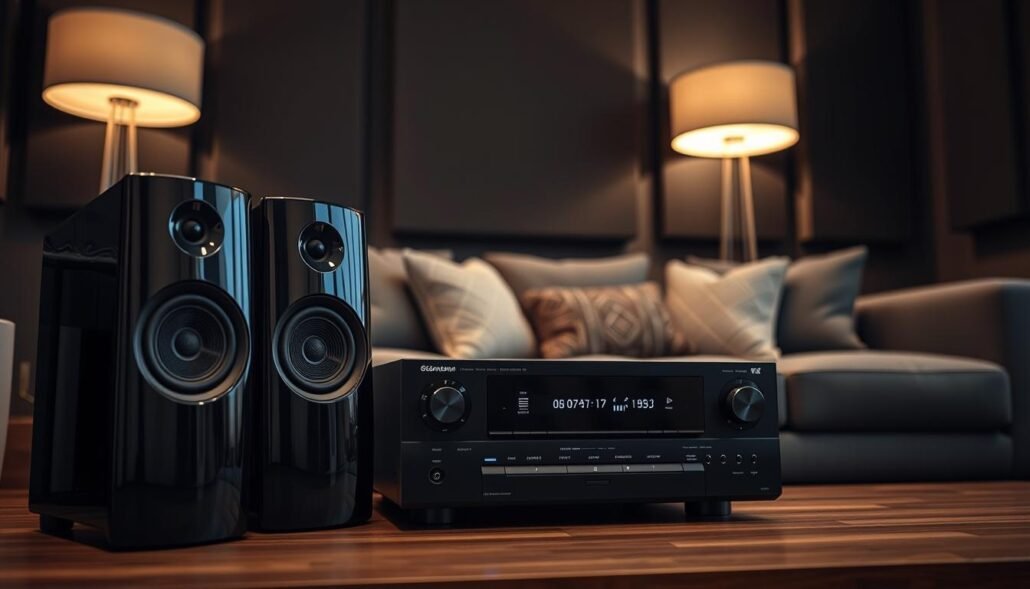
- Match these units with revealing bookshelf or tower speakers for a compelling stereo stage.
- Use Pure Direct or Direct modes and confirm 2.1 crossover settings for tight bass integration.
- Consider pre-outs and external amplification if your speakers demand extra current in large rooms.
| Model | Music Strength | Notes |
|---|---|---|
| NAD T 778 | Detailed, engaging | Audiophile ergonomics; no DTS:X |
| Anthem MRX 740 | Authoritative imaging | ARC Genesis for room correction |
| Denon AVR-S970H | Warm, long‑listening | Musical tuning, great daily sound |
Small rooms, apartments, and living rooms: compact and slimline choices
When space is limited, the right compact system can make a tiny room feel cinematic. A slim chassis helps the gear tuck into a media cabinet while keeping a clean design in multipurpose living areas.
Marantz NR1711 and pairing recommendations
Marantz NR1711 is a slimline reference with HDMI 2.1, VRR, and eARC that suits gaming-friendly living rooms and small home theaters.
Pair it with compact bookshelf or satellite speakers and a modest subwoofer. This keeps movie bass full without overwhelming neighbors or the space.
Calibrate at lower listening levels, enable dynamic volume or night mode, and use app-based sub control or receiver EQ to limit disturbance during late-night movie sessions.
- Save footprint: wall mounts or slim stands optimize surround angles in tight rooms.
- Cable tips: choose lighter-gauge, flexible runs that tuck under rugs or along baseboards.
- Height workarounds: virtual height modes are practical when mounting is impractical.
- Network: use 5 GHz Wi‑Fi and avoid crowded channels in apartments for stable streaming.
Look for intuitive on-screen guides to simplify setup in rentals. For a focused write-up on the slimline approach see the Marantz slimline review for more detail on design and real-world choice.
Design, control, and UX: interfaces, apps, and day-to-day usability
A well-designed interface turns complex setup steps into a five-minute routine.
Why UI matters: quick input switching, clear labels, and predictable app control reduce friction during daily use. Good design saves time and keeps everyone in the home happy.
Standout implementations
The Sony STR-AN1000 earns praise for a clear, responsive on-screen UI that surfaces important sound and HDMI settings without deep menus.
Marantz Cinema 50 provides an industry-leading on-screen setup that walks through cabling, speaker checks, and calibration step by step. Denon’s guided wizards help prevent wiring mistakes for first-time setup.
NAD T 778 improves daily control with a front-panel touchscreen that makes common tasks fast without hunting for the remote.
- Organize inputs with custom names and hide unused features to declutter menus.
- Set HDMI-CEC behavior carefully to avoid unintended device power-ons.
- Keep firmware current and document baseline settings before upgrades.
| Feature | Notable model | Benefit |
|---|---|---|
| Clear UI | Sony STR-AN1000 | Faster navigation, fewer menu layers |
| Guided on-screen setup | Marantz Cinema 50 | Stepwise cabling and calibration checks |
| Front touchscreen | NAD T 778 | Quick access to volume and input switching |
Reliability and build: chassis, power supplies, and long-term value
Solid mechanical design is often the first sign a unit will perform reliably for years. Heavier chassis and large power supplies usually mean parts run cooler and the unit resists strain during full multichannel playback.
Sony’s STR-AZ5000ES is a clear example: it tips the scales at over 42 pounds, uses a heavy-duty power supply and discrete amps, and carries a five-year warranty that signals manufacturer confidence.
Denon’s long-term track record matters too. Regular platform updates and proven component choices translate to steady value in the market and protect buyers over upgrade cycles.
Construction cues that matter
Yamaha Aventage models use anti-resonance frames and internal bracing to cut vibration and keep thermal paths clear. Marantz Cinema 50’s discrete amplification and a larger supply support steady output at reference levels.
Good thermal management — vents, heatsinks, and optional fans — preserves component life and consistent sound. For installations, prefer rack-friendly units, removable antennas, and well-placed vents.
- Practical advice: use surge protection or a power conditioner and allow airflow clearance.
- Maintenance: dust and check fan filters periodically to reduce thermal stress.
- Value factor: warranty length and service network add measurable long-term value.
Setup and placement tips for wireless-first home theaters
Start with the network: a stable signal matters as much as speaker geometry for modern home theaters.
Router placement, bands, and interference
Place the router or access point centrally and elevated. Favor 5 GHz for lower interference and better throughput for surround links like MusicCast 20/50.
Keep the system and wireless nodes out of metal racks or behind‑TV cavities to avoid attenuation. Use router tools to pick a static channel and reduce crowded frequencies.
Speaker placement, dual‑sub tips, and calibration
Align the front LCR at ear height and toe them in for a tight image. Ensure surrounds have clear sightlines to the main seats.
For two subs, try opposite wall midpoints or front corners, then run the receiver EQ or Dirac Live on an Onkyo TX‑RZ50 or Marantz Cinema 50 for smooth bass.
Set crossovers by speaker size (80–100 Hz for satellites, 60–80 Hz for larger stands) and validate with sweeps. Measure multiple mic positions during calibration and save profiles.
- Tidy cables: label runs to simplify troubleshooting and keep airflow clear.
- Acoustic tweaks: add rugs or panels to cut flutter echo and improve dialog clarity.
- Final check: verify lip‑sync and surround timing; adjust delay if needed.
| Focus | Action | Why it helps |
|---|---|---|
| Router | Central, elevated; prefer 5 GHz | Stronger links, less interference for surround devices |
| Speaker layout | Front LCR ear height; toe‑in surrounds | Better imaging and dialog clarity |
| Dual subs | Opposing walls or corners; EQ with Dirac/Audyssey | Smoother bass across seats |
Model-by-model highlights from the current market
Here are concise, model-by-model highlights to help you match gear to room, budget, and ecosystem.
Value heroes
Denon AVR-S760H delivers Atmos/DTS:X support and 75W/8Ω (two-channel) as a value standout. It balances sound and features for first-time theater builders.
Sony STR-DH590 is a budget 5.1 choice with 4K passthrough that keeps simple setups affordable.
Onkyo TX-NR696 adds 7.2 capability, dual sub outs, and Zone 2, giving flexible power and practical inputs for small multiroom installs.
Feature leaders
Denon AVR-X3800H offers 11.4 processing, six 8K hdmi inputs, eARC, and assignable pre-outs — a long-term choice for upgrade paths.
Marantz Cinema 50 brings nine amps, 11.4 processing, four discrete sub outs, and an optional Dirac upgrade for advanced low-frequency control.
Sony STR-AZ5000ES stocks 11 channels, rugged build, and a five-year warranty — a solid foundation for 7.1.4 layouts.
Wireless specialists
Yamaha RX-V4A excels when you want MusicCast rear pairing for cable-lite living rooms; note it lacks Atmos/DTS:X.
Integra DRX-3.3 serves Sonos households with 9.2 channels and about 90W/8Ω (two-channel), simplifying multiroom app control.
- Power per channel: headline specs are useful, but real multichannel power varies in practice.
- Inputs and HDMI 2.1: pick models with extra hdmi inputs to avoid port shortages later.
- Choice guidance: shortlist two or three that match your room, speakers, and preferred ecosystem before buying.
| Model | Notable strength | Key spec |
|---|---|---|
| Denon AVR-S760H | Value | 75W/8Ω, Atmos/DTS:X |
| Denon AVR-X3800H | Feature breadth | 11.4 proc, six 8K hdmi inputs |
| Marantz Cinema 50 | Sub control | Four discrete sub outs, Dirac option |
Conclusion
Start with how you use the room, then match models that balance calibration, power, and HDMI needs. This short guide helps you pick an ecosystem (HEOS, MusicCast, Sonos), define speaker layout, and confirm eARC/HDMI 2.1 support before shopping.
Prioritize room correction, stable wireless behavior, and enough power to drive your speakers. Cable‑lite setups are achievable with MusicCast or Sonos paths, but front speakers should stay wired for the best result.
Value routes include the Denon AVR-S760H and the Onkyo TX-RZ50 for Dirac Live. For future-proof builds, consider Denon AVR-X3800H, Marantz Cinema 50, or Sony STR-AZ5000ES for 11-channel ambitions.
Careful placement, dual‑sub strategies, and good calibration deliver bigger gains than chasing extra watts. There are plenty of strong options at every budget, so shortlist by room and ecosystem, then audition to confirm the sound and experience you want.
FAQ
What does “wireless-ready” mean for a home theater receiver?
“Wireless-ready” means the unit supports one or more ways to transmit or receive audio without speaker wires. That includes built-in Wi‑Fi for multiroom platforms (Denon HEOS, Yamaha MusicCast, Sonos-ready integrations), Bluetooth for phone streaming or a transmitter, and proprietary wireless speaker links for surrounds. It does not always mean every channel is wireless; many systems use wireless surrounds while keeping the front speakers hardwired.
Is wireless audio as good as a wired connection for surround sound?
For most listeners, wireless surrounds and streaming deliver excellent results, especially in music and casual movie listening. Wired speaker runs still offer the best reliability and lowest latency for immersive formats like Dolby Atmos and DTS:X, and they avoid dropouts or compression. If you choose wireless surrounds, pick a receiver and ecosystem known for stable mesh streaming (HEOS, MusicCast) and keep devices on a robust 5 GHz network.
Which surround formats should I prioritize: Dolby Atmos or DTS:X?
Dolby Atmos and DTS:X both provide object-based height effects and immersive sound. Atmos has wider content support on streaming services and Blu‑ray, while DTS:X often appears in high-bitrate discs or specific releases. Choose a receiver that decodes both if possible; then prioritize speaker layout and power per channel to get the most from either format.
How many watts per channel do I need for a typical living room?
Aim for 80–120 watts per channel into 6–8 ohms for a medium living room to achieve clean dynamics and headroom. Speakers’ sensitivity matters: high-sensitivity speakers can perform well with less power. For larger rooms or reference-level movie playback, look at receivers or amplifiers that offer higher continuous power or support bi-amping and dedicated subwoofer outputs.
What inputs and features matter most for gaming and 8K TVs?
Look for HDMI 2.1 features: 8K passthrough, 4K120 support, VRR, ALLM, and ample HDMI inputs. eARC is essential to pass high-quality audio from a TV app back to the receiver. Many mid- and high-tier models from Denon, Marantz, Sony, and Anthem include these gaming-focused features.
How important is room correction and which systems are best?
Room correction refines speaker timing, EQ, and bass response and can substantially improve clarity. Dirac Live offers advanced correction and is often found on premium Onkyo/Integra models. Audyssey MultiEQ (especially XT32) is common and effective on Denon and Marantz. Anthem ARC Genesis is a high-end solution focused on accurate bass and imaging. Choose based on budget and whether you want manual or automatic tuning options.
Can I add wireless surrounds to an existing stereo system?
Yes. Many receivers support adding MusicCast or HEOS wireless rear speakers, or you can use dedicated wireless surround kits. Another path is integrating Sonos via a Sonos Port or using wireless-capable receivers like Integra models that work with Sonos components. Ensure the receiver supports the chosen ecosystem for seamless setup and lip-sync management.
Do wireless setups increase latency or sync issues with video?
Some wireless systems introduce small delays, but modern receivers and ecosystems include lip-sync correction and low-latency modes to address these. Bluetooth typically has more latency than Wi‑Fi-based multiroom systems. For gaming or fast-action content, prioritize receivers with strong AV sync controls and wired connections where possible.
How do I choose between multiroom ecosystems: HEOS, MusicCast, Sonos?
Choose based on ecosystem strengths: Denon HEOS has broad streaming support and works well with Denon receivers; Yamaha MusicCast integrates wireless surrounds and AV receivers with compact speakers; Sonos excels at user-friendly multiroom playback and tight app control but may require a Sonos Port for full receiver integration. Match the ecosystem to your existing devices, streaming needs, and desired speaker choices.
Are slimline or compact receivers good for small rooms and apartments?
Yes. Slimline models like the Marantz NR1711 and some Denon slim AVRs deliver good stereo and surround performance while fitting tight spaces. They pair well with efficient bookshelf or satellite speakers and a compact subwoofer. Prioritize features you need—HDMI inputs, room correction, and streaming—since slim models sometimes trade power or expansion for size.
What role does subwoofer placement play in a wireless-first setup?
Subwoofer placement still matters even with wireless subs. Corner placement increases perceived bass but can create boominess; an offset position often yields tighter response. Use crawl tests or measurement tools, then apply equalization offered by the receiver’s room correction. Dual subs can smooth room modes and improve low-frequency control.
How much should I expect to spend for a reliable midrange system with wireless surrounds?
Expect to invest roughly in the midrange tier: a receiver like the Denon AVR-S760H or Yamaha RX-V4A paired with wireless-capable surround speakers or small wireless modules typically falls into a moderate price bracket. Add good quality bookshelf fronts and a subwoofer for balanced performance. Prices vary by brand and features, but this approach balances sound quality, features, and wireless convenience.
Can I stream high-resolution music and lossless formats through these ecosystems?
Many modern platforms support high-resolution streaming. HEOS, MusicCast, and Sonos-compatible setups can handle FLAC, WAV, and some Tidal/Spotify HiFi formats depending on the receiver and app. Check each receiver’s codec support and the app’s capabilities. For true lossless multichannel, wired connections and eARC may offer the most consistent path.
Which brands are noted for reliability and long-term value?
Sony (including ES), Denon, Marantz, Yamaha (Aventage), NAD, and Anthem have strong reputations for build quality and long-term value. Sony ES and Denon’s AVR lines often receive praise for durable construction and consistent firmware support. Choose models with good warranties and active firmware updates for best longevity.