Short answer: defining “best” means balancing clear sound, steady power, modern hdmi switching, and long-term value for a living-room cinema.
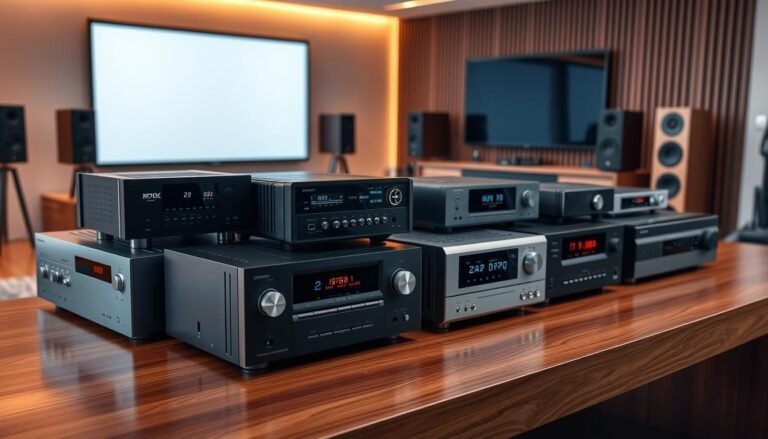
This roundup compares top models like Onkyo TX-RZ50 with Dirac Live, Sony STR-AZ5000ES with DCAC IX, Marantz Cinema 50 with 11.4 processing, Anthem MRX 740 with ARC Genesis, and Denon AVR-A1H as a flagship-class option.
We focus on real factors buyers use: sound clarity, power delivery, room calibration, connectivity, and build quality. Each affects how music and movies fill a room.
Channel counts matter for immersive layouts. A 7.1.4 or 7.2.4 setup needs enough channels for overhead speakers and dedicated bass management.
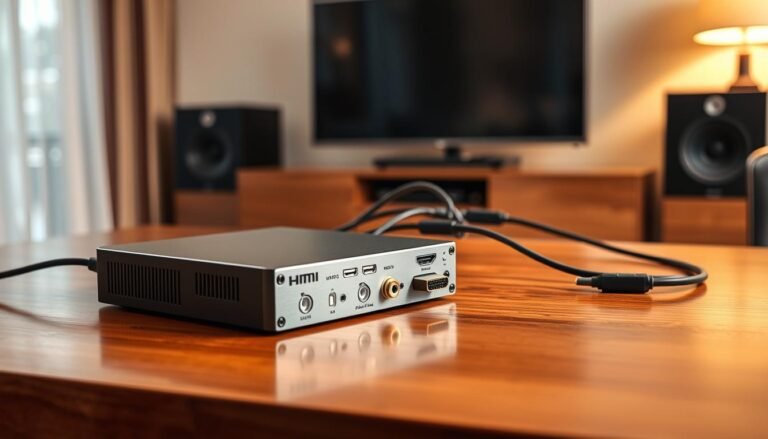
Futureproof inputs such as 8K-capable hdmi and eARC keep consoles, streamers, and TVs working without bottlenecks. That helps long-term performance and user experience.
Goal: blend lab data and hands-on notes so readers can match a choice to speakers, room size, and budget.
High-end AV receivers in 2025: what “premium” really means in the home
In 2025, a true premium home audio hub blends rugged engineering with advanced signal processing. Expect multiple 8K-capable hdmi inputs, Dolby Atmos and DTS:X processing, and robust room correction like Dirac Live or ARC Genesis.
Design touches matter: heavier transformers, discrete amplifier stages, and better thermal management give sustained performance into real-world speaker loads. That hardware translates to clearer dynamics and trustworthy power during reference listening.
Features go beyond watts on a sheet. Premium units add eARC for uncompressed audio return, app and voice control, multi-zone options, and GUIs that simplify complex setups. Calibration headroom lets technicians tune a system to the room rather than forcing textbook speaker placement.
- Formats and HDMI: Multiple 8K-ready hdmi paths futureproof consoles and streamers.
- Performance vs spec sheets: Better supply rails and discrete amps preserve control at loud passages.
- Options and expandability: Preamp outputs, extra channels, and integration with external amps let a system grow.
Price range reflects build quality and long-term value. Compare upper midrange units by channels, inputs, and EQ sophistication to find which option matches your home system and listening goals.
Search intent decoded: you want top-tier sound, formats, and futureproof HDMI
Modern buyers pair musical detail with future-ready video switching when choosing an AV hub. They seek units that handle multiple 8K-capable hdmi inputs while delivering clean sound for movies and music.
Key features include Dolby Atmos and DTS:X support, robust room correction, and eARC for uncompressed audio from TV apps. Models like Onkyo TX-RZ50 and Sony STR-AZ5000ES pack six 8K-ready hdmi ports and wide streaming suites.
- Connectivity: Wi‑Fi streaming, bidirectional Bluetooth, voice assistants, and multiple inputs to marry old devices and new sources.
- Futureproofing: HDMI 2.1 bandwidth, eARC, and 4K/120Hz support for next-gen gaming.
- Calibration: Dirac Live, ARC Genesis, Audyssey, and Sony DCAC IX matter for consistent room-tuned performance.
| Feature | Why it matters | Example |
|---|---|---|
| 8K-capable hdmi inputs | Handles consoles, players, and streamers without swapping cables | 6 ports on TX-RZ50 / STR-AZ5000ES |
| Room correction | Adapts sound to real rooms for consistent performance | Dirac, ARC, Audyssey, DCAC |
| Streaming & eARC | Plays apps and returns uncompressed audio from TV | AirPlay, Google Cast, Spotify Connect, eARC |
Bottom line: shortlist models that combine generous hdmi capacity with proven audio quality. That reduces upgrades and keeps your home system flexible for years.
Editor’s roundup: the best high-end/premium receivers right now
Below are curated picks that balance power, calibration, and expansion options for real rooms.
Onkyo TX-RZ50 with Dirac Live
The Onkyo combines 9 powered channels and 11 preamp outputs for easy expansion. It includes Dirac Live, six 8K-capable inputs, eARC, and two-way Bluetooth.
Why it stands out: pro-grade room correction, solid onboard channels, and practical outputs to add amps later.

Best 11-channel value pick: Sony STR-AZ5000ES
Sony brings 11 channels, 130W per channel (two-channel driven), DCAC IX mapping, and six 8K inputs. Build quality and a five-year warranty add reassurance for long-term use.

Best 9-channel with big-bass control: Marantz Cinema 50
Marantz packs nine amps and 11.4 processing with four discrete subwoofer outputs. Audyssey MultEQ XT ships onboard with an option to upgrade to Dirac Live.

Biggest and baddest flagship tier: Denon AVR-A1H
Denon aims at maximum channel count, muscle, and generous features for large home cinemas. Expect extensive I/O and top-tier build.
Best sounding for the money: Anthem MRX 740
Anthem offers seven powered channels, 11 preamp outs, and ARC Genesis. It favors sound-first design and strong two-channel power for music.
- Quick spec cues: channels, inputs/outputs, and calibration differ by model.
- Price vs value: Sony and Onkyo sit mid-top for feature depth; Denon targets flagship budgets; Anthem focuses on sonic payoff.
- Choice guide: match a model to speaker layout, room size, and content mix before spending more for extra channels.
| Model | Channels | Key features |
|---|---|---|
| Onkyo TX-RZ50 | 9 powered / 11 preouts | Dirac Live, 6x 8K inputs, eARC, expand via preouts |
| Sony STR-AZ5000ES | 11 | 130W/ch (2-ch), DCAC IX, 6x 8K inputs, wireless surrounds |
| Marantz Cinema 50 | 9 amps / 11.4 proc | 4 sub outputs, Audyssey MultEQ XT, warm musical tuning |
| Denon AVR-A1H | Extensive channel count | Flagship build, broad I/O and high-end parts |
| Anthem MRX 740 | 7 powered / 11 preouts | ARC Genesis, 140W (2-ch), sound-first engineering |
Next: deeper dives follow for each headline pick, with setup tips and calibration notes to help match features to a real home system.
Which is the best high-end/premium receiver?
Priority one is whether a unit delivers believable dynamics and clear dialogue across multiple seats. That single test sums up the judging pillars we use.
How we judge
Sound quality at cinema levels, support for modern formats like Dolby Atmos and DTS:X, and robust hdmi switching with multiple 8K-capable inputs top our checklist.
Calibration engines—Dirac Live, ARC Genesis, Audyssey, and DCAC IX—get extra weight because they tune a system to real room behavior. Good room EQ yields stable imaging and consistent performance for every seat.
Top choice rationale
We favor a balance between per channel power and usable channel count. A design with solid current delivery beats inflated peak watt numbers, especially with low-sensitivity speakers in larger home theaters.
- More channels let you run full 7.1.4 or 7.2.4 layouts without external amps.
- Preamp outputs offer a growth path; adding discrete amps can improve headroom and fidelity.
- Chassis design, transformer size, and discrete amp stages reduce noise and improve dynamics.
| Judging Pillar | Why it matters | Example impact |
|---|---|---|
| Sound quality | Defines clarity, dynamics, and dialogue | Clean effects, tight bass, clear voices |
| HDMI 2.1 / 8K | Prevents source bottlenecks as devices multiply | Six 8K inputs reduce cable juggling |
| Calibration | Adapts output to room acoustics | Even imaging across seats |
Bottom line: our top pick threads channels, per channel capability, and room EQ sophistication into a single package that delivers reliable performance day after day. Before buying, match power and channels to your speakers and room size for the intended home use.
Dolby Atmos & DTS:X mastery: channel counts, height options, and layout flexibility
Channel count and height placement decide whether overhead effects feel natural or vague in real rooms.
9 vs 11 channels: a 9-channel unit like Onkyo TX-RZ50 or Marantz Cinema 50 can process 11 channels with external amplification to reach 7.2.4. An 11-channel model such as Sony STR-AZ5000ES powers 7.1.4 natively, removing the need for extra amps.
Practical trade-off: choose 9 channels if you plan phased upgrades. Pick 11 channels when you want a simpler, all-in-one 7.1.4 setup from day one.
Height virtualization vs true height speakers
True overhead or upfiring speakers usually give better localization and fuller envelopment. Ceiling height, seating distance, and dispersion shape how effective in-ceiling, on-wall, or upfiring modules will be.
Virtualization modes like Dolby Atmos Height Virtualizer and DTS Virtual:X help in apartments or when wiring is impractical. They improve perceived overhead content but rarely match genuine height speaker performance.
| Setup | When it helps | Real-world impact |
|---|---|---|
| 9-channel + external amp | Phased upgrades, budget planning | 7.2.4 capability with one added amp |
| 11-channel native | Immediate 7.1.4 plans, simpler wiring | No external amp complexity, cleaner install |
| Height virtualization | No ceiling runs, rentals | Simulated overhead, less precise localization |
- Placement & calibration matter: careful positioning and room correction maximize surround and height layer performance.
- Balance bed and height speakers to keep pans coherent and immersive.
Per-channel power and amplifier design: why watts aren’t the whole story
Power delivery matters more than a headline wattage when you listen at realistic living-room levels.
Published watt figures like 130W/ch (2-ch driven) or 140W (2-ch) give a snapshot, not the full picture. Models such as Sony STR-AZ5000ES and Anthem MRX 740 advertise strong two-channel numbers, while Marantz Cinema 50 backs its claims with a very large power supply and all-discrete components.
Discrete stages, supplies, and real-world headroom
Robust power supplies and discrete amplifier stages sustain dynamics when many channels play together. That keeps bass tight and transients clean during action scenes.
- Two-channel ratings: often measured with only two drivers active; multichannel loads demand more current.
- Current delivery: impacts how well an amp controls low-impedance speakers at loud levels.
- Build cues: look for big transformers, heavy heat sinks, and rigid chassis for consistent performance under load.
Consider preamp outputs if a room or speakers need extra muscle from separate amps. In short, match power and design to your speakers, room size, and listening habits for the best system performance.
| Spec note | What it means | Real impact |
|---|---|---|
| 130W/ch (2-ch) | Rated with two channels driven | Good for stereo peaks; may fall short with full multichannel mixes |
| Discrete amp stages | Separate transistors per channel | Improved control and lower distortion under load |
| Large power supply | Higher current reserve | Tighter bass and stable dynamics in movies |
Room correction shootout: Dirac Live vs Audyssey vs ARC Genesis vs Sony DCAC
Room correction can change how a system images and how bass ties to the rest of the soundtrack. Proper calibration helps speakers work with your room, not against it.
Dirac Live on the Onkyo TX-RZ50 offers full-band correction and phase optimization. Use the supplied mic or a calibrated MiniDSP microphone for tight bass integration and sharper imaging. The TX-RZ50 also provides six 8K hdmi inputs and two-way Bluetooth for flexible source linking.
Audyssey MultEQ XT/XT32 on Denon and Marantz gives fast, reliable gains and an easy on-screen setup. Many appreciate its consistent results and the option to upgrade Marantz units to Dirac Live when deeper control is needed.
Anthem ARC Genesis
ARC Genesis targets audiophile listeners. It offers granular target curves and repeatable correction for difficult rooms. For users who chase reference performance, ARC Genesis often delivers very linear results.
Sony DCAC IX
DCAC IX takes a mapping approach. It measures multiple listening positions and builds a spatial model to preserve surround coherence across a sofa rather than a single seat. The guided routine is thorough and yields a stable 3D image.
How to choose
- Dirac: full-band, phase-aware fixes for imaging and bass integration.
- Audyssey: quick setup and reliable day-one improvement; upgradeable on some models.
- ARC Genesis: deep control for challenging acoustics and reference tuning.
- DCAC IX: multi-position mapping for even seating-area performance.
| System | Strength | Practical tip |
|---|---|---|
| Dirac Live (Onkyo TX-RZ50) | Full-band & phase correction | Use a calibrated mic and multiple measurement points for best bass integration |
| Audyssey (Denon/Marantz) | Ease-of-use and consistency | Run on-screen setup, save profiles, consider Dirac upgrade if needed |
| ARC Genesis (Anthem MRX 740) | Audiophile-grade tuning | Use detailed target-curve adjustments for tough room modes |
| DCAC IX (Sony STR-AZ5000ES) | Multi-position spatial mapping | Follow guided routine to map seating area for even imaging |
Final note: calibration improves outcomes but does not replace good speaker placement, sub positioning, and basic treatment. Re-run calibration after major changes and save profiles for music and movies to compare performance. Any of these systems can elevate a modern home setup when applied carefully; pick the ecosystem whose tools match your experience and goals.
HDMI, inputs/outputs, and 8K readiness: getting video and audio switching right
Modern video switching shapes how effortlessly a home theater handles many sources and future formats. Choose a hub with enough ports so you don’t juggle cables every time you add a new device.
6x 8K inputs matter. Both the Onkyo TX-RZ50 and Sony STR-AZ5000ES offer six 8K-capable hdmi inputs with eARC. That headroom keeps streaming sticks, UHD players, and consoles connected at once.
Onkyo adds two independent hdmi outputs for a projector and a flat panel. Note: if zone 2 is active, the second output may drop to 4K. Plan wiring when you use multi-zone video.
eARC versus ARC: eARC carries uncompressed Dolby Atmos from TV apps; ARC often sends compressed tracks. For best audio fidelity, prefer eARC when your TV and hub support it.
- For gaming, route consoles to the TV for best 4K/120Hz and VRR, then use eARC back to the receiver for lossless audio.
- Label inputs, enable CEC where it helps, and disable it where it conflicts with universal remotes.
- Use HDMI 2.1 bandwidth and certified Ultra High Speed cables to protect frame-rate and signal rate negotiation.
| Why | Practical tip | Impact |
|---|---|---|
| Multiple inputs | Keep sources hot without swapping cables | Smoother daily use |
| Dual outputs | Projector + TV setups | Flexible viewing zones |
| eARC | Use with TVs that pass uncompressed audio | Full Atmos from apps |
Final note: keep firmware current and test each input after updates to confirm HDR, Dolby Vision, and audio negotiation. Robust inputs and outputs reduce friction as your device collection grows.
Top pick deep dive: Onkyo TX-RZ50 for immersive performance and value
The Onkyo TX-RZ50 stands out for blending flexible amplification with modern connectivity aimed at real home setups.
Power and expansion: nine powered channels with 11 preamp outputs let you run 7.2.4 by adding a two-channel external amp via preouts. That gives a clear upgrade path without swapping the main unit.
9 powered channels, 11-channel processing, and two-way Bluetooth
The 9.2 design handles full Atmos layouts while bidirectional Bluetooth supports late-night headphone listening and quick music sharing from phones.
Streaming suite and voice control
Connectivity: six 8K-capable hdmi inputs, two independent hdmi outputs (both 8K unless zone 2 is active), and eARC on the main out cover modern sources. Streaming includes Google Cast, DTS Play‑Fi, and Spotify Connect. Sonos Port compatibility and voice control via Google Assistant or Alexa add convenient hands-free control.
Dirac setup tips for first-time users
Practical advice: measure multiple positions at ear height, reduce room noise, and use a calibrated mic (for example, a MiniDSP) for better results. Save separate Dirac profiles for movies and stereo music to compare target curves quickly.
- Onkyo Controller app and the onboard GUI simplify daily setup and input switching.
- Value callout: Dirac Live, solid hdmi I/O, and expansion options deliver strong performance at a competitive price.
Bottom line: this model pairs room correction and broad connectivity to anchor many home theaters with flexible long-term value.

11-channel contender: Sony STR-AZ5000ES for cinematic scale
Sony’s STR-AZ5000ES brings full 11-channel processing to living-room cinemas that need wide coverage. Native eleven-channel drive makes a 7.1.4 layout simple without adding external amps. That saves cost and reduces wiring complexity for many installs.
Build, power, and wireless options
Sturdy design and a weight over 42 lbs signal robust parts and thermal management. A five-year warranty backs daily reliability.
The unit rates 130W/ch (2-ch driven) and pairs that spec with a substantial power supply. In practice this keeps dynamics composed at movie reference levels.
Six 8K-capable hdmi inputs and eARC futureproof source routing. Sony also supports wireless surround speakers and phantom modes when running cables is impractical.
Calibration, mapping, and setup guidance
DCAC IX uses multi-position 3D mapping to widen the sweet spot for families. Follow the on-screen guide, measure all seats you care about, and confirm speaker polarity before saving profiles.
| Feature | Why it matters | Practical note |
|---|---|---|
| 11 channels native | Run 7.1.4 without extra amps | Simpler 7.1.4 installs, less gear |
| 130W/ch (2-ch) | Strong two-channel headroom | Good for reference scenes; pair efficient speakers in very large rooms |
| 6x 8K hdmi + eARC | Futureproof connections | Keep consoles and streamers connected without swapping cables |
Performance: expect big, enveloping sound with precise steering and stable imaging across more seats. For very large rooms, consider efficient speakers or add external amps via preouts for extra headroom. The AZ5000ES serves as an 11-channel value benchmark for turnkey 7.1.4 systems in a modern home.
Bass authority specialist: Marantz Cinema 50 with four discrete sub outs
If low-frequency control matters, the Cinema 50 makes a strong case with multiple sub outputs and careful voicing.
Four discrete subwoofer outputs let you calibrate each driver independently to smooth room modes and reduce peaks across listening positions. Placing subs in varied spots then running calibration yields much more even bass than a single unit can deliver.
9 amps, 11.4 processing, and upgrade paths
The chassis supplies nine amplifier channels alongside 11.4 processing, so you can run a 7.4.4 layout by adding a small 2-channel external amp to free up channels for extra heights.
Connectivity and calibration options
Six 8K hdmi inputs and eARC cover modern sources and displays. Audyssey MultEQ XT handles fast, reliable tuning; users who want finer control can opt for a Dirac Live upgrade for tighter bass and sharper imaging.
- Tonality: warm, musical, yet capable of dynamic movie punches.
- Placement tip: distribute subs around the room, then run calibration to integrate outputs for uniform bass.
- Extras: moving magnet phono input for vinyl and a clear on-screen setup guide to cut configuration errors.
Bottom line: Cinema 50 suits listeners who value bass authority and musical engagement. In many rooms, multiple subs are the most cost-effective upgrade for better low-frequency performance.
Audiophile sound-first: Anthem MRX 740 with ARC Genesis
If you chase natural, revealing music and tight movie bass, the MRX 740 deserves attention.
Sound-first design: Anthem builds a listening-focused unit with ARC Genesis room correction that brings out detail and even bass across seats. That tuning flexibility helps tailor target curves for music or movies.
7 powered channels, 11 preamp outputs, and stout 140W (2-ch) capability
The MRX 740 offers seven powered channels and eleven preamp outputs to scale a system with extra amplifiers. Rated 140W (2-ch), its amplifier topology yields tight midbass and clear treble control for demanding speakers.
When to add external amps for larger rooms
Add outboard amps if a room is large, speakers run low sensitivity, or you plan a full 7.1.4 layout. External amplification preserves headroom and lowers distortion during dynamic scenes.
- No phono stage: vinyl users need an external phono preamp.
- Seven 8K-capable HDMI inputs keep modern sources connected without swapping cables.
- Low noise floor and stable power delivery support critical listening and theater dynamics.
| Feature | Why it matters | Practical note |
|---|---|---|
| ARC Genesis | Fine-grain room correction | Separate music/movie profiles |
| 11 preamp outputs | Expansion with external amps | Easy upgrade path to more channels |
| 140W (2-ch) | Strong stereo headroom | Pairs well with efficient speakers or added amps |
Bottom line: Anthem MRX 740 suits enthusiasts who prize musicality yet want cinema flexibility. Match speakers carefully and plan outboard amplification to unlock full performance in a real home.
Music vs movies vs gaming: choosing by primary use case
Decide whether music, movie nights, or gaming will drive most use before you choose a system. That decision steers priorities: streaming and DAC quality for music, immersive decoding and quiet dynamics for movies, and low-latency HDMI paths for gaming.
Streaming and vinyl: phono inputs, DAC quality, and app ecosystems
Music-focused buyers should prioritize strong streaming suites, clean DACs, and a built-in phono input if vinyl matters. Onkyo TX-RZ50 ships a robust app set, two-way Bluetooth, and voice control for easy daily playback.
Marantz Cinema 50 includes a moving magnet phono input for direct vinyl connection. Anthem MRX 740 omits a phono stage, while Yamaha RX-A4A earns praise for its onboard phono preamp.
Tip: check DAC implementation and app stability. Good control apps and clear input labeling cut setup friction and keep family members from accidentally changing modes.
Gaming features: 4K/120Hz, ALLM, and low-latency video paths
For gaming, confirm HDMI 2.1 features like 4K/120Hz, ALLM, and VRR. Sony STR-AN1000 supports these, and Onkyo TX-RZ50 plus RX-NR6100 handle Xbox Series X 4K/120Hz signals.
Best practice: route consoles to the TV for top frame rates, then use eARC back to the hub for lossless audio. Use certified Ultra High Speed cables and enable low-latency modes to avoid input lag.
- Music buyers: pick units with quality DACs, streaming apps, and phono if you spin vinyl.
- Movie fans: prefer reliable immersive decoding, multiple sub outputs, and quiet operation for clear dialogue.
- Gamers: verify HDMI 2.1, low-latency paths, and 4K/120Hz handling on both TV and hub.
| Use case | Key features to check | Practical note |
|---|---|---|
| Music | Streaming suite, DAC, phono | Onkyo streaming; Marantz phono; Yamaha phono praised |
| Movie | Immersive decoding, multi-sub, quiet amp | Keep separate profiles for music and movie EQ |
| Gaming | HDMI 2.1, 4K/120Hz, ALLM | Route consoles to TV, use eARC for full audio return |
Final checklist: pick by your dominant use case and verify the unit checks the boxes for streaming, phono, inputs, HDMI features, remote app control, and simple profile switching. That keeps daily life smooth and the system ready for all your devices.
Design, control, and setup experience: what living with a premium receiver feels like
A polished user interface and smart app control can make an advanced system feel simple. Good design helps you finish wiring, assign inputs, and run calibration without guesswork. That practical ease shapes everyday enjoyment more than raw specs.
On-screen guides, apps, and remote behavior
Clear GUIs walk you through speaker wiring, inputs assignment, and Audyssey or DCAC IX calibration. Sony’s on-screen routine for DCAC IX and Marantz’s step-by-step Audyssey flow reduce setup errors for most users.
Mobile apps simplify daily control and source selection. The Onkyo Controller app adds voice support via Google Assistant and Alexa, making quick changes easier than hunting for a physical remote.
Integration, troubleshooting, and long-term upkeep
- Third-party control options help custom installs link lights, screens, and automation to a unified system.
- Good setup experiences include test tones, polarity checks, and clear error messages to catch miswired speakers or mismatched inputs.
- Quirky remotes are common; consolidate via apps or a universal remote for family-friendly operation.
- Neat chassis design, better ventilation, and labeled back panels speed cable management and reduce heat issues.
Practical tip: label and document connections, save input-specific presets for audio modes and video passthrough, and keep firmware current over network control. A refined setup and control experience improves daily use long after initial installation.
Price, value, and upgrade paths: when to invest more channels or external amps
Smart expansion paths let a modest core unit become a powerful multi-zone system.
Preamp outputs and practical expansion
Preamp outputs let you add external amps to increase headroom or add channels without replacing the main unit. Models like the Onkyo TX-RZ50 and Anthem MRX 740 offer 11 preouts, giving flexible growth options for a living room or multi-zone setup.
Marantz Cinema 50 supports 11.4 processing and four discrete subwoofer outputs. That makes multi-sub setups and tight bass control easier. Sony STR-AZ5000ES powers eleven channels natively, avoiding an immediate need for outboard amps.
- When to buy 11 channels: choose native 11 if you want a turnkey 7.1.4 install without extra gear.
- When to add amps: pick a 9-channel hub with ample preouts if budget or staged upgrades matter.
- Power amp matrixing: Anthem’s matrixing reassigned internal amps to different duties as layouts change.
| Model | Key expansion trait | Price/value note |
|---|---|---|
| Onkyo TX-RZ50 (read Review) | 11 preouts | Good value for staged upgrades |
| Marantz Cinema 50 (read Review) | 11.4 processing, 4 sub outputs | Strong for bass-focused systems |
| Anthem MRX 740 (read Review) | 11 preouts + matrixing | Flexible routing for evolving layouts |
| Sony STR-AZ5000ES (read Review) | Native 11 channels | Simpler one-box installs |
Balance price against real-world value. Adding a two-channel external amp often gives the most bang for your buck to reach 7.1.4 from a 9-channel base. Budget for quality interconnects and power management when moving to separates to protect your system. Pick the path that fits your room, speakers, and expected upgrades—don’t pay for unused channels.
Alternatives worth a look: Denon AVR-X2800H, S770H, Yamaha RX-A4A, Sony STR-AN1000
If modern features and lower cost matter more than extra channels, these options fit many homes.
Denon AVR-S770H and AVR-X2800H deliver reliable audio with Audyssey room EQ, eARC, and three 8K hdmi inputs. The S770H covers everyday 7.2 layouts at 75W/ch, while the X2800H steps up to 95W/ch and flexible height settings.
Yamaha RX‑A4A offers strong stereo power (110W) and seven hdmi ports. Its build and cinematic tuning suit music and movies, and a solid phono stage benefits vinyl users.
Sony STR‑AN1000 targets gaming homes with hdmi 2.1 support, 4K/120Hz paths, and DCAC IX mapping for easier multi-seat calibration.
- Where money is saved: fewer channels, simpler amplification, and reduced hdmi counts versus flagship models.
- These models shine for 5.1.2 or 7.1 setups without plans for 7.1.4.
| Model | Channels / Power | Key strengths |
|---|---|---|
| Denon AVR‑S770H | 7.2 / 75W (2-ch) | Audyssey, eARC, 3×8K inputs, Atmos height virtualizer |
| Denon AVR‑X2800H | 7.2 / 95W (2-ch) | Audyssey MultEQ XT, flexible height settings, 3×8K inputs |
| Yamaha RX‑A4A | 7.2 / 110W (stereo) | 7 hdmi ports, cinematic voicing, strong phono stage |
| Sony STR‑AN1000 | 7.2 / spec varies | HDMI 2.1, 4K/120Hz, DCAC IX, gaming-friendly features |
Bottom line: map speaker count and content mix before buying. For many living rooms, this range gives modern hdmi, stable streaming, and solid sound at a friendlier price, with upgrade paths that stay practical if needs grow.
Conclusion
Final take: practical fit beats feature lists when choosing a long-term audio hub.
Quick recap: Onkyo TX-RZ50 leads for value and performance with Dirac Live and six 8K hdmi inputs. Sony STR-AZ5000ES suits those who want native 11-channel drive. Marantz Cinema 50 shines for multi-sub bass control, Anthem MRX 740 targets audiophiles with ARC Genesis, and Denon AVR-A1H serves large installs needing maximum channels and build.
Set a clear price ceiling, then pick by channels, calibration, and inputs to match room and speakers. Careful setup and calibration often trump raw spec sheets for long-term sound quality and daily experience. Shortlist two or three models, compare interfaces, and plan upgrades—subs or external amps—so your receiver investment stays relevant for years.
FAQ
Which receiver offers the strongest overall performance for immersive home theater?
Look for models that combine robust per-channel power, advanced room correction, and full object‑based decoding like Dolby Atmos and DTS:X. The Onkyo TX-RZ50, Denon AVR-A1H, and Sony STR-AZ5000ES illustrate different balance points: Onkyo for Dirac Live tuning and value, Denon for flagship power and connectivity, and Sony for build quality and 11‑channel scale.
How important is channel count for Atmos and DTS:X setups?
Channel count matters when you move from basic overhead effects to full 7.1.4 or 7.2.4 rigs. A nine‑channel amp can run 7.2.2 or 5.2.4 well; an 11‑channel unit gives true 7.2.4 without external amps. More channels let you place height speakers where the room benefits most and reduce the need for external amplification.
Do watts per channel tell the whole story about sound quality?
No. Watts provide a baseline, but amplifier topology, power supply design, and dynamic headroom matter more in real listening. Discrete amp stages and larger toroidal transformers or regulated supplies yield cleaner transient response and better control of speakers and subwoofers than raw watt numbers alone.
Which room correction system delivers the most audible improvement?
Dirac Live and Anthem ARC Genesis generally lead in measured correction and subjective clarity. Audyssey MultEQ XT/XT32 gives excellent results with simpler workflows on Denon and Marantz. Sony’s DCAC IX offers multi‑position mapping that helps complex rooms. Choice depends on budget and willingness to perform precise measurements.
How futureproof should HDMI features be when buying now?
Prioritize HDMI 2.1 features such as 8K passthrough, 4K/120Hz, eARC, ALLM, and multiple 8K inputs if you plan to use next‑gen consoles and high‑end sources. Receivers like the TX-RZ50 and STR‑AZ5000ES include several 8K inputs to avoid early obsolescence and simplify source switching.
Are virtual height modes a good substitute for real height speakers?
Virtual height can improve immersion in rooms where installing speakers is impossible, but authentic ceiling or upward‑firing speakers deliver more precise height imaging and better object placement. Use virtualization as a practical compromise rather than a full replacement.
When should I consider adding external amplification?
Add external amps if you need greater headroom for large rooms, bi‑amping high‑efficiency speakers, or driving many channels in multi‑zone setups. Receivers with strong preamp outputs and power‑amp loop options (or a power amp matrix) allow seamless upgrades without replacing the entire system.
What setup features matter for first‑time Dirac users?
Use a calibrated measurement mic, follow the multiple measurement positions routine, and keep speaker distances and levels consistent. Allow Dirac to perform target curve adjustments, then fine‑tune bass management and crossover only after listening. Many Onkyo guides and community forums offer step‑by‑step help.
Which receivers balance music fidelity with movie dynamics?
Marantz Cinema 50 and Anthem MRX 740 lean toward musical, warm presentation while retaining movie power. Denon and Sony flagships combine neutral tuning and dynamic heft. Choose based on whether you prioritize tonal richness for vinyl and streaming or slam and impact for film soundtracks.
How many subwoofer outputs should I look for?
Multiple subwoofer outputs (two or more) let you time‑align and level match separate subs, improving bass uniformity and reducing room nulls. Models like the Marantz Cinema 50 provide four discrete sub outs, which is ideal for serious low‑frequency management.
What gaming features should a living‑room receiver support?
Prioritize 4K/120Hz passthrough, low‑latency video paths, ALLM, and VRR support for smooth gaming. Good HDMI bandwidth and direct game modes help preserve responsiveness. Many premium AVR models include these features, but verify firmware support for consoles like PS5 and Xbox Series X.
Can I upgrade calibration on a receiver that ships with Audyssey?
Some manufacturers offer paid upgrades or hardware revisions that add Dirac or improved calibration. Alternatively, you can use external processors or preamps with better measurement suites. Check model‑specific upgrade paths before purchasing if calibration is a priority.
How do I choose between a built‑in phono stage and an external preamp?
Built‑in phono stages on many Marantz and Yamaha units are convenient and good for casual listening. Audiophiles or users with low‑output MC cartridges often prefer high‑quality external phono preamps for lower noise and better gain control.
Are flagship receivers worth the price premium over upper‑midrange models?
Flagships like the Denon AVR‑A1H justify cost through superior power supplies, more channels, advanced calibration, and richer feature sets. Upper‑midrange units such as Denon AVR‑X2800H or Yamaha RX‑A4A offer strong value for smaller rooms. Consider room size, upgrade path, and how many features you’ll actually use.
What role does streaming and app integration play in receiver choice?
Robust streaming suites, reliable mobile apps, and voice assistant support (Alexa, Google Assistant) improve everyday use. Choose a receiver with services you use, stable firmware updates, and broad codec support for hi‑res audio playback and multiroom setups.