This introduction sets expectations for a hands-on, measurement-backed look at a modern 9.4-channel receiver aimed at serious home theater and music fans.
Built in Japan and offering 11.4-channel processing, four independent subwoofer outputs, and 8K video passthrough/upscaling, this model brings visible upgrades in design and display menus.
We’ll cover sound for movies and music, calibration choices like Audyssey and optional Dirac, connectivity breadth, streaming via HEOS, and real-world setup notes.
Expect clear takeaways on price, value, and trade-offs, plus how features such as pre-amp mode and per-pair amp disable aid system growth without replacement.
Our approach blends lab measurements, listening tests, and practical setup advice to help buyers in the United States judge long-term firmware and feature maturity.
Overview: Where the AVR-X4800H Fits in Denon’s Lineup and Today’s Market
This model fills the gap between midrange and flagship gear, adding a monolithic amp approach and extra install conveniences.
Positioning: Sitting above the X3800H and below the A1H, the denon avr-x4800h bridges value and capability in the company line. It offers higher build quality and a monolithic amplifier layout that improves channel separation while keeping a competitive feature set for audio and video.
The unit targets buyers who want nine built-in channels with 11.4 decoding, multiple HDMI 2.1 inputs (7 in, 3 out with eARC), and modern HDR formats like HDR10+ and Dolby Vision without stepping to flagship pricing.
Practical benefits: Extra triggers, a third zone, legacy video inputs, and refined ergonomics save time during installation and daily use. The Full HD GUI and setup assistant make setup smoother than many mid-tier receivers.
This overview primes deeper dives into connectivity, room correction, and measured performance in later sections.
Key Highlights and Specifications at a Glance
Here’s a compact look at the hardware and format support that matters for movies, music, and gaming.
Power and channel layout: Nine internal amps deliver 9 x 125W (8Ω, two channels driven), with 11.4-channel processing and four independent subwoofer outputs for flexible bass placement.
I/O and video: Seven HDMI 2.1 inputs and three outputs (one with eARC) support 8K upscaling/passthrough and 4K/120. This keeps modern TVs and projectors fed with high-bandwidth signals.
Formats and gaming: The unit decodes Dolby Atmos, DTS:X, Auro‑3D, IMAX Enhanced, 360 Reality Audio, and MPEG‑H. HDR options include HDR10+ and dolby vision. Gaming features like VRR, ALLM, and QFT reduce latency and preserve frame pacing.
Room calibration: Audyssey MultEQ XT32 ships standard for fast setup, with dirac live available as an optional upgrade for deeper multi-position correction and time-domain control.
- Supports 5.x.4, 7.x.2, and 7.x.4 layouts when paired with external amplification via pre-outs.
- Labelled inputs and a clear menu speed up installation and routing of video and audio sources.

Design and Build Quality: Made in Japan, Monolithic Amplification
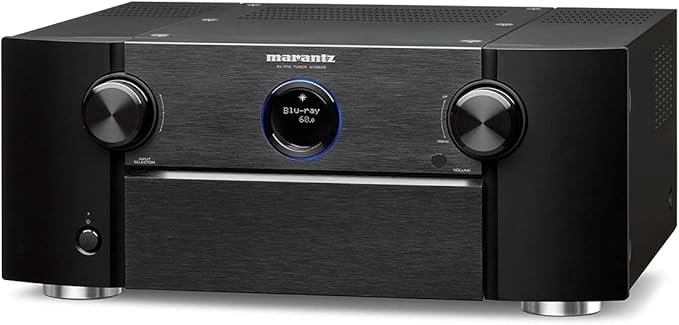
Look closely and the build choices make clear this unit prioritizes long-term reliability and clean signal paths. The thick aluminum faceplate and refined front fascia give a premium feel. Knobs and buttons turn with improved tactile feedback. The clear display shows modes and status at a glance.
Chassis, front panel, display, and remote feel
The Japanese design ethos shows in the robust chassis and clean lines. The front panel presents a restrained, professional look that fits higher-tier systems.
The remote is solid and ergonomic, though it lacks backlighting. That trade-off is easy to accept given the overall fit and finish.
Internal layout and cooling for reliable performance
The monolithic amplifier architecture places each amplifier on its own board. This reduces crosstalk and keeps channel separation tight during dynamic passages.
Generous heatsinks and airflow paths cool nine amp modules under load. The back-panel has ample space and logical terminal spacing to simplify cable runs and rack installs.
| Feature | What it Means | Benefit |
|---|---|---|
| Thick aluminum faceplate | Sturdy front panel | Perceived quality and durability |
| Independent amp boards | Monolithic amplification layout | Lower interference, cleaner audio |
| Spacious back panel | Well-spaced terminals | Faster installs, less cable congestion |
| Heatsinks & cooling | Thermal management | Reliable performance over time |
These choices reduce internal noise and support consistent audio performance. Over time, this design approach enhances both fidelity and user satisfaction with the receiver.
Connectivity and I/O: HDMI, Inputs/Outputs, and Multiroom Options
A flexible I/O suite determines whether a system stays current as formats and consoles evolve. This receiver pairs broad video bandwidth with legacy analog connections to cover present and near-future needs.
Video and source integration
The rear panel gives seven HDMI 2.1 inputs and three HDMI outputs, one with eARC. 8K/60 passthrough and upscaling plus 4K/120 support keep modern consoles and displays happy.
Analog, digital and control features
Phono MM, optical and coaxial options accept turntables and legacy players. A front USB and setup mic jack speed firmware updates and calibration.
- 11 speaker terminals let you build complex layouts or add external amps via the pre-outs.
- Assignable triggers and one IR/serial control port simplify screen and accessory integration.
- Three-zone capability and HEOS streaming extend audio to other room locations with app-based control.
Practical touch: Inputs can be renamed and shown with icons on the on-screen display to reduce confusion. Overall, the I/O design fits rack-based AVR systems and minimizes the need for upgrades as sources change.
Video Pipeline: 8K Upscaling, Dolby Vision, HDR10+, and Switching
The video path handles modern sources with high bandwidth and stable switching that matters for both films and games.
The unit supports 8K/60 and 4K/120 signals and uses high-bandwidth hdmi 2.1 switching to feed top-tier displays and projectors. Native passthrough preserves HDR10+ and dolby vision metadata so compatible screens receive scene-by-scene cues intact.
Real-world switching is fast and dependable. The pipeline keeps source changes smooth and avoids frame dropouts during busy viewing sessions. Firmware updates are delivered over the air to maintain compatibility as new formats and displays arrive.
- Gaming features: VRR, ALLM, and QFT reduce latency while protecting picture integrity.
- Audio sync: Lip-sync controls match the video process with the audio path for tight dialog response.
- Multi-output routing: Multiple outputs let you drive a TV and projector with simple routing options.

| Capability | What it Does | Benefit |
|---|---|---|
| 8K/60 & 4K/120 | Upscales or passes native signals | Supports next-gen displays and consoles |
| HDR passthrough | Preserves HDR10+ and Dolby Vision metadata | Accurate color and contrast on compatible screens |
| HDMI 2.1 switching | High-bandwidth signal routing | Clean switching with minimal artifacts |
| Low-latency modes | VRR/ALLM/QFT support | Improved gaming response with stable picture |
Amplification and Channels: Power Delivery, Assignability, and Pre-Amp Mode
Real-world output depends on headroom, assignability, and how the amps share the power supply.
Rated delivery: The unit is specified at 9 x 125W into 8Ω (two channels driven) across 20Hz–20kHz at 0.05% THD. A shared PSU gives extra headroom for dynamic transients when multiple channels demand current at once.
Flexible channel assignment
You can reassign channels and selectively disable a channel pair to free internal output stages. That makes it simple to add a focused external amp for LCR or mains.
Pre-amp mode and expansion
Pre-amp mode turns off internal amps, lowering thermal load and noise. The clean signal routing supports audiophile-grade external amplification via the 11.4 pre-outs.
- Use external amps for demanding channels to improve output stability with low-impedance speakers.
- Common layouts: 5.4, 7.4.2, or 7.4.4 via pre-outs and selective amp disable.
- Plan which channel pair to disable (often surrounds) for best synergy when upgrading LCR first.
| Spec | Practical effect | Benefit |
|---|---|---|
| 9 x 125W (8Ω, 2 ch) | Shared PSU headroom | Better transient behavior across channels |
| Per-pair amp disable | Free outputs for external amp | Targeted upgrades, lower heat |
| 11.4 pre-outs | Full pre-amp routing | High-level system expansion |
Matching speaker sensitivity and room size with per-channel level and mode selection yields balanced audio and predictable system performance.
Processing Engine and DACs: ADSP-21593, Format Support, and TI PCM5102A
Under the hood, the maker consolidated DSP hardware into a single ADSP‑21593 SHARC+, reshaping how the unit handles modern formats and filters. That move reduces inter-chip latency and simplifies the processing path without cutting feature support.
From multi‑chip to single SHARC
Single‑chip processing lowers complexity and improves timing. The ADSP‑21593 lets the avr run multiple decoders and room filters with less overhead. This helps channel steering and spatial accuracy in complex mixes.
Formats and DAC changes
The platform supports dolby atmos, DTS:X, Auro‑3D, IMAX Enhanced, 360 Reality Audio, and MPEG‑H for wide playback ability. TI PCM5102A DACs replace earlier AKM parts due to supply limits. Engineers raised the part count and optimized circuit layout to preserve low noise and high fidelity.
- Dirac Live: the platform family can run full‑bandwidth dirac live on up to 15 channels for precise correction.
- Processing horsepower improves filter resolution and reduces jitter effects in measurements.
- Firmware maturity keeps decoders and routing stable across updates.
| Item | Effect | Benefit |
|---|---|---|
| ADSP‑21593 SHARC+ | Consolidated DSP | Lower latency, simpler routing |
| TI PCM5102A DACs | Higher part count | Maintained audio quality |
| Format support | Wide codec set | Future‑compatible playback |
Room Correction and Bass Management: Audyssey XT32 vs Dirac Live
How you measure and correct a space changes the clarity of dialog and the impact of effects.
Microphone workflow and multi-point setup
Audyssey MultEQ XT32 uses a guided setup: plug in the supplied mic, place the stand, and run measurements at up to eight listening positions. The on-screen assistant walks you through a fast, repeatable setup that improves average seating response.
Upgrade path and advanced editing
The dirac live option provides deeper control. With a PC and a calibrated third-party mic you can edit filters, shape target curves, and run full-bandwidth correction for tighter timing and smoother response.
Subwoofer outputs and tuning
This receiver offers four independent subwoofer outputs. That lets you route bass directionally and create per-sub custom curves.
| Feature | Practical Result | Why it helps |
|---|---|---|
| Audyssey MultEQ XT32 | Quick multi-position correction | Better average seating response |
| Dirac Live | Filter editing and target curves | Higher precision in complex rooms |
| Four subwoofer outputs | Directional bass and per-sub curves | Smoother in-room bass and improved cohesion |
In practice, audyssey multeq is the fast, reliable choice for most users. The dirac live option suits those who want surgical calibration and use calibrated mics. Regular recalibration after furniture changes keeps audio and response consistent over time.
User Experience: Setup Assistant, Control, and HEOS Streaming
A refreshed Full HD GUI and smart apps make common tasks feel fast and obvious for all users.
Interface and initial setup
The Full HD GUI uses crisp icons and smooth animations to speed navigation. The display presents inputs, modes, and quick shortcuts so family members find sources without fuss.
The built‑in setup assistant guides you step‑by‑step through initial setup, input naming, speaker layout, and a quick calibration run. Front USB and mic jacks let you update firmware and finish mic‑based correction in short time.
Control and streaming
App and web control extend full unit management to phones and laptops. The HEOS app handles multiroom music and popular streaming services, while the web interface exposes deeper menus for installers.
Voice services (Alexa, Google Assistant, Siri via AirPlay 2) complement physical panel controls for fast source switching and volume changes.
| Control Method | Strength | Best for |
|---|---|---|
| Full HD GUI | Immediate feedback | Daily use |
| HEOS app / web | Multiroom & streaming | Music libraries |
| Voice / panel | Hands‑free quick actions | Casual listeners |
Roon Tested compatibility helps users with local libraries and rich metadata. Calibration touch‑ups via the GUI let you tweak sub levels or experiment with dirac live targets without lengthy reruns. Overall, the UX reduces friction so the whole household enjoys consistent audio experiences.
Performance for Movies: Dynamics, Soundstage, and Clarity
Listening tests with Open Range, Captain America: Civil War, Tron: Legacy, and The Patriot showed how the unit handles real cinematic stress. The results emphasize strong transient control, steady low-frequency behavior, and sustained dialog clarity during intense sequences.
Impact, dialog intelligibility, and LFE control
Impact was authoritative: explosions and orchestral hits hit with weight while preserving midrange detail. Dialog remained clear amid heavy effects, thanks to consistent level handling and careful calibration.
Four independent subwoofer outputs and careful bass management kept LFE tight. Storm scenes and action beats showed controlled decay without muddiness, which improved perceived clarity.
Consistency under load across layouts
The receiver kept composure in 5.4, 7.4.2, and 7.4.4 setups. Shared PSU headroom supported transient peaks, so the sound stayed clean at louder levels in larger rooms.
Dolby Atmos mixes steered precisely, with convincing height cues that extended the room vertically. For users wanting extra punch, adding external power to LCR channels boosts headroom while the unit remains the system brain and processor.
- Expansive soundstage with clear front/back imaging.
- Stable dynamics over time during long sessions.
- Calibration and bass alignment prevented overlap between speaker and sub outputs.
Performance for Music: Stereo and Multichannel Listening
Stereo tracks reveal the receiver’s ability to render tone, imaging, and pace with clarity. The presentation is clean and engaging, with steady imaging between speakers that suits acoustic, rock, and electronic mixes.
Multichannel music feels enveloping. Height and surround speaker contributions add a natural sense of space without drawing attention away from the core performance. The soundstage stays coherent and musical across formats.
Proper room correction evens bass and midrange response so long listening sessions stay comfortable. Using the built‑in calibration and careful speaker alignment reduces smear around crossover regions and improves transient response over time.
Hi‑res audio up to 192kHz/24‑bit and stable processing make the unit a versatile hub for digital libraries and disc players. Roon compatibility helps users manage large collections while preserving resolution and timing.
- Example: Dolby Atmos music, such as Pink Floyd’s Dark Side, placed instruments and ambience with discrete, believable locations.
- Performance scales with speaker quality; upgrading speakers yields clearer detail without replacing the receiver.
| Listening Mode | Characteristic | Benefit |
|---|---|---|
| Stereo | Balanced tonal response, stable imaging | Works well for varied genres and long sessions |
| Multichannel / Atmos | Enveloping height cues, discrete placement | Immersive, natural ambience |
| With room correction | Even bass and clearer midrange | Reduced fatigue and better clarity |
For buyers comparing options, see other best AV receiver options in our guide for matching speakers and room sizes: best AV receiver options.
Gaming Readiness: 4K/120, VRR, ALLM, QFT and Low-Latency Video
Next‑gen consoles and gaming PCs push video and audio through tighter pipelines, so low latency and stable switching matter.

HDMI 2.1 support unlocks 4K/120 for smoother motion and reduced blur on fast titles. The high frame rates improve perceived response and overall performance when paired with capable displays.
VRR keeps frame pacing steady, while ALLM switches the display to a low‑latency mode automatically. Together they preserve input feel and let players react faster.
QFT further trims delay in complex processing chains so controller actions line up with on‑screen events. Stable switching across inputs and outputs prevents stutters when you swap consoles or sources.
The receiver routes multichannel audio without corrupting the picture, avoiding dropouts and sync issues that break immersion.
- Match console output to display capabilities during initial setup.
- Pick the HDMI input tied to eARC when you want simple cabling and full multichannel audio.
- Enable low‑latency mode on both display and receiver for best control and sound timing.
Lab Measurements and Bench Results: What the Numbers Say
Measured data helps separate impression from repeatable performance. Below are focused bench findings that match listening notes and reveal where the unit shines and where test conditions affect results.
DAC performance, jitter, and wideband response
DAC SINAD and dynamic range are competent for this class. SINAD sits slightly below the prior generation but remains solid, while dynamic range and linearity stay accurate down to very low levels.
Jitter tests on HDMI and Toslink show stable clocking and a well‑designed input stage. That stability preserves timing and keeps audible artifacts low across sources.
Frequency response reveals filter‑related behavior: wideband SINAD at 48kHz test tones is impacted by out‑of‑band energy. Higher‑rate (192kHz) tests reduce that effect and show improved measured response.
Amplifier power, multitone, and sweep behavior
Measured power into 8Ω and 4Ω shows respectable output with useful headroom. The shared PSU design helps sustain transients when several channels demand current.
Multitone and sweep tests are strong for an integrated receiver. Results are not desktop‑DAC class, but they confirm reliable performance under realistic multi‑channel loads.
Variability, pre-outs, and practical takeaways
Some measurement variability arose from grounding and the unit’s double‑insulated design. These differences reflect test setup sensitivity more than everyday listening impact.
Practical outputs: 2V unclipped pre‑out level was verified, making integration with external amps straightforward. Per‑pair amp disable functions as advertised, easing upgrades.
| Metric | Result | Practical Meaning |
|---|---|---|
| SINAD | Slightly below previous gen; class‑solid | Clean DAC performance for music and movies |
| Dynamic range & linearity | Good, accurate to low levels | Detail retrieval and low‑level fidelity |
| Jitter (HDMI/Toslink) | Well controlled | Stable timing and low artifacts |
| Power into 8Ω/4Ω | Respectable output with headroom | Handles realistic multi‑channel demands |
| Pre‑outs | 2V unclipped | Clean integration with external amps |
Summary: The bench numbers back the listening impressions. Measured performance and outputs confirm this receiver as a capable, flexible unit for home theater and music use, with clear upgrade paths and predictable behavior in real rooms.
Comparisons: AVR-X3800H, A1H, and Alternatives
Choosing between models comes down to I/O needs, amplification layout, and how much you plan to expand over time.
Step up from the X3800H
The step-up model adds a monolithic amplifier layout, extra triggers and a third zone, plus legacy video I/O that installers value.
That yields cleaner channel separation and more flexible speaker wiring for multiroom setups. Audyssey MultEQ remains standard and the dirac live option is supported for both units.
When to stretch to the A1H
The A1H makes sense if you need 15 amplified channels, higher rated power, or balanced XLR connectivity for pro installs.
That capability suits very large rooms or systems that demand top-tier headroom, but the jump in price is significant.
Price-to-performance and rivals
Against competitors, this model stands out for seven HDMI 2.1 inputs, four independent sub outputs, and wide format support.
Some rival receivers at similar price points cut inputs or channels, weakening long-term video and audio value.
| Model Class | Strength | Consider |
|---|---|---|
| Step-up | Amp layout & I/O | Installer flexibility |
| Flagship | More channels & XLR | Higher price |
| Rivals | Lower price | May skimp on inputs |
Bottom line: This unit hits a sweet spot in avr terms for buyers who want robust video and audio now, plus room to grow over time.
System Matching: Rooms, Speakers, and Expansion Paths
Choosing the right speakers and placement makes the difference between a good setup and a great one in a 25 x 24 ft room with 9‑ft ceilings.
For medium-to-large rooms, use efficient towers for mains and a high-quality center to reduce required power and keep dialog clear. Dual subs and the four independent subwoofer outputs smooth bass across seats when placed and delayed properly.
When headroom matters: consider adding external amplification for the front LCR via the pre-outs. Per-channel amp disable lets you mix internal and external amps for a balanced expansion path.
- Set crossover near each speaker’s recommended point and use gently sloped filters for coherent blending.
- Treat room acoustics with rugs, panels, and bass traps to control reflections and standing waves.
- Leave space behind the rack for cabling, cooling, and easy control access during adjustments.
| Need | Action | Benefit |
|---|---|---|
| Even bass | Use four sub outputs + calibration | Smoother seat-to-seat response |
| More headroom | Add external amp to LCR via pre-outs | Stronger dynamics and cleaner peaks |
| Room issues | Acoustic treatment | Improved clarity and imaging |
Revisit calibration after speaker moves or furniture changes to keep audio performance consistent over time.
Value Analysis: Price, Longevity, and Who Should Buy It
At $2,499 MSRP, this unit asks whether its blend of I/O, processing, and build justifies the cost for a long-term home theater core.
MSRP, features-per-dollar, and future-proofing
The features-per-dollar here is strong. Seven HDMI 2.1 inputs, 8K upscaling, four independent sub outs, and wide codec support give modern video and audio coverage out of the box.
Optional Dirac Live and the ability to add external amps via pre-outs extend value later, so buyers can upgrade incrementally rather than replace the receiver.
Pros, cons, and ideal buyers
Who benefits most: enthusiasts with mid to large rooms, multi-sub plans, and those who may add Dirac or external power later.
- Pros: made-in-Japan design, robust I/O, excellent audio and video handling, flexible system growth, and polished control/UX.
- Cons: no backlit remote, not Roon Ready, and very demanding speakers may need external amplification for peak performance.
| Metric | Takeaway | Why it Matters |
|---|---|---|
| MSRP $2,499 | Competitive for features | Good balance of video and audio I/O |
| Future-proofing | HDMI 2.1, Dirac option | Longevity in a fast-moving market |
| Upgrade path | Pre-outs & amp disable | Grow system without swapping core |
In short, the receiver represents a smart purchase for a home system that values modern connectivity and steady performance over time. It offers clear upgrade routes and sensible long-term value for buyers who plan to evolve their setup.
Denon AVR-X4800H Review: Final Rating and Verdict
Here’s the bottom line: how the unit balances measured numbers, everyday use, and upgrade paths.
Verdict: This receiver is a top-value choice. Independent measurements place its performance well within class expectations. Audio Science Review recommends it, and HCC awarded 5/5 for specification, sound, and value.
Strengths include engaging sound for movies and music, steady dynamics, and broad video support. Calibration works reliably, and four sub outputs give real bass control in multi-seat setups.
Everyday use is simple thanks to a clear on-screen display and layered control via the app. Connectivity and expandability via pre-outs make it easy to add external amps as needs grow.
Few drawbacks matter: the remote lacks backlight, and it is not Roon Ready. Those do not undermine the overall performance or the unit’s long-term value.
| Category | Score | Why it matters |
|---|---|---|
| Performance | 9/10 | Measured competence and solid dynamics |
| Sound & Audio | 9/10 | Engaging tonal balance and calibration results |
| Video & Display | 9/10 | 8K/4K bandwidth and reliable HDR passthrough |
| Control & Usability | 8/10 | Clear GUI, app control, installer features |
| Value (price) | 9/10 | Feature-rich for the asking price |
Final rating: 9/10. If you want a versatile centerpiece that scales with external amps and advanced calibration, shortlist this review contender. It delivers balanced features, measured results, and everyday ease of use for home theater buyers in the United States.
Conclusion
Ultimately, this AVR delivers a tuned mix of connectivity, measured performance, and expandability for serious listeners.
The Denon AVR-X4800H stands as a comprehensive receiver that blends flexible channels, seven HDMI inputs, and wide format support like Dolby Atmos and Dolby Vision.
Calibration choices—Audyssey MultEQ XT32 for fast setup and the optional Dirac Live for deeper correction—let beginners and power users reach consistent sound and room response.
Build quality, clear panel and display, and sensible I/O including pre-outs and pre‑amp mode make future upgrades simple. Video and audio handling are strong now and ready for later expansion.
Assess room size, speakers, and power needs to plan growth. In short, this unit is a high‑value centerpiece for home theaters and music systems that want long-term ability and control.
FAQ
What channels and power ratings does the unit provide?
The receiver offers a 9-channel amplifier configuration with support for pre-outs that expand to 11.4 channels. It delivers robust power per channel for home theater use, with conservative ratings that translate to strong real-world headroom when driving typical bookshelf and floorstanding speakers.
Which HDMI and video features are supported?
The unit includes HDMI 2.1 features such as 8K/60 and 4K/120 passthrough, plus HDR support including Dolby Vision and HDR10+. It handles modern gaming features like VRR, ALLM, and low-latency modes to support next‑gen consoles and high-refresh PC setups.
Is room correction included, and what are the options?
Audyssey MultEQ XT32 is included for multi-point room calibration. Owners can opt for a premium Dirac Live license for more advanced correction and target-curve control if they want finer tuning and improved spatial accuracy.
How many HDMI inputs and outputs are available, and is there eARC?
The receiver features multiple HDMI inputs and several outputs, with at least three outputs and full eARC support on the primary output. This setup provides flexible source switching and seamless audio return for modern TVs.
What analog and digital connections are provided for legacy gear?
Alongside HDMI, expect a mix of analog RCA inputs, digital optical and coaxial inputs, and a dedicated phono input for turntables. There are also multi-room outputs, trigger lines, and comprehensive preamp outputs for system expansion.
Can I expand the system with external amplifiers or use pre‑amp mode?
Yes. Dedicated pre-outs allow adding external power amps or creating larger multi‑amp systems. The front panel and menu let you assign or disable internal channels for bi-amping or bridged configurations.
What immersive audio formats does it decode?
The unit decodes major immersive formats including Dolby Atmos and DTS:X, with support for Auro-3D and IMAX Enhanced where applicable. It also handles object-based and immersive music formats for broader content compatibility.
How does bass management and subwoofer support work?
The receiver provides detailed bass management with multiple subwoofer outputs, independent level control, and flexible crossover settings. This lets you tune bass response and placement for even low-frequency coverage across large rooms.
Is HEOS or similar streaming built in, and what control options exist?
Integrated network streaming and multiroom capabilities are included, with app control, a web interface, and voice assistant compatibility. The setup assistant and on-screen GUI simplify initial configuration and source mapping.
How does it perform for movies and music in real-world listening?
Performance balances dynamics and clarity: movies benefit from impactful LFE and spacious soundstaging, while stereo music maintains detail and imaging. The onboard amplification sustains consistent output across common surround configurations.
Is the receiver suitable for gaming at 4K/120 and low latency?
Yes. HDMI 2.1 features and low-latency processing support 4K/120 gameplay, VRR, and related technologies to minimize lag and preserve smooth motion for fast-action titles.
What measurement and lab results should buyers expect?
Bench tests typically report strong amplifier linearity, solid SINAD and dynamic range from the DAC stage, and reliable power delivery into 8Ω and 4Ω loads. Measurement variability can appear under extreme multitone loads but is within acceptable home-theater margins.
How does it compare to lower- and higher-tier models?
This model sits between mid- and high-end offerings. It provides more channels, advanced video and audio features, and better connectivity than entry-level units, while remaining more affordable than flagship separates that offer higher single‑ended amplifier power or dedicated reference DACs.
Can the unit be used in multi-room setups and as part of a whole-house system?
Yes. Multi-zone outputs, pre-outs, and streaming modules let you feed different rooms. The built-in multiroom ecosystem supports synchronized and independent playback across compatible speakers and zones.
What should buyers know about setup and calibration workflow?
Setup uses a guided on-screen assistant with step-by-step speaker placement, distance, and level configuration. Audyssey calibration requires a measurement microphone and multiple positions; Dirac setup follows a similar multi-point routine but offers more tuning granularity.
Are there any known limitations or caveats to consider?
Expect trade-offs typical of full-featured receivers: complex menus, the potential need for external amps for very demanding speakers, and optional paid upgrades for some advanced room-correction features. Cooling and cabinet size also require adequate shelf or rack space.