This concise introduction previews a practical look at a 7-channel receiver that aimed to balance modern video readiness with strong sound for U.S. home cinema buyers.
The unit supports 7.2 or 5.2.2 layouts and brings Dolby Atmos and DTS:X along with virtual height processing. It added 8K video capability and kept two HDMI 2.1-certified outputs with eARC, while total HDMI inputs dropped to six.
Expect clear audio traits: confident dynamics, clean dialog, and taut bass across movie and music material. Streaming and control features include HEOS, AirPlay 2, Bluetooth dual output, voice assistants, and Roon compatibility for flexible multi-room setups.
This section sets buying context: who benefits from the price and features, what the HDMI changes mean for multi-source systems, and why some enthusiasts might prefer newer models or larger units when chasing more inputs or advanced formats.
Overview and Key Takeaways for U.S. Home Cinema Buyers
For buyers who want 8K readiness without top‑tier cost, this receiver hits a practical balance. It adds a single hdmi 2.1 input and keeps two 2.1 outputs with eARC, which modernizes video support for new TVs and consoles.
The unit trims total hdmi inputs to six vs. the previous model, trading some front‑panel I/O for cleaner styling. It still passes 8K/60 and 4K/120 and supports HDR10+, HDR10, HLG, and Dolby Vision for broad display compatibility.
Seven amplifier channels let installers choose 7.2 or 5.2.2 speaker layouts without adding external amps. Streaming and multi‑room options include HEOS, AirPlay 2, and Roon Tested, and Bluetooth now mirrors audio to headphones and speakers at once.
- Who it’s for: U.S. buyers wanting modern video and reliable multichannel sound at a sensible price.
- Notable omissions: No IMAX Enhanced or Auro‑3D decoding—reserved for higher models.
- Room fit: Best for small‑to‑medium rooms with bookshelf or compact tower speakers.

| Item | This model | Previous model | Higher model |
|---|---|---|---|
| HDMI inputs | 6 | 8 | 8+ |
| HDMI 2.1 certified | 1 in / 2 out (eARC) | None / 2 out | 2+ in / 2 out |
| Channels | 7 (7.2 / 5.2.2) | 7 (7.2 / 5.2.2) | 9 or more |
| Key HDR | HDR10+, HDR10, HLG, Dolby Vision | HDR10, HLG, Dolby Vision | Same + advanced tuning |
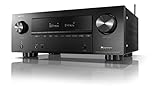
Denon AVR-X2700H Review: Features, Connectivity, and Formats
Modern home theaters need a receiver that handles high‑bandwidth video and low‑latency gaming without fuss. This model focuses on practical next‑gen video and a broad streaming ecosystem for U.S. buyers.
HDMI 2.1, eARC, and next‑gen video
One HDMI 2.1 input and five additional hdmi inputs mean all sources can use gaming features. Each input supports variable refresh rate, quick frame transport, and auto low latency to cut lag and stutter.
Both hdmi outputs are 2.1-certified and include eARC. Video passthrough covers 8K/60 and 4K/120 and preserves HDR10+, HDR10, HLG, Dolby Vision, and Dynamic HDR during playback.
Streaming, voice control, and ecosystem
Wireless features include HEOS, AirPlay 2, Spotify, Tidal, and Deezer, and the unit is Roon Tested for stable network playback. Native Dolby Atmos and DTS:X decode multichannel formats while virtualization modes add height effects without extra speakers.
Voice control works with Alexa, Google Assistant, and Siri for hands‑free input switching and basic playback. Bluetooth can output to headphones and speakers at once, which helps late‑night listening or mixed household needs.
| Feature | What it does | Why it matters |
|---|---|---|
| HDMI inputs | 1 x HDMI 2.1 + 5 x HDMI (all support VRR/QFT/ALLM) | Connect multiple consoles and streamers with low latency and solid handshakes |
| HDMI outputs | 2 x HDMI 2.1 with eARC | Simultaneous TV and projector hookup plus high‑bitrate audio return |
| Video formats | 8K/60, 4K/120, HDR10+, HDR10, HLG, Dolby Vision | Keeps tone mapping and contrast accurate across media |
| Streaming & control | HEOS, AirPlay 2, Roon Tested, Alexa/Google Assistant/Siri | Easy multi‑room music and voice-driven playback |
Audio and Video Performance in Real Content
Real-world scenes put the receiver’s multichannel staging and transient control to an immediate test. Listening moved smoothly between loud action and quiet passages, showing how the design handles texture and timing.
Channels, power, and configurations
The seven available channels let you run 7.2 or 5.2.2 layouts with dolby atmos and DTS:X decoding. Channel balance stayed even, keeping dialog clear while effects moved around the room.
Power delivery felt composed: 95W into 8 ohms provided confident drive in small to mid rooms, and dual subwoofers added weight without muddying mids.
Movie immersion and dynamics
Movie mixes delivered tight bass control and precise pans. Impacts landed with authority but did not mask detail, so ambience and spatial cues remained intact.
The result is convincing 3D staging with coherent height effects from dolby atmos content.
Music and gameplay in practice
Music playback favored clean highs and an articulate midrange. Lossless sources rewarded the system with natural texture and reliable audio fidelity.
For gaming, 4K/120 passthrough over the HDMI input worked well with variable refresh rate, quick frame transport, and auto low latency engaged. Motion stayed smooth and input lag dropped in low latency mode, keeping play responsive.
- Summary: a balanced sound and video match for home cinema and mixed music use; see our related comparison guide for alternatives.
Setup, Calibration, and Day‑to‑Day Use
Getting the system sounding right starts with a careful, step‑by‑step setup and calibration routine. Run Audyssey MultEQ XT with the supplied mic across multiple seating positions. In most rooms, only small level and crossover tweaks are needed to achieve seamless speaker integration.
Audyssey MultEQ XT tips and switching profiles
Store two measurement profiles to compare a movie reference curve and a music curve without re‑measuring. Review trims after the run and adjust subwoofer level, phase, and crossover for tighter low end.
Room acoustics vs. calibration: why treatment still matters
Calibration can correct tonal balance, but room treatment sets the baseline. Bass traps and broadband panels tame modes so the software refines, rather than fights, the room.
After adding treatment, re‑run calibration to lock in improvements across listening positions.
Build, I/O considerations, and limitations
The chassis is sturdy with a clean front panel and necessary ports: front USB, headphone jack, and setup mic remain. Note there are six HDMI inputs and two HDMI 2.1‑certified outputs with eARC, so plan which sources use the single HDMI 2.1 input for gaming consoles.
Limitations: no IMAX Enhanced or Auro‑3D decoding. For daily control, the remote, HEOS app, and Google Assistant voice control provide fast input switching and stable HDMI handshakes.
| Item | What to do | Why it matters |
|---|---|---|
| Calibration | Run Audyssey, save two profiles | Quickly switch between movie and music curves |
| Room | Use bass traps and panels | Improves accuracy and tightens bass |
| Inputs / Outputs | Prioritize HDMI 2.1 for consoles | Ensures low latency and HDR/Dolby Vision passthrough |
| Power & ventilation | Allow airflow on shelf | Prevents thermal throttling under load |
Conclusion
If you need low-latency gaming and confident cinema sound without high cost, this model delivers both. It pairs authoritative audio and clear dialogue with 8K/60 and 4K/120 video passthrough and modern gaming features like VRR, QFT, and ALLM for smooth play in low latency mode. The seven channels and practical HDMI routing — six inputs and two 2.1 outputs with eARC — give flexible hookup for current sources and future upgrades.
Streaming and multiroom support (HEOS, AirPlay 2, Roon Tested) and Bluetooth dual output make daily use simple for music or TV. Run Audyssey MultEQ XT and modest room treatment for best results; calibration yields reliable integration. Missing IMAX Enhanced and Auro‑3D are the main caveats, and the unit is discontinued, but on value and sound performance it remains a savvy pick for U.S. home cinema buyers mindful of price.
FAQ
What channels and speaker configurations does this 7.2‑channel receiver support?
It supports native 7.2 operation and can also run 5.2.2 for Dolby Atmos or DTS:X setups. That lets you use a two‑subwoofer layout or add two height or surround‑back speakers for immersive object‑based formats.
Does it handle HDMI 2.1 features like 4K/120, VRR, and ALLM for gaming?
Yes. The unit passes 4K/120 and supports Variable Refresh Rate (VRR), Auto Low Latency Mode (ALLM), and Quick Frame Transport (QFT) on compatible inputs, improving responsiveness for consoles and PCs.
How many HDMI inputs and outputs are available, and is eARC supported?
The receiver includes six HDMI inputs and two HDMI outputs, and it supports eARC on the main output for high‑quality audio return from a TV, including Dolby Atmos streams from smart TV apps.
Can I stream music and use voice assistants with this model?
Yes. It integrates HEOS multiroom streaming, AirPlay 2, and is Roon Tested. Voice control works via Amazon Alexa, Google Assistant, and Siri through paired devices.
What calibration system does it use and how effective is it?
It uses Audyssey MultEQ XT calibration. It provides solid room correction and profile options; however, manual tweaks and some acoustic treatment usually improve midrange focus and bass tightness.
Is IMAX Enhanced or Auro‑3D supported?
No. The receiver does not include IMAX Enhanced or Auro‑3D decoding, though it covers mainstream immersive formats like Dolby Atmos and DTS:X.
What is the power output and how does it perform with movies and music?
Power ratings are conservative per channel and deliver dynamic headroom for movie peaks. Expect clean dialogue, competent bass control with a quality subwoofer, and a neutral tonal balance that suits both soundtracks and music.
Are there any limitations with firmware or future feature updates?
Firmware updates can add features or improve HDMI compatibility, but hardware limits apply for advanced formats. Check manufacturer release notes for updates on VRR/4K/120 stability and streaming enhancements.
Does the receiver support Dolby Vision and HDR formats?
Yes. It passes Dolby Vision and common HDR formats, ensuring high dynamic range imaging when connected to compatible sources and displays.
How does it behave in real‑world 4K/120 passthrough tests with consoles like PS5 or Xbox Series X?
In practice it reliably passes 4K/120 to supported displays, with low latency modes engaging for smoother gameplay. Performance can depend on cables and display firmware, so use high‑speed HDMI 2.1 cables and keep device firmware current.
Can I use it with a multiroom speaker setup and what ecosystem is best?
The HEOS ecosystem works well for multiroom use and integrates streaming services and grouped playback. AirPlay 2 provides easy Apple device streaming, while Roon support benefits audiophiles using that platform.
Are there variable refresh and quick frame transport benefits for PC gaming?
Yes. VRR reduces screen tearing and QFT lowers latency, both helpful for competitive play. The receiver acts as a transparent pass‑through when these features are negotiated with the GPU and display.
What inputs should I use for the best audio‑video sync and performance?
Use HDMI inputs for modern sources to preserve AV sync and enable eARC. For music, opt for network streaming via HEOS or AirPlay 2, or digital inputs for high‑resolution files.
How easy is setup for first‑time home cinema builders?
Setup is straightforward with an on‑screen guide and Audyssey calibration. Labeling inputs and assigning speaker roles during the guided setup shortens the learning curve for newcomers.
Does it offer variable speaker profiles or tone controls for different listening modes?
It provides listening modes and tone controls, plus the ability to switch Audyssey profiles. These let you tailor sound for movies, music, or gaming without external processing.