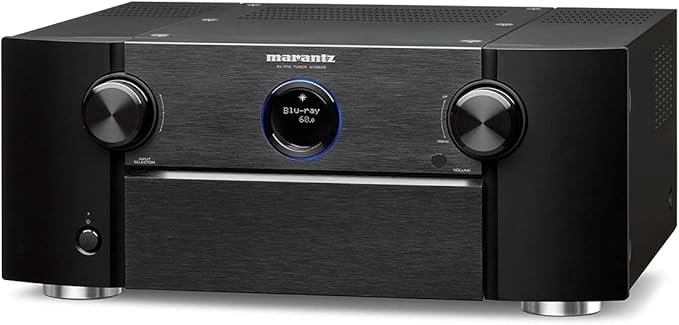
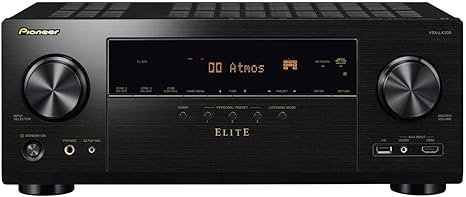
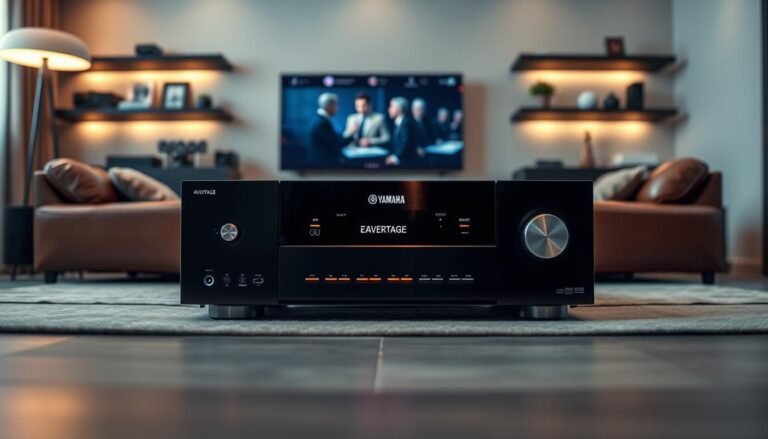
This midrange 7.2-channel AV receiver targets U.S. buyers who want modern HDMI 2.1 gaming features, broad streaming support, and solid Dolby Atmos/DTS:X performance at about $900–$999.
The unit packs six HDMI inputs, two HDMI outputs, and select ports that handle 4K/120Hz and 8K/60Hz. It also supports VRR, ALLM, eARC, Dolby Vision, HDR10, HLG, and IMAX Enhanced passthrough for cinema and gaming setups.
Wireless options include Wi‑Fi, Bluetooth, AirPlay 2, Chromecast Built-In, and Spotify Connect, plus compatibility with a popular multiroom ecosystem via an optional port. Calibration is sped up by DCAC IX and a new stereo mic while still allowing manual room entry.
Expect around 85–90W into 8 ohms in real-world use, no built-in phono input, and easy integration with a Bravia TV for better dialogue anchoring. This intro sets the stage for a detailed look at sound, video, and overall value.
Who the Sony STR-AN1000 Is For and What’s New right now
This review is for U.S. buyers who want a 7.2-channel hub that pairs modern gaming video with home theater audio.
The receiver suits movie-first households and mixed-use living rooms that want convincing Dolby Atmos and DTS:X impact without moving to bigger, pricier multi-channel models.
Gamers who use a PS5 or Xbox Series X get 4K/120Hz, VRR, and ALLM on two HDMI inputs while popular HDR formats pass through for crisp video.
Streamers benefit from AirPlay 2, Chromecast Built-In, and Spotify Connect for easy handoff from phones. Owners of Bravia TVs gain Acoustic Center Sync to improve dialogue anchoring in larger rooms.
Compared with the previous model, this unit adds HDMI 2.1 gaming features, 360 Reality Audio and an improved DCAC IX routine for multi-position calibration.
Note the lack of a phono stage; vinyl fans should plan for an external preamp. At a U.S. price near $900–$999, it competes with Yamaha, Onkyo, and Denon alternatives on features and system support.

Connectivity, Design, and Build: Six HDMI inputs, two outputs, and 8K/4K120 support
Connectivity centers on a full complement of HDMI ports, but only a subset carry the highest bandwidth for gaming and 8K video. The AVR includes six HDMI inputs and two HDMI outputs. Plan which sources need the two 4K/120Hz and 8K/60Hz-capable inputs.
HDMI layout, eARC, and port notes
The main output supports eARC, allowing high-bandwidth audio to return from a compatible TV. Both outputs and two inputs are 4K/120 and 8K capable. All HDMI ports support VRR and ALLM for smoother gaming.
Video formats and passthrough
HDR formats are covered: Dolby Vision, HDR10, and HLG all pass through cleanly. IMAX Enhanced is also supported for select titles and compatible displays.
Chassis, controls, and feel
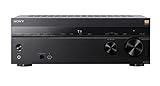
The design echoes a previous clean-line chassis with practical front buttons for mode selection. The compact remote gives solid basic control, though the Settings and HDMI Out buttons sit close together and can be pressed by mistake.
| Feature | Count/Type | High-bandwidth Support | Notes |
|---|---|---|---|
| HDMI inputs | 6 | 2 inputs support 4K/120 & 8K/60 | Labeling clarifies which ports to use |
| HDMI outputs | 2 | Both support 4K/120 & 8K/60 | Main out includes eARC for high-res audio |
| Other I/O | Ethernet, USB, optical, coaxial, analog | N/A | No phono input; use external preamp for vinyl |
Practical build and clear labeling make setup straightforward. Speaker posts are arranged for tidy wiring, and the UI uses large white text on black for quick navigation.
Features and ecosystem: Dolby Atmos, DTS:X, 360 Reality Audio, and 360 Spatial Sound Mapping
This receiver brings native object-based decoding alongside flexible channel layouts for movies and music.
Immersive formats decode Dolby Atmos and DTS:X to a full seven-channel bed. You can run a classic 7.1 setup or a 5.1.2 layout with two height channels for overhead effects.
Immersive audio and channel flexibility
Choose 7.1 for full surround duty or 5.1.2 to add height without a larger amp. Per-channel power is tuned for real-world seating and dynamic films.
When to use spatial sound mapping and 360 Reality Audio
Spatial sound mapping creates phantom speakers to widen the stage. Use it for big movies or to make small speaker arrays feel larger.
360 Reality Audio plays compatible music natively and can upmix stereo tracks for a more enveloping experience. Turn mapping off for critical two-channel listening.
Streaming, multiroom, and cross-platform support
The unit supports AirPlay 2, Chromecast Built-In, and Spotify Connect for easy streaming from phones and computers. It also works with Sonos when paired with a Sonos Port for multiroom control.
Gaming credentials and passthrough notes
Gamers get VRR, ALLM, and two 4K/120Hz inputs for next-gen consoles or fast PCs. Auto HDR Tone Mapping and Auto Genre Picture pass through to compatible displays to keep video and audio synced.
| Feature | What it does | Notes |
|---|---|---|
| Object decoding | Dolby Atmos / DTS:X | Up to 7 channels; supports 7.1 or 5.1.2 layouts |
| Spatial tech | 360 Spatial Sound Mapping / sony 360 | Creates phantom speakers; overlays native Atmos or stereo |
| Streaming & multiroom | AirPlay 2, Chromecast, Spotify, works sonos | Cast from phones; Sonos Port enables system integration |
| Gaming | VRR, ALLM, 4K/120Hz | Two high-bandwidth HDMI inputs; best for PS5/Xbox Series X |
Setup and calibration: DCAC IX auto-calibration and manual tuning
Getting the receiver sounding right starts with a fast, guided calibration that blends measurements and user inputs. The flow asks for listening distance, room height, and TV height, then runs quick multi-position sweeps with the supplied stereo mic.
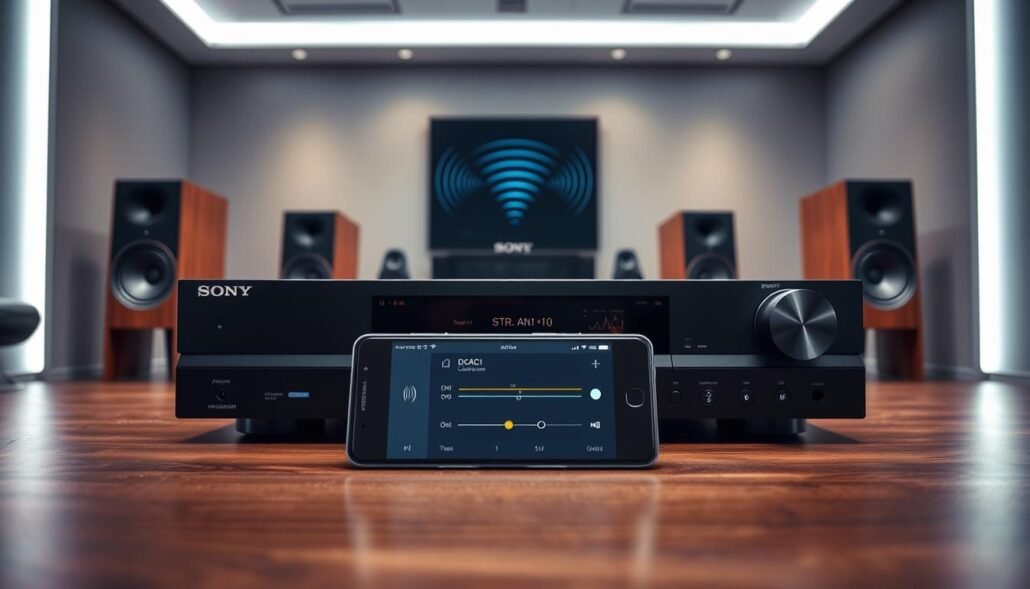
Digital Cinema Auto Calibration IX with multi-position mic and room inputs
DCAC IX uses a stereo microphone mounted on a sturdy plastic stand to measure multiple seats. This speeds setup and improves accuracy without eight mic moves.
Multi-position readings keep tonal balance consistent across the room and make the system more forgiving for family seating.
Manual tweaks, bass management, Acoustic Center Sync, and wireless speakers/subs
The manual menu lets you enter screen and speaker heights, tweak bass trims, and adjust crossovers. Auto Phase Matching aligns timing between mismatched drivers for tighter action and clearer transients.
- Wireless handling: add compatible wireless speakers or a sub and the receiver integrates them automatically.
- Sub handoff: switching to a wireless sub will disable the wired sub path for clean control.
- Pro tips: verify distances and use a handheld SPL meter to lock in the final 1–2 dB.
Re-run calibration after moving furniture or adding treatments to restore imaging and bass smoothness without rebuilding settings from scratch.
Sony STR-AN1000 Review: Performance & comparisons
Listening tests show the receiver delivers punchy impact and refined detail across movies and music. The overall performance favors cinematic material while remaining capable for two‑channel listening.
Stereo music and DSD: clarity, timing, and tonal balance
Stereo playback offers clear leading edges and crisp separation. Native DSD support plays high‑res files without conversion, preserving transients and texture.
For music, turning on Pure Direct or disabling spatial processing tightens imaging and reveals midrange detail.
Home theater sound: Dolby Atmos cohesion and dialogue lift
In Atmos mixes, object placement feels coherent and integrated. Spatial Sound Mapping widens immersion on blockbusters while Acoustic Center Sync boosts dialogue clarity with compatible TVs.
Bass, dynamics, and speaker integration in real rooms
Bass leans tight and punchy rather than boomy. Low‑end effects hit with speed and control, and DCAC IX helps match mains, center, and sub for smooth handoffs.
How it stacks up vs rivals
The unit often sounds more cohesive than the Yamaha RX‑V6A, though Yamaha can project height more aggressively in some rooms. Against Onkyo TX‑NR6100, the Onkyo trades price and a phono stage for slightly higher output. Compared with Denon midrange models, this receiver favors a livelier, more energetic presentation versus Denon’s smoother tone.
| Competitor | Price/Edge | Sound/Performance |
|---|---|---|
| Yamaha RX‑V6A | Similar price; slight height bias | More airy height; Sony integrates surrounds more cohesively |
| Onkyo TX‑NR6100 | ~$100 cheaper; built‑in phono | Higher measured output; less processing depth |
| Denon midrange | Varied; more 4K/120 inputs on some models | Smoother, less incisive; better for long music sessions |
Value, price, and who should buy this receiver in the United States
If your priority is a balanced home theater system with reliable per-channel power and modern video passthrough, this model merits serious consideration.
At roughly $900–$999, the price places the unit between budget entry gear and four-figure flagships. That makes it a good pick for apartments and mid-size homes where about 85–90 watts per channel covers most listening positions without extra heat or bulk.
The receiver supports VRR/ALLM, two 4K/120-capable inputs, and common HDR formats, so gaming and streaming stay current. Dual HDMI outputs help when you run both a TV and projector or plan an upgrade path to 8K.
Compare options: Onkyo’s TX‑NR6100 is usually ~$100 cheaper and adds a phono input and slightly more measured power. Yamaha’s RX‑V6A is similarly priced and depends on taste, while Denon’s step‑up models justify higher costs with more fully 4K/120 inputs.
| Buyer type | Why it fits | Notes |
|---|---|---|
| Apartments / mid-size homes | Enough power, tight bass, compact footprint | Good for 5.1 or 5.1.2 setups |
| Console gamers | HDMI features, VRR/ALLM, 4K/120 inputs | Two high-bandwidth ports; supports PS5/Xbox Series X |
| Multiroom users | Works with Sonos via Port; streaming support | Integrates into an existing Sonos-based home |
Conclusion
If you want a single AVR that balances modern gaming video with room-friendly audio, this model makes a strong case. It delivers convincing Dolby Atmos and DTS:X immersion, two 4K/120‑capable hdmi inputs, and broad HDR passthrough including Dolby Vision. The real‑world power (about 85–90W) suits most apartments and mid‑size home rooms.
360 Spatial Sound Mapping and 360 Reality features widen immersion without extra speakers. DCAC IX calibration and Acoustic Center Sync speed setup. Streaming options and Works with Sonos support make whole‑home audio easy. For buyers who want clear sound, solid bass control, and practical HDMI flexibility, the sony str-an1000 is a confident, useful choice.
FAQ
What audio formats does this AVR support for immersive home theater?
It handles Dolby Atmos and DTS:X for object-based surround, plus 360 Reality Audio and 360 Spatial Sound Mapping for height and spatial effects. The unit supports flexible channel layouts such as 7.2 and 5.1.2, letting you configure height speakers or use Atmos-enabled models.
How many HDMI inputs and outputs are available, and do they support 8K/4K120?
The receiver includes six HDMI inputs and two HDMI outputs. Not every port supports the highest bandwidth features: only two inputs are 8K-capable, and two handle 4K/120Hz. eARC is provided on the main output for high-bitrate audio from TVs.
Does it pass through Dolby Vision and HDR formats?
Yes. It offers passthrough for Dolby Vision, HDR10, HLG, and IMAX Enhanced content, so video from compatible sources reaches your display with full metadata preserved when routed through the correct HDMI input.
How good is the auto-calibration and can I fine-tune manually?
The unit uses Digital Cinema Auto Calibration IX with a multi-position microphone to map your room. It provides solid baseline correction. You can then make manual adjustments for bass management, distance, and level trims to match speaker size, placement, and personal taste.
What about per-channel power and real-world listening performance?
Per-channel power ratings are competitive for its class and deliver clean output at reasonable volumes. In stereo music the receiver offers clear mids and good timing, while home theater benefits from coherent Atmos imaging and improved dialogue clarity when using spatial sound mapping.
Can it work with wireless speakers and subwoofers?
It supports wireless speaker integration and subwoofer output options, plus Acoustic Center Sync for compatible wireless speakers to help align center-channel dialog with your display. Wireless subwoofer pairing depends on your network and the specific speaker models.
Is this a good choice for gaming consoles like PS5 and Xbox Series X?
Yes. The AVR includes gaming-friendly features such as VRR, ALLM, and 4K/120Hz passthrough on the designated HDMI ports, which helps reduce latency and preserve frame rates when connected to current-gen consoles.
What streaming and multiroom services are integrated?
The receiver has AirPlay 2, Chromecast Built-In, and Spotify Connect, and it’s compatible with Works with Sonos for multiroom setups. These options allow streaming from mobile devices and integration into multiroom ecosystems.
How does the unit handle bass and dynamics in real rooms?
Bass response is punchy with good extension for typical living rooms, and dynamics remain controlled at moderate-to-high levels. Performance depends on room acoustics and speaker matching; calibration helps mitigate common room-induced bass issues.
How does it compare with similarly priced rivals from Yamaha, Onkyo, and Denon?
Against models like the Yamaha RX-V6A, Onkyo TX-NR6100, and comparable Denon units, it competes well on features and format support. Differences often come down to voice/tonal character, user interface, and specific HDMI bandwidth allocations. Evaluate on the basis of inputs required, ecosystem needs, and personal listening preference.
Are there any HDMI or port caveats to watch for during setup?
Yes—only certain HDMI inputs support 8K or 4K/120Hz, so route high-bandwidth sources (like a console or 8K player) to those ports. Also verify eARC functionality with your TV model to ensure high-resolution passthrough for game consoles or streaming devices.
Does the receiver support MQA, DSD, and high-res audio for music listening?
It supports common high-resolution formats and performs well with lossless sources. Specific codec support such as DSD and MQA should be confirmed in the spec sheet for your firmware revision, but optical and network playback handle hi-res music with strong clarity and detail.
What controls and display features are available on the front panel and remote?
The chassis uses a clean front panel with tactile buttons and a responsive remote. The display provides clear input and format feedback. Build quality feels solid for the price bracket, and the remote includes shortcuts for calibration and source selection.
How does Spatial Sound Mapping work and when should I use it?
Spatial Sound Mapping creates virtual height channels using speaker placement and room measurements, improving immersion when you lack physical height speakers. Use it if you want a stronger overhead effect without installing in-ceiling drivers, but compare it to true height speakers for maximum realism.
Is firmware support and manufacturer assistance reliable?
Firmware updates are periodically released to add features and improve compatibility. Manufacturer support generally covers setup questions, HDMI compatibility, and calibration guidance; check regional support channels for specifics in the United States.