Quick guide: learn how to tell if your audio/video hub can pass high-frame-rate video through the latest hdmi standard. This short intro explains what to check on the device, which cables matter, and how the entire chain must match to get smooth gaming at high refresh.
Why bandwidth matters: legacy hdmi links have lower throughput than the 48 Gbps ceiling that hdmi 2.1 introduces. That extra headroom is what enables true high-frame-rate 4K play and better future-proofing.
We’ll show simple checks: read the spec sheet, inspect rear-panel labels, and run a real-world test with a modern console or PC.
Takeaway: a working setup needs source, hub, and display to match features. Follow the steps here to avoid common pitfalls and enjoy fast, clean video in your home theater.
What you’ll learn and why 4K/120Hz over HDMI 2.1 matters
Quick overview: Learn which sources and displays actually use the latest link, what the bandwidth jump enables, and why some setups still run at lower rates.
Who needs this? Competitive gamers, high-frame-rate PC owners, and next-gen console players get the most benefit. Modern graphics cards and consoles can output higher refresh and need the extra data headroom to do it well.
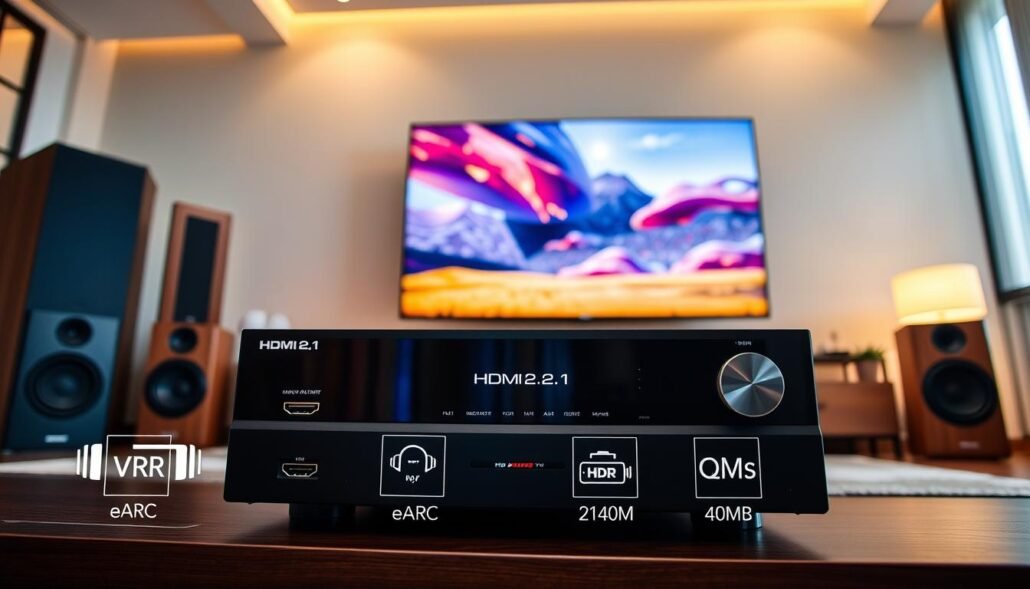
Key technical gains: The update increases throughput from 18 Gbps to 48 Gbps, enabling higher resolutions, higher refresh, and advanced features like VRR, eARC, and Dynamic HDR. Fixed Rate Link is the transport that carries these signals, while QMS cuts blanking when frame rates change.
Many new tvs reserve full capabilities to specific inputs, so check exact port labels. For clean picture and full sound pathways, confirm each device and input in the chain and use Ultra High Speed cables when needed.
How to check your receiver for HDMI 2.1 support
Quick start: inspect the back panel and the product spec sheet for terms like HDMI 2.1, 4K/120, FRL, eARC, or VRR. Not every input may list the same features, so note which port carries the label.
Test with a known high-frame-rate source such as a PlayStation 5, Xbox Series X, or a recent GPU. Use the console or PC to push a 4K/120 signal and check the on-screen signal info in the receiver and the TV menus.
Swap cables if the test falls back to lower rates. A certified Ultra High Speed cable is required to handle up to 48 Gbps and full feature sets like Dynamic HDR and QMS. Many older High Speed cables only cover lower bandwidths and may limit the output to 60 fps.
Confirm the full chain: the source must output the higher refresh and the port on the center device and the TV must accept it. Also keep devices updated; a firmware update can unlock added features on some models.
| Checkpoint | What to look for | Quick test | Fix if missing |
|---|---|---|---|
| Port labels | “HDMI 2.1”, “4K/120”, “FRL”, “eARC” | Visual scan of rear panel and manual | Use labeled input or direct connect |
| Source test | PS5, Xbox Series X, or high-end GPU output | Enable 120 fps mode and check signal pane | Try different port, cable, or direct TV link |
| Cable | Ultra High Speed vs High Speed | Swap to certified Ultra High Speed end-to-end | Replace older cable with certified cable |
| Firmware | Latest updates may add features | Check manufacturer site and update | Apply firmware update or contact support |
Does my receiver support HDMI 2.1 for 4K/120Hz?
Begin with the simple rule: one outdated device can cap the whole signal chain. If a console and a TV are modern but the center box is an older spec, the system will drop to the lower link’s capabilities. This affects both video and audio paths.
Common signs of a limiting component include inability to enable the higher refresh rate, HDR modes failing to activate, or variable refresh menus shown as unavailable. Many legacy AV units were built around 18 Gbps pipes and pass 4K at 60 fps easily but block higher rates and gaming features.
- Every device in the chain—source, center box, and TV—must handle hdmi 2.1 to reach 4K/120; one HDMI 2.0 link forces a fallback.
- Check which ports are labeled as high‑bandwidth; some models only give full pass‑through on select inputs.
- If menus report a 4K/60 signal despite selecting 120 Hz, bypass the unit to test if it is the bottleneck.
| Scenario | Symptom | Quick test |
|---|---|---|
| Legacy AVR (18 Gbps) | No 120 Hz, VRR disabled | Connect console directly to TV |
| Single 2.1 port on unit | Only one input shows full features | Use labeled port or update firmware |
| Gaming PC or console | Must choose direct video or reduced features | Send audio via eARC or optical if available |
Features to verify beyond 4K/120: VRR, eARC, HDR formats, and QMS
Check the ancillary features that carry dynamic picture and full‑bandwidth audio across the link. These items decide whether high-frame content looks smooth and whether object-based audio reaches your speakers intact.
VRR / G‑Sync / FreeSync over HDMI
Game Mode VRR matches frame output to the source’s render timing. This reduces tearing, stutter, and input lag, similar to G‑Sync and FreeSync on PCs.
Verify VRR is enabled on both the display and the hub so frames sync end-to-end.
eARC and full‑bandwidth object audio
eARC delivers uncompressed Dolby Atmos and multi‑channel sound back to a processor. Many setups will pass Atmos via eARC even with older cables, but confirm the port labeled eARC on the unit and the TV.
Dynamic HDR, Dolby Vision, HDR10+
Dynamic HDR formats allow scene‑by‑scene tuning. Look for explicit mentions of Dolby Vision or HDR10+ in the spec sheet to ensure dynamic metadata travels with the picture.
QMS and FRL: the transport and fast switching
FRL is the low-level data link that raises bit throughput. QMS speeds switching between frame rates and cuts the black-screen delay when content changes.
- Identify which port handles eARC and which takes the high‑bandwidth video path.
- Confirm bit depth and metadata handling in device specs so color and HDR info survive the chain.
- For multi‑speaker layouts, test that speaker processing remains available when audio returns via eARC.
| Feature | What to verify | Quick test |
|---|---|---|
| VRR | Enabled on display and hub | Run a variable‑frame game and watch for tearing |
| eARC | Port labeled eARC, passthrough of Atmos | Play Atmos content from TV app and check processor input |
| Dynamic HDR | Dolby Vision / HDR10+ listed | Play HDR demo with scene metadata |
Setup paths that work today: direct connects, eARC audio return, and cable choice
Pick the wiring that keeps the video path simple and the audio path full‑feature. Send a gaming console or high‑end card directly to a TV’s hdmi 2.1 input to guarantee the highest refresh and VRR. Then use the TV’s eARC port to return full‑bandwidth dolby atmos to your sound processor or soundbar.
Direct source-to-TV + eARC back to processor
This route avoids a middle unit limiting the signal. Video stays native to the display while audio travels back as uncompressed multichannel. It preserves dolby atmos and lets gaming run at peak refresh with fewer handshake issues.
Why Ultra High Speed cables matter
Use certified Ultra High Speed hdmi cables (48 Gbps) between the source and the TV. Many older High Speed cables handle 4K/60, but they often fail at higher rates or when VRR is active. A correct cable reduces stutter and dropped modes.
Real-world example: LG CX with older AVR
Owners of the LG CX and dated AV units often find that routing a PS5 or Xbox through the AVR blocks 120 Hz or VRR. Direct-to-TV video with eARC audio return fixes this without replacing the center box. Toslink or optical may carry stereo only and will not pass Atmos.
- Tip: dedicate TV hdmi 2.1 inputs to high-bandwidth devices and keep the receiver for 4K/60 sources.
- Confirm the TV’s eARC port and enable CEC/ARC so audio returns automatically.
- Verify dolby vision and HDR pass-through on the direct path before finalizing the setup.
| Path | Video | Audio | When to use |
|---|---|---|---|
| Direct → TV, eARC → amp | Full high-rate, VRR enabled | Full Dolby Atmos via eARC | Best for gaming and peak refresh |
| Source → amp → TV | May limit to 60 Hz if amp is older | Processed by amp, includes legacy passthrough | Use if amp explicitly lists full pass-through |
| Source → TV; optical → amp | Full video to TV | Stereo or compressed surround only | Temporary workaround; not Atmos-capable |
Troubleshooting: firmware updates, adapter warnings, and signal limitations
Begin with software updates—many devices gain high‑bandwidth features after a patch. Update firmware on TVs, amps, consoles, and GPU drivers to unlock vrr, QMS, and other features. A firmware update often fixes handshake quirks and HDR modes that won’t engage.
If a video or audio link flickers, power‑cycle gear, reseat cables, and try alternate ports. If a direct TV connection restores a stable signal, the middle box or cable is the bottleneck.
- Avoid USB‑C to hdmi dongles for high‑bandwidth modes; they can overheat and shift color (documented Delta Error >13 at 60Hz and worse at 120Hz).
- Prefer direct connections with certified Ultra High Speed cables and minimize adapters or extenders.
- Know audio limits: Toslink can’t carry full‑resolution dolby atmos or uncompressed 7.1; use eARC on the TV and amp for best multichannel sound.
| Issue | Quick action | Expected result |
|---|---|---|
| Handshake/HDR fails | Apply firmware update to all devices | Stable HDR and enabled vrr |
| Intermittent 120Hz or flicker | Reseat cables, try direct TV link | Signal stabilizes or bottleneck identified |
| Audio limited over optical | Switch to eARC port | Full dolby atmos and uncompressed channels |
Conclusion
Finish with a quick audit: verify each device and cable in the chain is rated to pass the required hdmi bandwidth and that the correct port is used on every unit.
If a middle box limits the link, send video direct to the TV and return full‑bandwidth audio via eARC. This keeps the picture sharp and preserves dolby atmos to your receiver and speakers.
Keep firmware current, avoid adapters that corrupt the signal, and use certified Ultra High Speed cables to carry the full bit load. Prioritize the features you value—smooth motion, dynamic picture, or rich multichannel sound—and upgrade components over time to match that goal.
FAQ
How can I tell if an AV receiver offers HDMI 2.1 features like 4K/120Hz?
Check the rear-panel labeling and the official spec sheet. Look for phrases such as “HDMI 2.1,” “4K/120,” “FRL,” “eARC,” and “VRR.” If the manual lists Fixed Rate Link (FRL) or a 48 Gbps bandwidth, the unit likely handles high-frame-rate video. Also confirm firmware notes on the manufacturer site that mention added support for gaming features and high refresh rates.
What simple test proves high-frame-rate pass-through works?
Use a known source like an Xbox Series X, PlayStation 5, or a GPU that outputs 120Hz at 4K. Connect source → receiver → TV using Ultra High Speed HDMI cables and set the console or PC to 120Hz. If the TV reports 120Hz input and the receiver shows HDR/audio formats correctly, pass-through is functioning.
Which cable type do I need to reach 4K at 120Hz and advanced features?
Use Ultra High Speed HDMI cables. They support the full bandwidth required for high frame rates, VRR, and hdr metadata. High Speed cables may work in some cases but can fail with higher data demands, so always choose cables certified for the highest spec.
Can a receiver block 4K/120Hz even if the TV and console support it?
Yes. The chain is only as strong as its weakest link. If any component—receiver, cable, or TV input—is limited to older specs, the signal will downscale to the lowest capability. Some older AVRs are rated at HDMI 2.0 and will not pass 4K/120Hz or newer HDR features.
Are VRR and FreeSync handled by all modern AVRs?
Not all. Some models pass Variable Refresh Rate, G‑Sync, or FreeSync over HDMI, while others do not. Confirm explicit VRR support on the spec sheet. Even with declared support, VRR behavior can depend on firmware and the connected display’s compatibility.
Will eARC deliver full Dolby Atmos and object-based audio when using direct TV connection?
Yes, when both TV and AVR support eARC. A common setup routes the 4K/120 video straight to the TV and uses eARC to send lossless Dolby Atmos and other multichannel formats back to the amp. Make sure eARC mode is enabled and the connected cables meet the spec.
Which HDR formats travel reliably through modern AV equipment?
HDR10 and Dolby Vision typically pass through modern gear, and HDR10+ is supported on some devices. Dynamic HDR metadata and format handoff can vary, so check each device’s compatibility. QMS and FRL handling can affect how quickly sources switch resolutions and HDR modes.
What are QMS and FRL, and why should I care?
FRL (Fixed Rate Link) is the data link method that enables higher bandwidth on newer ports. QMS (Quick Media Switching) prevents a black screen when switching between frame rates or resolutions. Both improve performance and user experience during high-bandwidth gaming and video playback.
Is it better to connect game consoles directly to the TV or through an AVR?
For guaranteed 4K/120 and VRR, many users connect the console directly to the TV and route audio back via eARC to the AVR or soundbar. This avoids pass-through limits while preserving full audio fidelity. If your AVR fully supports the needed features and bandwidth, a single-chain connection can work.
How much do firmware updates matter for unlocking features?
They matter a lot. Manufacturers often add VRR, improved pass-through, and other fixes via firmware. Keep TV, AVR, and console/GPU firmware up to date to unlock or stabilize newer features.
Can adapters or dongles handle high-frame-rate HDMI signals?
Most USB-C or cheap HDMI adapters struggle with 4K/120, causing heat, color shifts, or unstable output. Use dedicated HDMI ports and certified Ultra High Speed cables for reliable performance. Avoid adapters unless explicitly rated for the full bandwidth.
What audio connections cannot carry full Atmos or multichannel sound?
Optical (Toslink) cannot pass lossless Dolby Atmos or high-bitrate multichannel formats. Use eARC or HDMI to retain full object-based audio and PCM multichannel. If the AVR lacks eARC, you may lose some audio fidelity when routing through the TV.
How do TVs report incoming refresh rates and formats?
Most modern TVs display the active refresh rate and HDR format in the info overlay or in the input status menu. When testing 120Hz, check the TV’s input readout to confirm 120Hz and the expected HDR or color format are active.
What should I verify on the spec sheet to avoid surprises?
Verify explicit mention of FRL, 48 Gbps or “Ultra High Speed” bandwidth, VRR, QMS, and eARC. Also check supported HDR formats like Dolby Vision and HDR10+. If a spec is ambiguous, look for firmware updates or manufacturer clarifications before purchase.