Difference Between 5.1, 7.1, and 9.2 Channel Receiver Explained

Quick guide for home theater shoppers: this intro clears up the main choices for surround sound systems and what you actually pay for. A common label has two parts, sometimes three. The first part names ear-level speaker groups, the second marks subwoofer outputs, and a third, when shown, points to height speakers.
Key confusion: a nine-dot setup does not automatically mean Dolby Atmos. Often it simply means nine ear-level outputs plus two subs. Amplified channel counts describe processing ability, not the exact number of physical speakers you must buy today.
This article will cover how these counts work, basic five-point setups, wider seven-point layouts, and what a nine-plus-two system really offers. Expect clear tips on room size, seating, speaker placement, content formats, and which setup fits movies, streaming, or music.
Understanding surround sound channel numbers in today’s home theater receivers
Learning how numeric labels map to speaker roles makes picking a home theater system far less confusing.
First number: this counts ear-level speakers meant to sit around listeners. Think left, center, right and the surrounds that place effects at ear level. Those outputs shape lateral immersion and directionality.
“.1” explained: the point-one stands for the LFE (Low-Frequency Effects) track. It delivers impact and rumble and is written as a single decimal because it carries only low bass content. Note that the LFE track and the physical subwoofer are not identical; bass management can route low notes from other speakers to your subwoofer.
Third number: when present it shows available height outputs. These feed in-ceiling or upward-firing drivers used by Dolby Atmos and similar formats to add vertical depth rather than extra rear detail.
- Labels show processing capability, not always built-in amplification.
- Bigger counts help in large rooms, but room size and content often matter more than raw specs.
5.1 channel receiver basics for a surround sound system
A compact five-speaker setup still delivers strong cinematic presence for most living rooms.
Standard layout: three front speakers — left, center, right — sit along the front wall. Two surround speakers go to the sides or just behind the main seating. One subwoofer handles low-end impact.
The standard speaker roles
The center channel carries most dialogue. Good center placement makes speech clear even at low volumes. This dramatically improves movie and show comprehension in a typical living room.
Why this became the baseline
Dolby Digital 5.1 became common on DVD, Blu-ray, and streaming. That broad support made the layout a reliable home theater system choice.
| Feature | Placement | Benefit |
|---|---|---|
| Left / Right / Center | Front wall | Directional imaging, clear dialogue |
| Surrounds | Sides / slightly behind | Envelopment, ambient effects |
| Subwoofer | Flexible placement | Deep bass impact |
Who should pick this setup? Apartment dwellers, small family rooms, and first-time buyers get a major upgrade over TV speakers without complex wiring. Proper placement and calibration often beat poorly placed higher-count systems in real-world sound quality.
How a 7.1 receiver expands soundstage, depth, and rear detail
Adding two extra surround channels widens the sweet spot and fills larger listening areas with smoother motion.
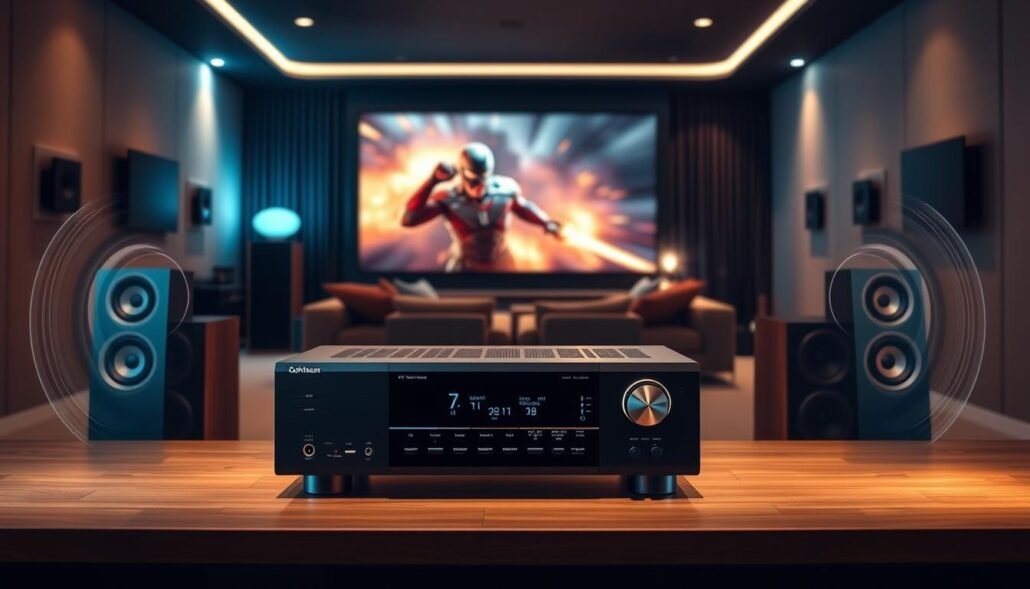
Exactly what it adds: a 7.1 surround setup brings two more outputs beyond a five-speaker layout. That lets effects move from side to back without collapsing into one point.
Placement logic for side and rear
Place side speakers beside the main seat line and rear speakers behind the listening area. This split helps pans — like passing cars or crowds — travel more naturally across the space.
Room size and rear detail
In a deep room, extra surrounds improve envelopment and increase perceived depth. Action scenes and games gain clearer rear localization, making enemies or vehicles easier to pinpoint.
Handling five-source mixes: many units play 5.1 tracks directly or use upmix modes to engage the extra speakers. Results vary by soundtrack and processing mode, so gains can be subtle or dramatic.
| Feature | Placement | Benefit |
|---|---|---|
| Side surrounds | Beside seating | Smooth lateral motion |
| Rear speakers | Behind seating | Improved back-stage detail |
| Upmixing | Receiver processing | Uses extra speakers for immersion |
Realistic note: if the couch sits against the back wall, extra rear channels may offer little advantage. For full context on gear that handles multi-channel processing well, see best AV receivers. Next, labels with higher counts can confuse buyers who expect height effects.
What a 9.2 label really means (and what it doesn’t)
When you read 9.2 on gear, read it as nine speaker outputs for ear-level placement and two subwoofer ports, usually carrying the same low-frequency feed.
Breaking down the main speaker count
Nine refers to ear-level outputs the unit can process or amplify. Brands use that extra headroom for wider front imaging, split surrounds, or model-specific front width options.
What the “.2” actually means
Two subwoofer outputs normally carry the same LFE signal. Most Dolby and DTS soundtracks have a single LFE track, so both jacks duplicate that feed.
Why dual subs exist and common confusion
Two subwoofers help smooth bass and reduce nulls by letting you place low bass in different spots. That improves evenness across seats.
- 9.2 does not promise overhead effects; height speakers use a third number like 9.1.2.
- Soundbar marketing often virtualizes channels—check for discrete outputs versus simulation.
Expectation: more channels means more wiring, calibration, and setup time. The best unit depends on how many speakers you will place correctly and the content you watch.
What is the difference between a 5.1, 7.1, and 9.2 channel receiver?
More outputs mean more precise placement for effects, but they don’t replace good setup and calibration.
Quick comparison: a five-point system uses three front speakers, two surrounds, plus one sub. A seven-point layout splits surrounds into side and rear pairs for smoother motion. A nine-output model adds extra ear-level positions and two sub outputs for bass flexibility.
Real-life impact for movies and shows
Extra surrounds improve directionality and separation. Action scenes and practical effects move with more clarity when sounds have distinct speaker locations.
Music and spatial formats
Most music stays stereo, so gains often come from better speakers, room correction, or upmixing rather than native multichannel tracks. Streaming services now offer spatial audio and Atmos music, but benefits depend on service, playback chain, and speaker layout.
- Choose five-point for simple installs and small rooms.
- Choose seven-point for larger rooms needing clearer rear motion.
- Choose nine-output with dual subs if you want expansion room and smoother bass.
Remember: placement and calibration usually affect perceived realism more than raw numbers. Next section covers true height effects and how Atmos changes the game.
Dolby Atmos and height speakers: where 5.1.2, 7.1.2, and beyond fit in
Dolby Atmos brings vertical movement to home theaters by treating sounds as independent objects that can travel above you. Instead of locking effects to fixed channels, up to 128 discrete audio objects can be placed anywhere in a three-dimensional hemisphere.
How that feels: listeners hear more convincing overhead motion — helicopters, rain, and spatial ambience pass naturally from front to back and above. Transitions sound smoother than traditional horizontal-only surround mixes.
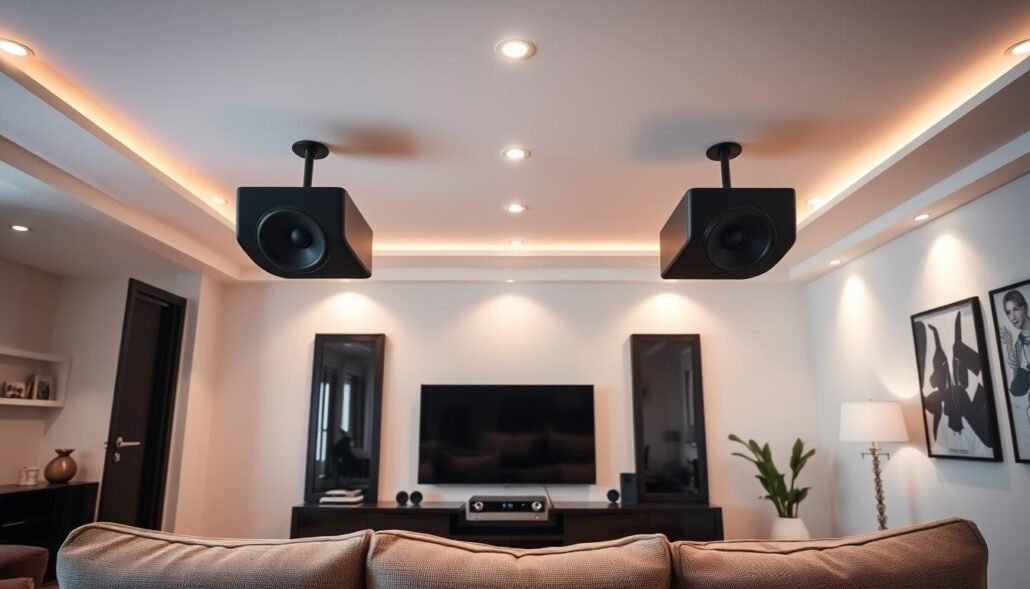
Minimum common home Atmos layout and needs
The usual entry-level setup is 5.1.2. That requires an Atmos-capable receiver, two height speakers or upward modules, and Atmos-encoded source material.
In-ceiling vs upward-firing height speakers
In-ceiling speakers fire directly down for clearer overhead imaging. They usually deliver the most reliable height effects.
Upward-firing modules bounce sound off the ceiling. They work well with flat drywall or plaster ceilings and when ceiling height stays under roughly 14 feet.
Content and compatibility chain
- Source: an Atmos-enabled Blu-ray, streaming app, or game with an Atmos mix.
- Processor: a unit that can decode and map object audio to your speakers, including height outputs.
- Speakers: correctly placed front, surrounds, and height units for accurate reproduction.
Practical note: Atmos tracks are common on major streaming services and many 4K releases, but not every title includes an Atmos mix. Also, a unit labeled for more surround outputs must explicitly support height channels to run a true .2 setup; shopping for expansion means checking height-channel support, not only total output count.
Room size, layout, and seating position: choosing the right number of channels
Match channel count to the actual dimensions and seating plan of your room for the best results.
When 5.1 is enough for a small living room setup
Small living areas often gain more from quality speakers and correct placement than extra outputs. If seating sits near walls, side surrounds will provide full effect.
Use a compact layout and focus on center clarity so dialogue and midrange fill the space.
When 7.1 makes sense for a larger media room
Larger rooms benefit from distinct side and rear locations. Spread surrounds far enough to create smooth motion and a wider sweet spot.
Expect more wiring and calibration, but the added channels can lift immersion and give a richer sound experience.
When 9-channel layouts pay off in dedicated home theaters
Dedicated home theaters with flexible seating distances enable front width and extra ear-level positions. That helps with precise imaging and uniform coverage.
Keep in mind installation costs: more stands, runs, and tuning time. Prioritize speaker quality; good speakers placed well beat crowded arrays.
| Room type | Best pick | Why |
|---|---|---|
| Small living room | 5.1 | Compact placement, clearer dialogue, fewer wires |
| Large media room | 7.1 | Distinct side/rear spacing, smoother pans |
| Dedicated theater | 9 (with dual subs optional) | Expanded imaging, even coverage, future Atmos upgrade |
Note: bass depends heavily on room interaction. Even one sub can sound uneven across seats, so the next section will cover subwoofer strategy.
Subwoofer strategy: one subwoofer vs dual subwoofers in a “.2” setup
Bass placement and sub strategy determine how films feel more than raw speaker counts.
Why two units smooth bass across the room
One subwoofer often excites room modes unevenly. That causes a seat to get boomy bass while another seat hears thin lows.
Adding a second unit averages peaks and nulls. That creates more consistent low-end for groups of listeners, not louder bass overall.
Placement and calibration basics for consistent low-frequency effects
Try opposing walls or diagonal placement to spread low energy. Match levels, set delay (distance), and align phase for coherent output.
Use your receiver’s room correction (Audyssey, Dirac, or similar) when available. Measure or listen from several seats to verify even coverage.
- Reality check: two mismatched models can be harder to blend; similar units simplify tuning.
- LFE routing: most units send the same audio feed to both outputs, so gains come from acoustics, not extra tracks.
- Decision tip: in a difficult room, dual placement often improves perceived sound more than extra surrounds.
| Aspect | One subwoofer | Dual units |
|---|---|---|
| Seat-to-seat consistency | Variable; hotspots likely | Smoother, more even coverage |
| Setup complexity | Simple calibration | Requires level, phase, and placement work |
| Cost and gear | Lower cost | Higher cost, better room averaging |
| Best for | Small rooms, single listener | Large or challenging rooms, multi-seat listening |
Tip: measure or walk through listening positions while tuning. Bass is a room problem, so test more than one seat.
Receiver buying checklist: features that matter beyond channel count
A smart purchase looks past raw counts and targets decoding, inputs, and upgrade paths.
Format support decides what your unit can decode. Look for Dolby Digital, Dolby Digital Plus for streaming, and Dolby TrueHD for lossless Blu-ray. DTS-HD and DTS-HD Master Audio cover many disc mixes. If you want dolby atmos, confirm explicit decoding support and that your source outputs Atmos correctly.
Upmixing and processing
Many units can expand stereo to 5.1 or map 5.1 to extra outputs via Pro Logic or proprietary modes. This processing helps older TV or sports feeds use more speakers and fill the room.
Real-world considerations
Inputs and HDMI: check HDMI count, eARC, and gaming features like 4K/120. These affect future upgrades and compatibility.
Amplification and install: more channels may mean external amps. Expect extra speaker wire runs, mounts, and calibration time. Plan budget and room labor.
| Feature | Why it matters | Tip |
|---|---|---|
| Codec support | Determines playable audio formats | Match to your discs and apps |
| Pre-outs / extra processing | Future expansion without swapping gear | Buy a unit with pre-outs if you’ll need more amps |
| Room correction | Improves overall sound quality | Prefer proven systems like Audyssey or Dirac |
Conclusion
Quick takeaway: spec numbers show how many ear-level outputs a unit can handle, while the decimal marks low-frequency output and any height outputs point toward true overhead playback.
Practical recap: a standard five-speaker layout makes an excellent starting point. Seven-speaker setups add clearer side and rear motion for larger spaces. Nine-output gear usually gives expansion room plus dual sub jacks for smoother bass, but that label does not guarantee Dolby Atmos performance.
Buy based on your room, seating plan, and preferred content. Prioritize correct speaker placement and careful calibration. Many users begin with a quality five-point sound system or soundbar and upgrade later as needs grow.
Decision cue: small room = invest in better speakers; larger room = consider seven; want bass smoothing and future growth = consider nine with two subs and Atmos readiness.
FAQ
Difference Between 5.1, 7.1, and 9.2 Channel Receiver Explained?
Channel labels tell how many speaker outputs a receiver supports. The first number names ear‑level speaker channels (left, center, right, surrounds). The “.1” marks the low‑frequency effects feed for a subwoofer. Higher first numbers mean more discrete speakers for wider, more precise placement. A 9.2 setup adds two subwoofer outputs for bass smoothness but does not change the LFE track itself.
Understanding surround sound channel numbers in today’s home theater receivers?
Modern receivers list supported channels to show wiring and processing capability. Ear‑level channels handle directional cues. The LFE output routes deep bass. Some receivers also decode height or object‑based streams, which may be shown with extra digits like .2 or .2 in format names such as 5.1.2.
What the first number means: ear‑level speaker channels?
That number equals standard, left/right, center, and surround speakers. It defines how many discrete audio channels the amp can drive at ear height for placement around listeners.
What the “.1” means: the LFE channel and the subwoofer role?
The “.1” is the LFE channel dedicated to low frequencies used for explosions and deep notes. One or more subwoofers reproduce this content, but the mix originates from the same LFE track in source material.
When a third number appears: height speakers for Dolby Atmos‑style setups?
A third digit shows dedicated height or overhead channels used for object‑based audio like Dolby Atmos. Labels such as .2 or .4 tell how many ceiling or upfiring channels the receiver can handle.
The standard 5.1 speaker layout: left, center, right, and surround speakers?
A 5.1 layout places left and right front speakers, a center for dialogue, and two surrounds for side/rear effects, plus one subwoofer for bass. It’s compact and suits most living rooms.
Why 5.1 became the common home theater baseline?
5.1 balances simplicity, cost, and immersive effect. It maps well to most film mixes and portable media, and it requires fewer speakers and less room treatment than larger arrays.
What changes from 5.1 to 7.1: adding side surround channels?
7.1 adds two rear or side surround channels for finer rearstage detail. That improves directional accuracy and helps discrete effects move behind listeners more cleanly.
Better separation for surround vs rear effects in larger rooms?
Extra channels give sound designers more placement options, which prevents crowding of effects and preserves clarity in big rooms or when listeners sit farther back.
How receivers can handle 5.1 content on a 7.1 setup?
Most modern receivers upmix or assign 5.1 channels across a 7.1 speaker layout. They can create phantom channels or use processing modes to spread sound naturally to the extra speakers.
Breaking down “9”: more speaker channels for wider, more immersive audio?
A nine‑channel section refers to the number of discrete non‑height channels the amp can drive. That allows broader left‑to‑right staging and additional surround positions for a fuller sound field.
Breaking down “.2”: two subwoofer outputs, same LFE track?
The “.2” means the receiver has two sub outputs or can bi‑amp low end. The program still contains one LFE mix, but dual subs smooth room bass response and reduce modal peaks.
Why 9.2 is often confused with 9.1.2 and other Atmos‑style labels?
Manufacturers use different shorthand. A 9.2 label may describe only main and sub outputs. A 9.1.2 label explicitly shows nine main channels, one LFE, and two height channels. Check exact specs for height and object decoding support.
Channel count and speaker placement differences at a glance?
Lower counts like five mains work in small rooms; seven adds rear precision for medium rooms; nine mains widen the stage for large or dedicated theaters. Placement follows manufacturer and Dolby/DTS guidelines for angle and height.
Immersion and realism: what extra channels add in movies and shows?
More channels increase localization detail, smoother panning, and a stronger sense of envelopment. Height channels add vertical dimension, making rain, aircraft, or overhead ambiences feel overhead instead of just around you.
Music listening and spatial audio considerations?
For stereo music, more channels can be used by upmixers, but purists often prefer high‑quality two‑channel systems. Spatial mixes and Atmos music benefit from height and extra surrounds for a true 3D effect.
Why object‑based audio feels more “3D” than traditional surround?
Object audio treats sounds as movable objects placed in three‑dimensional space instead of fixed channels. The receiver maps each object to available speakers, creating precise placement and height cues.
The minimum common Atmos home configuration and what it requires?
A common entry Atmos setup is 5.1.2: five ear‑level channels, one sub, and two height channels. It requires a receiver with Atmos decoding and either in‑ceiling or upward‑firing height speakers.
In‑ceiling vs upward‑firing height speakers and ceiling limitations?
In‑ceiling speakers provide direct height cues and work well with high ceilings. Upward‑firing modules reflect sound off the ceiling and suit rooms where installation is limited, but reflections vary with ceiling material and height.
Content and compatibility chain: source, receiver, and speakers all matter?
To hear Atmos or DTS:X, the source (Blu‑ray, streaming app), the player, and the receiver must support the format. Speaker layout and calibration complete the chain to reproduce intended spatial cues.
When 5.1 is enough for a small living room setup?
If seating is close and space is limited, a 5.1 array offers cinematic impact without complex wiring. It keeps costs and setup time down while preserving most surround effects.
When 7.1 makes sense for a larger media room?
Choose 7.1 when the room is wide or deep and you want clearer rear imaging. It helps keep discrete effects from collapsing into a single rear sound field.
When 9‑channel layouts pay off in dedicated home theaters?
Invest in nine mains when the room is large and you want theater‑level staging. Dedicated spaces benefit from extra channels for both scale and accuracy.
Why two subs can smooth bass across the room?
Two subwoofers reduce room mode peaks and nulls by distributing bass more evenly. Placement and level matching during calibration produce a flatter, more consistent low end.
Placement and calibration basics for consistent low‑frequency effects?
Start with subs in opposite or complementary corners, run room correction, and use SPL measurements at the listening position. Adjust phase and level to minimize peaks and dips.
Surround format support: Dolby Digital, Dolby TrueHD, Dolby Digital Plus, and DTS options?
Confirm receiver decoding for legacy and lossless formats. Dolby Digital Plus and Dolby TrueHD handle streaming and disc content differently; DTS variants matter for gaming and some Blu‑ray titles.
Upmixing and processing: making stereo or 5.1 content fill more speakers?
Many receivers include Dolby Surround or DTS Neural:X that upmix stereo and 5.1 to multi‑channel or height setups. Results vary; audition modes with your source material to find a pleasing balance.
Real‑world considerations: speaker wire runs, amplification, and future upgrades?
Longer wire runs need thicker gauge. Ensure the receiver supplies enough amplification channels or plan for external amps. Buy a receiver that supports future formats and expansion to protect your investment.