Modern living-room rigs can deliver rich audio without the traditional hub. Many streaming-first homes now rely on soundbars, powered speakers, or all-in-one systems that handle decoding and amplification internally.
This introduction previews what follows: what surround sound means today, the classic role of the AV receiver, and which tasks new gear replaces. The guide will cover mapping sources, choosing HDMI or optical paths, speaker placement, and simple tuning tips for clear dialog.
Decision factors are plain: simplicity, device count, available TV ports, room size, and desired formats such as Atmos-style immersion. If multiple inputs, a large room, or plans to expand to many speakers exist, receivers remain a clear choice.
Practical promise: this how-to will help plan connections and improve the home theater experience, while showing when trimming boxes makes sense.
Surround Sound Basics: What “Immersive Audio” Means in Today’s Home Theater
Modern home theater audio moves beyond left and right channels to create a true sense of place. Immersive audio places effects in front, beside, behind, and sometimes above the listening area. This makes on-screen action feel present in the room rather than stuck to the screen.
From stereo to multi-channel systems
Stereo uses two channels to create width. Multi-channel rigs add dedicated channels so dialog stays anchored to center while effects sweep around listeners. That separation boosts clarity during complex scenes.
Understanding 5.1, 7.2, and beyond
Numbering decodes system layout. In 5.1, the “5” covers five main speakers (front left/right, center, surround left/right) and the “.1” is one subwoofer channel for bass.
With 7.2 the first digit rises as extra rear or height speakers are added. The “.2” signals two subwoofers, useful for smoother low end in larger rooms.
How modern formats shape room-filling audio
Dolby Atmos, DTS:X, and Auro 3D change mixing style. Object-based and layered formats place sounds above and around seats. That makes helicopters, rain, and ambient cues feel three-dimensional.
Key expectation: adding more channels raises the need for correct decoding and processing. Small rooms and modest speaker counts can use simpler systems, while larger rooms push toward more capable processing solutions.
What an AV Receiver Traditionally Does (and Why People Bought One)
For years the main hub in living rooms combined HDMI switching, format decoding, and amplification under one chassis.

The central hub for connections
One-box convenience: an AV receiver bundles source switching, audio decoding, and amplification so a single unit can run a full home theater system.
Port shortages on modern TVs often force owners to route multiple devices through an AVR. That prevents juggling inputs when a blu-ray player, streaming box, and game console all need attention.
Decoding and audio routing
When a multichannel soundtrack arrives, the receiver decodes formats and sends dialog to the center speaker while fronts, surrounds, and heights carry music and effects.
This processing keeps clarity during busy scenes and ensures spatial cues land in the right spots.
HDMI switching and format support
HDMI switching simplifies connections: multiple devices plug into the receiver and one HDMI runs to the TV for video and control.
Buyers often check format compatibility so new players and displays work without hiccups.
Amplification and power delivery
Passive speakers require amplification. Channel count and watts per channel matter most in larger rooms where extra headroom prevents distortion.
High-end setups may split processing and amplification into an AV processor and separate power amps to drive demanding speakers with clean power.
You No Longer Need a Receiver for Surround Sound Setups!
When sources are limited and streaming rules the day, compact audio systems shine. Homes that use built-in TV apps or one streaming box often get cleaner setups with fewer components. Small rooms benefit most because short listening distances let compact speakers fill the space effectively.
Going receiver-free works best under clear conditions: most content streams from the TV, only one or two devices exist, and daily use favors simplicity. In those cases many people don’t really need a receiver to get better TV sound plus light surround effects.
Modern gear replaces traditional receiver tasks by including decoding and processing inside soundbars and powered speakers. Wireless rear modules connect to the main unit and cut long cable runs, though those modules usually require power outlets.
Simplified control is a big win: fewer remotes, fewer conflicts between inputs and audio modes, and easier tuning. For readers weighing tradeoffs, check practical cost comparisons and upgrade paths at how much an AV receiver costs. The next section explores receiver-free options and their performance tradeoffs.
Receiver-Free Options That Still Deliver Surround Sound
Several compact systems now deliver convincing spatial audio while keeping equipment and cables to a minimum.
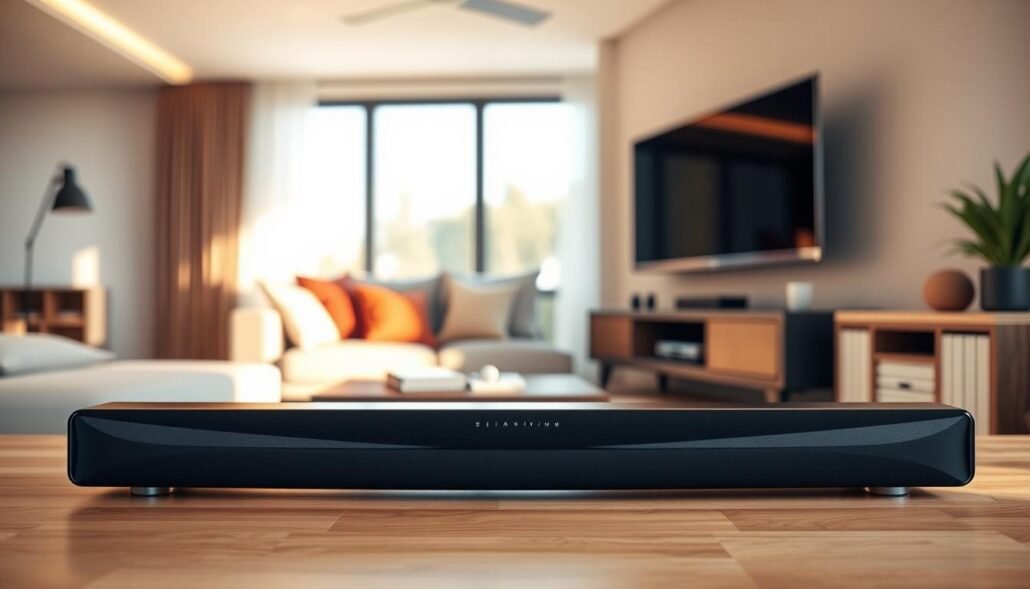
Soundbars: virtual widening versus real rear speakers
Soundbars range from virtual processors that widen the image to packages that include true rear modules. Virtual widening uses psychoacoustic tricks to simulate surround, which works well in small rooms.
Models with discrete rear speakers provide clearer placement and better ambient cues. Atmos-capable soundbars add height effects, but results depend on room shape and ceiling height.
Integrated systems and HTiB kits
All-in-one home theater systems simplify setup. These systems combine amp and speakers into one purchase, which lowers cost and reduces setup time.
HTiB kits often offer good value. Tradeoffs include limited upgrade paths and modest peak quality in larger rooms.
Powered speakers plus active subwoofer
Powered speakers include built-in amplification and sometimes decoding. This route avoids extra boxes and gives flexible placement while maintaining high quality.
Planning inputs and control matters; check supported formats and connectivity before ordering components.
| Option | Included components | Upgrade path | Best for |
|---|---|---|---|
| Soundbars (virtual) | bar ± wireless sub | limited | small rooms, simple setup |
| Soundbars (with rear) | bar + rear speakers + subwoofer | moderate | immersive effects, easy install |
| Integrated / HTiB | amp and speakers kit | low | budget buyers, quick setup |
| Powered speakers + sub | active speakers + active subwoofer | high | audiophile quality, flexible upgrades |
How to Set Up Surround Sound Without a Receiver
Start with a sources inventory to keep connections simple and effective. List every device you use: TV apps, a streaming box, a blu-ray player, and gaming systems. This defines how many inputs the TV must handle and which components require direct HDMI.
Plan connections and cables
Common signal path: route sources into the TV for video. Send audio out to the sound system via HDMI ARC/eARC or optical when ARC isn’t available.
- Prioritize HDMI for main players and reserve one port for ARC/eARC.
- Use optical as a fallback if hdmi compatibility is limited.
- Choose quality cables and keep lengths reasonable to avoid dropouts.
Speaker placement and room layout
Place front left/right at ear level and the center aligned with the screen to keep dialog clear.
Surround speakers belong slightly behind and to the sides. Move the subwoofer while listening until bass feels even across seats.
Dial in performance
Set volume so dialog is distinct, then raise surrounds for immersion without distraction. Tame reflections with rugs, curtains, and soft furnishings to improve clarity in typical US homes.
When You Still Might Really Need a Receiver
Requesting centralized control becomes sensible when many devices and viewing modes compete for attention. Homes with varied sources demand a central unit that keeps video and audio organized.
Multiple inputs and complex systems
Frequent switching among Blu‑ray, consoles, streaming boxes, and media players is the clearest trigger. If the TV’s limited inputs throttle workflows, a receiver restores clean routing and remote simplicity.
Higher channel counts and premium formats
Expanding to more speakers, or chasing object‑based formats, often means an AVR or separate processor plus amps. These components handle decoding, deliver stable signal paths, and allow gradual upgrades.
Cost, reliability, and longevity
Power demands rise with larger rooms and harder‑to‑drive speakers. Heavier units often house beefier power supplies; longer warranties suggest maker confidence.
- Check HDMI version and release date to avoid early obsolescence.
- Budget cables, speaker wire, mounts, and surge protection when totaling cost.
- Plan channel count and power per channel to match room and listening needs.
| Reason | How a receiver helps | When to skip |
|---|---|---|
| Many inputs | Central switching and one‑remote control | Only TV apps and one or two devices |
| More channels | Native decoding and amplification options | Small rooms with powered speakers |
| Futureproofing | Modern HDMI and format support | Budget setups where cost overshadows upgrades |
Bottom line: receiver‑free rigs suit many rooms, but receivers still win when signal routing, format support, and scalable power matter most.
Conclusion
Many living rooms find the right balance between minimal gear and immersive playback without extra boxes. A strong, practical takeaway: compact products can deliver rich sound and clear audio when streaming apps and a single player handle most video duties.
Count sources and devices, confirm the connection path (HDMI eARC preferred, optical as fallback), then pick the simplest system that meets format goals. Good speaker placement and basic tuning often beat chasing specs when optimizing the home theater experience.
Choose this if: soundbars when clutter must stay low, integrated kits when bundles and ease matter, powered speakers when upgrade paths are wanted, and receivers when many inputs, higher channel counts, or growth plans exist.
As standards evolve, prioritize compatibility and simplicity so the home audio experience stays enjoyable day to day.
FAQ
Can a soundbar replace an AV receiver and still provide true surround audio?
Yes. High-end soundbars from brands like Sonos, Samsung, and Sony include built-in decoding for Dolby Atmos and DTS:X, wireless rear modules, and active subwoofers. These systems can deliver convincing room-filling sound without a separate AVR, though full discrete multi-channel setups may still outperform them in larger rooms.
How do Dolby Atmos and DTS:X work without an AVR handling decoding?
Many modern TVs, streaming devices, and soundbars decode object-based formats on board. Devices such as Apple TV 4K, NVIDIA Shield, and select Samsung and LG models pass or decode Atmos streams and send properly mapped signals to connected speakers or bars, eliminating the need for a separate receiver in many setups.
What about powered speakers and active subwoofers — can they create a true surround system?
Absolutely. Powered bookshelf and floorstanding speakers from KEF, Klipsch, or ELAC include internal amplification for each driver. Pairing these with an active subwoofer and a preamp or streaming hub creates a receiver-free system with precise control and strong dynamics, suitable for music and movies.
Will removing the AVR limit the number of devices that can be connected to the TV?
It can, but there are workarounds. Use HDMI switchers, TVs with multiple HDMI 2.1 ports, or network streamers to expand inputs. Some soundbars include several HDMI inputs, and dedicated switchers like those from Monoprice or Atlona resolve input shortages without reverting to a full AVR.
How important is speaker placement when not using a receiver?
Very important. Proper placement of front left/right, center, surrounds, and the subwoofer ensures channel separation and clear imaging. Follow room guidelines for distance and height, and use built-in room calibration tools available in many soundbars and active speaker systems to optimize performance.
Can gaming consoles and Blu-ray players work well without an AVR in the loop?
Yes. Consoles like PlayStation 5 and Xbox Series X can output multichannel PCM or passthrough Dolby/DTS via HDMI to compatible TVs and sound systems. For best latency and full feature support, connect consoles directly to the primary HDMI input on the TV or soundbar that supports eARC/ARC.
When does an AVR remain the better choice?
Choose an AVR when planning complex systems with many inputs, high channel counts (7.1.4 or higher), legacy analog sources, or when requiring high power per channel for large speakers. AVRs from Denon, Yamaha, and Marantz provide flexible I/O, advanced room correction, and expandability that simpler solutions can’t match.
Are there compatibility or setup issues with receiver-free configurations?
Some challenges exist: ARC/eARC support variations, firmware quirks, and limited passthrough for advanced formats on certain TVs. Confirm eARC capability, keep firmware updated, and check manufacturer notes for format support to avoid missing Dolby Atmos or lossless audio on specific source combinations.
Does removing the AVR save money without sacrificing audio quality?
Often yes for small to medium rooms. Budget-conscious buyers can get strong performance from soundbars or powered speaker systems at lower total cost than a comparable AVR plus passive speakers. However, audiophiles seeking peak fidelity in large rooms may find AVR-based systems still offer better value long term.
How do wireless surrounds compare with wired speakers in receiver-free systems?
Wireless surrounds offer installation flexibility and cleaner aesthetics. Quality varies by brand; Sonos and Samsung use dedicated wireless protocols for low latency. Wired speakers still deliver slightly better reliability and consistent latency, especially in RF-noisy environments, but wireless tech has improved significantly.
What role does room acoustics play when skipping an AVR?
Room acoustics matter as much as gear. Treating reflections, using rugs, curtains, and diffusers improves clarity and bass response. Many receiver-free systems include basic calibration tools; combining those with physical room treatments yields the clearest dialog and balanced frequency response.
Can streaming services provide lossless and object-based audio without an AVR?
Yes. Services like Apple Music, Tidal, and some apps on Apple TV and select smart TVs offer high-resolution and spatial audio. The playback chain must support lossless or Atmos: ensure the streaming device or soundbar supports the required codecs and bandwidth for full-quality delivery.
How does power handling differ between active speaker systems and traditional AVR-driven passive speakers?
Active speakers have internal amplifiers matched to drivers, preventing mismatches and simplifying setup. Passive speakers need an external amplifier or AVR sized for watts per channel. For large listening volumes and demanding speakers, AVRs still provide scalable power and protection features that matter in bigger rooms.
What should buyers prioritize when choosing a receiver-free setup?
Prioritize format support (Dolby Atmos, DTS:X), eARC compatibility, number of HDMI inputs, and room size. Evaluate whether wireless surrounds or powered speakers meet placement needs. Brands such as Sonos, Samsung, Sony, KEF, and Yamaha offer competitive receiver-free options with clear spec sheets to compare.