Short answer: Yes. If your receiver has preamp outputs, use RCA line-level cables from the pre-outs (often front L/R) into the amp and you are set.
If there are no pre-outs, workarounds exist. You can use a speaker-level converter (line output converter), feed a DAC from digital outputs, or extract audio via HDMI with an HDMI audio extractor. These methods provide a safe line-level output instead of wiring speaker terminals into RCA jacks.
In this guide, “external amplifier” means a separate power amp while the receiver still handles source switching, decoding, volume, and bass management. Adding an amp often gives cleaner sound at high volume and reduces strain on the receiver when driving demanding speakers.
What follows: a quick should-you score, step-by-step hookups for pre-out and no-pre-out setups, and a list of decision factors like listening level, room size, speaker sensitivity, and bass needs. This aims to help you pick the right path and avoid wasted gear purchases.
Why add an external amplifier to a receiver in a home theater setup?
Adding a dedicated power amp can change how a home theater sounds at real-world listening levels.
Power supply strain: Many AV receivers share one power supply across five or more channels. Offloading front channels frees that supply and reduces current limiting. This often yields cleaner sound during demanding scenes.
More usable power: Tough speakers with low impedance dips or low sensitivity demand more current. A beefier power amplifier delivers higher usable power into difficult loads, helping maintain volume without distortion.
Bass and headroom: Low frequencies eat power. When a system has extra headroom, bass stays tight and controlled at high volume. Many listeners notice improved bass first.
Preserving dynamic range: Compression sounds like flattened peaks and loss of slam. A separate amp keeps transients intact so explosions and drum hits retain impact.
- Simple math: dB gain = 10*log(Pext / Precv). Moving from ~100W to 500W yields about +7dB.
- Even if surrounds remain on the receiver, powering the front stage externally improves clarity and separation.
| Scenario | Receiver Behavior | Benefit of Power Amp |
|---|---|---|
| Small room, low volume | Receiver adequate | Minor improvement in clarity |
| Large room, high volume | May current-limit under load | More headroom and control |
| Low-impedance speakers | Receiver loses power into 4 ohms | Stable output and cleaner bass |
Can I connect an external amplifier to my receiver?
Before spending money, check whether your listening habits and gear actually need more power.
Check your listening habits and typical volume level
Estimate your normal listening level. Conversation-level listening (60–70 dB) rarely needs extra power. Loud movie nights (75–85 dB) add strain and may push the receiver toward current limiting. If you regularly run “volume 11” you gain points toward an upgrade.
Room size and headroom
Large rooms require more acoustic output to fill them. Sitting farther away raises the required SPL, so a bigger room means more headroom and often more power.
Speaker load basics: impedance and sensitivity
Impedance (measured in ohms) tells how hard a speaker asks for current. Speakers that dip near 4 ohm at low frequencies demand more current than steady 8 ohm models. Sensitivity (dB @ 1W/1m) also shifts required wattage significantly.
Bass management vs full-range mains
Using a powered subwoofer and setting a crossover reduces the bass burden on mains. Running full-range speakers forces the amp or receiver to deliver heavy low-frequency energy, which is the usual stress test.
A simple scoring approach
Use this quick checklist and add points. Total >4 suggests you should consider adding a power amp.
| Factor | Low | Medium | High |
|---|---|---|---|
| Listening | 0 | 1 | 2 |
| Room (ft³) | <1500 (0) | 1500–3000 (1) | >3000 (2) |
| Speaker load | 8Ω >90dB (0) | 8Ω <90dB (1) | 4Ω <90dB (2) |
| Bass management | Subwoofer (0) | Full-range (1) | — |
Practical cues: If dynamics flatten when you turn it up, bass becomes loose, or the receiver runs hot, you likely need more power. If your total score is 0–4 the receiver will usually stay clean at your levels. If above 4, an amp will improve control and sound quality.
Decide first; the next step is checking for pre-outs or alternate hookup options.
How to connect an external amp to a receiver with pre-outs
If your AVR includes line-level pre-outs, wiring a separate power amp is quick and foolproof.
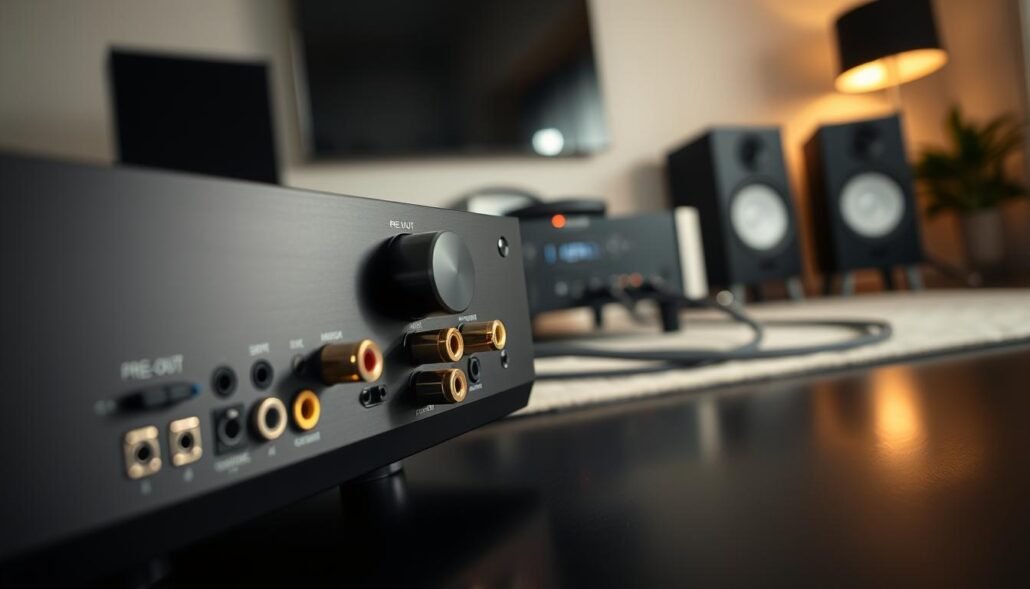
Compatibility check: Confirm the receiver has front L/R pre-outs (often labeled “Front,” “Main,” or “Pre Out”). Verify the external unit accepts RCA inputs. Use good-quality RCA cables for a clean audio output.
Step-by-step hookup
- Turn off all gear. Run RCA cables from the receiver’s front left and front right pre-outs into the power amp left/right inputs.
- Move the front speaker wires from the receiver speaker posts to the power amp binding posts.
- Power on and keep the receiver as the preamp/processor: it still handles volume, decoding, bass management, and room correction.
Level setup and verification
Run your receiver’s speaker calibration (auto-setup or manual SPL meter). Check that channel levels are balanced and the front stage blends with center and surrounds.
Gain tips: If the power amp has input level knobs, follow the manufacturer guidance—many set them near maximum and use the receiver for master volume.
| Quick checks | Expected result |
|---|---|
| Hum or noise | None |
| Left/right swap | Correct channel mapping |
| Receiver still driving fronts? | No — amp should drive them |
Real-world note: A Marantz SR6013 feeding a Parasound A21 is a classic pairing; users report firmer bass and clearer dynamics without stressing the receiver. Small systems may see subtler gains, but larger rooms and demanding speakers often benefit most.
How to connect an external amplifier to a receiver with no pre-outs
No pre-outs doesn’t leave you stuck. You can step down speaker signals with a line-output converter, use the receiver’s digital outputs with a DAC, or extract analog from HDMI. Pick the path that matches your outputs and budget.
Speaker terminals + line-output converter
Attach a LOC to the receiver speaker terminals (in parallel or on spare posts). The LOC scales speaker voltages (a 50W/8Ω amp can produce ~20V) down to typical RCA line-level (~0.5–2V).
Safety note: Use a quality unit with adjustable output. Cheap adapters can introduce noise or limit performance.
Impedance and load
Most LOCs present a high input impedance (40–80Ω or more). That changes the speaker load only slightly—4Ω becomes about 3.75Ω with a 60Ω adapter, and 8Ω becomes roughly 7Ω. Rare low-impedance adapters can stress the receiver.
Digital outputs and HDMI extractors
Use optical or coaxial into a DAC for clean RCA outputs; optical avoids ground-loop hum but must be handled gently. An HDMI audio extractor is another option: route the receiver HDMI out into the extractor, then feed analog outs to the amp. Confirm format support before buying.
Expectations and channel options
Speaker-to-line conversion works well for stereo but usually won’t match direct pre-outs or a native DAC. For multichannel external amps you need a LOC per channel or a decoder that supplies multiple analog outputs.
Advanced and unused channels
Pro setups run the AVR’s preamp through an HT-bypass stereo preamp and use the same power amp for music and movies—this is doable but fiddly (examples include Marantz SR6013 with Parasound). Any unused receiver channels can often be reassigned to Zone 2, height channels, or disabled via speaker A/B settings.
Conclusion
This conclusion focuses on the practical steps and the best signal paths for boosting power and control.
Use the score: 0–4 means the receiver amp section will usually suffice. Above 4 suggests adding a power amplifier will help with headroom, bass, and clarity.
Connection recap: if you have pre-outs, simply connect RCA from front left/right pre-outs into the amp. With no pre-outs, prefer a DAC on digital outputs or an HDMI audio extractor; a line-output converter works if speaker-level is all you have.
Do this next: identify your outputs, pick the cleanest path (pre-outs first), gather correct cables, and confirm channel mapping before playing loud material. Never feed speaker outputs into RCA jacks without a proper converter.
Start by offloading the front channels in your home theater, verify stability and sound quality, then expand only if room, load, or volume needs demand more power.
FAQ
What are the main benefits of adding a power amp in a home theater?
Adding a dedicated power amplifier can improve sound quality by taking the heavy lifting of driving speakers away from the receiver’s internal power supply. That reduces strain and distortion at higher volumes. A separate amp also delivers more usable power for demanding speakers, which tightens bass and preserves dynamic range during loud movie scenes and music peaks.
How does using a power amp help with demanding speakers and bass?
A stronger amp provides headroom so the system doesn’t compress during transients. That yields cleaner bass and better control, especially with low-sensitivity or low-impedance speakers. It also keeps midrange and highs clearer because the receiver isn’t operating near its limits when pushing bass-heavy passages.
How should I assess whether adding a power amp fits my listening habits?
Check your typical listening levels, room size, and speaker sensitivity. If you listen loud, have a large room, or use speakers rated under 88–90 dB, extra amplification often helps. Use a simple scoring approach: give points for large room, high volume, low-sensitivity speakers, and demanding musical content; a higher total suggests a power amp is worthwhile.
What speaker specs matter when deciding on extra amplification?
Focus on impedance (ohms), sensitivity (dB), and power handling. Low impedance or low sensitivity increases power demand. If your speakers dip into 4 ohms or below, or have sensitivity under roughly 88 dB, they’ll benefit from an amp with robust power and stable impedance handling.
How does bass management and adding a subwoofer affect power needs?
Using a subwoofer and setting proper crossover points reduces the low-frequency load on main speakers. That lowers the amplifier power the mains require and can improve overall clarity. If you run mains full-range without a sub, you’ll need more amplifier headroom to avoid strain at deep bass frequencies.
My receiver has front left/right pre-outs. How do I hook up a power amplifier?
Use RCA cables from the receiver’s front left/right pre-outs to the amp’s line-level inputs. Set the receiver to use its preamp section (check menu settings) and leave the receiver’s internal amplifier off or bypassed if the unit supports it. Adjust levels carefully to match gain between devices.
What level and gain steps ensure safe operation when using pre-outs?
Start with receiver volume low and the power amp’s input gain at a mid-level. Play program material and increase the receiver until you reach normal listening volume, then fine-tune the amp’s gain to balance loudness and headroom. Avoid maxing gains to prevent clipping and distortion.
My receiver lacks pre-outs. What options do I have to add a power amp?
You can use a speaker-level to line-level converter (hi‑lo adapter) wired to the speaker terminals, which creates an RCA-level feed to the amp. Alternatively, use a DAC with digital optical or coax outputs converted to analog, or an HDMI audio extractor to pull analog left/right outputs from an HDMI stream.
Is using a speaker‑level converter safe for my speakers and amp?
A quality line output converter presents a low-voltage feed to the power amp while leaving the speaker load on the receiver unchanged. It won’t significantly alter impedance seen by the receiver, but ensure the converter is rated for your receiver’s output and that you never short speaker terminals during installation.
How does sound quality compare when converting speaker-level to line-level?
Properly designed converters and DACs can yield excellent results, but each conversion stage may slightly change tonal balance. Optical/coaxial to analog via a good DAC typically preserves clarity better than cheap converters. For best fidelity, use pre-outs when available; otherwise choose high-quality adapters.
Can I use HDMI or digital outputs to feed a stereo power amp?
Yes. An HDMI audio extractor can provide analog left/right outputs from an HDMI source or receiver. A digital optical/coax output routed to a DAC also provides line-level RCA outputs. These options let the receiver still handle decoding while sending analog signals to the amp.
What limitations exist for surround setups without pre-outs?
Without pre-outs you may be limited to stereo power expansion or require one of the conversion methods above for front channels. Full multi-channel biamping or replacing several channels with a multi-channel power amp is harder without pre-outs. Digital or HDMI extraction typically supports only stereo unless the receiver passes multi-channel analog before the amp stage.
Can I integrate a separate stereo preamp while keeping the receiver’s processing?
Yes. Use the receiver as the main processor and route its preamp outputs into the stereo preamp in a bypass configuration, or use the receiver’s processing out to the stereo preamp’s inputs if it supports HT bypass. That lets you use dedicated analog controls while retaining home theater decoding and bass management.
What should I do with unused receiver amplifier channels after adding a power amp?
You can leave them unused, bi-amp speakers if supported, or repurpose them for other zones if the receiver allows. Ensure the receiver’s speaker outputs are correctly configured in setup menus to prevent accidental drive or improper load. Some users disable unused channels in the receiver’s settings to avoid confusion.