This guide aims to help you find the right unit that balances cutting-edge hdmi capabilities, low latency, and immersive dolby atmos sound. The goal is a clear buying path that fits your room and budget.
A modern receiver acts as a video switch and decodes audio from each source. It connects consoles and streaming boxes to your TV via hdmi and sends amplified sound to speakers.
We test how receivers handle next-gen video, multi-channel output, and real-world performance in movies and game titles. Criteria include connectivity, calibration tools, and meaningful features that affect play and movie experience.
The lineup covers simple 5.2 models up to flagship multi-channel systems. Expect notes on firmware maturity, reliability, and measured quality so you can map power and amplification to your speaker setup without overpaying.
Why gamers need an AV receiver in 2025
Today’s AV hubs must pass high-bandwidth video and keep latency near zero to match modern consoles and fast PCs. That makes HDMI 2.1 central in 2025: it enables 4K at high frame rate and keeps controller inputs feeling instant.
Latency and frame timing matter. Variable refresh rate syncs the source and display, cutting tearing and stutter that can cost a match. Consoles like Xbox Series X and PS5 push 4K/120 and VRR, while PC rigs demand even higher bandwidth and firmware stability.
Good receivers preserve signal integrity with clean passthrough for 4K/120, HDR, and VRR so the TV never becomes a bottleneck. They also deliver object-based audio that raises spatial cues, helping players locate threats in the room.
Matching platforms and core features
- Check for ALLM, VRR, and HDMI 2.1 support on the unit and your TV.
- Consider channels and room size: more channels widen the field, but placement and seating distance guide choices.
- Look for auto calibration—Sony STR-AN1000 and Onkyo TX-NR6100 include 4K/120 signaling, while Denon AVR-A1H adds VRR and ALLM.
| Model | HDMI 2.1 / 4K120 | VRR / ALLM | Calibration |
|---|---|---|---|
| Sony STR-AN1000 | Yes (4K/120) | Yes | Advanced auto |
| Onkyo TX-NR6100 | 4K/120 compatible | Yes | Standard room EQ |
| Denon AVR-A1H | Next‑gen HDMI | VRR & ALLM | Pro-level tools |
Receivers also act as central hubs, simplifying inputs and protecting your investment as console firmware and titles evolve. To compare options, compare top AV options.
Best receiver for gaming? Search intent and what this guide covers
This guide helps you compare models quickly and shortlist units that balance low-latency play with music and movie enjoyment at home.
What we cover: core features that drive real-world performance—HDMI 2.1 throughput, VRR/ALLM support, channel counts, and calibration—across price tiers. The roundup tests Denon AVR-X2800H, Yamaha RX-V4A, Sony STR-AN1000, NAD T 778, and Denon AVR-A1H for sound, features, and reliability.
- Commercial intent: compare products and make a fast, confident choice.
- Selection criteria: measured performance, long-term support, and ease of setup—not just spec sheets.
- Segmentation: budget 5.2, upper midrange 7.2/9.2, and flagship multi-channel systems.
| Tier | Sample model | Highlight |
|---|---|---|
| Budget | Yamaha RX-V4A | Clean 4K/120 passthrough |
| Mid | Denon AVR-X2800H | Audyssey tuning, versatile channels |
| Flagship | Denon AVR-A1H | High channel count, pro features |
We validate each model by noting strengths, weaknesses, and likely trade-offs so you get actionable takeaways and a clear path to the right system.
How to choose a gaming-ready receiver: HDMI 2.1, VRR, and more
Start by matching throughput and real-world features to your setup. Confirm hdmi 2.1 bandwidth for native 4K/120 and 8K passthrough. Certified 48 Gbps ports reduce handshake issues with consoles and high-end TVs.
VRR, ALLM, and QFT coordinate frame delivery, auto-enable low-latency modes, and trim pipeline delay. That keeps input lag low and motion smooth during fast play.
Don’t trust printed watts alone. Compare per‑channel power, current delivery, and speaker sensitivity to estimate true performance. Stability into 4/6/8 ohms matters for long-term amplification reliability.
Channels, speakers, and room scaling
Start with a 5.1 or 7.1 base and add height channels for Dolby Atmos or DTS:X as the room and budget allow. Multiple subwoofer outputs help smooth bass in complex rooms.
Inputs, outputs, ports and compatibility
Map consoles, PC, streamer, and turntable to available inputs and outputs. Look for eARC support to send TV app audio back to the receiver. Verify HDR and hdmi feature compatibility across the chain to avoid downscaling.
- Check firmware maturity—brands that update regularly unlock new options.
- Final checklist: hdmi 2.1 ports, VRR/ALLM/QFT support, adequate channels and outputs, and solid calibration tools for your room.
Top picks at a glance: the best receivers for gamers right now
Below are concise picks that map price tiers to real-world HDMI, channel, and calibration strengths. Use this snapshot to match room size, speaker plan, and budget without digging through long specs.
Budget hero: Yamaha RX‑V4A (5.2, strong streaming, 4K/120)
Yamaha RX‑V4A is a compact 5.2 unit with 80W per two channels and 4K/120 hdmi pass-through. It shines with AirPlay 2, MusicCast, and Spotify streaming. This is the go-to budget pick when Dolby Atmos DTS:X is not required.
Under $1,000: Sony STR‑AN1000 (HDMI 2.1, VRR/ALLM)
Sony STR‑AN1000 offers HDMI 2.1, VRR, and Dolby Vision support across multiple inputs. It’s quick to set up and performs well in living-room systems where low latency matters.
Best value: Denon AVR‑X2800H (7.2, Audyssey, 8K/4K120)
Denon AVR‑X2800H brings 7.2 channels, Audyssey MultEQ XT, and support for Atmos/DTS:X. Expect balanced sound and robust format support at a fair price.
Step‑up with Dirac: Onkyo TX‑RZ50
Onkyo TX‑RZ50 adds Dirac Live, extra 8K inputs, and 120W output for larger speakers. Use this when precision tuning and higher performance are priorities.
Flagship power: Denon AVR‑A1H (15.4 channels)
Denon AVR‑A1H suits ambitious home systems with 15.4 channels, multiple subs, and pro features. Choose this if you plan a 9.1.6 Atmos layout and long-term expansion.
Tip: Compare firmware support and update history when making a final choice. That often decides long-term value between similar products.
| Model | Key trait | Why choose |
|---|---|---|
| Yamaha RX‑V4A | Streaming, 4K/120 | Low price, simple setup |
| Sony STR‑AN1000 | HDMI 2.1 | VRR/ALLM stability |
| Denon AVR‑X2800H | 7.2, Audyssey | Formats & room tuning |
Sony STR‑AN1000 for gamers: 4K/120Hz, VRR, and calibration wins
The STR‑AN1000 pairs next‑gen HDMI throughput with automated setup tools aimed at fast, accurate results. It’s a 7.2‑channel Dolby Atmos unit built to keep play responsive while delivering cinematic sound in a typical living room.
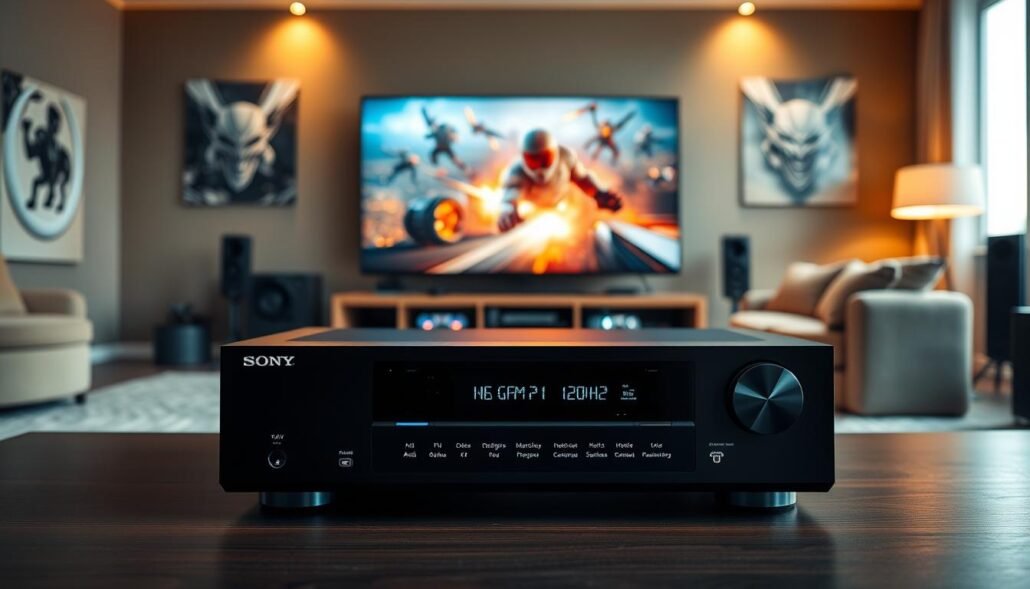
Digital Cinema Auto Calibration IX and spatial mapping
Digital Cinema Auto Calibration IX uses a stereo mic and stand to take multi‑position measurements. The system applies granular corrections to balance sound across seats.
360 Spatial Sound Mapping fills gaps when you have fewer speakers. It creates believable height and width cues, improving immersion without a full speaker farm.
Connectivity check: inputs, outputs, and formats
The unit includes six hdmi inputs, two with 8K capability, plus two 8K outputs for flexible routing. That setup simplifies multi‑device systems and keeps eARC-compatible TVs in the chain.
Supported HDR formats—Dolby Vision, HDR10, and HLG—ensure broad compatibility with consoles and streaming apps. Note the lack of a phono input; vinyl fans should add an external preamp.
- Why it works for play: hdmi 2.1 4K/120 plus VRR/ALLM preserve smooth motion and low input lag.
- Daily performance: stable handshakes, quick setup, and consistent calibration yield reliable home performance.
- Speaker advice: Match channels and placement to room size to maximize spatial cues in small to mid rooms.
| Feature | Detail | Impact |
|---|---|---|
| Channels | 7.2 Dolby Atmos | Good for 5.1.2 and 7.1 setups |
| HDMI inputs / outputs | 6 inputs (2 with 8K), 2 outputs (8K) | Flexible routing, multi‑source management |
| Calibration & spatial | Digital Cinema Auto Calibration IX; 360 Spatial Sound Mapping | Even coverage across seating; virtualized height |
Quick verdict: Under $1,000, this Sony model stands out for modern hdmi features and automated calibration that improve both video and sound experience at home.
Onkyo TX‑NR6100: affordable Dolby Atmos/DTS:X performance
Onkyo’s TX‑NR6100 delivers 7 x 100 watts per channel and convincing Dolby Atmos DTS:X staging at a friendly price. It’s built to fill mid‑size rooms with strong height effects and clear dialogue.
7 x 100 watts per channel with robust streaming options
The unit has six HDMI inputs, three with 8K/hdmi 2.1 passthrough while the others handle HDR10 and Dolby Vision. That makes connectivity simple for two consoles, a PC, and a streamer.
Built‑in phono, Google Cast, DTS Play‑Fi, Spotify Connect, Sonos, AirPlay, and Bluetooth expand music options across a typical home system.
- Sound: expansive Atmos imaging and clear midrange.
- Support: verified compatibility with Xbox Series X 4K/120 signals.
- Setup: quick auto tools tune speakers to real rooms.
| Spec | Detail | Impact |
|---|---|---|
| Power | 7 x 100 watts per channel | Good headroom for most living rooms |
| HDMI / Ports | 6 HDMI inputs (3 × 8K‑ready) | Flexible multi‑source connectivity |
| Streaming & Inputs | Cast, Play‑Fi, AirPlay, phono | Broad music and legacy support |
Trade‑offs: fewer 8K ports than higher models, but the price and performance make it a practical choice where 7 channels are the system ceiling.
Onkyo TX‑RZ50: Dirac Live, more 8K inputs, and higher power
Onkyo’s TX‑RZ50 is a clear step up when you need extra hdmi 2.1 capacity and stronger amplification in a home system. It adds six 8K‑compatible inputs, giving more room for multiple consoles, PC, and streamers without an external switch.
Dirac Live calibration is the headline feature. Properly run, it tightens bass, aligns timing across speakers, and improves imaging for both music and Dolby Atmos playback.
Gaming and music synergy: where Dirac makes the difference
The unit delivers 120 W per channel, stable hdmi handshakes, quick input switching, and strong outputs that suit larger rooms and demanding speakers.
- Connectivity: six 8K inputs vs three on the NR6100—more inputs means fewer compromises.
- Features: two‑way Bluetooth plus Google Assistant and Amazon Alexa integration for daily convenience.
- Sound: dynamic, detailed presentation that scales with better speakers and room treatment.
Setup needs care: use the Onkyo Controller app and the included mic to get the best Dirac results. Enthusiasts who invest this time are rewarded with top-tier calibration and consistent atmos dts:x performance.
| Aspect | TX‑RZ50 | NR6100 |
|---|---|---|
| 8K‑compatible HDMI inputs | 6 | 3 |
| Power (typ.) | 120 W | 100 W |
| Voice / Bluetooth | Assistant, two‑way BT | Standard BT |
Yamaha RX‑A4A: cinematic sound and better phono for hybrid setups
The RX‑A4A leans into cinematic delivery with a robust chassis and a neat internal layout. It supplies reliable power—about 110 W per channel in stereo—so sustained dynamic scenes stay controlled.
The unit includes seven hdmi ports to simplify multi‑device wiring. That connectivity makes it easy to mix consoles, a streamer, and a TV without extra switches in your home system.
Notable perk: the onboard phono stage outperforms many rivals, giving vinyl owners cleaner gain and less noise. If music and vinyl are part of your routine, this is a meaningful quality advantage.
The sound signature is big and roomy. It flatters blockbuster soundtracks and serialized drama by adding weight and strong dynamics without sounding congested. Channel flexibility covers common 5.1 and 7.1 layouts with clear paths to expand as your room and speakers grow.
Streaming features are competent but not the headline act—Onkyo and some others stream more broadly. Still, the RX‑A4A’s day-to-day performance and simple menus make setup fast and speaker management intuitive.
- Use case: medium‑size rooms where movie nights dominate and occasional vinyl listening matters.
- Connectivity convenience: seven hdmi inputs and clean system routing simplify daily use.
- Value: a balanced receiver that favors theater‑grade impact while supporting mixed music setups.
Denon AVR‑X2800H: best value with Audyssey MultEQ XT
This Denon model blends flexible HDMI support, strong power delivery, and proven room correction into a compelling value package.
The AVR‑X2800H offers 7.2 channels and about 95 W per two channels at 8 ohms, a practical match for most living rooms pursuing a 5.1.2 or 7.1 layout.
Audyssey MultEQ XT calibration smooths room peaks and improves imaging across seats. That tuning makes dialogue clearer and height effects more believable in Atmos and DTS:X mixes.
Inputs and format support are broad: 8K/60, 4K/120 passthrough, hdmi 2.1 features including variable refresh rate, plus phono MM and streaming via HEOS, AirPlay 2, and Roon readiness.
Day‑to‑day sound is articulate: stable bass, crisp midrange, and convincing effects once the room is set. Power and channels give reliable headroom without moving into premium price tiers.
- Why it stands out: strong price-to-performance ratio and easy ecosystem support.
- Who should consider it: users wanting one unit that handles movie, music, and next‑gen video without fuss.
| Feature | Detail | Impact |
|---|---|---|
| Channels / Power | 7.2, 95 W (2ch, 8Ω) | Good for 5.1.2 setups |
| Calibration | Audyssey MultEQ XT | Better tonal balance across seats |
| Connectivity | 8K/60, 4K/120, hdmi 2.1, eARC | Next‑gen console and TV support |
Yamaha RX‑V4A: best budget 5.2 for clean sound and easy streaming
The RX‑V4A is a compact, affordable option that focuses on clear stereo and solid 5.2 playback for smaller rooms. It offers about 80 W per two channels at 8 ohms and handles 8K/60 and 4K/120 signals with reliable HDMI 2.1 passthrough.
Streaming is a highlight: AirPlay 2, MusicCast, and Spotify make daily music playback frictionless. The menus and app controls are simple to navigate, so setup is fast for first‑time buyers.
Ports and inputs are sufficient for one or two consoles plus a streamer. While it lacks Dolby Atmos and DTS:X, the unit still delivers engaging stereo imaging and stable rate‑related benefits for current consoles.
- Use case: apartments, bedrooms, or compact living rooms where space and price matter.
- Value: under $500, good price-to-feature balance without advanced formats.
- Tip: pair with efficient speakers to get the most headroom from the amplification.
| Spec | Detail | Why it matters |
|---|---|---|
| Channels | 5.2 | Simple multi‑speaker setups for small rooms |
| Power | 80 W (2ch, 8Ω) | Enough for efficient speakers and clear playback |
| Connectivity | AirPlay 2, MusicCast, Spotify + HDMI 2.1 | Easy music and video handling in a compact home system |
Bottom line: the RX‑V4A is an entry path into multi‑room streaming and modern HDMI features. It’s a practical choice if you prioritize clean sound, simple connectivity, and a low price, with room to upgrade speakers or move up later.
NAD T 778: audiophile-grade power with Dirac Live
The T 778 pairs thoughtful amplification with advanced calibration to lift both music and movie playback. This 9.2 channel unit supplies about 140 W @ 8 ohms (2ch) and targets listeners who value true audio quality and headroom.
Dirac Live full‑band calibration tightens bass and refines imaging. That correction makes Atmos and music mixes translate more accurately in real rooms.
The T 778 supports Dolby Atmos DTS:X and flexible channel layouts like 5.1.4 or 7.1.2 via its outputs and inputs. It handles modern sources with 8K/60 and 4K/120 HDMI passthrough.
- Amplification & power: robust watts per channel to drive demanding speakers.
- Sound: spacious, detailed, and dynamic once calibrated.
- Daily use: touchscreen interface, phono MM, and streaming (AirPlay 2, Roon, Tidal, Spotify) for smooth integration into a home system.
| Feature | Detail | Impact | Best use |
|---|---|---|---|
| Channels | 9.2 | Supports complex Atmos builds | Medium to large rooms |
| Power | 140 W (2ch, 8Ω) | Drives demanding speakers with headroom | High-dynamic content |
| Calibration | Dirac Live full‑band | Tighter bass, clearer imaging | Critical listening & movie mixes |
| Connectivity | 8K/60, 4K/120 HDMI, phono, streaming | Modern source compatibility | Multi‑device home systems |
Performance note: the T 778 rewards careful setup and speaker placement. While pricier than mainstream options, its calibration precision and amplification step up overall system quality and long‑term value.
Denon AVR‑A1H: ultimate 15.4-channel beast for 9.1.6 Atmos
Designed for dedicated theaters, the AVR‑A1H gives you the channel count and power to run sprawling Atmos layouts.
Channels and power: This unit supplies 15.4 channels and about 150 W @ 8 ohms (2ch). That amplification headroom keeps large speaker arrays under control and preserves dynamics at reference levels.
Gaming and video features: Native hdmi 2.1 support includes variable refresh rate, ALLM, and QFT. These features keep responsiveness and smooth frame delivery when you connect next‑gen consoles or a high‑end PC.
Bass, outputs, and integration
- Multiple sub outputs: Four subwoofer outputs let you tune bass across seats and reduce room nodes for a tighter low end.
- Inputs and outputs: Ample hdmi and analog routing simplify multi‑display setups, projectors, and TV pass‑through.
- System features: HEOS multiroom, Alexa and Google integration, and broad inputs support complex home installations.
Calibration pathways: Audyssey ships standard; optional Dirac Live unlocks deeper room correction for critical listening rooms. Both paths keep audio consistent across seats.
| Attribute | Detail | Impact |
|---|---|---|
| Channels | 15.4 (supports 9.1.6 Dolby Atmos) | Full-height immersion in large rooms |
| Power | 150 W @ 8Ω (2ch) | Ample headroom for many speakers without strain |
| Subwoofer outputs | 4 | Smoother bass response across seating |
Who needs it: Enthusiasts building purpose‑designed theaters or multi‑zone systems where audio authority, channel flexibility, and advanced features matter. It consolidates many components into one platform with unmatched flexibility, though at a premium price.
Dolby Atmos and DTS:X for gaming: channels, height speakers, and room setup
Adding height speakers brings audio objects above the listener, which tightens spatial cues in fast-paced play. Dolby Atmos and atmos dts:x break sound into objects, so footsteps, drones, and gunfire can be placed precisely around and over you. That 3D audio improves positional awareness and immersion.
Choosing channel counts:
7.2 vs 9.1.4 vs 9.1.6: choosing the right channel count
Use 7.2 in compact rooms where front/rear width and two heights give clear overhead cues without crowding space. Move to 9.1.4 for stronger envelopment in larger living rooms. Pick 9.1.6 or AVR‑A1H-style layouts for reference-grade home theaters where full height density matters.
Placement and routing: Front-height speakers or in-ceiling drivers both work. Prioritize front heights if you must choose. Receivers route audio objects to the nearest matching channel; correct placement ensures panning and elevation stay accurate.
- Calibration (Audyssey, Dirac) aligns crossover, distance, and level so objects pan smoothly.
- Match timbre across the bed layer (fronts and surrounds) to avoid audible shifts during pans.
- Treat first reflections and set subwoofer crossover/integration to tighten low end.
| Layout | Best room size | Why choose |
|---|---|---|
| 7.2 | Small to medium rooms | Compact height cues, fewer speakers to place |
| 9.1.4 | Medium to large rooms | Stronger envelopment, fuller height layer |
| 9.1.6 | Large/home theater | Reference immersion, precise object placement |
Start with a 5.1.2 setup and expand to 7.1.4 as budget and space allow. Verify content availability in these formats and use test tones to confirm levels and object routing via HDMI during setup.
HDMI inputs and outputs: switching video sources without compromise
Smart I/O planning means your 4K/120 console and PC keep full bandwidth even as you add devices.
Allocate hdmi inputs by priority: give consoles and a high‑frame‑rate PC the ports that support 4K/120 or 8K passthrough. Sony STR‑AN1000 has six HDMI inputs (two 8K) and two 8K outputs. Onkyo TX‑NR6100 offers six inputs with three 8K‑capable ports. The TX‑RZ50 expands that count to six 8K‑ready inputs, while Denon AVR‑A1H adds broad I/O and multiple subwoofer outputs.
Extra ports reduce re‑cabling and allow future growth. Dual outputs let you feed a TV and projector or switch displays without moving cables. That preserves compatibility and eases daily switching.
Handshakes and EDID matter. Receivers negotiate formats to keep 4K/120 and HDR intact; a proper EDID table prevents unexpected fallbacks or dim tone mapping. Use high‑quality HDMI cables for long runs and wall routing to avoid signal loss.
- Daily use: label inputs, set source profiles, and enable quick presets to speed switching.
- Audio/video planning: map eARC when TV apps are primary so lossless audio returns to the unit.
- System balance: plan speaker and subwoofer I/O alongside video ports to avoid bottlenecks later.
| Model | HDMI inputs | 8K‑ready inputs | Notable I/O |
|---|---|---|---|
| Sony STR‑AN1000 | 6 | 2 | 2 8K outputs, flexible routing |
| Onkyo TX‑NR6100 | 6 | 3 | HDR10/Dolby Vision support on remaining ports |
| Onkyo TX‑RZ50 | 6 | 6 | More 8K inputs for multi‑device setups |
| Denon AVR‑A1H | Extensive | Multiple | Four sub outputs and broad analog/digital I/O |
Summary: plan ports around high‑frame‑rate sources, use quality cables, map eARC, and reserve outputs for displays. Thoughtful connectivity prevents visual and audio compromises as your home system grows.
Room calibration and tuning: Audyssey, Dirac Live, and manufacturer tools
Automatic measurement tools catch many problems fast, but deeper correction can reveal hidden detail.

When to use auto vs manual calibration
Use Audyssey MultEQ XT on the Denon AVR‑X2800H when you want a fast, effective setup that improves sound across seats with minimal effort.
Choose Dirac Live on the Onkyo TX‑RZ50 or NAD T 778 when you need tighter bass, improved imaging, and premium performance that rewards careful tuning.
Sony’s Digital Cinema Auto Calibration IX is useful when multi‑position alignment matters and you want consistent results for several listeners.
- Practical tips: place the mic on a tripod, run measurements in a quiet home, and take multiple points to capture room behavior.
- Advanced options: use target curves, time alignment, and subwoofer integration to tighten low end and dialogue clarity.
- Workflow: run auto, listen, tweak crossovers/distances, save profiles for movie and game setups, and re‑run after hardware or furniture changes.
| System | Tool | Strength |
|---|---|---|
| Denon AVR‑X2800H | Audyssey MultEQ XT | Fast, reliable multi‑seat balance |
| Onkyo TX‑RZ50 | Dirac Live | Deep correction, tighter bass |
| NAD T 778 | Dirac Live | Audiophile precision and imaging |
| Sony STR‑AN1000 | Digital Cinema Auto Calibration IX | Precise multi‑position alignment |
Remember: calibration complements good speaker placement; it cannot fix fundamental acoustic problems. Proper tuning improves overall quality and the listening experience across your home system, and it keeps hdmi signal modes consistent during measurements to avoid skewed results.
Price-to-performance guide: budget, midrange, and high-end recommendations
A clear price strategy prevents buying unused features while keeping sound and power where you need them.
Under $500: Expect core hdmi support, reliable streaming, and clean stereo. The Yamaha RX‑V4A is a strong example: 5.2 channels, 4K/120 passthrough, and easy streaming but no Atmos or DTS:X. This tier suits small rooms and simple speaker setups.
$500–$1,000: sweet spot for features and gaming support
Here you gain HDMI 2.1, VRR/ALLM, and better auto calibration. The Sony STR‑AN1000 shows how midrange models add useful features without overspending. Choose this band when you want low latency, solid surround, and enough power for a medium room.
$1,000+: power, channels, and advanced calibration
At this level you buy more channels, stronger amplification, and premium tuning. Examples: Onkyo TX‑RZ50 adds Dirac and extra 8K inputs; Denon AVR‑A1H delivers 15.4 channels, multiple sub outputs, and high channel counts for large home systems.
- Tip: match price to room size and speakers, not just specs.
- Future‑proof: prefer more hdmi ports, extra sub outputs, and flexible channel layouts.
- Value: good setup and calibration often unlock more real performance than chasing higher specs.
| Tier | Example model | Why it fits |
|---|---|---|
| Under $500 | Yamaha RX‑V4A | Streaming, 4K/120, compact systems |
| $500–$1,000 | Sony STR‑AN1000 | HDMI 2.1, VRR/ALLM, better calibration |
| $1,000+ | Onkyo TX‑RZ50 / Denon AVR‑A1H | Dirac, many channels, extra sub outputs |
Conclusion
, Focus on pairing the right I/O, amplification headroom, and room tuning to get a consistent daily result.
Pick a receiver that aligns hdmi capability, channel count, and calibration with your room, speakers, and daily home use. Shortlist two or three models—Yamaha RX‑V4A, Sony STR‑AN1000, Denon AVR‑X2800H, Onkyo TX‑RZ50, NAD T 778, and Denon AVR‑A1H—then weigh support and power headroom.
Even entry-level units can anchor a great system when matched with efficient speakers and careful setup. Midrange options usually hit the sweet spot of quality, features, and price. If you plan a dedicated theater, flagship models consolidate growth and deliver long-term value.
Make one clear choice and enjoy a dramatic audio and video upgrade across movies and everyday experience.
FAQ
Do I need an AV receiver to get Dolby Atmos or DTS:X on my PC or console?
Not always. Some soundbars and TVs decode Atmos or DTS:X, but an AV receiver gives more flexible speaker layouts, better amplification per channel, and support for multiple subs. If you want true 3D height channels and room correction like Audyssey or Dirac Live, an AVR is the more capable choice.
How important is HDMI 2.1, VRR, and ALLM for next‑gen gaming?
Very important if you use a PS5, Xbox Series X, or a powerful PC. HDMI 2.1 enables 4K at 120Hz and 8K passthrough, while VRR (Variable Refresh Rate) and ALLM (Auto Low Latency Mode) reduce tearing and lag. Look for AVRs with HDMI 2.1 inputs and confirmed VRR/ALLM or QFT support to keep latency low.
What does “watts per channel” mean and how much do I need?
Watts per channel indicate continuous power a unit can deliver into a specified load. Room size and speaker sensitivity matter more than raw wattage. Small rooms do fine with 50–80 Wpc, medium rooms 80–120 Wpc, and large or demanding setups often benefit from 120+ Wpc or external amplification.
Can a midrange AVR handle both gaming and music well?
Yes. Many midrange models like Denon’s AVR‑X2800H balance low‑latency gaming features with good music fidelity and room correction. Prioritize an AVR with solid DACs, a good calibration suite, and enough channels for your speaker layout to keep both music and games satisfying.
What’s the difference between Audyssey, Dirac Live, and manufacturer tuning?
Audyssey MultEQ focuses on ease and consistent results across many rooms. Dirac Live offers more advanced correction and time‑domain fixes for precision. Manufacturer tools vary; some are basic, others add useful speaker distance and level setup. If ultimate accuracy matters, Dirac Live is the top pick.
How many HDMI inputs and outputs should I plan for?
Count your current sources—console(s), PC, streaming box, Blu‑ray—and leave room for growth. Aim for at least 4 HDMI inputs and one dedicated HDMI output for the display. If you use a projector and TV, look for dual outputs. Make sure inputs support the formats and bandwidth you need (4K/120, 8K passthrough).
Do I need multiple subwoofer outputs for gaming?
Multiple sub outputs help smooth bass in large or irregular rooms and reduce localization. For compact spaces, one high‑quality subwoofer often suffices. If you plan a 9.1.4 or bigger Atmos layout, dual subs improve impact and evenness for explosions and low‑end effects.
Will an AVR reduce input lag compared with connecting a console straight to the TV?
A well‑designed AVR with HDMI 2.1 and VRR/ALLM can match or beat TV passthrough latency, especially when Game Mode is enabled. Cheaper or older AVRs may add processing delay; verify measured latency or use the AVR’s passthrough/game features to minimize lag.
How does channel count affect Dolby Atmos setups like 7.2 vs 9.1.6?
Channel count defines how many speakers you can drive natively. A 7.2 setup gives solid overhead experience with limited height channels. 9.1.6 supports wider surrounds and three height layers for more precise 3D imaging. Choose based on room size, budget, and how immersive you want object panning to be.
Are AVRs with Dirac Live worth the extra cost for gaming?
If you want the cleanest spatial imaging and best frequency/time correction, yes. Dirac improves clarity and localization, which enhances both music and competitive gaming where positional cues matter. For casual use, good EQ and Audyssey still deliver excellent results.
Which formats should my AVR support to avoid compatibility issues?
Ensure support for Dolby Atmos, DTS:X, Dolby TrueHD, and Dolby Digital Plus for streaming. For game consoles and high‑frame‑rate titles, check HDMI 2.1 features like 4K/120, VRR, and HDR10/HLG/ Dolby Vision passthrough. Also confirm multi‑channel PCM and bitstream options for compatibility with PCs and players.
What compromises do I make with a budget AVR under 0?
Expect fewer HDMI 2.1 ports, lower per‑channel power, and simpler room correction. You’ll still get 5.x or 7.x channel support and solid decoding for movies and games, but advanced features like multiple subs, Dirac Live, or high channel counts usually require stepping up in price.
How should I match speaker placement and room size to my AVR choice?
Start with a realistic speaker layout for your room—5.1/5.2 for small, 7.1/7.2 or 9.x for medium to large. Pair that with an AVR that can drive the planned channels without clipping. Measure distances for accurate delay settings and use room calibration to correct room modes and frequency dips.
Can I use an AVR primarily for headphones or streaming only?
Many AVRs include a preamp or headphone output and strong streaming features. For headphone use, check for a dedicated amp and low‑noise preouts. If streaming is primary, prioritize models with stable app support, Wi‑Fi, Bluetooth, AirPlay, and Chromecast built‑in.
How do firmware updates affect gaming features like VRR or QFT?
Firmware updates can add or improve HDMI features, fix compatibility with new consoles, and refine latency handling. Check the manufacturer’s firmware history and update policy—active support means the AVR can gain features after purchase, keeping it current for gaming upgrades.