Quick answer: This guide explains whether a typical 8Ω-rated home theater or stereo unit in the United States can safely run lower-impedance drivers.
The core issue is simple. Speaker impedance is the electrical load a speaker places on an amplifier. Lower-impedance units draw more current, which raises heat in the amp and can trigger protection modes.
Read on for practical checks you can do on your receiver, wiring tips, and listening habits that cut risk. The goal is stable operation: avoiding overheating, audible distortion, or shutdown while keeping enjoyable sound.
We will cover basics of impedance, a direct compatibility verdict, step-by-step safety checks, wiring notes, and tradeoffs. As a rule of thumb, the supported load range matters more than the label on the box. Safe use often depends on volume and ventilation.
Speaker impedance basics that affect amplifiers, power output, and sound
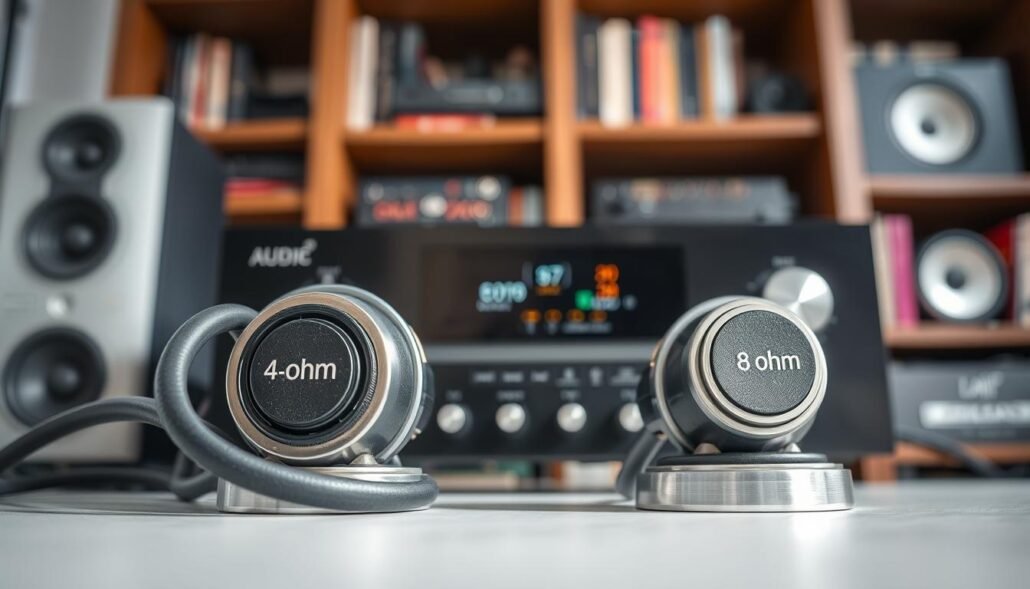
Impedance tells us how hard a speaker makes an amplifier work across different frequencies. It is the speaker’s opposition to electrical current and behaves like a changing electrical load on the amp. Lower numbers mean the amplifier must supply more current at the same volume.
What “ohm” means in real systems
Think of the receiver’s power section as pushing current into a load. Ohm ratings are nominal values; actual impedance varies with frequency. Those dips matter because they raise the current demand on the amplifier.
Why lower impedance draws more current and creates heat
At equal loudness, a lower impedance forces the output stage to deliver higher current. That current produces heat in the amp’s transistors and transformers. Modern units use protection circuits that cut output or shut down if temperature or current gets too high.
Common misconceptions
- Lower ohms ≠ guaranteed worse sound; speaker design and sensitivity drive real quality.
- Follow the practical 80% minimum guideline to judge how low is too low for a given amp.
Can I use 4-ohm speakers with an 8-ohm rated receiver?
A drop in impedance makes the power section work harder and can reveal limits in everyday gear.
What an “8Ω rated” unit usually implies
Eight-ohm labeling typically signals the safe continuous load for published power specs. Manufacturers pick that number to set expectations for heat, reliability, and typical listening levels in a home setting.
That label does not always forbid lower loads. It does mean the receiver’s thermal design and protection limits assume roughly 8Ω operation during normal use.
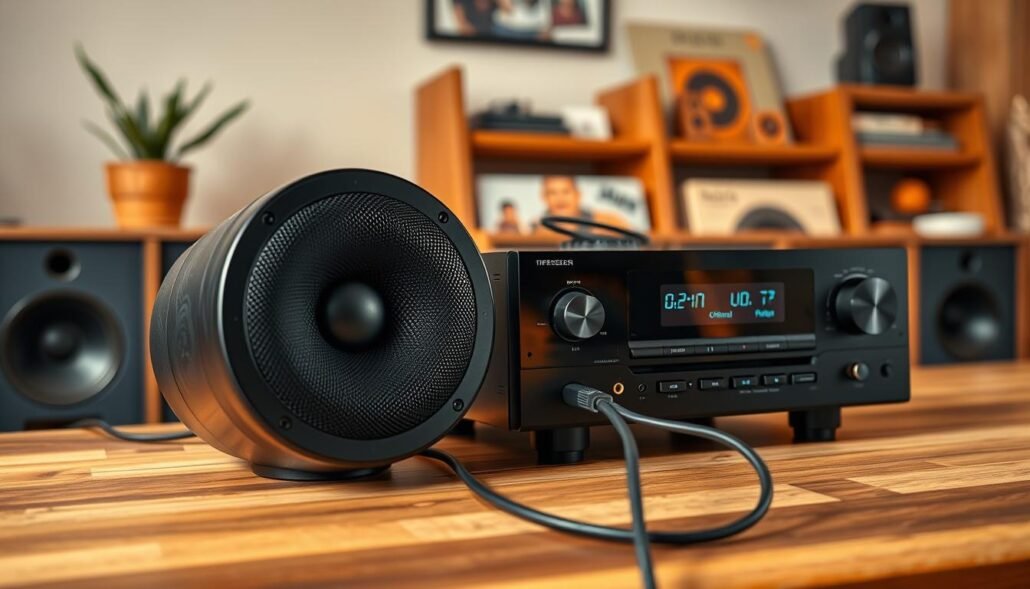
How lower impedance can trigger overload, heat, distortion, or shutdown
When the load falls, the amplifier must deliver more current at the same volume. That raises internal temperature and stresses the output stage.
- Increased current can raise power output temporarily but also increases thermal stress.
- Common warning signs: unusually hot chassis, harsh clipping, intermittent shutdown, or a protect indicator.
- Damage usually builds over time; sustained clipping and heat are the real hazards.
| Load | Likely amplifier behavior | Practical warning signs |
|---|---|---|
| 8Ω nominal | Stable output, designed thermal margin | Normal temp, clean sound at expected volumes |
| 4Ω nominal | Higher current draw, more heat, possible extra output | Warm case, occasional clipping at high volume |
| Dips below ~2–2.5Ω | Protection circuits likely engage; sustained strain | Frequent shutdowns, loud distortion, protect light |
| Poor wiring/multiple drivers | Unexpected low total load and hotspots | Uneven output, sudden load swings, thermal trips |
For most U.S. homes and moderate volume, the practical risk is often low if you run sensibly and watch for heat. For large rooms or party-level listening, choose gear rated for the lower load or keep volume conservative.
How to safely connect 4-ohm speakers to an 8-ohm receiver without damaging your system
Begin by confirming what speaker load the receiver is built to handle, as shown on the chassis and in the manual. The rear-panel label or spec sheet is the only authoritative source; a clear “4–8Ω” marking is the green light.
Practical checklist:
- Read the manual and back panel for supported impedance and A/B output notes.
- Use the 80% rule: expect a 4Ω nominal to dip near 3.2Ω in real use.
- Start at low volume and stop if you hear distortion or see a protect light.
- Keep the receiver ventilated and avoid enclosed cabinets to reduce heat buildup.
Wiring math example: two 4Ω units in series = 8Ω (safer). Two in parallel = 2Ω (danger zone for many amps).
| Connection | Total impedance | Risk |
|---|---|---|
| Single 4Ω | ≈4Ω nominal | Manageable if receiver supports 4–8Ω and ventilation is good |
| Two 4Ω in series | 8Ω | Lower current, safer but less loud |
| Two 4Ω in parallel | 2Ω | High current, likely overload or shutdown |
For small US apartments, conservative volume and good airflow usually keep systems stable. For large rooms, prefer an amp rated for lower impedance or higher headroom speakers.
What results to expect: performance, frequency response, and risk tradeoffs
Lower nominal impedance often promises higher power on paper, yet real-world gains are smaller and conditional.
Expect modest loudness increases and possible shifts in tonal balance rather than dramatic improvements.
Power and volume differences and why specs vary
Manufacturers test amps under different conditions. One rating may show power across 20 Hz–20 kHz at low distortion. Another might quote higher watts at 1 kHz with more allowed THD.
Use MAX SPL = 10·log10(amplifier power in watts) + speaker sensitivity to estimate real output. For example, 160W → ~108 dB and 250W → ~110 dB with 86 dB sensitivity. That 2 dB rise is noticeable but not double loudness.
How impedance matching impacts distortion and balance
If an amp strains into a low load, clipping rises and harshness grows. That raises audible distortion and reduces perceived audio quality.
Current limiting can also loosen bass control and dynamic balance. Listeners may report less punch or a thinner sound when the amp runs hot or clips.
When higher-impedance units are safer and when lower offers value
Stability: higher-impedance designs suit common home receivers and keep heat and protection trips low.
Value: lower-impedance models can be worth the money when paired to a high-current amplifier or receiver built for that load and good thermal design.
| Factor | Higher impedance | Lower impedance |
|---|---|---|
| Power handling | Stable across frequency | Higher rated watts in some tests |
| Distortion risk | Lower at normal volumes | Increases if amp is strained |
| Practical outcome | Reliable performance for TV/background music | Better peak output if paired with proper amp |
Bottom line: Match long-term listening goals to gear design. For small US rooms and casual use, choose stability. For louder playback or large spaces, invest in a high-current amplifier to get the best performance and audio quality.
Conclusion
The final takeaway boils down to matching load tolerance, cooling, and wiring choices.
Verify the receiver’s supported impedance range on the back panel or manual before pairing any speaker. Avoid wiring that drops the total load near 2–2.5 ohm to keep the amplifier from overheating or tripping protection.
Keep the device ventilated and stop if you hear distortion or see heat build-up. Series wiring raises total ohm; parallel wiring lowers it sharply.
For simple rules: choose 8 ohms for broad compatibility and cooler operation. Pick lower-ohm models only when an amplifier is explicitly rated to handle them.
Final safety note: in most US homes, moderate volume and good airflow preserve long-term reliability better than chasing extra output.
FAQ
What does speaker impedance mean for an amplifier?
Impedance, measured in ohms, is the electrical load a driver places on an amplifier. It combines resistance and reactance and varies with frequency. Lower impedance draws more current from the amp, so matching load expectations helps prevent overheating and distortion.
Why does lower impedance make an amplifier work harder?
A lower impedance demands higher current at the same voltage. That raises heat dissipation in the amplifier’s output stage and power supply. If the amp isn’t designed for that current, protection circuits may throttle, the unit may distort, or it could overheat.
Does impedance directly determine sound quality or ease of driving?
Impedance alone doesn’t define tonal quality. Drivers, crossover design, sensitivity, and cabinet construction matter more. Lower impedance might allow higher power delivery, but it won’t automatically produce better sound and can stress the amplifier if mismatched.
What does an “8Ω rated” receiver typically imply?
An 8-ohm rating usually signals the safe, nominal load for the amplifier. Manufacturers often specify a supported range—commonly 4–16Ω—or warn that below a certain threshold the unit may activate protection features. Check the manual and back-panel labeling for exact limits.
How can low-impedance speakers trigger overload or shutdown?
When impedance drops, current rises. The amplifier’s thermal and current limits may be exceeded, causing clipping, thermal shutdown, or activation of protection relays. Repeated stress can degrade components or shorten the amp’s lifespan.
How should the receiver’s manual or back panel be checked for load support?
Look for speaker-output specs and any explicit impedance range (for example, “4–8Ω”). Also read warnings about minimum load and multi-speaker wiring. If the documentation is absent or unclear, consult the manufacturer’s website or customer support.
What is the 80% minimum-impedance guideline?
This rule of thumb suggests avoiding loads that fall below about 80% of the amplifier’s nominal rating under real-world conditions. It accounts for impedance dips at certain frequencies; respecting that margin reduces the chance of overheating or distortion.
How can conservative volume targets protect the amp?
Keeping listening levels moderate reduces current demand and heat generation. Avoid long periods of maximum volume and brief headroom peaks. This practice lowers stress on output transistors and the power supply, preventing thermal trips.
What cooling and placement steps help prevent overheating?
Provide good ventilation around the receiver, avoid stacking components, and leave clearance for airflow. Use fans or place the unit in a well-ventilated rack. Heat buildup is an early sign of mismatch or sustained heavy current draw.
How do series and parallel wiring affect total load when using multiple drivers?
Series wiring adds impedances (total = sum), increasing load and easing amplifier stress. Parallel wiring reduces total impedance (1/total = 1/R1 + 1/R2 …), increasing current demand. Always calculate total load before connecting multiple drivers to a single channel.
At what load levels do many amplifiers struggle?
Loads below roughly 2–2.5 ohms typically push consumer receivers into a danger zone. Professional or high-current amps may handle lower values, but most home AV receivers aren’t built for sustained operation at these low impedances.
How should room size and listening goals influence speaker choice?
In small apartments, stability and predictable behavior matter more than raw power, so higher-impedance, efficient drivers can be preferable. In large rooms, lower-impedance, higher-power-capable drivers can deliver louder levels—but only with an amp rated to handle them.
What power and volume differences occur between lower and higher impedance loads?
Lower impedance can allow higher power transfer from an amplifier with a robust power supply, increasing potential volume. However, many receiver power ratings are specified at 8Ω; actual output into a lower load depends on the amp’s design and thermal limits.
How does impedance matching affect distortion and stereo balance?
If one channel is driven harder because of a lower load, distortion may rise and imaging can shift. Mismatched loads between left and right channels can alter perceived balance and clarity, especially at high levels.
When is choosing higher-impedance drivers a better option?
Opt for higher-impedance drivers when system stability, long-term reliability, and lower heat are priorities—typical for compact receivers and small-room setups. They reduce risk of protection-triggered shutdowns and maintain consistent performance.
When might lower-impedance drivers be worth the investment?
Low-impedance designs can be attractive when paired with an amplifier rated for high current or a dedicated power amp. They may offer greater headroom and tighter control when the electronics are matched and cooling is adequate, delivering better dynamics in larger rooms.