This review gives US home theater shoppers clear, practical information about a flagship single-box receiver option priced at an MSRP of $3,500.
The unit offers 11 channels of onboard amplification with the ability to expand to 13.4 processing via external amps. It also includes seven full-bandwidth HDMI 2.1 inputs and Audyssey; optional Dirac Live and Bass Control require a license and extra hardware.
We clarify naming for US buyers: the model is sold as the AVR-X6800H when an FM tuner is included, but feature parity is otherwise intended. This piece answers core questions about meaningful sound gains versus the prior generation, whether HDMI 2.1 matters for gamers, and how optional calibration affects value.
Rating framework: sound, build, features, and value. The final verdict blends measured usability in setup and menus with real listening experience. This is an informational, source-grounded analysis — not marketing copy — and pricing context may shift the recommendation.
Denon AVC-X6800H Review: Key Takeaways for US Home Theater Buyers
For US buyers building large immersive systems, this model offers expansive channel routing and full-bandwidth HDMI inputs.
What it is and who it suits in 2026
This is an upper-tier 11-channel receiver designed for 3D audio playback and next-gen console gaming. It fits owners planning 7.x.4 or 7.4.4 speaker layouts and hobbyists who may add external amplification later through 13.4 processing.
At-a-glance highlights
- 11 channels of onboard amplifier power with 13.4 preamp processing for expandability.
- Seven HDMI inputs supporting 8K/60 and 4K/120 plus VRR, ALLM, and QMS to simplify connectivity for multiple consoles and streamers.
- Immersive formats include Dolby Atmos, DTS:X, and Auro-3D. Four sub outputs aid bass integration.
How we evaluate it
We judge surround steering and immersion on Atmos tracks, dialogue clarity, bass blending across subs, and menu stability.
| Category | Primary Focus | Why it matters |
|---|---|---|
| Sound | Immersion & clarity | Measures real-world audio staging and dialogue intelligibility |
| Video & HDMI | 8K/60, 4K/120 passthrough | Reduces need for external switchers; preserves HDR and VRR features |
| Calibration | Audyssey baseline, Dirac Live optional | Audyssey covers most rooms; Dirac Live/Bass Control is advanced and paid |
Price, Value, and Where It Sits in Denon’s Current Range
Street pricing and real-world dealer offers shape the true value more than MSRP does. The listed MSRP is $3,500, while some US retailers show near-$3,799 listings. Most buyers should shop the street price rather than rely on launch MSRP.

What you pay for at this tier
The premium covers high channel count, seven full-bandwidth HDMI 2.1 inputs, and flexible pre-outs for future amplifiers. You also get advanced processing and multiple outputs for complex speaker setups.
Head-to-head value: model vs Arcam AVR5
Arcam’s AVR5 retails near $2,000 but needs an Arcam PA410 (~$1,650) to match channel power. That brings total ownership close to $3,650 — roughly the same range as this model.
| Item | Typical US Price | Notes |
|---|---|---|
| MSRP | $3,500 | Launch guidance only; shops may vary |
| Common retail listing | $3,799 | Street price can exceed MSRP at some dealers |
| Arcam AVR5 + PA410 | $3,650 (approx.) | Matches amplification but different sound character |
Upgrade and budgeting notes
If you own the prior model, upgrades are most compelling for expanded HDMI 2.1 and newer processing. For systems needing more than 11 amplified channels, include external amplifier costs in your budget.
Build Quality, Design, and Day-to-Day Usability
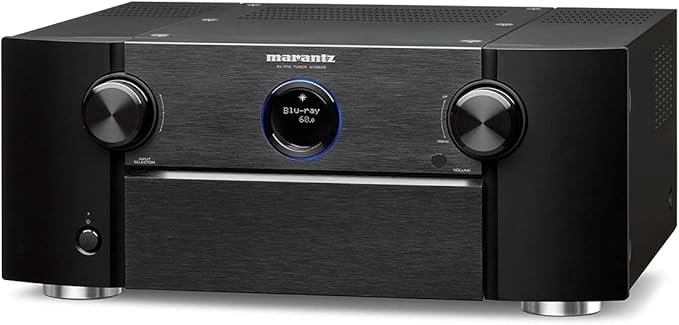
Physical build and everyday controls define how easy this unit is to live with. The faceplate follows the familiar dual-knob layout with a clear central display. That design gives quick visual feedback about source and volume during normal use.
Chassis, weight, and front panel ergonomics
The chassis weighs 15.6 kg, which matters for rack placement and ventilation. Plan for extra space if you rack-mount it or tuck it into enclosed furniture.
The source and volume knobs are easy to grip, and the display is readable from seating position. That helps when you change input or check mode at a glance.
Front flap convenience
The front flap hides useful quick-access features. You get a dedicated setup microphone jack for calibration runs, a USB port, and a headphone output for private listening.
These ports speed troubleshooting and temporary listening without digging to the rear inputs or outputs.
Remote, app, and menu usability
The supplied remote handles core tasks reliably but lacks backlighting and some single-press shortcuts. Expect to use the on-screen menu for a few advanced functions.
HEOS app control reduces friction, especially when the receiver sits in a cabinet. The app makes input switching and basic streaming faster than the hand remote.
The on-screen setup guidance is clear and step-by-step. It flags wiring or speaker position issues, which shortens setup time and improves final sound by ensuring levels and bass management are correct.
| Item | What to expect | Impact on use |
|---|---|---|
| Weight | 15.6 kg | Easier DIY installation; plan ventilation |
| Front flap | Microphone, USB, headphone | Quick calibration and private listening |
| Control options | IR remote + HEOS app | Remote covers basics; app aids daily control |
| On-screen setup | Step-by-step guidance | Reduces setup errors; improves sound |
Features and Connectivity That Define the Experience
Connectivity here is about real-world convenience: multiple 2.1 HDMI ports, flexible outputs, and modern streaming options that fit typical living rooms.

HDMI routing and video support
The unit provides seven hdmi inputs and three HDMI outputs with eARC. It handles 8K/60 and 4K/120, plus VRR, ALLM, QMS and QFT to keep consoles responsive.
Wide HDR and video formats
Movie collectors get broad coverage: Dolby Vision, HDR10+, HLG, HDR10 and IMAX Enhanced playback. That reduces format anxiety across players and streaming apps.
Immersive audio, channels, and bass
Supported formats include Dolby Atmos, DTS:X and Auro-3D, plus upmixers to expand legacy mixes. Internally it delivers 11 channels of amplification and up to 13.4 preamp processing with external amplifiers.
Subwoofers, legacy I/O, and streaming
Four subwoofer outputs allow smoother bass across the seating area and one output can drive a tactile transducer for seat-shake effects. Legacy inputs include phono, optical/coax, multi-zone I/O, triggers and RS-232C.
Streaming and control: HEOS, AirPlay 2, Spotify Connect, Tidal, Bluetooth and voice assistants give flexible multi-room playback and simple hands-free control.
| Feature | Why it matters | Real use |
|---|---|---|
| Seven HDMI | Keep all sources connected | Multiple consoles, Blu-rays, streamers |
| Three outputs + eARC | Main display + zones, TV app audio return | Watch in living room; send audio to second display |
| Four subs | Even bass, tactile option | Smooth low end for seats and HT furniture |
Setup and Room Calibration in Real Rooms
Begin with a single-seat check: confirm HDMI inputs, speaker polarity, and display sync before moving to calibration.
Audyssey workflow and microphone placement
Use the included microphone and the front jack to run Audyssey. Place the mic at the main seat, then follow the on-screen prompts for multi-point measurements.
Audyssey typically guides you through several positions to map room effects. Small mic shifts change dialogue clarity and bass smoothness, so be methodical.
Dirac Live and Bass Control notes
Dirac Live is supported but not bundled. Plan to buy a license, a recommended measurement microphone, and a laptop to run the process.
Dirac Live Bass Control improves multi-sub integration and bass articulation in difficult rooms.
Speakers, channels and multi-zone choices
The internal amps cover a 7.4.4 layout with sensible channel assignments. Adding more processing or powering extra speakers needs external amplification.
Assigning channels to Zone 2/3 trades off main-room power. Choose based on how often you use multi-room audio.
| Step | What to check | Why it matters |
|---|---|---|
| First-day check | HDMI, polarity, display sync | Prevents errors before calibration |
| Audyssey run | Microphone multi-point measurements | Corrects room tonal balance |
| Dirac option | License + mic + PC | Better sub integration and room correction |
Sound Performance for Movies, Gaming, and Music
Across films, games, and albums the presentation blends musicality with precise imaging. The overall sound tilts warm and rich while keeping high-frequency clarity that helps vocals and effects cut through.

Signature, clarity and dynamics
The sound signature favors a lush midrange with tight lows and clean treble. Dynamics and scale feel strong at moderate volume, giving action scenes real punch without sounding aggressive.
Dialogue and vocal detail
Dialogue stays intelligible in crowded scenes thanks to a well-defined center channel. Clear vocal rendering matters more than raw power for readability in mixes with heavy background effects.
Surround imaging and height effects
Surround steering is smooth; effects pan across the room without gaps. Height channels deliver convincing overhead motion in Dolby Atmos mixes, enhancing placement accuracy and immersion.
Bass authority and integration
Bass has two faces: fast, articulated lows for music and strong impact for films. Multi-sub setups and proper calibration—Audyssey baseline or paid Dirac upgrades—make the biggest difference for tight, coherent low end.
Music, streaming and playback modes
Streaming via Spotify Connect, HEOS and Tidal sounds crisp with good dynamics. Use Direct mode for unprocessed music; switch processing on to unify mixed speakers or room imbalances.
All-channel stereo
All-channel stereo delivers bold, room-filling sound for parties. Critical listeners may notice slightly softened attack and less pinpoint imaging versus stereo or Direct modes.
How It Compares to Key Alternatives
When choosing between top-tier receivers, the right trade-offs hinge on real-world needs more than spec sheets.
Upgrade decision: when swapping from the prior model makes sense
If you own the previous model, upgrade urgency is low unless three things matter to you: multiple full-bandwidth HDMI 2.1 gaming sources, the latest processing platform, or the revised internal design.
Real-world upgrade means audible improvements at normal listening levels — clearer dialogue, tighter transient punch, and smoother surround cohesion rather than just higher numbers on a spec sheet.
Feature and sonic contrasts with Pioneer and Arcam class rivals
Pioneer VSA-LX805 matches many features: formats, room correction options, and multi-zone outputs. That makes it a strong feature-parity contender.
By contrast, the Arcam AVR5 tends to sound more agile and natural to some listeners. However, Arcam may need external amplifiers to match channel power, which raises total system cost.
| Compare | Feature parity | Sonic character |
|---|---|---|
| This model | Formats, processing, multi-zone | Warm, wide-scale sound with solid punch |
| Pioneer VSA-LX805 | Very similar feature set | Balanced, detailed presentation |
| Arcam AVR5 (+ amp) | Needs added amplifiers to match channels | Agile, more neutral timbre |
Amplification, connectivity, and ecosystem
Consider amplification strategy: a rival’s lower entry price can become less compelling after adding external amplifiers to reach comparable channel counts.
Connectivity wins for households with many consoles — seven full-bandwidth HDMI inputs remove the need to swap sources or add external switchers.
Finally, ecosystem and control matter. Menus, app maturity, and setup guidance affect the daily experience more than raw specs for many buyers.
- Choose this model if: you need many HDMI 2.1 sources, built-in 11-channel power, and easy setup.
- Choose a rival if: you prioritize a more neutral, music-first sonic signature or lower upfront cost and plan to add amps later.
Conclusion
If you want a single hub that handles gaming, movies, and multi-channel music, this is a strong contender for a modern home setup.
Strengths: broad HDMI support for multiple inputs and reliable video handling, immersive Dolby Atmos staging, and wide dynamic performance that keeps music and film moments engaging.
Important caveat: it processes up to 13.4 channels but only powers 11 internally, so high-channel speaker arrays will need an external amplifier to reach full capability.
Calibration: Audyssey gives solid baseline tuning for most rooms. Dirac Live (paid) and Bass Control are the upgrade path for tighter bass and finer tonal balance.
Bottom line: excellent daily performance, clear dialogue, and flexible expansion make it a strong long-term home theater hub.
FAQ
What channels and processing does this receiver support?
The unit offers 11 discrete power channels and up to 13.4-channel preamp processing. That means you can drive a 7.4.4 speaker layout natively and use external amplification or assign channels for multi-zone setups when needed.
How many HDMI inputs and outputs are available, and what video features do they support?
There are seven HDMI inputs and three HDMI outputs. The video section supports 8K/60 and 4K/120 passthrough, eARC, VRR, ALLM, and fast metadata switching (QMS/QFT). It also handles HDR formats such as Dolby Vision, HDR10+, and HLG, plus IMAX Enhanced playback compatibility.
Does it include room calibration and what options are available?
Yes. The receiver supports Audyssey-style multi-point mic calibration for quick setup. It also offers Dirac Live and Dirac Live Bass Control for advanced room correction; Dirac typically requires a separate license or dealer activation depending on the model and region.
Can I use multiple subwoofers and tactile transducers?
The unit provides four subwoofer outputs, which simplifies placement and integration for smoother bass response across the room. You can also route low-frequency outputs to tactile transducers or dedicated amplifiers for enhanced tactile impact.
How does the receiver handle music streaming and wireless connectivity?
Streaming features include HEOS built-in, AirPlay 2, Spotify Connect, Tidal, and Bluetooth. Voice-assistant compatibility is supported through common platforms. The HEOS ecosystem enables multi-room music playback and grouping with other compatible products.
Is the receiver suitable for gaming setups?
Yes. HDMI 2.1 features like 4K/120 passthrough, VRR, and ALLM make it well suited for current consoles and high-frame-rate PC gaming. Low-latency switching and advanced video processing maintain image quality while reducing input lag when properly configured.
What analog and digital inputs are included for legacy gear?
The I/O includes phono input for turntables, multiple optical and coaxial digital inputs, USB on the front for music playback, multi-zone preouts, 12V triggers, and an RS-232C port for advanced control and integrator use.
How much power does each amplifier channel deliver and what about speaker load handling?
Power ratings vary by room conditions and speaker impedance, but the internal amplification is designed to drive typical 6–8 ohm home-theater speakers with strong reserve. For demanding setups or low-impedance loads, adding external amplifiers is a common approach.
Is Dirac Live included or an extra cost, and what does it add?
Dirac Live availability depends on the specific retail package and region. When included or purchased, Dirac Live adds precise impulse-response correction and advanced bass management (Dirac Bass Control) that can significantly improve imaging and low-frequency tightness compared with basic calibration.
How user-friendly is the setup process and remote/app control?
Setup is streamlined with on-screen guidance, a front-panel setup mic input, and clear menus. The bundled remote covers core functions; full feature control and firmware updates are easier via the manufacturer’s mobile app, which also handles network streaming and zone management.
Does the receiver support IMAX Enhanced and other immersive formats?
Yes. It supports IMAX Enhanced content as well as Dolby Atmos, DTS:X, and Auro-3D for immersive object-based sound. Upmixing modes and configurable height channels help tailor immersive playback to your speaker layout.
What are the differences between this model and its immediate predecessor?
Key upgrades typically include improved HDMI bandwidth and processing enhancements, expanded format support, and updated connectivity. Whether to upgrade depends on your current setup—if you need HDMI 2.1 features like 4K/120 or enhanced processing, the newer model offers tangible benefits.
Can I integrate this receiver into a smart home or custom install?
Yes. It includes 12V trigger outputs, RS-232C, IP control, and compatibility with common control systems and voice assistants. These options make it suitable for professional integration and smart-home automation.
How does the receiver perform with music compared to movies?
The receiver balances dynamics and clarity for movie playback while offering transparent music playback modes such as “Direct” or “Pure” that bypass extra processing. Streaming via HEOS or USB yields good musical detail; audiophiles may still prefer separate dedicated electronics for two-channel critical listening.
What should I consider when matching speakers and subwoofers?
Consider speaker sensitivity, impedance, and power handling alongside room size. Use the calibration tools to set levels and crossover points. For large rooms or low-frequency-heavy content, multiple subs and careful placement will improve evenness and impact.
How often are firmware updates released and how do they improve the product?
Firmware updates appear periodically to add format support, improve HDMI compatibility, and refine network and streaming features. Installing updates keeps the receiver compatible with new sources and fixes interoperability issues with TVs and game consoles.