This mid-line AVR sets expectations for a flexible, modern home theater hub. Launched at a U.S. list price near $1,699, the unit sits above the AVR-X2800H and below higher-tier models in the same range. It adds 11.4-channel processing with nine onboard amps and broad HDMI 2.1 coverage across six inputs and three outputs with eARC.
Key video and audio formats are supported, including HDR10, HDR10+, Dolby Vision, HLG, Dolby Atmos, DTS:X and Auro 3D. Streaming and control are well covered with HEOS, AirPlay 2, Spotify, Tidal, Roon and voice assistants.
What to watch for: independent measurements show amplifier performance similar to the prior generation, while DAC SINAD trails the AVR-X3700H by about 10 dB. Thermal notes matter in real homes; the top panel can run hot, so plan airflow and rack space.
This introduction previews value, real-world usability, and upgrade paths for buyers weighing price, room size, and competing models in the current year. Expect balanced, cinematic sound with good dialogue clarity and solid expansion options.
At-a-glance: Why the Denon AVR-X3800H still matters for home theater today
Packed with full-bandwidth HDMI and expanded channel handling, this receiver aims to future-proof living-room systems.
The unit offers six 40 Gbps hdmi inputs and three outputs with eARC, ready for 8K/60 and 4K/120 pass-through. It also supports VRR, QFT, ALLM and the main HDR formats for smooth gaming and high-detail video.
Processing steps up to 11.4 channels, delivering 5.4.4 out of the box and an easy path to 7.4.4 with an external amp. Four independent sub outputs and flexible height layouts give the system room to grow over time.
Setup is faster thanks to an updated GUI. Dual Speaker Presets and the Audyssey MultEQ Editor app add practical calibration control for different seats or use cases.
A small but important note: Quick Media Switching follows older HDMI.org behavior. That quirk should not affect most users at the end of the day.
| Feature | What it means | Benefit |
|---|---|---|
| 6 × 40 Gbps HDMI inputs | Full HDMI 2.1 bandwidth | Supports 8K/60, 4K/120 and gaming features |
| 11.4 channel processing | 5.4.4 native, expandable to 7.4.4 | Flexible height layouts and multi-sub setups |
| Dual presets + Audyssey | Quick switching and deep tuning | Faster setup and tailored room correction |
Design, build, and I/O: A familiar Denon look with smarter thermal and layout considerations
The receiver keeps a familiar, utilitarian fascia while adding practical thermal and connection upgrades for modern systems.
Chassis, heatsinks, and airflow
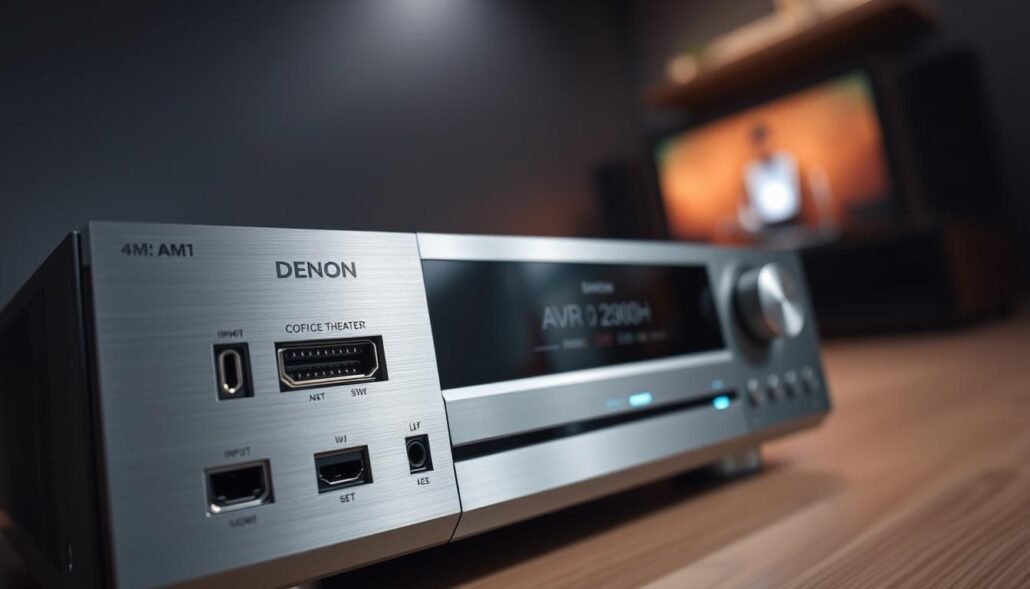
The chassis uses solid extruded aluminum heatsinks that wick heat away from critical components. Expect the top-front panel above the heatsink to become warm to the touch; leave extra vertical space in a cabinet.
An internal fan exists but is conservative and may not engage in typical playback. For stacked gear, open shelving or active cooling is recommended so the supply of cool air keeps temps down.
Rear panel tour
Rear connectivity covers modern and legacy sources. You get six 40 Gbps hdmi inputs and three outputs (including eARC), a dedicated phono input, nine speaker binding posts, and four independent subwoofer outputs.
Selective preamp mode lets power users assign channels to pre-out only so an external amp can handle specific duties while internal power covers the rest. A small setup-menu hiccup was seen once; a power cycle fixed it—keep that note in mind during installation.

Features and connectivity: 11.4 processing, 9-channel amp, and full-bandwidth HDMI 2.1
A strong video pipeline pairs with deep processing to let you run immersive speaker layouts and high-resolution sources with ease.
Video pipeline and gaming readiness
The unit uses six HDMI 2.1 inputs and three outputs at 40 Gbps to support 8K/60 and 4K/120 pass-through. This setup covers HDR10, HDR10+, Dolby Vision, and HLG while offering eARC for lossless multichannel return.
Gaming features like VRR, QFT, ALLM, and FRL stabilize high-refresh play and reduce latency for modern consoles and PCs.
Audio formats and streaming
Processing reaches 11.4 channels on a Griffin Lite XP platform with nine onboard amps rated at 105 W (8 ohms). Supported formats include Dolby Atmos, DTS:X, Auro 3D, IMAX Enhanced, and Sony 360 Reality Audio, plus virtualization modes for rooms without ceiling speakers.
Network features span HEOS, AirPlay 2, Spotify, Tidal, Deezer, Roon, Bluetooth, Wi‑Fi, and voice control via Alexa, Google Assistant, and Siri.
Expandability and system modes
Selective preamp mode and Dual Speaker Presets let you add a small external amp to reach 7.4.4 or to tune separate listening profiles. Audyssey MultEQ XT32 ships standard, with an optional Dirac license for users who want advanced calibration.
| Feature | Spec | Why it matters |
|---|---|---|
| HDMI bandwidth | 6 inputs / 3 outputs, 40 Gbps | High-frame-rate video, 8K/60, 4K/120, and full HDR support |
| Processing / amps | 11.4 processing, 9 onboard amps (105 W) | Run 5.4.4 now; expand to 7.4.4 with external power |
| Streaming & voice | HEOS, AirPlay 2, Roon, Alexa/Google/Siri | Multi-room audio and smart-home integration |
Setup and room calibration: Faster GUI, Audyssey MultEQ XT32, and optional Dirac Live
The revamped full-screen GUI makes initial setup simple and fast. The wizard walks you through speaker checks, cable verification, and input labeling. It also helps assign amp channels so the system matches your layout goals.
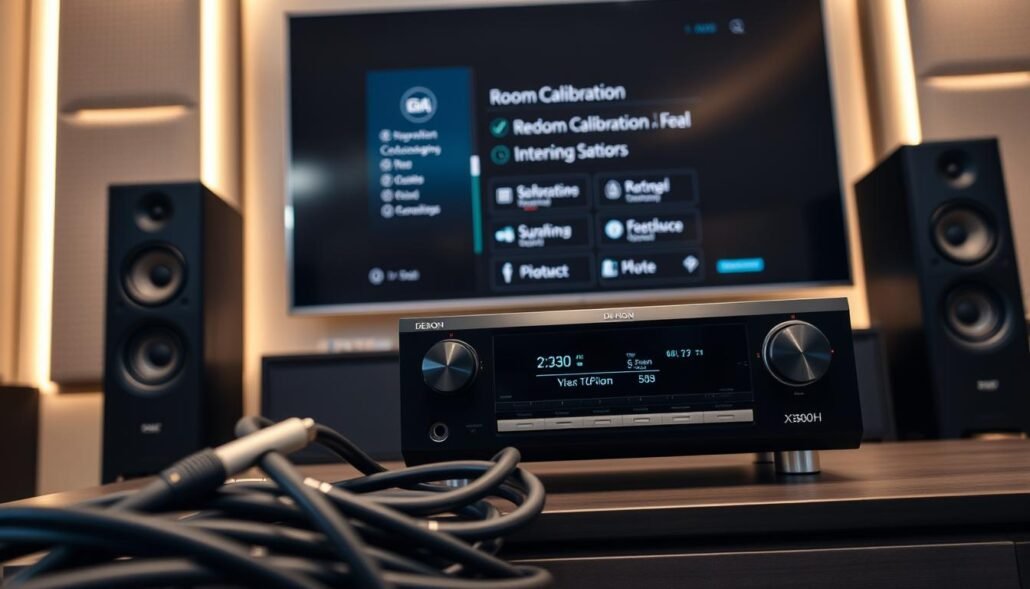
Guided onboarding and app tools
Audyssey MultEQ XT32 is included for detailed room EQ. Running measurements from multiple mic positions smooths bass and improves dialogue clarity across seats.
The MultEQ Editor app adds useful tweaks. You can change target curves, adjust midrange response, and fine-tune per-speaker roll-offs for different content types.
Practical tips and compatibility
Dual Speaker Presets let you store two full calibrations — for example, a movie mode and a late-night mode. Optional Dirac Live is available via paid license after the 2023 firmware for another correction approach.
| Tool | What it does | When to use |
|---|---|---|
| On-screen wizard | Guides wiring, labeling, amp assign | First power-on or reconfiguring system |
| MultEQ XT32 + Editor | High-res room EQ; per-speaker tuning | When you need better bass balance and dialogue |
| Dirac Live (optional) | Time-domain and target-curve options | Preference for precise time correction |
Real-world performance: movies, music, and gaming impressions
Listening tests reveal a precise, agile sound that favors clarity over exaggerated low-end bloom. The presentation stays quick and controlled, so complex action scenes keep their impact without mud. Dialogue remains natural and intelligible even in dense mixes.
Home cinema presence
The unit handles dynamic movie soundtracks with authority and restraint. It delivers wide surround steering and clear effects that feel cinematic rather than overblown.
Bass is taut and supportive, preserving midrange detail so vocals and effects don’t get masked.
Music nuance
For two-channel and multichannel music it delivers surprisingly nuanced results. Transients attack cleanly — the start synth note jumps out, while reverb tails bloom naturally over time.
On SBTRKT’s sbtrkt trials past, reviewers heard an assured attack and spacious decay; shakers nicely defined across the top end spectrum and hefty bass that stays controlled.
Gaming-friendly
Gaming features and stable 4K/120 video pass-through cut lag and visual artifacts. VRR, QFT, and ALLM keep motion smooth so responsiveness and power feel consistent in fast titles.

Denon AVR-X3800H Review benchmarks: measurements vs rivals and generations
Measured testing shows the amplifier section largely holds its ground while the DAC path steps back versus the previous generation.
Lab results record roughly a 10 dB SINAD drop in the DAC compared with the prior model. Distortion spikes and earlier IMD saturation explain most of that loss. Jitter and filter behavior also score worse, even as dynamic range stays similar.
The amp output and power delivery remain comparable to the earlier unit. Noise and channel behavior on amplifier dashboards show only minor differences.
Comparisons with key rivals
Against other avrs, the Yamaha RX-A6A sounds more forward and energetic. The Arcam AVR5 wins on value and musicality but offers fewer channels and less processing headroom.
Price, HDMI headroom, and longevity
Post-pandemic price shifts moved this receiver into higher competitive tiers. Still, full-bandwidth hdmi and 11.4 processing give a clear multi-year upgrade path.
| Metric | Result | Impact |
|---|---|---|
| DAC SINAD | ~10 dB lower vs prior generation | Less clean detail at high output |
| Amplifier output | Similar to previous generation | Expected power and channel behavior |
| HDMI vs optical | HDMI slightly raises noise floor | Input choice affects noise but not core distortion |
Bottom line: measured trade-offs in the DAC are real, but the unit’s power, setup flexibility, and hdmi capability keep it competitive in the mid-to-high range for theater-first systems.
Who should buy it: room sizes, speaker layouts, and upgrade plans
Buyers needing native 5.4.4 capability today and a straightforward route to 7.4.4 later will find this a practical choice. It fits owners who want an out‑of‑the‑box immersive setup and the freedom to add power later.
The receiver suits medium to larger living rooms and dedicated home cinemas. Four independent sub outputs help smooth bass across seats and reduce nodal issues in wider spaces.
Best-fit scenarios:
- Immediate 5.4.4 systems with nine onboard channels and height channels driving immersive formats.
- Upgrade to 7.4.4 by adding a small external amp via selective preamp mode to offload front L/R.
- Households needing multi-source switching—six high-bandwidth inputs and three HDMI outputs ease setup for consoles, streamers, and projectors.
- Zone 2 audio (and in some setups HDMI video) to extend entertainment without a second full system.
Caveats to consider: objective DAC measurements show regression versus one prior model, so audiophiles focused on absolute DAC numbers may prefer other models. Quick Media Switching follows older HDMI behavior and may not match the latest HDMI.org updates.
| Factor | Impact | Recommendation |
|---|---|---|
| Thermal/top panel | Runs warm under load | Allow ventilation and avoid tight cabinets |
| Selective preamp | Add external amp to expand channels | Use to offload front L/R and preserve internal power |
| Inputs & outputs | Six inputs, three outputs | Simplifies multi‑device setups and TV/projector combos |
Conclusion
In practice, this receiver blends modern connectivity with practical room-ready performance for most home setups.
It pairs broad HDMI 2.1 support and 11.4 processing with nine onboard amps, HEOS/AirPlay 2/Roon streaming, and voice control via Amazon Alexa and Google Assistant. That mix keeps video and audio systems current and flexible.
Measured DAC trade-offs exist, but amplifier output holds steady. Music remains surprisingly nuanced musical; attack start synth moments and the reverb tail given have room to breathe while bass stays solidly controlled.
For buyers focused on connectivity depth, expandability to 7.4.4, and long-term feature supply, this receiver is a strong pick in this year’s avrs range.
FAQ
What power and channel configuration does this receiver offer?
The unit delivers a 9-channel amp with 11.4 processing capability. It handles native 9-channel output and supports expansion to 7.4.4 or 5.4.4 using external amplification or preamp outputs.
How many HDMI inputs and what video specs are supported?
It includes multiple HDMI 2.1 ports with full 40Gbps bandwidth per capable input, supporting 8K/60 and 4K/120 passthrough, HDR10+, Dolby Vision, HLG, and eARC for high-resolution audio return.
Does it support modern gaming features like VRR and ALLM?
Yes. The video pipeline supports VRR, ALLM, QFT and FRL, making it suitable for next-gen consoles and gaming PCs while preserving stable 4K/120 performance.
What immersive audio formats and spatial features are available?
The unit decodes Dolby Atmos, DTS:X, Auro-3D and IMAX Enhanced, and supports Sony 360 Reality Audio for compatible streaming, delivering layered overhead and object-based sound.
Which streaming services and voice assistants are supported?
It supports HEOS multiroom, AirPlay 2, Spotify, Tidal and Roon streaming. Voice control works with Amazon Alexa, Google Assistant, and Siri for basic playback and volume commands.
Is room correction included and can I upgrade it?
Audyssey MultEQ XT32 is included for room calibration, with guided setup through the app. The platform also supports optional Dirac Live upgrades for users who want more advanced tuning.
How does the receiver perform musically, especially on electronic and acoustic tracks?
In listening tests it delivers assured attack at the start of synth notes, clean transient detail, and reverb tails that have room to breathe. Bass remains solidly controlled, giving both electronic and acoustic material nuance and punch.
What about build, cooling, and rack placement considerations?
The chassis uses robust heatsinks and optimized airflow. The top panel runs warm under load, so plan rack space and allow ventilation above the unit to prevent thermal throttling.
How many subwoofer outputs and speaker connections are available?
The rear panel provides multiple subwoofer outputs (quad outputs in many configurations), nine speaker terminals for flexible layouts, plus analog and phono inputs and configurable pre-outs for external amplification.
Can this model be used as a preamp only?
Yes. A selectable preamp mode lets you bypass the internal amplification and use the receiver as a processor, which is useful when adding high-power external amps for more channels.
How does it compare with previous and rival models?
It improves video headroom and connectivity over earlier generations, while amp linearity remains similar to recent predecessors. Competitors like Yamaha and Arcam offer different tuning and ecosystem trade-offs, so choose based on feature priorities and room needs.
Are there known measurement caveats I should consider?
Some measurements show a slight DAC/SINAD regression versus earlier units. For most listeners this won’t affect musical enjoyment, but critical listeners or those using the receiver as a primary two-channel DAC should audition before purchase.
What room sizes and speaker layouts are best suited to this receiver?
It fits medium to large rooms well — ideal for 5.4.4 out of the box and expandable to 7.4.4 with external amps. Smaller rooms will benefit from its headroom, but ensure adequate speaker matching and calibration.
Does it support multiroom or a second zone output?
Yes. It supports multiroom streaming via HEOS and has outputs to feed a second zone, letting you run independent audio in another room or simplified music playback elsewhere.
What should I know about setup speed and the GUI?
The GUI and onboarding are faster than previous generations, and the mobile app provides helpful guided setup tools and the ability to switch between two speaker presets for different listening modes.
Is the unit futureproof for several years of upgrades?
With HDMI 2.1 bandwidth, 8K/60 and 4K/120 support, and flexible processing, it offers a multi-year upgrade path. Keep ventilation and firmware updates in mind to maintain peak performance.