If you’ve seen Denon’s AVR-1312 listing claiming support for Deep Color and x.v.Color, you likely want clear answers. This intro will define what people mean when they ask if a receiver can handle those enhanced formats and why that matters for picture quality.
Most questions are about HDMI pass-through: can the receiver pass a high-bit video stream from a source to a display without downgrading it. This is a chain issue, not just a single toggle on one box.
Expectations matter. Deep color and x.v. color can improve gradients and reduce banding, but the total system, source format, and cables determine the real result.
This guide will show how to check the spec and owner’s manual, verify TV and source settings, enable enhanced color safely, and avoid HDMI handshake problems like a black screen or no audio. We use the Denon AVR-1312 as a real example of confirmed support in manufacturer documentation.
Deep Color vs. x.v.Color: what they are and why they matter for picture quality
Two separate enhancements affect what you see: one adds shades per channel, the other expands the range of hues.
Deep Color explained: 10-bit, 12-bit, and 16-bit over HDMI
Deep Color raises the number of shades each pixel channel can show. Moving from 8-bit to 10-bit gives more subtle steps in gradients like skies and shadows.
This reduces visible banding on smooth tones. Higher bit levels (12-bit, 16-bit) add even more steps, but gains depend on the source and display.
x.v.Color explained: wider gamut and truer hues
x.v.Color is about the color gamut — more colors, not just more steps. It aims for more natural, vivid reproduction when the whole chain uses the same color space.
That means richer greens and reds, and better skin tones when content and display are aligned.
Real-world expectations: what changes in your images
These are different fixes: one targets banding and tonal steps; the other targets gamut and richness.
If content is mastered in standard 8-bit, turning on these options won’t add new detail to images. Banding may still come from compression or panel limits.
| Feature | Primary effect | When you notice it |
|---|---|---|
| Deep Color | More tonal steps per channel | Smooth gradients, less banding |
| x.v.Color | Wider color space | Richer hues, truer skin tones |
| Limitations | Depends on source, cable, and display | No benefit if content is 8-bit or display cannot render |
What you need for Deep Color or x.v.Color to work in a home theater system
A few simple items must be correct for enhanced HDMI video to pass cleanly through a home theater.
HDMI requirements
Both devices linked by HDMI must accept the same enhanced format. If any hop in the chain cannot handle the setting, the output falls back to standard video.
Use the right cable
Use a certified High Speed HDMI cable. For 4K, ARC, and similar features, choose one marked “with Ethernet” and bearing the HDMI logo.
Know your signal chain
Think of the path as source → AVR/switch → display. A Blu-ray player or game console is the source, a receiver acts as the switcher, and the TV is the display. Each device must be compatible for the system to pass enhanced data.
Compatibility basics and HDCP
HDCP is required for protected Blu-ray and other digital content. If a device lacks HDCP compliance, you may see no picture, no sound, or intermittent dropouts even with correct cables.
| Requirement | Why it matters | Troubleshooting |
|---|---|---|
| Compatible source device | Outputs the higher-bit or wider-gamut signal | Check source HDMI settings and firmware |
| AVR/switch that passes format | Must forward the exact video data to the display | Confirm HDMI pass-through specs and input labels |
| Display input that accepts format | Final rendering happens here; panel must render extra data | Enable enhanced HDMI settings on the display |
Does my receiver support “Deep Color” or “x.v.Color”?
Start by locating the exact model number on the unit and matching it to the manufacturer’s spec sheet. That direct match is the fastest way to get accurate information about HDMI pass-through and enhanced options.
Check the spec sheet and owner’s manual
Search the exact model name plus “specifications” and open the owner’s manual PDF. Look for the literal terms deep color and x.v. color in the HDMI, video, or “Supported video signals” sections.
Find related HDMI features
- Scan for 4K, 3D, Content Type, HDMI Pass Through, HDMI Control, and ARC.
- Seeing these items grouped together usually means the manual lists pass-through capabilities.
Example and verification tips
Denon’s AVR-1312 explicitly lists deep color and x.v. color in its spec and frames the benefit as a more lifelike, vibrant picture.
| Where to look | Why it matters | Quick check |
|---|---|---|
| HDMI / Video section | Lists accepted signals | Search PDF for keywords |
| Supported video signals | Shows pass-through limits | Confirm bit-depth lines |
| Manufacturer site | Definitive model information | Match exact suffix for US models |
Note: when a spec says “supports” it usually means pass-through. The whole chain must also match for any visible gain on your display.
How to check compatibility on every device in your setup
Quickly confirming each link in the chain prevents surprises and shows whether enhanced video will actually reach your screen.
On your TV or display
Look in the picture or HDMI input menus for labels like HDMI UHD Color, Enhanced format, or similar. Manufacturers often hide these per‑input toggles.
Enable the enhanced setting for the HDMI port connected to the receiver. Some sets default to a standard mode per input, which blocks higher bit‑depth and wider gamut signals until switched.
On the receiver
Open the on‑screen information panel while playing a test signal. The info screen reports incoming and outgoing formats, making it the fastest way to confirm actual output.
Also scan HDMI video settings in the setup menus for options that affect passthrough. If the receiver shows the higher bit depth or wider color space on its info page, the chain is passing the data.
On your sources
Check consoles, Blu‑ray and DVD players, and cable boxes for HDMI output menus. Look for bit depth, color space, or an Auto selection. Common devices like the PS3 let you choose output resolution and color settings.
When in doubt, leave the source on Auto so it negotiates the best match with the display and receiver and avoids handshake issues.
Verify with real content
Only content mastered with higher bit depth or a wider gamut will show improvements. Use a known high‑quality disc or stream and check the receiver information screen before and after toggling settings.
This practical test proves whether the device chain and the content are aligned to deliver visible gains.
How to enable Deep Color and x.v.Color without breaking your HDMI signal
A careful order and a few safe defaults keep HDMI negotiations stable when you try to enable enhanced modes like deep color and x.v. color.
Turn features on in the right order
Set the source first, then the receiver, and finally the display. This lets each device negotiate capabilities in sequence and reduces failed handshakes.
When to use Auto to avoid handshake issues
Leave HDMI color and bit-depth on Auto if you are unsure what every device can handle. Auto usually finds the best match and prevents a black screen or flicker.
What Content Type / auto settings do
Content Type tells devices what kind of content is playing and can change how the device processes and outputs video. That can swap color space or processing automatically to match the content.
- Why order matters: devices negotiate at connection time; changing settings out of order can cut the picture until a re-handshake occurs.
- What can break the signal: mismatched capability negotiation can cause a black screen, flicker, or audio dropouts.
- Quick recovery: revert the last change, reselect the input, then re-enable features one at a time to find the problematic setting.
| Step | Symptom | Fix |
|---|---|---|
| Enable on source | No picture | Turn off, reselect input |
| Enable on hub | Flicker | Power cycle hub |
| Enable on display | Audio dropouts | Set back to Auto |
Practical rule: stable operation matters more than chasing a setting. If enabling a feature causes instability, leave it off until you can upgrade the weakest link in the chain.
Choosing Deep Color vs. x.v.Color: which setting should you pick?
Pick the setting that solves the visual issue you actually see, not the one with the flashiest label.
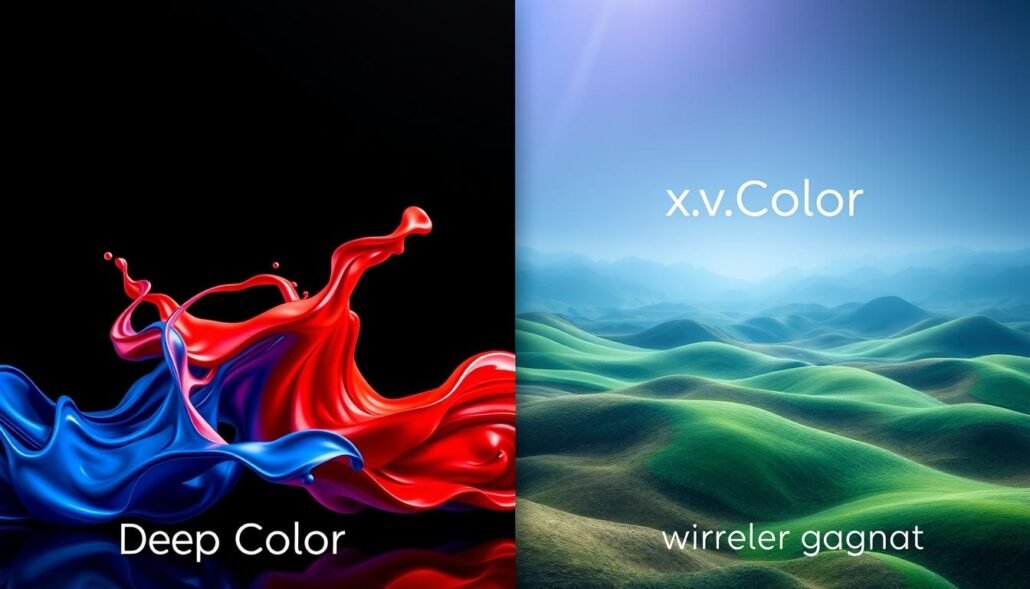
If banding in gradients is your main complaint
deep color targets tonal steps by increasing bit depth. It can smooth skies and shadows when source material and the display both accept higher bit levels.
Results vary because compression, source mastering, receiver processing, and the panel itself can still create banding. Test with a high‑quality disc or test file to see real change.
If you want more natural, vivid hues
x.v. color expands the gamut. Choose it when your source and TV explicitly advertise wider colors and you care about richer greens and reds.
If the content or display cannot use the wider space, forcing the mode adds little and can cause handshake issues.
Separating technology from marketing
Some vendors pushed x.v. heavily years ago, which fed claims of “smoke and mirrors.” Real gains depend on content workflows and device chains, not just labels.
- Decision quick guide: pick deep color for banding fixes with a stable HDMI chain; pick x.v. for wider gamut when display and source match.
- Start with Auto if unsure, then test deep color first. Force x.v. only when content and display clearly benefit.
| Need | Best pick | Why |
|---|---|---|
| Reduce banding | deep color | Higher bit level smooths gradients if source and screen allow |
| Richer hues | x.v. color | Wider gamut for more natural skin tones and vivid greens/reds |
| Uncertain setup | Auto | Device negotiation avoids handshake failures and instability |
Practical recommendation: if you have limited time, set HDMI to Auto, test deep color for banding, and enable x.v. only when both content and display clearly show improved images without instability.
Best way to connect your PS3, cable box, and other devices through the receiver
Treat the receiver as the switcher: plug consoles, cable boxes, Blu‑ray/DVD players, and other sources into the receiver’s HDMI inputs, then run one HDMI output to the TV or display.
Recommended wiring
This wiring keeps cables tidy and makes input selection simple. The receiver handles audio decoding and routes the video output to your display.
Where the cable box should go
Plug the cable box into any free HDMI input. Labels like “Game” or “Blu‑ray” are just names you can rename in the setup menu so on‑screen information matches what’s connected.
ARC basics
Arc lets TV audio travel back to the receiver on the same HDMI cable when both devices advertise ARC and HDMI Control is on. If not, use a separate optical or coax audio cable.
HDMI Pass Through in standby
Enable HDMI Pass Through so a source can send video to the TV while the system is in standby. It’s handy for quick viewing without powering the full system.
| Why this works | Quick tip | Verify |
|---|---|---|
| Single switch point for audio/video | Rename inputs in the receiver menu | Check receiver info for the active format |
| Fewer cables to the TV | Use one certified HDMI cable for output | Confirm passthrough of x.v. and HDCP-capable content |
Conclusion
Final takeaway: image results come from the whole HDMI chain, not just a model line. Confirm the exact spec and then validate the live output shown in on‑screen information.
Higher bit level settings can reduce banding for some content, while wider gamut modes aim to render truer colors and richer color tones. Both need matching source, hub, and display to pass the extra data.
Quick checklist: check the spec, use a certified cable, enable features in order, and use the receiver info screen to confirm the outgoing video format. If you see dropouts, return to Auto and test one change at a time.
For tidy switching and easier control, wire sources into the hub and run one HDMI to the TV. Then verify the final signal on screen over time so you know what your system reliably delivers.
FAQ
What do “Deep Color” and “x.v.Color” mean for picture quality?
Deep Color increases color depth (10‑, 12‑, or 16‑bit) to reduce banding and give smoother gradients. x.v.Color expands the color gamut so hues appear more accurate and vivid. Together they can improve subtle tones and saturation, but visible benefit depends on source content, display capabilities, and the entire HDMI chain.
How does bit depth affect images compared to a wider color gamut?
Higher bit depth adds more discrete shades per channel, which helps gradients and reduces posterization. A wider color gamut adds new reproducible hues and richer saturation. Bit depth fixes stepping; gamut expands the range of colors available for more lifelike scenes.
What HDMI requirements are needed for these features to work?
Every HDMI device in the chain—source, receiver, and display—must advertise the needed capability and complete an HDCP/EDID handshake. Use High Speed HDMI cables and confirm both ends report the same bandwidth and color capabilities in the devices’ HDMI status menus.
Do I need a special HDMI cable to get higher bit depth or wider gamut?
Use a High Speed HDMI cable (or Premium High Speed for higher bandwidth, and Ultra High Speed for latest 4K/8K formats). Cheap or damaged cables can fail handshakes and drop to lower color/bit modes, so choose a quality, certified cable for reliable performance.
How can HDCP or EDID interfere with these settings?
HDCP copy protection and EDID capability reporting affect what the source will output. If one device reports limited capabilities or blocks content, the source may downshift color depth or gamut. Ensure firmware is current and all devices match compatible HDCP/EDID versions.
Where do I find definite proof a specific receiver model offers these features?
Check the manufacturer’s spec sheet and owner’s manual for explicit mentions of Deep Color, x.v.Color, bit depth, or color gamut support. Manufacturer support pages and PDF manuals provide the clearest confirmation. Retail listings sometimes omit details, so prioritize official docs.
What other HDMI features often appear alongside these options?
Look for listings that mention 4K/60Hz, 3D, HDR, HDMI Pass‑Through, Content Type Recognition, and ARC/eARC. These features often appear on models that also handle enhanced color and depth, indicating broader HDMI bandwidth and processing capabilities.
Can you give a real example of a receiver that lists these functions?
Some AV receivers from brands such as Denon and Yamaha include explicit Deep Color and x.v.Color support in their specs. Always verify your exact model on the manufacturer site or in the product manual to confirm capabilities and any firmware caveats.
How do I check the TV or display for enhanced color settings?
Open the display’s picture or HDMI input settings. Look for names like Deep Color, HDMI UHD Color, Wide Color Gamut, or advanced color format. Many TVs hide these under expert or HDMI input settings and may require enabling per input to allow higher bit depths.
Where on a receiver will I see current HDMI input/output color information?
Many receivers show HDMI input/output status in an on‑screen information menu or front-panel display. Look for listed color space, bit depth, and resolution. If the receiver lacks a clear display, check the web or mobile app if the brand provides one.
How can I verify the source device is outputting higher bit depth or wider gamut?
Check the source’s video/output settings—Blu‑ray players, consoles, and streamers often list color depth and gamut options. Some sources report active output in menus or via on‑screen diagnostics. Play known high‑bit, wide‑gamut content for a practical test.
Does content type determine whether these features make a visible difference?
Yes. Native 10‑bit or higher content and material graded in wide gamut are required to see gains. Standard-definition or heavily compressed streams seldom benefit. Use UHD Blu‑ray, HDR streaming, or professional test patterns to evaluate improvements.
What’s the correct order to enable enhanced color modes without causing HDMI handshake issues?
Change settings starting at the source, then the receiver, then the display. Power cycle devices after changing settings to force a new EDID/HDCP handshake. If problems occur, set HDMI options to Auto or reduce bit depth until the link stabilizes.
When should I leave HDMI color settings on “Auto”?
Use Auto when you want the source and sink to negotiate the best mutually supported format. Auto avoids mismatches that can break the video link. Manually force settings only for testing or when a component refuses to negotiate properly.
Which setting helps reduce banding most effectively?
Increasing bit depth helps most with banding because it adds intermediate shades. If the source and display support it, enabling 10‑bit output can significantly reduce visible posterization in gradients and skies.
When is enabling a wider color gamut preferable over deeper bit depth?
Choose a wider gamut when you prioritize richer, more natural colors—important for vivid HDR content and color‑accurate movie playback. If banding is the main issue, bit depth has the greater impact. Ideally both are supported.
How should I wire a PS3, cable box, or other devices through an AVR for best results?
Connect sources directly to the receiver’s HDMI inputs. Use the receiver’s single HDMI output to the TV. This preserves surround audio and lets the receiver manage video switching. Ensure the receiver input you use advertises the required HDMI features.
Does it matter which HDMI input I use for devices like cable boxes or game consoles?
Any HDMI input generally works. Some TVs and receivers label inputs for specific use, but these are often cosmetic. Use inputs that the device manual recommends for high‑bandwidth content if available.
How does ARC or eARC fit into this chain when using enhanced color modes?
ARC/eARC handles audio return from the TV to the receiver and won’t change the video path from source to display. For best color/bit support, keep video routed through the receiver HDMI to the TV. Use eARC for high‑bit audio without affecting color negotiation.
What is HDMI Pass‑Through in standby and why use it?
HDMI Pass‑Through lets video pass from a source to the TV while the receiver is in standby. It’s handy for watching TV without powering the AVR. Note that some pass‑through modes limit advanced color/bit features, so check how your model handles bandwidth in standby.
If I see no visible improvement after enabling these modes, what should I check?
Confirm the source actually outputs higher bit depth or gamut, the display accepts it, and the cable supports the bandwidth. Also verify content is encoded with enhanced color or bit depth. Update firmware across devices and test with known UHD/HDR sources or test patterns.
How can I confirm the exact model and specs for a purchased unit in the U.S.?
Use the manufacturer’s website and enter the full model number from the unit label. Compare the official spec sheet and downloadable manual. Retail listings can help, but official support pages give definitive feature lists and firmware downloads.
Where can I find reliable test material to evaluate these features?
Use UHD Blu‑ray discs with HDR, professional test patterns (from calibration discs or apps), and validated streaming titles that specify HDR and wide color. Calibration tools and test patterns reveal banding, gamut limits, and bit‑depth performance.