Quick guide for anyone facing stubborn audio or video faults. This introduction explains realistic unplug windows, why power cycles work, and when simple steps stop working.
Most receivers reset their internal state after losing power for a short span. In many cases, waiting just a minute or two clears residual charge and frozen menus. That removes common handshake and playback issues without risk.
If problems persist, the guide moves into longer wait windows and safe checks. You will learn what to disconnect, what to watch on screen, and when to seek service.
Follow clear, low-risk steps first. This helps both new users and experienced owners fix issues without guessing or repeated cycles.
How long should I leave a receiver unplugged to clear a “glitch”?
Powering down at the wall resets volatile memory and can prompt fresh hardware handshakes. A short cut in mains supply often fixes transient HDMI and menu freezes without further steps.
The quick answer: typical unplug time windows that reliably clear residual power
For most models, 30–60 seconds is enough to discharge capacitors and remove transient faults. If the unit feels warm or has a large supply, extend that to 2–3 minutes for better odds.
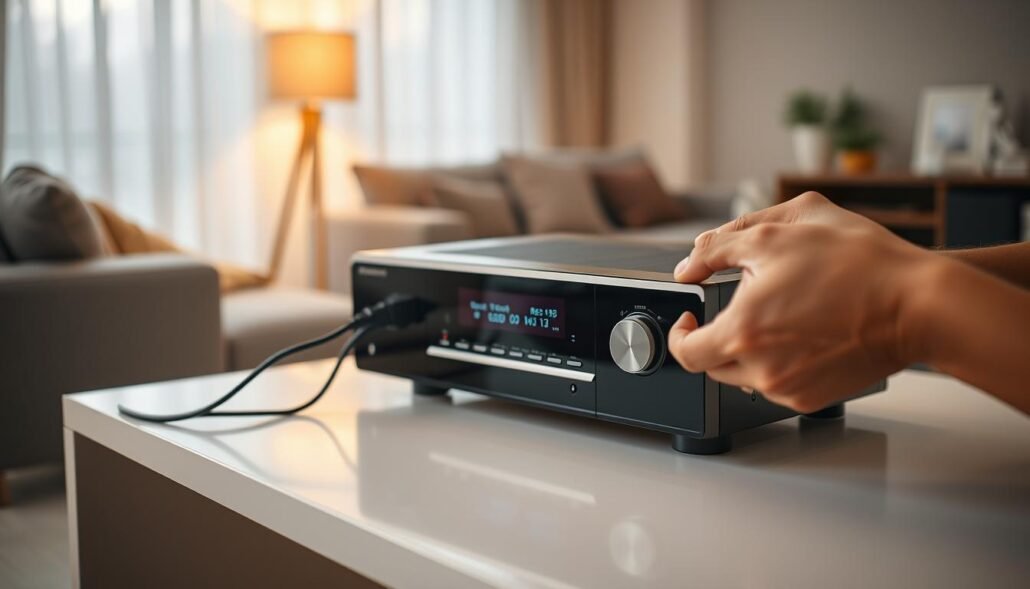
Why a power reset works: capacitors, handshake states, and frozen processes
Stored charge in capacitors and microcontroller states can hold partial configurations. Removing mains long enough forces firmware and hardware handshakes to reload at next boot.
When you might need a longer unplug: DVR/streaming boxes and stubborn HDMI states
If a DVR or streaming box is part of the chain, unplug both units and wait 2–3 minutes. Power the display first, the receiver second, then the source to rebuild EDID, HDCP, and CEC links.
- Persistent audio or video faults may need 5–10 minutes, especially with CEC/ARC issues.
- Ambient temperature, power supply size, and attached HDMI devices affect needed time.
- After any reboot, allow at least one full minute for HDMI and network initialization before testing.
| Scenario | Recommended wait | Why it helps |
|---|---|---|
| Simple menu freeze | 30–60 seconds | Discharges caps and clears transient states |
| Warm unit / large supply | 2–3 minutes | Ensures full residual power drain |
| CEC/ARC or multiple HDMI devices | 3–10 minutes | Allows all devices to drop stale handshake data |
For cost or upgrade planning, see the AV receiver cost guide for context when evaluating replacement vs. service.
Step-by-step power reset: the safest way to fully discharge and reboot your receiver
Start the power-reset process by preparing the unit and its connected devices so nothing feeds back during discharge. Switch the receiver to standby, photograph or label every connection, and gently remove HDMI and speaker loads.
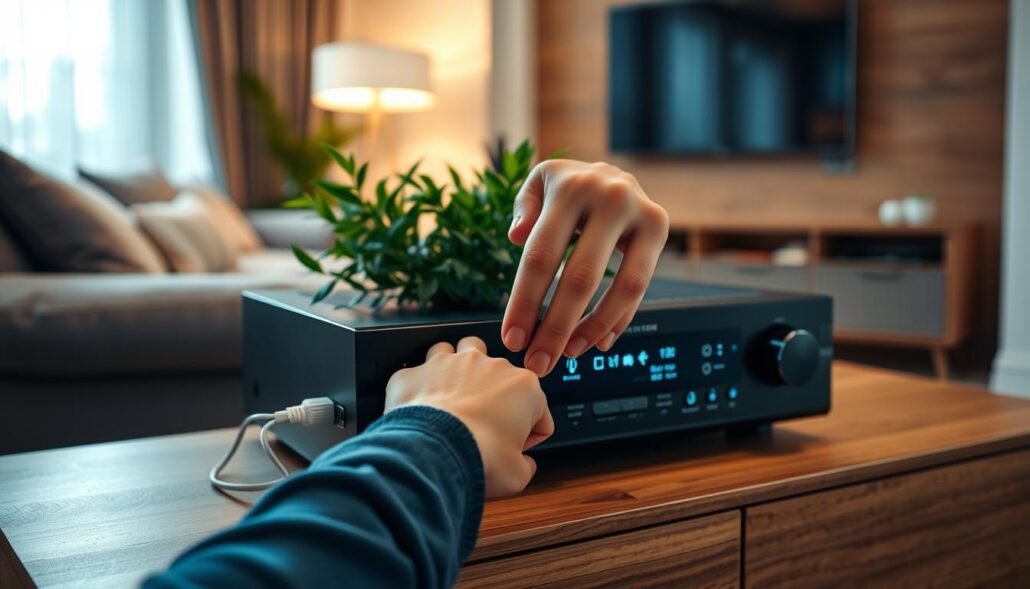
Unplug timing guidance
Choose unplug time based on symptoms. For minor freezes, wait 30–60 seconds. For stubborn handshake faults, wait 2–3 minutes, or 5–10 minutes for recurring HDMI issue patterns.
Reboot sequence
Plug the display in and power it on first. Next, reconnect the receiver and then each source one at a time. Reattach one HDMI cable, select its input, and confirm video picture and audio lock before adding the next.
Button-based soft reset vs full power cycle
If the model offers a soft reset via a dedicated button, try that first for a quick recovery. Reserve the full power cut when menus freeze, audio drops out, or inputs fail to respond.
Post-reboot checks
- Confirm input mapping, speaker config, and codec status on the on-screen menu.
- Verify protection lights and polarity to avoid shorts.
- Give the system a minute to finish network and HDMI initialization before stress-testing features.
If issues persist: HDMI, cable, and connection integrity checks that fix “no picture/no audio”
Persistent blank screens or dropouts often point to loose HDMI shells or marginal board contacts. Start with simple checks on every cable and port before opening the box.
Ensure each cable is fully seated and the backshell feels solid. Wiggle the plug gently; any wobble can cause intermittent picture or audio drops. Swap in a known-good cable if uncertain.
Inspect internal top HDMI board on Pioneer-style units
Remove side and rear screws, lift the back edge of the cover, then pull up and out toward the rear. Look for the forward-running HDMI cable that can loosen.
Reseat side connectors: Pull critical side plugs free and firmly reinsert them. Loose side connectors often cause missing audio channels while video looks normal.
Repair bent shields with care
If an external ground shield jacket is opened, remove the top board and very gently compress the HDMI outer surround with a settable clamp or adjustable ViceGrip. Limit jaw travel to avoid stress.
| Check | Action | Expected result |
|---|---|---|
| External HDMI fit | Seat cable, test for wobble | Stable picture and sound |
| Top board forward cable | Tighten internal plug | Restores lost signal paths |
| Side connectors | Remove and reseat firmly | Recovers missing audio outputs |
| Bent ground shield | Lightly compress shield with set clamp | Improves pin contact, reduces noise |
Reassemble carefully and test one source at a time. If the box works elsewhere but fails on one port, suspect port hardware or solder joints rather than the cable.
When a factory reset or service diagnostics is the right next step
If repeated cycles and cable checks do not fix symptoms, escalate to a model-specific hard reset or professional service. A factory restore removes user settings and can reveal whether the root cause is configuration or hardware.
Model-specific example: For many Integra and Onkyo units, turn the unit on, hold the CBL/SAT button, then press On/Standby until the display shows “Clear.” The unit will enter standby and the memory is wiped.
Satellite and cable box checks
Before changing account details, run diagnostics on the replacement box. With Dish Wally hardware, verify satellite signal and lock status in diagnostics. This confirms whether the new box fixes signal-loss.
- Document settings and calibrations before a reset; these are erased.
- Follow on-screen prompts after reset and test the original issue.
- If diagnostics show poor or no signal, inspect cabling, LNBs, and splitters upstream.
- When calling service, provide model, serial, firmware, and the button steps you tried to speed support.
| Scenario | Action | Why |
|---|---|---|
| Config corruption | Factory reset | Restores default firmware state |
| Suspected feed fault | Box diagnostics | Isolates upstream signal issues |
| Persistent fault | Contact service | Hardware inspection or repairs |
Note: Use factory reset as a last resort. If problems persist after a clean start and verified signal, professional repair may be required.
Conclusion
A simple power cycle and orderly reconnection often returns systems to normal operation.
Start with a timed cut of mains, wait the recommended span, then power devices back in order. Confirm inputs and speaker outputs before testing full features.
Escalate from visual cable checks to targeted reseating. A single marginal cable can mimic firmware faults. Swap suspect cables and use a different input when possible.
Use factory reset via the correct button sequence only after saving settings and eliminating external causes. If the problem remains, document each step and contact service with notes.
Routine things — certified HDMI, clean power, firmware updates, and cooling — reduce future faults. With this sequence and patience, most receivers return to stable operation without repair.
FAQ
How quickly does unplugging clear residual power in modern AV gear?
Most receivers and set‑top boxes clear most residual charge in about 30–60 seconds. This brief power removal lets capacitors discharge and stops frozen processes so the device can restart cleanly. For quick glitches like frozen menus or audio dropouts, this window usually works.
When is a longer unplug time recommended?
If the unit hosts a DVR, large capacitors, or persistent HDMI handshake faults, leave it unplugged for 5–10 minutes. That longer interval helps fully discharge power reservoirs and reset more stubborn states that short unplug cycles won’t clear.
Why does a power reset often fix picture or sound problems?
Power cycles interrupt hung tasks, clear memory buffers, and allow capacitors to discharge. They also force hardware and connected sources to renegotiate HDMI handshakes, which often restores lost picture, audio, or input switching.
What’s the safest step‑by‑step power reset procedure?
Turn the unit off, disconnect HDMI and speaker loads, unplug the power cord, wait the selected interval (30–60 seconds or up to 10 minutes), then reconnect power. Next plug HDMI and source devices back in, then power on in this order: receiver, then source devices, to reduce handshake errors.
When should I use the front‑panel reset button instead of unplugging?
Use a soft reset button for minor UI or playback freezes; it restarts firmware without full power removal. Choose a full power cycle (unplug) when the button doesn’t help, when HDMI handshakes fail, or when audio/video issues persist after a soft reset.
What checks should I run after rebooting?
Confirm picture lock, check audio output on expected speakers, cycle through inputs, and open on‑screen menus. Verify each source device powers on and displays correctly to isolate faults to a specific component or cable.
Could cables or HDMI ports cause recurring glitches despite resets?
Yes. Loose HDMI connections, damaged cable shields, or bent port pins can break handshakes and cause intermittent picture or audio loss. Inspect connectors, reseat cables, and test with a known‑good HDMI cable before pursuing deeper fixes.
Are there safe hardware tweaks to restore HDMI contact?
Simple remedies include firmly reseating cables and swapping ports or cables. Advanced steps—compressing a ground shield or reseating top HDMI boards—are delicate and best done by trained technicians to avoid further damage.
When is a factory reset or service call appropriate?
If power cycles, cable swaps, and soft resets fail, perform a model‑specific hard reset per the manual. If problems continue, contact manufacturer support or a certified service center; persistent faults may indicate hardware failure or the need for diagnostics.
Any model‑specific reset notes to know?
Some brands use button combinations for hard resets—examples include holding specific input buttons plus power until a display prompt appears. Always consult your receiver or cable box manual for exact steps to avoid unintended data loss.