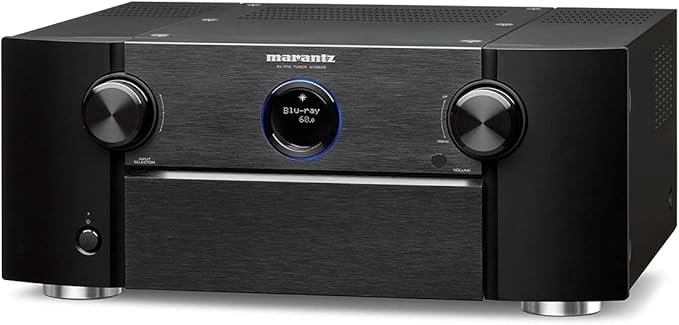
This introduction sets what the review will cover for US home theater buyers: real-world usability, how the receiver handles movies and music, and which buyers should consider this flagship in 2026.
The unit prioritizes hi‑fi-grade sound and clean power delivery over sheer channel count. Expect seven built-in amplifiers and up to sixteen channels of processing for larger setups that use external amps.
Key differentiators include Class G amplification, bundled Dirac Live room correction, and full HDMI 2.1 support for gaming and video. The review will test connections, setup flow, streaming, and everyday control.
Readers should be ready to weigh flagship-level execution and sound against trade-offs like fewer powered channels than some competitors. This section prepares you to judge performance, features, and real-world value.
Arcam AVR31 Review: Quick Take for Home Theater Buyers
If you’re deciding quickly, this section points to the ideal buyer and the core trade-offs to weigh.
Who this receiver suits in 2026
Ideal buyer: someone building a premium, theater-first system who also values two-channel music fidelity and hi‑fi behavior from their AVR.
Note: this is for buyers who prioritize sound quality and power delivery over packing the most built-in channels into one box.
Key strengths and trade-offs at a glance
- Strengths: refined tonal balance, strong immersive steering, bundled Dirac Live room correction, and modern HDMI 2.1 video features for movies and gaming.
- Trade-offs: only seven powered channels on board, so larger Atmos layouts generally need external amplification to add more channels.
- Value is aimed at quality and power, not maximizing built-in amp count—so you spend money on sound, not channel quantity.
Seven channels vs up to 16 channels of processing
The receiver provides seven channels of internal amplification to drive seven speakers directly. Processing can decode up to 16 channels (up to 9.1.6) and sends extra channels via pre-outs to external amps.
This means a single onboard channel handles one speaker; add external amplifiers when you need more active channels for immersive layouts.
| Feature | Onboard Amplification | Processing / Pre-outs |
|---|---|---|
| Maximum active powered channels | Seven channels | Up to 16 channels (requires external amps) |
| Best use | Core 7.1 or 5.1.2 / 7.1.2 setups with strong stereo performance | Large Atmos layouts (9.1.6), multi-amp systems |
| Room correction | Dirac Live included for onboard channels | Dirac can manage crossovers and levels across pre-outs |
| When to add amps | For more overhead or width speakers | When expanding to more than seven active speakers |
Quick advice: pair this AVR with capable speakers in a treated or calibratable room so Dirac can maximize results. If your plan is a coherent, high‑end system that can scale later, this architecture makes strategic sense.
Price, Value, and Where the AVR31 Fits in Arcam’s Lineup
Street pricing for flagship receivers varies, and this model lands firmly in the premium tier. U.S. list prices cited range from about $5,250 to $6,900, with real-world discounts often bringing the street price near $5,865.
Why is it placed at the top? The maker markets it as the platform’s highest execution. That means Class G amplification, heavier parts, and extra care to lower noise and improve dynamics at real listening levels.
Shared platform and close cousins
It shares core DAC and feature sets with the AVR21 model, so you get similar digital circuitry and user features. That common DNA explains why saving on the smaller sibling can still deliver strong audio results.
SDR-35 relationship and buyer advice
The JBL Synthesis SDR-35 is often cited as a close cousin in internal design. If HDMI 2.1 is not essential, the SDR-35 becomes a valid cross-shop for buyers who prioritize pure sound.
| Item | Typical U.S. Range | Buyer takeaway |
|---|---|---|
| List price seen | $5,250 – $6,900 | Flagship pricing; expect promotions |
| Street price example | ~$5,865 | Authorized-dealer discounts matter |
| Main premium addition | Class G amps & overbuilt power delivery | Lower noise, stronger control at volume |
Design, Build Quality, and Day-to-Day Usability
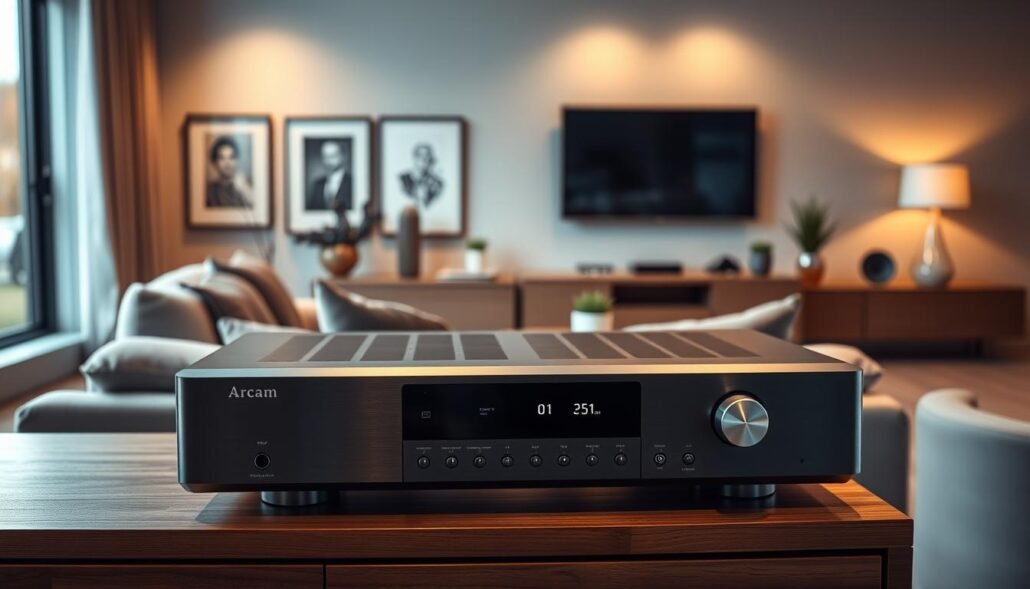
From the moment you touch the volume knob, the design intent is obvious. The dark gray, gunmetal chassis and silver controls feel sturdy and weighty. The front layout is clean and purposeful, with a tactile rotary control that is satisfying to use.
Front display and daily feedback
The large full-color display is genuinely readable from a listening position. It shows clear status, menu items, and album artwork when streaming content. This helps with quick checks without a TV.
Setup workflow and control tools
Expect no full-screen on-TV menu for deep setup. Basic wiring and network setup happen via the front-panel display. For faster, fuller configuration use the web GUI over Ethernet or Wi‑Fi.
- Connectivity: Ethernet, Wi‑Fi, Bluetooth antennas and standard inputs cover modern hookups.
- Control: Backlit remote is handy; note an “Amp” button quirk that takes practice.
- Software: Firmware and Dirac run over the network and have grown more stable with time.
| Area | What it delivers | Buyer takeaway |
|---|---|---|
| Build | Sturdy chassis, premium finish | Feels high quality in hand |
| Display | Full-color, artwork, status | Readable from seat; reduces TV reliance |
| Setup | Front-panel + web GUI | Great for enthusiasts; casual users may prefer guided on-screen menus |
| Control | Backlit remote, network updates | Powerful but with small usability quirks |
Connections and Video Features for Modern Systems
Connectivity defines how a modern home theater ties sources and displays into a single, seamless system.
This receiver provides seven HDMI 2.1 inputs and three HDMI outputs, one of which supports eARC. That lets you keep multiple consoles, streamers, and a UHD Blu‑ray player connected without swapping cables.
Inputs, outputs, and gaming-friendly video
With 8K/60 and 4K/120 support the unit handles next‑gen consoles and high‑frame PC gaming. VRR (variable refresh rate) reduces stutter. ALLM (auto low latency mode) lets consoles switch to low-lag output automatically.
HDR and format compatibility
HDR formats supported include Dolby Vision, HDR10+, HDR10, and HLG. That wide coverage improves playback across streaming apps, UHD discs, and set-top devices.
Legacy I/O and practical control
Older gear stays useful. There are coax and optical digital inputs, multiple RCA analog inputs, USB, Ethernet, and a built‑in Google Chromecast for streaming. RS‑232, IR, and trigger outputs simplify integration with custom control systems and external amps.
| Connection type | Count / Notes | Buyer benefit |
|---|---|---|
| HDMI 2.1 inputs | 7 inputs | Many sources can stay connected long-term |
| HDMI outputs | 3 outputs (1 with eARC) | Feed multiple displays; use eARC output for TV audio return |
| Video features | 8K/60, 4K/120, VRR, ALLM | High-frame gaming and smooth motion with low latency |
| HDR formats | Dolby Vision, HDR10+, HDR10, HLG | Broad compatibility with streams and discs |
| Legacy & control | Coax/optical, RCA, USB, Ethernet, FM/DAB, RS‑232, triggers | Supports older players and pro install workflows |
Bottom line: video capability here is future-ready while supporting the legacy gear many owners keep. That combination makes it easy to build a modern system without losing older sources.
Audio Architecture, Channels, and Power Delivery
Understanding the channel count and power delivery clarifies system trade-offs. This section explains why the design favors seven onboard channels, how Class G works in practice, and when adding external amplification makes sense.
How Class G amplification helps real rooms
Class G uses rail switching to supply extra voltage only when the music needs it. That lowers heat and improves efficiency compared with classic A/B designs.
Practical result: cleaner power delivery and more stable dynamics without constant high operating temperatures.
Why seven internal channels is a quality choice
Limiting the unit to seven channels lets engineers avoid compromises that appear when packing many amps into one chassis. Fewer onboard amps often mean better consistency and lower noise for the channels that are driven.
Power specs and real-room expectations
Published figures of about 120W per channel (2ch driven) and ~100W per channel with all channels driven translate to reliable headroom for most speakers. For typical 88–90dB sensitivity speakers at normal listening distances, this power level delivers clean dynamics and decent SPL without distortion.
If you have low-sensitivity speakers, a large room, or sit far from the front row, external amplification will buy needed headroom.
Immersive decoding and expandability
The processor supports Dolby Atmos, DTS:X, Auro-3D, and IMAX Enhanced and can scale up to 9.1.6 when additional outputs are amplified externally. Use the pre-outs to route surplus channels to outboard amps for larger layouts.
- When to add amps: expanding beyond 5.1.2 or 7.1, powering demanding front L/R speakers, or increasing headroom in big rooms.
- Paths to expand: PA410 for four extra surround/height channels; PA240 to boost two-channel front power; PA720 for driving a full bed layer.
- Hi‑fi credibility: dual ESS ES9026PRO DACs prioritize stereo refinement for music alongside immersive movie decoding.
| Topic | Specification / Option | Buyer takeaway |
|---|---|---|
| Onboard amplification | Seven channels, Class G | Better per-channel performance and thermal control |
| Power (spec) | ~120W/ch (2ch), ~100W/ch (all driven) | Suitable for most speakers; external amps for lower sensitivity or larger rooms |
| Immersive formats | Dolby Atmos, DTS:X, Auro-3D, IMAX Enhanced to 9.1.6 | High flexibility when paired with external amps |
| External amp options | PA410 (4ch), PA240 (2ch), PA720 (7ch) | Clear upgrade paths for more speakers or more headroom |
| Digital conversion | Dual ESS ES9026PRO DACs | Refined stereo performance for music playback |
For buyers weighing multi-channel flagships, consider system goals first. If you want more built-in outputs, compare options and read a side-by-side comparison for broader context: equipment comparison and integration tips.
Dirac Live Room Correction and Bass Integration
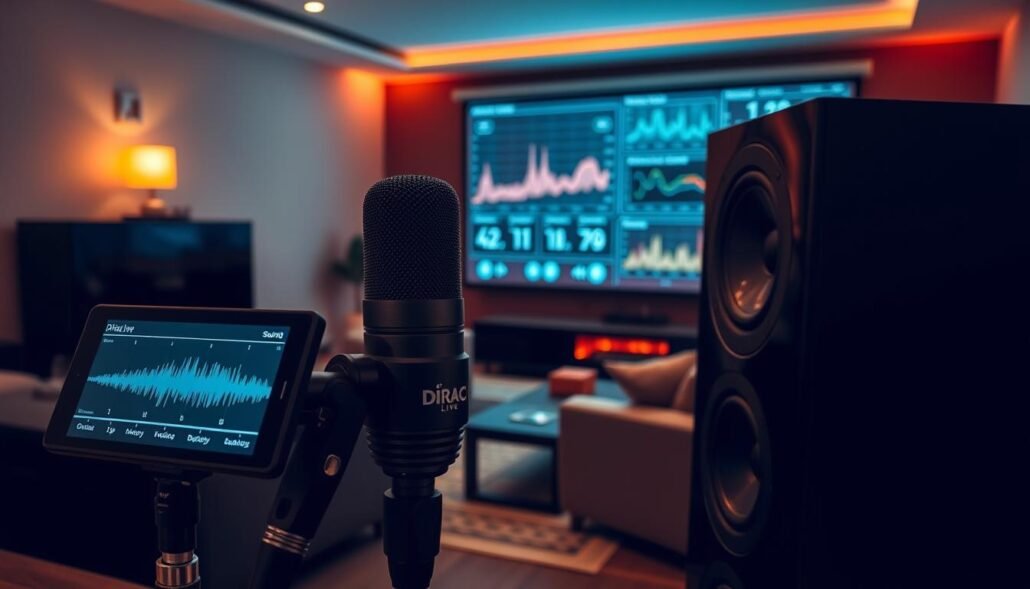
Dirac Live ships with a full license and a calibrated microphone, so room correction is ready at setup. That means correction is not an optional add-on; it’s part of the package.
What you get and how it differs from manual setup
The box includes the Dirac Live license and the calibrated microphone for measurements. Use Dirac to target impulse response and phase for tighter imaging.
Manual tuning still matters. You control distances, levels, crossover points, and slope selection (12/24/36/48 dB/oct). Those settings handle fundamentals the correction builds on.
Bass control and upgrade choices
Dirac Live Bass Control is an optional paid upgrade (single-sub pricing starts around $349). Choose it when you add multiple subwoofers or need advanced bass alignment.
For one well-placed sub, standard Dirac often gives very good bass integration. For multi-sub arrays, Bass Control optimizes phase and output across subs for smoother low end.
Practical tips for better results
- Measure from several listening positions if you want a sofa-wide sweet spot; up to three Dirac profiles can be stored and assigned to inputs.
- Avoid holding the microphone near reflective surfaces and keep the room quiet during sweeps.
- Adjust manual crossover slopes and points after a baseline Dirac run to fine-tune subwoofer blend with front speakers.
| Item | Included | When to upgrade |
|---|---|---|
| Dirac Live license | Included | Never required to enable basic correction |
| Calibrated microphone | Included | Use for all measurement profiles |
| Bass Control | Optional (≈$349 for single sub) | Recommended for multi-sub or complex rooms |
Expect tangible benefits: tighter bass, clearer dialogue, and a more coherent immersive soundstage. Use multiple profiles for music vs movie tuning and assign them to inputs for quick switching.
Performance Testing: Movies, Atmos, and Music Streaming
Testing for real-world movies, immersive mixes, and streaming music reveals strengths that specs alone cannot show.
Dolby Atmos object placement and movement
The processor places overhead objects with clear precision in demanding scenes. Effects move smoothly around and above the listener, creating a believable immersive bubble rather than a smeared wash.
Dynamics and action clarity
Class G power helps action peaks land with authority. Explosions and chase sequences hit hard while quieter passages retain micro-detail and layering.
Dialogue, imaging, and room correction impact
Dialogue stays intelligible even when the mix is busy. Voices remain anchored and easy to follow during complex scenes.
With room correction, imaging tightens and the soundstage coheres better once levels are matched. Pure Direct still appeals to stereo purists who want the most uncolored two-channel sound.
DTS:X and IMAX Enhanced behavior
DTS:X steering feels precise, with good low-end impact when the sub is properly integrated. IMAX Enhanced tracks retain weight and scale, giving strong bass and directional cues.
Music playback and streaming
As a music player the unit shows fast transients, balanced tonal character, and a stable stereo image at normal listening levels.
Streaming support is broad: Chromecast, AirPlay 2, aptX HD Bluetooth, Spotify Connect, Roon Ready, and Tidal Connect make playback seamless across devices and services.
| Area | What to expect | Real-world example | Buyer takeaway |
|---|---|---|---|
| Atmos placement | Precise object localization | Dune dust-storm overhead movement | Believable 3D envelope for movies |
| Action dynamics | Controlled, punchy peaks | No Time to Die Matera chase | Feels powerful without harshness |
| Dialogue & imaging | Clear, anchored voices | Tenet dense mixes | Crisp speech even in busy scenes |
| Music & streaming | Fast transients, clean stereo | Tidal/Roon tracks, hi‑res files | Works as a serious two-channel source |
Alternatives, Comparisons, and Buying Advice
Your room, speakers, and upgrade path will tell you whether to spend more for refinement or for channel count.
AVR31 vs AVR21: who should save or upgrade
Save with the AVR21 if most listening is casual and you want core features and similar DACs while keeping more money for speakers.
Upgrade to the AVR31 when stereo quality matters most and Class G power delivers a noticeable tonal and dynamic improvement for music and demanding movie peaks.
SDR-35 cross-shop: sound trade-offs
The SDR-35 can sound a touch more dynamic and lively in some setups. That extra punch might appeal to action-focused listeners.
But missing modern HDMI features can be decisive for gamers. If console latency and HDMI 2.1 outputs matter, factor that into the decision.
Mainstream flagships with more powered channels
Receivers offering 11–13 powered channels gain convenience: fewer external amps and simpler wiring.
You may give up per-channel sonic refinement and the thermal headroom that a fewer‑channel, higher‑quality design provides.
System matching and channel planning
| Layout | Typical need | When AVR31 forces external amps |
|---|---|---|
| 5.1.2 | Seven channels usually enough | Not required |
| 7.1.4 | More heights or surrounds | External amps for extra four channels |
| 9.1.6 | Large immersive systems | External amplification required |
- Speakers: Sensitive speakers (88–92 dB) make the receiver feel effortless; low-sensitivity models or large rooms benefit from early amp upgrades.
- Power & outputs: Use pre-outs to add amps for demanding front channels or extra heights.
- Subwoofer strategy: Focus on placement and calibration. Proper crossover points and Dirac or manual tuning often matter more than sub brand when room modes dominate.
Buy advice: choose based on your room, speaker load, and upgrade plan—not just channel count. If you value long-term expandability and top-tier stereo, invest in refinement. If you want many powered channels in one box to save on wiring and immediate amps, consider mainstream flagships instead.
Conclusion
strong, The avr31 lands as a premium receiver that acts like a high-end stereo amp while still delivering modern immersive performance.
Its core strengths are clear: Class G amplification for cleaner dynamics, included Dirac Live room correction, and robust HDMI 2.1 video features that matter for current sources.
The main compromise is the seven built-in channels; many large Atmos layouts will need added amplification via pre-outs. That affects system planning and budget.
Final advice: prioritize this unit if sound quality and scalability matter. Plan your channel layout, confirm HDMI 2.1 needs, and budget for external amps if you aim for bigger Atmos configurations.
FAQ
What channels and amplification does this receiver provide?
The unit offers seven onboard Class G amplifier channels. It processes up to 16 channels for complex layouts but only powers seven without external amps. For larger Atmos setups or to bi‑amp front speakers, add external amplifiers such as the PA410, PA240, or PA720.
Does it support HDMI 2.1 features for gaming and 8K video?
Yes. The receiver includes HDMI 2.1 inputs and outputs with eARC support, 8K/60 and 4K/120 passthrough, VRR, and ALLM, so it handles modern consoles and high‑frame‑rate sources.
Which HDR formats are supported?
It supports Dolby Vision, HDR10+, HDR10, and HLG, covering the major dynamic and static HDR standards used by streaming services and UHD discs.
Is room correction included and what does it do?
Dirac Live room correction is included along with a calibrated measurement microphone. The system corrects time and frequency response, lets you set crossover and slopes, and can be upgraded to Dirac Bass Control for multi‑subwoofer integration.
How much power can I expect per channel in a real room?
Rated power is roughly 100–120 watts per channel under typical listening conditions. Real‑world output varies with speaker impedance and room acoustics; Class G focuses on dynamic headroom and low distortion rather than huge continuous power numbers.
What digital-to-analog converters are used and how is stereo quality?
The unit uses dual ESS ES9026PRO DACs, giving strong hi‑fi credentials in stereo playback. Expect clean imaging, good transient speed, and musical tone when used for two‑channel listening.
How well does it handle Dolby Atmos and object-based mixes?
Object placement is precise and immersive in demanding scenes, with solid low‑end control and clear overhead rendering. Dirac further tightens imaging and dialogue focus when properly set up.
What streaming and network options are available?
The receiver supports Google Chromecast, Apple AirPlay 2, Bluetooth (aptX HD), Spotify Connect, Roon Ready, and Tidal Connect, covering most streaming workflows and multiroom use.
Are legacy inputs and control ports present?
Yes. You get coaxial and optical digital inputs, analog RCA, USB, Ethernet, FM/DAB tuners, RS‑232, and 12V trigger outputs for integration with legacy gear and automation systems.
Do I need a professional to set up Dirac Live and bass management?
You can run Dirac Live yourself with the supplied microphone and guidance. For complex multi‑sub or multiroom installs, a pro can optimize measurement positions, create multiple profiles, and configure Dirac Bass Control for best results.
How does it compare to more channel-heavy flagships?
Compared with receivers that power more channels internally, this model trades onboard amplification count for higher‑quality Class G output on seven channels and premium processing. If you need native power for 11–16 channels, expect to add external amps.
Is this a good choice for a mixed music and movie system?
Yes. The design balances home theater decoding and hi‑fi stereo performance. The DACs, Class G amps, and Dirac tuning provide musicality for two‑channel listening while delivering immersive movie sound.
What should I budget for to complete a system with this receiver?
Factor in quality speakers, at least one down‑firing or height pair for Atmos, one or more subwoofers, and possible external amplifiers if you want more powered channels. Also allow for calibration time or pro setup if you opt for advanced Dirac Bass Control.
Can I use multiple subwoofers and does room correction manage them?
Yes. Multiple subwoofers improve room modal response. The Dirac Bass Control upgrade helps time-align and level them for smoother low‑frequency output, or you can manage sub crossover and levels manually within the receiver.
How user friendly is the setup and daily control?
Setup mixes a front‑panel display with a web GUI rather than a full on‑screen menu. It’s straightforward once you learn the workflow, but some users prefer a full on‑screen interface for quicker adjustments during daily use.