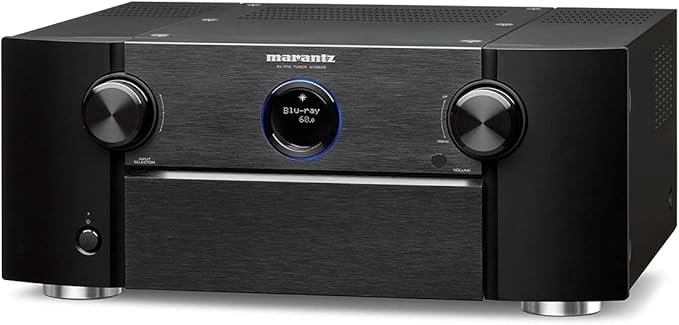
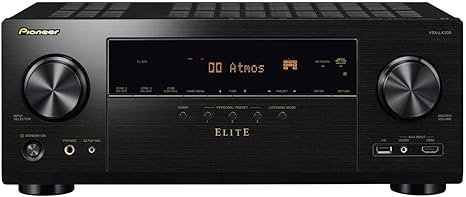
This introduction sets expectations for a hands-on look at a 15-channel flagship that aims to be an all-in-one heart for serious home theaters.
We focus on measured performance, daily usability, and value compared with separates and other high-end receivers. Lab numbers, real listening, and installation notes shape our view.
The unit pairs true 15-channel amplification with 15.4 processing and seven HDMI 2.1 inputs supporting 8K/60 and 4K/120. Measured two-channel power sits near the rated 150Wpc, and DAC testing shows clean audio metrics.
At $6,499 and built in Japan, this flagship targets enthusiasts who want many channels, four independent subwoofer outputs, robust room correction, and integration without adding multiple amps.
We will weigh lab-confirmed performance, thermal and installation considerations, and how the platform behaves with movies, Atmos tracks, and stereo music to judge overall value.
Why this flagship matters in 2025: who the Denon AVR-A1H is really for
This flagship targets home theater enthusiasts and integrators who want one chassis to drive large, complex speaker systems.
With 15 amplified channels and 17.4 processing, it enables layouts up to 15.1 Atmos or 13.1 Auro‑3D. That flexibility suits medium-to-large rooms that benefit from front wides and multiple overheads.
Practical power needs favor this design: a 900W supply and ~70 lb chassis provide stable delivery, and real-world playback rarely demands full output from every speaker at once. Estimated continuous power per channel with all channels driven sits lower, but dynamic content spreads peaks across the system.
Who should consider it? Movie-first cinemas, multi-console gamers using 4K/120 and 8K/60 sources, and integrator projects that need many inputs and robust video bit handling in a single rack-friendly receiver.
- Room fit: Best for purpose-built or larger lounge cinemas.
- Upgrade horizon: Keeps systems relevant across video and audio format changes for years.
- Practical note: Smaller rooms may find extra channels excessive unless future expansion is planned.
Design, build, and what’s under the hood
A rugged, well-braced enclosure signals this unit was engineered for continuous multi-channel use. Built at the Shirakawa Audio Works in Japan, the chassis weighs 70.5 lb and uses heavy internal bracing to cut vibration and support the large transformer and capacitor bank.
Made in Japan pedigree and heavy chassis
Quality control at Shirakawa means consistent assembly and long-term reliability. The deep, braced frame and substantial mounting points make rack planning essential; two people and strong shelving are recommended for safe installation in a home theater.

Power supply, transformer, and capacitor upgrades
The new amp module uses a high-current 4-pin transistor with an integrated thermistor for auto-biasing. This helps the amplifier stay stable as it warms, keeping performance consistent across listening sessions.
- Transformer: an E-Core unit (~25.4 lb) mounted on a 2mm copper plate; ~41% heavier than prior X8500H.
- Reservoir caps: custom Nichicon 33,000 µF four-pole units, larger than the 22,000 µF parts in earlier flagships.
- Outputs: 15 internal amps for 15 channels and four independent subwoofer outputs; balanced XLR stereo input on the rear.
| Component | Current Unit | Prior Flagship |
|---|---|---|
| Transformer weight | ~25.4 lb | ~18.0 lb |
| Reservoir capacitance | 33,000 µF (four-pole) | 22,000 µF |
| Measured two-channel output | ~175 watts clipping headroom | Closer to rated spec |
| Channels (amplified) | 15 | Varies by model |
These upgrades lower internal impedance to transient demands and translate into steady output when many speakers are active. Thermal management relies on large heatsinks and quiet fans, so allow proper ventilation for class AB operation.
Bottom line: the build choices favor durability and a wide operating range for demanding multi-channel playback over many years.
Connectivity and HDMI 2.1 for 8K home cinema and gaming
All modern sources plug into a comprehensive HDMI array that handles both high-frame-rate gaming and 8K video effortlessly. The unit offers seven HDMI 2.1 inputs and three outputs (two main, one Zone 2), each able to pass 8K/60 and 4K/120 with HDR10, HDR10+, Dolby Vision, and HLG.
Next‑gen HDMI features and gaming
ALLM, VRR, and QFT are supported for low latency and smooth motion during gaming. eARC simplifies audio from TV apps and improves lip-sync accuracy via Auto LipSync.
What’s present — and what’s missing
Every input implements full HDMI 2.1 bandwidth, but QMS is not included. That omission affects channel mapping for certain studio-grade sources, though most users will not notice day-to-day.
Analog, digital, streaming, and control
The analog/digital complement includes five stereo inputs (four RCA, one RCA/XLR), two optical, two coaxial, phono (MM), AM/FM, Bluetooth, Wi‑Fi, and Ethernet. A balanced XLR stereo input supports premium DACs or studio gear.
- HEOS multiroom streaming and a redesigned 1080p setup UI improve stability and discovery.
- Control integration via SSDP (Control4) and assignable inputs/outputs make Zone routing flexible.
- Dirac Live works via license, and stable HDMI handshakes help room-correction workflows.
Channels, amplification, and power delivery in the real world
How an AVR allocates watts across many speakers shapes loudness and headroom in a home theater.
15.4 processing, 15 amps, and four sub outputs
The unit processes up to 17.4 channels but provides 15 on-board amps. That lets a 9.4.6 layout run without extra amplification while still offering four independent subwoofer outputs for flexible bass routing.
Two-channel rating vs. multi-channel reality
The published spec is 150 watts per channel at 8 ohms into two channels. Engineering shows clipping near ~175 watts and a 900W internal supply that helps with short bursts.
- Continuous full-load estimates drop — roughly 30 watts per channel if all 15 run at steady output.
- Denser movie dynamics and short peaks mean burst capability is more relevant than sustained watts.
- Independent sub outputs offload low-frequency demand, freeing mid/high amp capacity for clearer sound.
| Aspect | Two-Channel | All Channels Active |
|---|---|---|
| Rated output | 150 watts (8Ω, 2ch) | ~30 watts (est. continuous) |
| Peak capability | Clipping near ~175 watts | Burst-dependent; supply and caps support transient peaks |
| Subwoofer handling | Internal subs share load | 4 independent outputs reduce amp LF demand |
Use efficient speakers and moderate listening distances to maximize perceived loudness and keep clean headroom. For the most demanding front pairs, engage preamp mode and add external amps while letting the AVR drive surrounds and heights.
Lab-backed performance: DAC and amplifier measurements
Lab measurements pin down how the DAC and amplifier behave under realistic home playback conditions. Tests used the latest firmware and preamp mode so the volume reference stayed consistent (82.5 = 2V RCA, 4V XLR).
DAC testing showed a third-harmonic-limited SINAD with solid dynamic range and very low-level jitter sidebands. These jitter artifacts sit well below audibility, and the dual-bit architecture delivers reliable bit depth across typical program material.
The default DAC filter gives limited out-of-band attenuation, which raises THD+N near the top end of the audioband. In practice this has little real-world impact for movies and music, but it explains higher measured distortion at extreme frequencies.
Amplifier and system
Amplifier tests via Toslink (ECO off) yielded about 157 watts into 8 ohms at 0.1% THD in two-channel mode, with healthy burst headroom at 1% THD. Wideband frequency sweeps across ten points showed stable output with minor roll-off at band extremes — typical for class AB designs.
Reassigning sub XLR outputs as mains increased distortion, so RCA preouts measure cleaner for critical stereo paths. Analog inputs measured slightly worse than digital, confirming the digital path’s edge for the lowest noise and distortion.
- Key points: consistent level calibration, respectable SINAD, and inaudible jitter.
- RCA preouts preferred over repurposed sub XLRs for main channels.
- Crosstalk is acceptable for a dense multi-channel receiver but not class-leading.
| Measurement | Result | Implication |
|---|---|---|
| SINAD (DAC) | Third-harmonic limited, strong | Good clarity for theater use |
| Output (2ch, 8Ω) | ~157 watts @ 0.1% THD | Clean 150Wpc-plus performance |
| Burst headroom | Higher at 1% THD | Handles dynamic peaks |
| Crosstalk | Moderate | Acceptable for AVR channel density |
Conclusion: These measurements match what you expect from a flagship class AB receiver with a modern ESS-based DAC. The objective results translate into predictable, controlled sound and reliable level alignment for tuning and real-world listening.
Room correction: Audyssey MultEQ XT32 vs Dirac Live
Room calibration can dramatically change what you hear. The AVR includes Audyssey MultEQ XT32, and you can fine-tune curves with the MultEQ Editor app for about $19.
Licensing and workflows differ. Dirac Live is optional and costs roughly $259 for up to 500 Hz or $349 for full-range. Dirac Live Bass Control may not be available at launch, so check current compatibility before purchase.
Practical setup and preset strategies
Audyssey is fast and budget-friendly for routine setup. The Editor app adds target curve tweaks and max filter limits.
Dirac Live offers deeper filter shaping and mic-position management for advanced results. It often smooths upper mids and highs in mixed speaker arrays and ceiling channels.
- Two stored presets: switch profiles for different content like Atmos vs Auro‑3D or standard vs directional bass.
- Hybrid workflow: run Audyssey first, then compare a Dirac profile to hear incremental gains.
- Mic and band guidance: use varied mic spots, respect Schroeder limits, and avoid over‑EQing below the room’s modal region.
| Aspect | Typical result |
|---|---|
| Bass control | Audyssey often tighter in bass‑challenged rooms |
| Top-end clarity | Dirac Live refines upper-mid/high detail |
| Workflow | Audyssey = quick; Dirac = deeper control |
Both systems improve localization and imaging when used thoughtfully. Verify target curves, levels, and re-check after moving speakers or furniture to confirm results for your home system.
Bass management and subwoofer outputs
Bass routing and sub placement shape how a system delivers impact and smooth low end.
The receiver offers four independent XLR subwoofer outputs, each with adjustable crossover, level, and delay. Use those per-output controls to align timing and phase so the low end integrates with your main speakers and the listening position.
Standard vs Directional: when each helps
Standard mode sums low frequencies to all subs. After calibration this usually gives the smoothest in-room response because multiple subs average room modes and reduce peaks.
Directional Bass routes LF from each channel to the nearest sub. It can improve impact for tiny satellites or when you must crossover at high points (like 150 Hz). Use it sparingly to avoid perceptible localization.
Practical crossover and placement advice
- Start near 80–100 Hz for most speaker/speaker combos; move higher for very small satellites.
- Note the jump from 120 to 150 Hz — measure at listening point to confirm integration at that point.
- Place subs on opposing walls or front/back pairs to smooth modes before heavy EQ.
- A dedicated bass shaker output can drive haptic transducers without changing the main sub array tuning.
| Control | Benefit | Note |
|---|---|---|
| Crossover | Defines LF handoff | Adjust and measure |
| Level & Delay | Time-align and balance | Per-output tuning |
| Routing mode | Standard vs Directional | Save presets to A/B |
Finally, avoid using XLR subwoofer outputs as mains preouts for critical channels; those paths measured higher distortion in lab tests. Save two presets — one Standard and one Directional — so you can A/B and pick what suits your home and room best.
Setup experience and system flexibility
Setup is driven by a clearer 1080p GUI and a step-by-step wizard that reduces common mistakes. The guided flow walks you through speaker detection, amp allocation, and room checks so initial configuration goes quickly.
Speaker maps up to 9.4.6: examples that make sense
Start with a 5.2.4 layout for most living rooms. It balances front imaging and height effects without extra wiring.
Move to 7.2.4 when you add rear surrounds. Use 9.4.6 for large cinemas with dedicated row seating and wide soundstage.
Bi-amping, zones, preamp mode, and XLR reassignment
Bi-amping front L/R helps when you need more headroom at the mains. If heat or space is a concern, repurpose those amp channels for extra surrounds or heights.
- Preamp mode: bypass internal amps for select channels and run a separate amp for LCR.
- XLR reassignment: convert four balanced sub outs to LCR preouts for a clean, balanced feed to a 3‑ch amp.
- Zone 2: audio and video matrixing allows shared sources and independent control in a second room.
| Use case | Benefit | Tip |
|---|---|---|
| Front wides | Broader stage | Avoid blocking walkways |
| Bi-amp fronts | More headroom | Consider external amp quality |
| XLR preouts | Balanced LCR feed | Keep AVR for surrounds |
Assign inputs with custom names and default modes in the GUI. Save two presets after tuning so you can compare maps and avoid room-specific interference with ceiling speakers.
Denon AVR-A1H Review: movie and Dolby Atmos listening impressions
Overall listening showed confident control and cinematic scale. The system delivered explosive dynamics with no congestion, keeping microdetail audible during busy scenes. Transient snap stayed tight and fast, so punches and percussive hits sounded precise.
Dynamics, imaging, and height performance
Dolby Atmos tracks with properly placed overheads expanded vertical envelopment and widened the perceived room boundaries. Native Atmos playback (Nightmare Alley via Apple TV+ on Roku) produced convincing distance cues: rolling thunder felt distant and layered, while interior ambience scaled naturally.
Upmixing well-mastered DTS‑HD MA 5.1 to Atmos grew venue realism without smearing directionality. Channel steering was accurate in dense mixes, and consistent timbre across speakers helped pans and flyovers remain seamless.
- System gain let listening reach reference-like SPLs (>85 dB) without harshness.
- Directional bass added tactile punch only with very small satellites at a 150 Hz crossover; Standard mode usually integrated better with subs.
- HDMI handled Dolby Vision and streaming inputs without handshake or lip-sync issues.
Practical note: an observed volume limit stopped exposure around 86.5 on the scale. Check protection and max volume settings during setup if you see similar behavior.
For a consistent home cinema experience, use careful speaker placement, consider Dirac Live tuning when needed, and save presets after dialing bass routing. The result is a refined, engaging sound that keeps movie nights compelling.
Stereo and streaming performance
Stereo listening revealed an intimate, well-focused soundstage with surprising microdetail retrieval. The center image stayed stable while width and depth felt believable across genres.
Tonal balance held up at low and high level. Transient edges stayed crisp and dynamic contrast remained natural, so vocals and percussion kept their bite without sounding harsh.
Integrated subs extended low-end reach without muddying midrange. Two-channel playback with the subwoofer engaged maintained scale for orchestral and bass-heavy tracks.
- Use the balanced XLR input for a clean feed from an external DAC when you want purist two-channel sessions.
- HEOS and AirPlay 2 made streaming stable, and the app navigation was responsive for library browsing.
- Optimize inputs and source trims to keep perceived level consistent across streaming and disc playback.
Dirac Live vs Audyssey: test both in stereo profiles. Dirac can refine upper-band balance on mixed speaker arrays while Audyssey often provides tighter bass control.
| Feature | Dirac Live | Audyssey |
|---|---|---|
| High-frequency shaping | Precise | Moderate |
| Bass control | Good with tuning | Tighter by default |
| Workflow | Deep | Faster |
For small rooms, nearfield listening reduces room interaction and speeds clarity. Toe-in and speaker distance adjustments tighten imaging and cut boundary reflections. Overall, this receiver is more than a surround-first thing; it rewards critical stereo listening over time.
Heat, efficiency, and installation considerations
A big transformer and class AB amplifier architecture make thermal planning an essential part of installation.
Why it gets warm: class AB topologies and a 900W supply convert unused energy into heat more than many class D designs. That means the amplifier will radiate steady warmth during long playback and multichannel bursts.
Plan ventilation in the cabinet or rack. Leave generous clearance above and to the sides, and use active rack cooling if space is enclosed.
- Pre-cool the room before an extended session to limit idle heat buildup.
- Keep cables tidy and away from heatsinks to prevent hotspots above the transformer.
- Run an Eco mode for energy savings when idle, but disable it during critical listening or calibration tests.
- Offload LCR to an external amp to reduce internal amp stress and run the AVR cooler when many channels are active.
| Concern | Action | Note |
|---|---|---|
| Hot cabinet | Active fans / open shelf | Fans may run frequently under load |
| Rear clearance | Allow service loops | Supports cabling and heat escape |
| Dust | Periodic cleaning | Maintain intake/exhaust flow |
Measure shelf temperature with a probe and verify fan cycling during a full multichannel test. Expect internal fans to be quiet at typical listening levels, but rack fans might be heard depending on placement.
Price, warranty, and value versus separates and rivals
Cost, warranty length, and upgrade paths determine value for a multi-channel home cinema centerpiece.
List price sits at $6,499 with a five-year warranty. That warranty adds tangible long-term support compared with many receivers and pre/pros that offer shorter coverage.
Compare street numbers: Marantz AV 10 ~ $7,000, Anthem AVM 90 8K ~ $7,499.99, and Trinnov Altitude16 near $18,500. Those pre/pro options need multiple external amps, cabling, and rack space, which raises the total build price fast.
Cost breakdown and practical tradeoffs
- The all-in-one route reduces cabling, integration time, and the number of separate amps to buy and rack.
- Adding equivalent external amps to match 15 channels often doubles or triples cost depending on watt targets and brand.
- Dirac Live license pricing ($259–$349) is an extra consideration when comparing tuning workflows and perceived value.
Who benefits most
This AVR suits owners who want a clean, lower-complexity way to drive many speakers now, with the option to add a high-current amp later for LCR using preamp mode and XLR reassignment.
| Item | All-in-one AVR | Pre/pro + amps |
|---|---|---|
| Typical entry price | $6,499 | $7,000–$18,500 + amps |
| Warranty (years) | 5 | Varies (often 1–3) |
| Integration cost | Lower (fewer cables/space) | Higher (rack space, cabling, labor) |
| Upgrade path | Preamp mode + XLR reassignment | Modular; high-current amps available |
Bottom line: For most users who need many channels, modern inputs, and robust outputs without the complexity tax, this approach is a cost-effective way to access reference-level features and flexible upgrade options.
Conclusion
In short, this flagship blends high channel density, reliable power, and modern HDMI video into a single, rack‑ready package that handles complex amplification and many output pathways.
Listening proved strong dynamics, precise imaging, and wide staging in both dolby atmos mixes and stereo audio. Lab numbers back the sound: the two‑channel output sits near 157W into 8Ω at 0.1% THD and the DAC shows competent behavior for critical playback.
Plan the setup and room ventilation, and consider external amps for very demanding fronts. Use Audyssey for bass management, test Dirac for upper‑band polish, and save presets to compare tuning choices.
The result is a practical way to reach reference performance without separates. For home theaters that need many channels and future‑ready hdmi, this receiver is a compelling option in 2025.
FAQ
What makes this flagship AVR stand out for 2025 home cinema?
The unit combines wide channel processing with heavy-duty amplification and modern HDMI 2.1 features. It supports 15.4 processing, up to 15 amplified channels, multiple subwoofer outputs, and full 8K/60 and 4K/120 video paths. That mix targets serious home theater builds that need an all-in-one solution rather than separates.
How many amplified channels and processed channels does it support?
It provides 15 amplified channels and 15.4 processing, allowing complex speaker layouts such as 9.4.6. That lets installers configure high-channel Atmos systems and still run multiple subs and zones without external amplifiers in many setups.
What are the HDMI capabilities and video features?
The AVR offers multiple HDMI 2.1 inputs and outputs with eARC support, 8K/60 and 4K/120 passthrough, Dolby Vision and HDR10+, and common gaming features like ALLM, VRR, and QFT. Note that it does not include QMS, so fast source switching may vary by device.
How much power does the amplifier deliver in real-world listening?
Rated at around 150 watts per channel into 8 ohms for two-channel operation, real-world all-channels-driven power will be lower. Measurements show strong burst and dynamic headroom, but sustained power across 15 channels will depend on speaker load and room acoustics.
Does it include room correction, and which one performs better?
It ships with Audyssey MultEQ XT32 for room correction and supports optional Dirac Live on certain configurations or firmware. Audyssey tends to control bass well in many rooms, while Dirac often delivers smoother highs and tighter midrange when properly tuned.
How many subwoofer outputs are available and are they assignable?
There are four balanced XLR subwoofer outputs. Each can be assigned and managed independently for placement, level, and crossover strategies, which helps even out low-frequency response in larger or acoustically challenging rooms.
Is there balanced connectivity for stereo sources and preamp use?
Yes. The unit includes balanced XLR stereo inputs and full preamp outputs, enabling direct integration with high-end sources, outboard processors, or power amplifiers. Preamp mode and XLR reassignment increase flexibility for separates-based systems.
How does the built-in DAC and amplification measure in lab tests?
Lab measurements indicate healthy DAC SINAD and dynamic range, low jitter, and robust amplifier performance with good burst power and frequency sweep stability. The design shows Class AB traits with excellent transient behavior and modest crosstalk consistent with high-channel designs.
Will this AVR run hot, and what should installers consider?
With a heavy transformer and big chassis, it generates substantial heat under full load. Plan for ventilation, avoid tight cabinetry without airflow, and consider rack cooling for built-in installations to maintain reliability and performance.
How easy is setup for complex speaker maps like 9.4.6?
The setup menus support advanced speaker maps and presets. While the wizard covers basic calibration, configuring high-channel layouts, bi-amping, and routing requires time and understanding of crossover and level alignment to get optimal results.
How does it perform for stereo music and streaming?
Stereo imaging and transient response are strong, thanks to the robust power section and quality DAC implementation. Built-in streaming options (HEOS, Ethernet/Wi‑Fi) offer convenience and good sonic fidelity for most listeners, though audiophiles may prefer external streamers for critical listening.
Should I choose this AVR instead of separates from Marantz, Anthem, or Trinnov?
The integrated approach offers value for those who want a single chassis to handle many channels and room correction. High-end separates still win on ultimate flexibility and incremental performance, but this unit competes well versus rivals like the Marantz AV10, Anthem AVM models, and even some Trinnov-based systems when total system cost and installation complexity are considered.
What about firmware, control, and integration with smart home systems?
The AVR supports common control options including Ethernet, IP control, RS‑232, and major third-party integration drivers. Firmware updates add features over time, and the platform includes HEOS for multiroom streaming and mobile control.