Quick decision help: If you own a decade-old unit and wonder whether to fix or replace, this guide lays out the facts. You’ll see realistic price ranges, likely sound gains, and how repair time affects value.
Electrolytic capacitors wear out over years. For vintage gear, a full recap can prevent smoke and failure. Parts for some 1970s models, like Elna Silmic II or Nichicon MUSE KZ caps, can cost under $100 for a complete set.
Practical view: We compare what a professional service or DIY would cost, which faults are cheap fixes, and when replacing the unit gives better features for the money. This helps hobbyists and home listeners choose the right path today.
By the end, you’ll have a clear one-way plan to judge cost, downtime, and expected audio results so you can act with confidence.
User intent: Compare repair vs. replacement for a 10‑year‑old receiver today
Deciding between repair and replacement often comes down to money, features, and sound. Use this short framework to match your needs to the right outcome.
For music-first listeners: A simple stereo path and good speakers often beat extra channels. An integrated amp or Sony ES–class amp can give cleaner audio than many receivers for the same price. That difference matters when tone and detail are top priorities.
For home theater: Channel count, room correction, and HDMI convenience drive value. If your system needs eARC, multiple sources, or automatic speaker setup, a modern AVR may save time and future money.
- Ask: room size, speaker sensitivity, content mix, and upgrade horizon.
- Accept manual input switching? Older units can handle 2.1/3.1 with fewer bells.
- Repair when faults are minor and the unit holds high resale or vintage value.
| Decision | When to choose | Key trade-off |
|---|---|---|
| Repair | Minor faults, vintage gear, strong build quality | Lower short-term cost, fewer modern features |
| Replace | Major board failure, need for HDMI/streaming, many channels | Higher upfront price, modern convenience and future-proofing |
| Integrated amp path | Stereo/music focus, desire for cleaner signal | Fewer channels but improved audio quality per dollar |
Is it worth repairing a 10-year-old receiver?
Start by checking whether the unit still drives your speakers cleanly and without noise. Run a quick listen for channel imbalance, hiss, or protection trips. These signs point to either simple fixes or deeper faults.
Quick answer: Repair makes sense when core performance is strong, faults are minor, and total cost stays well below replacement. A new unit is smarter when power or output failures approach what a fresh model would cost, or when missing features like room correction and eARC matter to your audio life.
Key variables to weigh
- Cost vs. value: compare the estimate to current prices for a comparable new unit.
- Power and output: check speaker sensitivity and planned sub or extra channel needs.
- Time without gear: long bench waits can push the decision toward buying new.
| Situation | Likely action | Why |
|---|---|---|
| Minor board faults | Repair | Lower cost, quick turnaround, preserves familiar sound |
| Power supply or DSP failure | Replace | Repair would cost close to a new one and downtime is long |
| Need more channels / sub integration | Replace | New models offer modern features and better channel management |
Next step: get a pro estimate, then compare that number to street pricing. If you want more detail, click expand.
Repair vs. replace: total cost of ownership over the next 5 years
Look past the initial estimate: the next five years of service, parts, and downtime determine real value.
Typical repair prices vary by age. A recent unit with a minor board fault might need a relay, cleaning, or small parts and runs cheap. Vintage gear often needs many electrolytic replacements; one DIY example lists ~25 caps for about $60 in parts, but labor and bench complexity push the final bill higher.
Hidden costs and follow‑ups
Factor two‑way shipping, bench minimums for diagnostics, and potential repeat visits. These add both direct cost and lost listening time.
Replacement math by segment
Compare current prices across entry, mid, and high end while matching channel, power, and output needs. A new unit gives warranty certainty; repairs can be cheaper only when the platform is otherwise strong.
| Option | Typical five‑year outcome | Why |
|---|---|---|
| Repair | Lower upfront, risk of follow‑ups | Good if core boards and power delivery are solid |
| Replace | Higher upfront, predictable | Warranty, modern features, no recurring bench fees |
| Vintage restore | Variable | Parts cheap, labor intensive; value depends on rarity |
Practical tip: build a simple spreadsheet to compare what each path would cost over five years and then click expand for deeper scenarios.
Performance and sound quality: will repair actually sound better?
A healthy power supply and clean signal path are the main reasons a repaired unit can sound alive again. Fixing worn components often lowers noise, reduces distortion, and restores missing clarity. That can make your system feel more dynamic without changing the basic capability of the gear.
Power delivery and current
Design matters. Receivers that use big output chips can hit rated watts but may struggle with current into tough loads.
Units built with discrete output transistors usually provide stronger real‑world control. You may hear firmer bass and better damping with those designs.
Speaker matching and real‑world output
Match speaker sensitivity and impedance to what your amp or receiver can sustain across channels.
For two‑channel listening, an integrated amp or separates often give lower noise and better dynamics than midsize receivers for similar money.
- Repair gains: fixes noisy relays, bad caps, and scratched pots to reduce distortion.
- Limits: repair restores lost performance but won’t add current a design lacks.
- Tip: check speaker crossovers—aged parts can hide improvements from the amplifier.
| Scenario | Likely sonic result | Why |
|---|---|---|
| Power supply refresh | Lower noise, tighter bass | Improved headroom and stable rails |
| Swap discrete outputs | Better current, control | Stronger drive into low impedance speakers |
| Minor cleanup (pots/relays) | Clearer image, less crackle | Reduced contact noise and channel imbalance |
In short, repair helps when faults reduce current or add noise. For high end goals, consider whether the platform’s topology and components match your speaker and room before you decide. Click expand for scenarios where stepping up gear beats service.
Features and connectivity: do you need what modern receivers offer?
Many listeners upgrade for convenience more than for pure sound improvements. Modern receivers add features that change daily use: HDMI 2.x switching, eARC for full‑bandwidth audio, auto room correction, app streaming, and multiroom support. These make setup and source switching simpler.
When those features matter
Choose new if you need seamless HDMI routing, native streaming, or whole‑home control. Firmware longevity and codec support affect future proofing and user experience.
Workarounds for older gear
If you prefer sound over bells, route video directly to the TV and send digital or pre‑out audio to the amplifier or receiver. That way you can keep vintage gear and still use modern sources.
- For a 2.1 or 3.1 system, confirm sub integration via dedicated sub out or pre‑out loop and an external crossover.
- If streaming is important today, add a small streamer or pick a receiver that supports your services to avoid juggling remotes.
- Integrated amps often give cleaner audio per dollar when only a few channels and solid output are needed.
| Need | Best path | Why |
|---|---|---|
| HDMI/eARC | Replace | Full bandwidth audio and simple video switching |
| Few channels, priority on sound | Keep or choose amp | Cleaner audio, simpler signal path |
| Multiroom & streaming | Replace | Stable network platforms simplify control |
Repairability facts: modern receivers vs. vintage gear
Modern boards cram many functions into tiny parts, which changes how service is done. Surface‑mount technology and multilayer PCBs reduce size and cost but raise the difficulty of board‑level fixes.
By contrast, classic units from the 1970s and 1980s were built for hands‑on service. Through‑hole parts, point‑to‑point wiring, and roomy layouts make board work and part swaps easier for most technicians.
Decades of use age electrolytic capacitors, so many vintage pieces need a full recap to run reliably. The parts landscape varies: some old transistors are scarce while modern ICs can be proprietary, so both eras present sourcing challenges.
- Pros of modern designs: compact feature sets and less shelf space, but harder board repairs.
- Pros of vintage: service‑friendly construction and often higher mechanical quality for long‑term maintenance.
- Practical note: pick units with intact transformers and no major board damage for the best repair outcome.
| Attribute | Modern | Vintage |
|---|---|---|
| Board type | Surface‑mount multilayer | Through‑hole, serviceable |
| Common hurdle | Proprietary ICs, tight parts | Aged caps, rare transistors |
| Longevity tip | Consider replacement for complex failures | One‑time restoration often pays off |
Common failures at the 10‑year mark and what a tech will check
A decade of service often surfaces repeat problems: tired caps, sticky switches, and protection trips under load.
Power supply, protection, relays, and controls
Technicians start with power rails. Weak regulators, aged rectifiers, or worn electrolytic capacitors cause hum, dropouts, or shutdowns when the unit is under stress.
A tech will measure DC offset, bias, and thermal behavior. They check protection thresholds to see if trips are local or systemic. Expect diagnostic time to confirm whether one fault or multiple issues are present.
Caps and restorations vs. selective service
Electrolytic caps degrade chemically over years and can fail violently. Vintage gear often needs a full restoration to be reliable for daily use.
For a ten‑year unit, targeted parts replacement usually suffices. Relays that chatter or oxidize can cause one speaker to drop out, and those are cheap fixes compared to transformer or board failures.
- Scratchy controls: cleaning with DeoxIT and lubrication with FaderLube often restores smooth balance and volume action.
- Watch the transformer: a bad transformer drives repair costs high and lowers resale value.
- Budget: include money for bulbs, LEDs, and incidental parts when you request an estimate.
| Symptom | Tech check | Likely action |
|---|---|---|
| Relay chatter / speaker dropout | Contact resistance, relay swap | Relay clean or replace |
| Protection trips | DC offset, bias stability | Isolate channel, repair board or replace parts |
| Noisy pots | Switch and potentiometer inspection | Clean with contact cleaner or replace pot |
Tip: ask for a written estimate with parts and labor broken down so you can decide quickly whether to proceed or pivot to replacement.
DIY vs. pro repair: time, tools, and risk
Tackling small fixes yourself can save money, but knowing limits keeps you from turning a minor job into a costly headache.
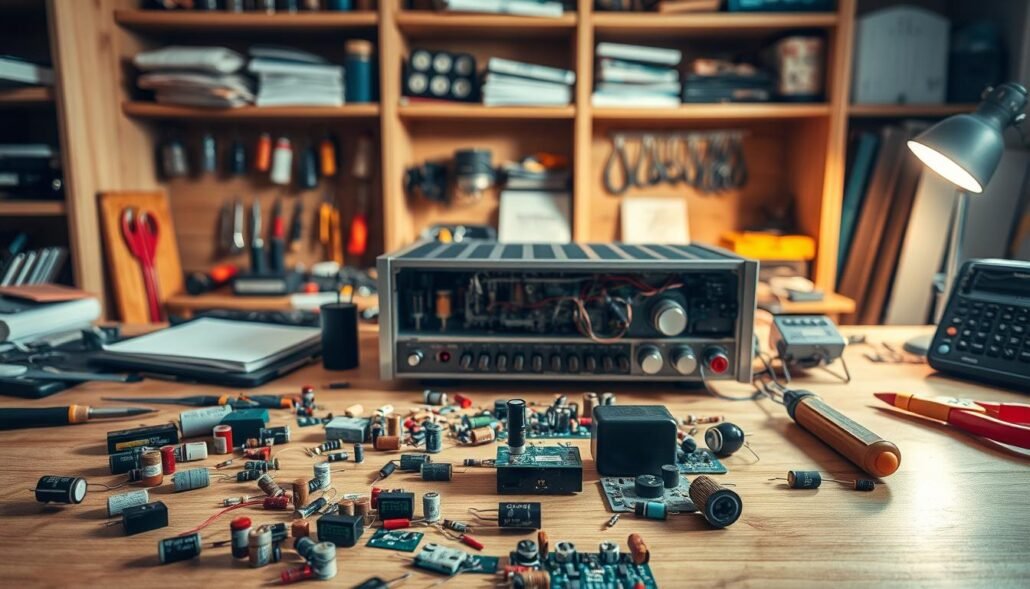
Safe DIY jobs are cleaning and basic swaps that need little bench time. Use DeoxIT on pots and switches and add FaderLube where knobs feel stiff. Replacing dial bulbs or careful LED conversions are also sensible DIY tasks.
When cleaning pots, switches, and bulbs is safe
Quick checklist:
- Label cables and photograph disassembly to save time during reassembly.
- Use a multimeter, quality screwdrivers, contact cleaner, and ESD precautions.
- Verify polarity and pinouts before swapping parts or soldering.
When to walk away
If you find a damaged multilayer board, lifted pads, or a bad transformer, stop. Power transformer replacement, rare transistor swaps, and dense SMD rework need pro tools and training. Trying these can make the problem worse.
| Task | DIY? | Why |
|---|---|---|
| Pot and switch cleaning | Yes | Low risk, restores sound and removes crackle |
| Bulb to LED swap | Yes | Simple, improves panel life |
| Transformer or major board rework | No | High safety and technical risk |
Practical way: DIY the cleaning and bulbs, then pay a pro for diagnostics when you hit unclear faults. Ask clear questions, document what you tried, and use community guides on audiokarma.org or diyaudio.com for model‑specific help. If unsure, click expand and get a pro estimate before spending more time.
Stereo music path: integrated amp or separates as an alternative
For focused two-channel listening, swapping the receiver for an integrated amp often brings clearer dynamics and a simpler setup. An integrated or separates stack concentrates budget on core electronics and power delivery rather than features you may not use.
Why integrated amps can outperform receivers for pure audio
Integrated amps reduce parts in the signal path and often use cleaner preamp stages and robust power supplies. That lowers noise and improves clarity.
Many models, including higher-end Sony ES units, include preamp outs so you can add a powered sub or future power amp. Prioritize output current and stable power over marketing watt numbers for real-world control of your speakers.
Subwoofer options without dedicated LFE: pre-out routing and crossovers
You can route preamp outputs to a powered sub, set the sub’s crossover, and then return to the power amp if needed. This keeps bass tight and reduces strain on the main amplifier.
If your speakers play low cleanly, a sub still helps with extension and lowers distortion in the mids by offloading deep bass.
- Value note: integrated amps often give better sound per dollar when you only need one or two channels.
- Choose units with phono, DAC, and pre-outs to futureproof connectivity.
- Consider serviceability and parts availability; simpler gear can be easier to maintain over time.
| Need | Recommended path | Why |
|---|---|---|
| Stereo music focus | Integrated amp or separates | Cleaner signal, fewer parts, better dynamics |
| Sub integration without LFE | Pre-out → sub → power amp input | Use sub crossover to manage bass and protect the amp |
| Multi-channel & HDMI | Keep or replace with AVR | Receivers handle video switching and many channels |
| Serviceability | Simpler designs | Easier parts sourcing and long-term maintenance |
Home theater path: AVR upgrade realities for channels and formats
For home theater setups, modern AVRs often solve switching and format gaps that older gear cannot.
If you only need 2.1 or 3.1, a modest AVR can deliver better bass management, room correction, and extra channels with little fuss. Entry and mid‑tier models often give more practical value than paying for bench time and parts on an aged unit.
If you’re fine with 2.1 or 3.1: value plays that beat repairing dated gear
Look for enough channel support to cover your current plan plus one expansion step. That prevents early upgrades and saves money over time.
- Check real‑world output and power per channel, not just marketing watts.
- Choose models with room correction to smooth bass between speakers and sub.
- Compare the would cost of repair against street prices for a new unit with eARC and streaming.
| Need | Best path | Why |
|---|---|---|
| Simple 2.1 / 3.1 | Entry/mid AVR | Better bass management, room EQ, easier switching |
| Multiple sources, eARC | New unit | Smoother TV integration and app streaming |
| Stereo purity | Amps / integrated amps | Cleaner signal path but fewer video features |
Practical tip: when you weigh prices, include warranty and firmware support. For many households, an AVR upgrade is the best balance of value, convenience, and performance. Click expand.
Value and resale: will you recoup the repair cost?
Market demand, model desirability, and documentation shape how much you can recoup. For restored vintage gear, premiums are possible, but many mainstream units do not recover full service cost.
Repairs rarely translate to one-for-one resale gains unless the model is desirable and the work is clear to buyers.
Small, visible fixes—cleaned controls, fresh bulbs, and neat cosmetic work—often raise selling interest more than deep board repairs that inflate what you spent.
- Compare what the repair would cost against current market prices for similar working units.
- Keep receipts and list parts replaced to show buyers why the unit now sounds better.
- For mass-market receivers, plan to keep the unit unless the model is sought after.
| Scenario | Resale outlook | Why |
|---|---|---|
| Vintage, documented | Good | Collectors pay for verified restoration |
| Mainstream mass-market | Low | Buyer prices lag service cost |
| Small fixes only | Moderate | High-impact work boosts buyer confidence for less money |
Bottom line: if resale matters, buy low, repair smart, document everything, and focus on the fixes that change perceived value most. One well-presented unit will sell faster and often for more than an identical unrepaired piece.
Environmental angle: repair to reduce e‑waste vs. buying efficient new gear
Choosing to service older audio gear can cut electronic waste while keeping sound you like.
Repairing keeps electronics out of the waste stream when components and parts are available and affordable.
Many vintage designs were made to be serviced. With modest work, those units can run for more years, which lowers the number of devices sent to landfills.
That said, newer models often use less power during daily use. If you listen many hours at home, an efficient unit may reduce energy and emissions over time.
- Greenest way: favor platforms that avoid frequent replacement or long shipping for fixes.
- Factor in packaging, transport, and the parts footprint when you compare paths.
- If a unit is unsafe or unreliable, replace with an efficient model and recycle old parts properly.
| Choice | Environmental edge | Why |
|---|---|---|
| Repair | Less waste | Keeps usable parts in service |
| Replace | Lower idle draw | Modern efficiency offsets production impact over time |
| Hybrid | Balanced | Fix core faults, upgrade sources or power management |
Practical tip: extend useful life, recycle failed parts responsibly, and use smart strips or standby features as a simple, effective way to cut impact.
Decision guide: choose repair or replace based on your use case
Match your listening needs to realistic costs and feature gaps. Start with how you use the system daily: music, movies, or mixed use. That checklist makes the choice clear.
Repair when
Minor faults on a high end unit that still drives your speakers cleanly usually justify parts and bench time. If the platform delivers the channels and preouts you need, a targeted fix keeps the sonic signature you prefer.
Replace when
Modern features matter: need for HDMI/eARC, current streaming support, or a major board failure with scarce parts pushes toward getting a new one. For home theater growth in channel count, an AVR upgrade often makes more sense.
Edge cases
Vintage gear you love can reward a full restore if you accept the cost and downtime. By contrast, midrange, year old units with deep faults may not recover value even after service.
- Check speaker and sub matching first — no repair fixes a platform that lacks current for your speakers.
- If 2.1 or 3.1 meets your needs, simpler paths can beat full feature chasing.
- Always get a written estimate and compare that to a sensible new one before committing.
| Scenario | Recommended path | Why |
|---|---|---|
| High end unit, small fault | Repair | Preserves sound quality and resale for desirable models |
| Need HDMI/eARC or streaming | Replace | New models offer full compatibility and warranty |
| Vintage gear you love | Restore | One-time refresh yields long-term stereo enjoyment |
| Midrange unit, major board problem | Replace | Repair cost often nears price of a capable new AVR |
Final tip: decide based on listening style, room needs, and upgrade horizon rather than sunk cost. That gives a practical, long-term result.
Conclusion
Final note, let your listening habits, timeline, and budget guide whether service or replacement is smarter.
If the receiver still drives your speakers cleanly and only needs modest parts or cleaning, repair often offers the best value and keeps your system sounding like you enjoy today. For home theater needs—extra channels, room correction, or HDMI convenience—modern AVRs or new amps may beat the total price and downtime.
Vintage gear can reward a full restore, but be realistic about labor, parts, and years of use. Ask focused questions, get a written estimate, and compare that number to street prices. For model‑specific info, check Denon receivers. In the end, pick the way that gives you the most music and movies, not just the neatest bench notes. click expand
FAQ
When does repairing a ten‑year receiver make sense?
Repair makes sense when the unit is higher end, the fault is simple (bad relay, blown fuse, or a failed capacitor), and repair costs are under 30–40% of a comparable new receiver. If the chassis and power supply are solid and you value the sound, a service tech can extend life for years.
What repair costs should I expect for a decade‑old unit?
Expect bench fees (–0), parts (–0+), and labor. Typical fixes—capacitor replacement, relay swaps, and protection‑circuit resets—often land in the 0–0 range. Major board failures or rare parts push costs higher, sometimes exceeding replacement value.
Will a repaired receiver sound noticeably better than a new budget model?
Often yes. Mid and high‑end receivers or integrated amps from ten years ago can outperform current entry‑level units in tonal balance and power delivery. But you’ll miss modern features like eARC, Dolby Atmos, or built‑in streaming unless added externally.
How do power and output tech affect the decision?
Older receivers may use discrete output transistors, offering robust power delivery. Newer chips can be efficient but sometimes lack headroom for demanding speakers. Match speaker impedance and real‑world watt needs; if the vintage amp drives your speakers cleanly, repair can be justified.
What hidden costs should I factor into repair vs. replace math?
Include shipping, diagnostic fees, possible return trips, and the time you’ll go without your system. Also add any future repairs if the unit shows age‑related failures. Compare those to the warranty and feature set of a new unit before deciding.
Are modern receivers harder to repair than vintage gear?
Yes. Surface‑mount components, multilayer PCBs, and compact assemblies make modern AVRs more complex. Vintage 1970s–1980s units used through‑hole parts and simpler circuits, so many techs find them more serviceable and affordable to restore.
Which failures are most common around year ten?
Power supply capacitors degrading, protection circuits tripping, worn relays, scratchy pots, and aging electrolytics. A qualified tech will test the PSU rails, speaker outputs, protection board, and inputs to isolate faults.
Can I fix minor issues myself?
Safe DIY tasks include cleaning pots and switches, replacing bulbs/LEDs, and checking speaker connections. Avoid transformer, soldering on multilayer boards, or replacing output transistors unless you have tools and experience—these risks can make the problem worse.
If I mainly listen to stereo music, should I consider an integrated amp instead?
Yes. Dedicated integrated amplifiers often deliver cleaner signal paths, better phono stages, and stronger stereo performance than AV receivers. For pure music, switching can be a cost‑effective upgrade compared with repairing a dated AVR.
For home theater, when does upgrading beat repairing?
Upgrade when you need HDMI 2.1, eARC, object‑based audio (Dolby Atmos/DTS:X), or modern streaming and multiroom features. Also replace if the receiver has multiple major board failures or if repair costs are near the price of a capable new midrange AVR.
Can I keep using an older unit by pairing external gear for missing features?
Yes. Add an HDMI switcher with eARC, a network streamer, or a small AVR for video duties while keeping the older unit for stereo amplification via preouts. That can extend usefulness without full repair or replacement.
Will repairing reduce environmental impact?
Repairing reduces e‑waste and can be greener than buying new, especially if the unit has a long usable life ahead. Factor in the energy efficiency of new models, though—newer receivers can draw less standby and run more efficiently during use.
How does resale value affect the repair decision?
Repairs rarely increase resale value by the repair cost unless you fully restore a collectible or high‑end unit. If you plan to sell, get a market check first—sometimes selling “as‑is” to a buyer or a tech is more economical.
What checklist should I use when talking to a repair shop?
Ask for a diagnostic fee, estimated repair range, parts availability, warranty on workmanship, and turnaround time. Get a clear fail/repair threshold—ask them to contact you before proceeding if costs exceed your limit.
Any fast rule to decide repair vs. replace?
Repair when the unit is mid/high‑end, faults are simple, and total cost stays below ~40% of a suitable replacement. Replace when the AVR lacks key modern features, has major board damage, or repair quotes approach new midrange prices.