This section introduces what the full review will cover. We look at real-world performance, everyday usability, and whether the $4,500 U.S. MSRP matches the experience for a serious home theater buyer.
The new flagship replaces the SR8015 and brings 11 onboard amps rated at 140W per channel (8 ohms). It also offers 13.4 processing and four independent subwoofer outputs. Expect modern HDMI 2.1 features and robust connectivity for current systems.
What to watch for: power needs, room size, speaker sensitivity, and whether you will use the extra height channels or 13.4 processing. These factors decide if you need external amps or this marantz cinema receiver will suffice.
We preview the key trade-offs: Audyssey MultEQ XT32 versus paid Dirac Live, bass routing with four subs, and how this marantz avr stacks versus the CINEMA 40, the SR8015 it replaces, and rivals from Denon and Arcam.
Quick Take: What the Marantz CINEMA 30 Is and Who It’s For
Positioned as the series’ top-tier offering, it focuses on large, multi-speaker home layouts. This flagship replaces older reference models and is built in Shirakawa, Japan, so expect premium parts and careful assembly.
Flagship positioning in the cinema series
Why flagship matters: better processing, upgraded DACs, and a sturdier chassis give longer service life and easier future expansion for complex setups.
Price in the U.S. market and what you’re paying for
The U.S. MSRP of $4,500 buys 11 channels of amplification, 13.4 processing headroom, improved digital-to-analog conversion, and premium build quality.

Best-fit home theater setups and room sizes
- Ideal for 7.2.4 or 9.2.4 systems now, or for owners planning 7.4.4/9.4.4 with external amps later.
- 140W per channel and a strong power supply suit medium-to-large rooms where headroom and dynamics matter.
- Skip this unit if you only need a simple 5.1/5.2 setup in a small room; a smaller receiver will be more cost-effective.
| Feature | What it means | Best use |
|---|---|---|
| 11.4 channels / 13.4 processing | Onboard power with advanced upmixing | Large immersive layouts, multi-sub setups |
| Built in Shirakawa, Japan | Premium parts and assembly | Long-term reliability and resale value |
| U.S. MSRP $4,500 | Price reflects amplification, DACs, chassis | Enthusiasts and custom installers |
Sound expectations: buyers can expect a smooth, warm, and controlled tonal balance that pairs well with many popular U.S. speaker brands and common home layouts.
Design, Build Quality, and Front Panel Usability
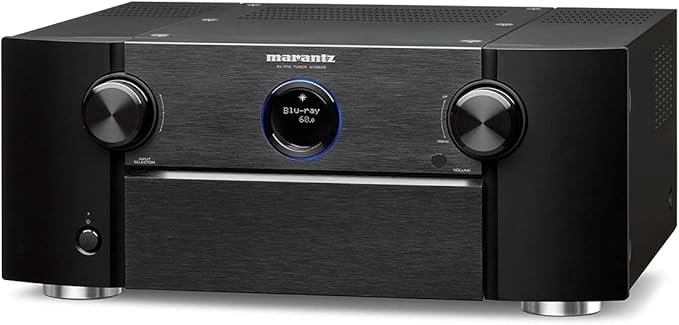
The front of the unit mixes classic symmetry with modern minimalism for a refined living-room presence. The two-layer faceplate pairs symmetrical knobs and a porthole OLED with a secondary 2-line display hidden behind a bottom-hinged flap. This arrangement keeps the front panel clean while giving full access when you need it.
Premium fascia and hidden controls
The visible display shows volume and source at a glance. Open the flap and you get ports, tuning switches, and quick-access controls for setup. That approach helps everyday living-room use: neat appearance with pro-level access when you want it.
Size, weight and internal hardware
At about 17.6″ deep and 42.8 lbs, the unit is roughly 2″ deeper and 10 lbs heavier than the sibling model. That extra mass signals higher build quality and a larger power section. A toroidal transformer adds weight and reduces radiated noise, improving low-level clarity.
Copper plating and controls
The copper-plated chassis aids grounding and lowers noise floor, which can yield cleaner detail in complex mixes. Connectivity and app control are available, but the tactile front panel and included remote control remain valuable for quick, reliable operation.
Connectivity and Inputs/Outputs for Real-World Systems
Connectivity is where this flagship proves practical: it balances modern HDMI switching with flexible analog and multi-sub options. The layout is built for typical living rooms and for future upgrades.
HDMI layout and everyday devices
The unit offers 7 HDMI inputs and 3 HDMI outputs, with HDCP 2.3 on board and eARC/ARC on the main output. That covers a game console, streaming box, UHD Blu‑ray player, plus a TV return for app audio.
Analog and digital inputs
There are seven analog inputs including a built‑in MM phono stage for turntables. Digital options include two optical and two coax inputs for legacy CD transports and older gear.
Pre-outs, speaker terminals, and subwoofers
13.4 pre-outs let you add external amplifiers or powered monitors without swapping the receiver. Thirteen assignable speaker terminals support heights, surrounds, and a second zone for flexible wiring.
Four independent subwoofer outputs offer Standard and Directional routing. Use separate level and delay settings for each subwoofer to smooth bass across seats and reduce room modes.
| Port | Count | Practical use |
|---|---|---|
| HDMI inputs | 7 | Console, streamer, disc player, AV sources |
| HDMI outputs / eARC | 3 (main supports eARC) | TV return audio and bi-amped displays |
| Analog / MM phono | 7 | CDs, turntable, analog sources |
| Pre-outs / speaker terminals | 13.4 / 13 | External amps, flexible speaker layouts |
| Subwoofer outputs | 4 independent | Multi-sub tuning and directional bass routing |
Amplifier Power, Channels, and Processing Capabilities
Power delivery and processing are the heart of any high-end AVR. This model provides 11 powered channels rated at 140W per channel into 8 ohms (20Hz–20kHz, 0.05% THD) with the spec measured two channels driven. That “2 channels driven” note matters: the rating shows peak clean output for a pair, not the simultaneous output with all amps taxed.
The onboard amplifier topology is Class A/B. Expect solid low‑frequency control and good efficiency, but also heat when many channels run loud. Real-world layouts using the 11 onboard channels include 7.1.4 or 5.1.6, where the amp count limits how many speakers get power without adding external gear.

When 13.4 processing needs extra amps
13.4 processing unlocks extra height and wide channels for immersive mixes. To drive all 13.4 channels simultaneously you will need an external 2‑channel amplifier to supply the remaining two channels. That lets the receiver handle processing while the added amp supplies continuous power for full layouts.
Power supply design and toroidal transformer
The unit uses a toroidal transformer in its power supply, which reduces radiated noise compared with older EI designs. A cleaner supply yields steadier current during movie peaks and better composure with low‑impedance speakers.
Conversion and tuning: DACs and HDAM
32‑bit ESS Sabre DACs handle conversion, while discrete HDAM modules shape the analog path. Together they lower noise and preserve detail, giving a refined sonic character for both films and stereo music.
| Spec | Detail | Practical effect |
|---|---|---|
| Channels powered | 11 onboard | Drives 7.1.4 or 5.1.6 without extra amps |
| Rated power | 140W/ch (8Ω, 2ch driven) | Strong headroom for dialogue and peaks; less with all channels active |
| Processing | Up to 13.4 | Supports extra heights/wides; external amp required for full power |
| Transformer / supply | Toroidal transformer | Lower radiated noise and steadier current during peaks |
| DAC / analog tuning | 32-bit ESS Sabre + HDAM | Cleaner conversion and the brand’s tuned analog character |
Surround Formats and Home Theater Features
Modern AVRs must decode multiple immersive formats to handle streaming, UHD Blu‑ray, and gaming sources. This model supports a broad set of options to keep compatibility high.
Supported formats: Dolby Atmos (with Height Virtualization), DTS:X, DTS Neural:X, DTS Virtual:X, IMAX Enhanced, and Auro-3D. That coverage matters if your library mixes streaming, disc, and game content.
Dolby Atmos and height options
Height channels add vertical cues that lift effects above the listener. Use in-ceiling or upward-firing speakers for the full effect.
Height Virtualization is useful when you cannot install physical height speakers. It simulates a 3D soundstage and preserves front-stage imaging on most mixes.
DTS:X and upmixing choices
DTS:X plus Neural:X expands non‑object tracks into a wider field. Expect more ambience and envelopment, though upmixers vary in how they treat dialogue and tone.
IMAX Enhanced and Auro-3D
IMAX Enhanced appears on selected UHD releases and provides tuned remasters for certified setups. It fits easily into an AVR workflow for disc playback.
Auro-3D can feel more natural to some listeners. Reviewers noted it often preserves a strong front stage while adding lush ambience — a good choice for music and certain film mixes.
| Format | Effect | When to use |
|---|---|---|
| Dolby Atmos | Object-based height and placement | UHD Blu‑ray, Atmos streams, games |
| DTS:X / Neural:X | Flexible upmixing and scene expansion | Legacy tracks and wider surrounds |
| Auro-3D | Natural ambience, preserved front stage | Music and immersive film mixes |
Practical tip: pick the mode that gives clear dialogue and the right level of envelopment for the content. Swap modes quickly during listening to find what suits each title.
Room Correction and Bass Management: Audyssey MultEQ XT32 vs Dirac Live
Good room correction tightens bass, cleans imaging, and makes big systems feel unified.
Audyssey MultEQ XT32 runs an eight‑position sweep with a handheld mic. Place the mic at ear height across main seats, follow the onscreen prompts, and let the receiver average measurements. Typical gains: tighter bass, smoother frequency response, and clearer imaging.
Dynamic EQ helps restore perceived bass at low volumes, while Dynamic Volume tames loud peaks for late‑night listening. Use Dynamic EQ for quiet viewing; avoid Dynamic Volume if you want full dynamic impact.
Dirac Live upgrade and control
Dirac Live is a paid path with two tiers: ~$259 (limited to 500Hz) and ~$349 (full 20Hz–20kHz). The upgrade adds target curves, finer control, and better transient correction for listeners who want surgical tuning.
Bass routing and multi‑sub strategies
Standard bass sends mono LFE to all subs. Directional routing assigns bass to the nearest speakers plus LFE for seat‑to‑seat consistency and localized bass effects with 2–4 subs.
| Feature | Practical effect | When to pick |
|---|---|---|
| Audyssey MultEQ XT32 | Smooth, reliable auto‑calibration | Most living rooms |
| Dirac Live | Fine tuning and target curves | Dedicated rooms and installers |
| Directional bass | Improved seat consistency | Multiple subwoofer setups |
Decision framework: Audyssey is enough for most U.S. homes. Choose Dirac Live if you want advanced control or have a tuned listening room and multiple subs that justify the extra cost.
Setup Experience, On-Screen Assistant, and Day-to-Day Control
Getting started is straightforward. The on-screen Setup Assistant guides you step-by-step. Animated clips show stripping and connecting bare wire so wiring mistakes are rare.
First-time setup and speaker wiring
The assistant walks through terminal assignment and polarity checks. Each speaker connection is labeled on screen, which helps DIY builders avoid swapped channels.
Visual wiring cues include how much insulation to remove and where to press the terminal—simple, practical, and quick to follow.
Apps, voice services, and network benefits
Connect the unit to Ethernet or Wi‑Fi to unlock HEOS and the Marantz AVR Remote app for streaming, multi-room grouping, and firmware updates.
Voice assistants (Alexa, Google, Siri) work once the network is active, making hands-free control easier in a living-room setup.
Daily control: remote, app, and late-night listening
The premium remote control has a metal faceplate and backlight for fast input switching and mode changes during playback.
Use the app for deeper tweaks and multi-room streaming. Bluetooth headphone listening handles late-night audio without disturbing others.
| Task | Best tool | Why it helps |
|---|---|---|
| Quick source switch | Remote control | Immediate response, backlight for low light |
| Fine tuning | Marantz AVR Remote app | On-the-fly EQ and preset management |
| Multi-room streaming | HEOS app | Group speakers and control zones |
| Late-night listening | Bluetooth headphones | Private audio without disrupt |
Marantz Cinema 30 Review: Sound Quality Performance
Listen first, measure later: the unit presents a warm, smooth sound that rarely tires the ears. The tilt toward musical midrange keeps vocals natural. At the same time, detail and refinement are improved over the prior sibling.
Overall sonic character
Warmth and control mean low frequencies feel tight rather than bloated. With real speakers in a U.S. living room, bass has grip and transient control.
The amplifier shows restraint: it softens harsh highs without dulling nuance. That balance helps long movie nights and mixed music libraries.
High-volume performance and headroom
Power delivery gives clean swings during action scenes. Dynamic headroom keeps explosions from compressing dialogue.
Bass remains controlled when tracks get loud, and the amp preserves transient snap for weapon hits and orchestral transients.
Dialogue clarity, imaging, and 3D placement
Center-channel intelligibility is a strong suit—speech stays forward and natural. Sibilance is managed, so dialog rarely bites at higher volumes.
Immersive mixes place effects in the room, not just at speaker positions. Height channels create convincing vertical cues and realistic 3D placement.
Stereo music listening
For stereo fans, the soundstage is wider than typical AVRs at this price. Imaging is focused and instruments separate well.
This makes the unit useful as a two-channel hub before adding a dedicated amplifier or separates.
Streaming playback via HEOS and AirPlay 2
HEOS handles PCM to 24-bit/192kHz and DSD up to 5.6MHz (DSD128). AirPlay 2 works reliably for casual streaming.
Limitations: HEOS currently lacks Qobuz support, so audiophile services may need other clients or sources.
| Feature | Support | Practical note |
|---|---|---|
| PCM | Up to 24-bit/192kHz | High-res files play without downsampling |
| DSD | Up to 5.6MHz (DSD128) | Works for compatible library files |
| Streaming services | AirPlay 2 supported; HEOS lacks Qobuz | Use external apps or players for full service access |
Video Switching, 8K/4K120 HDMI 2.1 Features, and Gaming Considerations
For movie and gaming setups, video switching and HDMI bandwidth shape how future-proof your system will be. All seven HDMI inputs pass 8K/60 and 4K/120 signals, so next‑gen consoles and UHD sources keep full resolution and high frame rates.
Gaming features made simple
VRR smooths frame pacing for fewer stutters. ALLM switches displays to game mode automatically. QMS cuts the blank screen when switching resolutions. These features reduce lag and keep play responsive.
Bandwidth and HDR compatibility
The HDMI links use 40Gbps bandwidth. That handles current 4K/120 and 8K/60 content reliably but could limit future exotic color-depth/bitrate combos. HDR support is broad: Dolby Vision, HDR10+, HLG, and Dynamic HDR cover the formats U.S. buyers see on streaming and UHD Blu‑ray.
Outputs, eARC, and handshake notes
The third HDMI output is a zone output limited to 4K/60—useful for a second display but not a full main output. eARC works well for high‑quality audio returns, though occasional HDMI‑CEC handshake hiccups appear rarely. If a device fails to pair, power‑cycle the TV and receiver, check cable specs, and re-seat the connection to restore control.
| Item | Effect | Practical note |
|---|---|---|
| HDMI inputs | 8K/60, 4K/120 | Full-res pass-through for consoles and players |
| Gaming features | VRR, ALLM, QMS | Smoother gameplay, auto game mode, less blanking |
| Video output | 3 outputs (third limited) | Zone 2 use at 4K/60 only |
How It Compares: CINEMA 30 vs CINEMA 40, SR8015, and Key Rivals
If you plan a large, multi-sub theater, the differences in internal power and construction will matter more than the spec sheet.
CINEMA 30 vs CINEMA 40
Channels and processing: the CINEMA 30 adds two amplified channels and raises processing to 13.4 from 11.4. That expands usable layouts without external gear.
Hardware deltas: the newer model uses a toroidal transformer while the sibling keeps an EI core. The toroidal transformer generally yields steadier current and lower radiated noise.
Chassis and DAC upgrades include copper plating and higher-performance 32-bit ESS Sabre parts that refine tone and lower noise.
Should SR8015 owners upgrade?
The 30 replaces the SR8015 with visible gains: four independent sub outputs, modern HDMI features, and optional Dirac Live. Expect more sub control and processing headroom.
If you like the prior voicing and only need minor HDMI updates, the move may feel evolutionary rather than revolutionary.
Value vs Denon AVC-X6800H and Arcam AVR31
The Denon often costs less while sharing platform elements, so it is a solid value for buyers focused on raw features and price.
By contrast, Arcam’s AVR31 targets audiophiles with a separates-like approach. It has fewer onboard amplifiers but a refined analog path that some prefer for music.
| Model | Key trade | Who it fits |
|---|---|---|
| CINEMA 30 | More powered channels, toroidal transformer, multi-sub | Large setups, multi-sub tuning |
| Denon AVC-X6800H | Lower price, similar features | Value-minded buyers |
| Arcam AVR31 | Fewer amps, premium analog sound | Music-first listeners willing to add amps |
Buyer takeaway: pick this cinema receiver if you want onboard amplification for big layouts, advanced sub control, and a build that favors long-term refinement. Choose Denon for budget value, or Arcam if you prioritize two-channel purity and will marry separates.
Value Verdict: Pros, Cons, and Who Should Buy
Deciding if this unit is worth the price hinges on its combination of output strength, bass management, and long-term build quality. Read on to see who benefits most and what trade-offs matter.
Why choose it
Authoritative power from 11 × 140W channels gives room-headroom for big layouts. The 13.4 processing and pre-outs make future expansion simple.
Superior bass control via four independent subwoofer outputs plus Directional mode improves seat-to-seat bass and reduces room modes.
Premium design and build—copper plating, toroidal transformer, and 32-bit ESS DACs—raise perceived sound quality and longevity.
Key drawbacks
At a $4,500 MSRP this is a premium purchase. Dirac Live is a paid upgrade (two license tiers), which adds cost for advanced room correction.
The unit runs warm under heavy loads; plan ventilation and rack space to handle heat and depth.
Pairing and hidden costs
- Best for systems using multiple subs and many height channels; pair with speakers that prefer clean current and smooth top-end control.
- Hidden costs: possible external 2‑channel amp for full 13.4 drive, heavier speaker wire management, and a sturdy rack or cabinet.
| Who benefits | Why | Planning note |
|---|---|---|
| Immersive multi-sub owners | Onboard power + multi-sub routing | Use dual or quad sub setups for even bass |
| Builders wanting expandability | 13.4 pre-outs and strong processing | May still add external amps later |
| Casual buyers with small rooms | Not ideal | Pass if you won’t use extra channels |
Recommendation: buy if you value refinement, power, and subwoofer flexibility. Pass if your room and speakers won’t use the extra channels or sub control.
Conclusion
, For buyers who want a long-term centerpiece that blends strong amplification with flexible bass control, the marantz cinema flagship earns its place in serious installs.
Bottom line: it’s worth it if your system ambition includes many height channels, multiple subs, and you can absorb the higher MSRP and installation needs.
Standouts: premium build, refined sonic character, 11 powered channels, 13.4 processing, and unusually flexible multi-sub routing via four independent outputs.
Trade-offs: cost, optional Dirac Live upgrade versus Audyssey MultEQ XT32, and physical demands (depth, weight, heat) that affect rack planning.
Who should buy: dedicated home‑theater owners planning 7.2.4/9.2.4+ and music lovers seeking a warmer, smoother AVR. Who should skip: casual 5.1 users, small rooms, or buyers chasing the best price-per-feature.
Before purchasing, re-check the comparison and setup sections to confirm speaker pairing, rack space, and long‑term expansion via pre-outs and processing headroom.
FAQ
What distinguishes this flagship cinema receiver from other models in the series?
The unit positions itself as the series flagship through higher-quality power delivery, advanced DACs, and expanded processing. Expect stronger power supply components like a toroidal transformer, copper-plated chassis treatments for improved grounding and lower noise, and 32-bit ESS Sabre DACs with HDAM signal path tuning for more refined soundstage and dynamics than lower-tier models.
How many channels and watts does it deliver, and what topology does it use?
It drives 11 channels at roughly 140 watts per channel under typical ratings, using a Class A/B amplifier topology. The onboard processing supports 13.4 channel routing, so you may need an external two-channel amp if you plan to bi-amp or drive all outputs simultaneously in certain configurations.
What room-correction options are available and which should I choose?
It ships with Audyssey MultEQ XT32 and includes Audyssey Dynamic EQ and Dynamic Volume features. MultEQ XT32 handles multi-point measurement and filters for speaker distance, level, and frequency response. For users seeking finer control, a paid Dirac Live upgrade is available and delivers tighter impulse response correction and more adjustable filters.
How many subwoofer outputs and bass-routing modes are supported?
The receiver provides four independent subwoofer outputs and supports directional and standard bass modes for flexible routing. This helps smooth in-room bass response and lets you optimize multiple sub placements to reduce room modes and improve low-frequency uniformity.
What HDMI and video features does it support for modern gaming and sources?
The unit includes multiple HDMI inputs and outputs with support for 8K/60 and 4K/120 pass-through, VRR, ALLM, QMS, and HDCP 2.3. It also supports HDR formats such as Dolby Vision, HDR10+, HLG, and Dynamic HDR for broad compatibility with current and next-gen consoles and players.
How flexible is the connectivity for complex home setups?
Connectivity is comprehensive: seven HDMI inputs and three outputs including eARC/ARC, analog and digital inputs, MM phono input for turntables, 13.4 pre-outs for external amplification, and 13 speaker terminals for advanced layouts. This makes it suitable for multi-zone or elaborate immersive systems.
Does it include advanced DACs and discrete analog stages for improved sound?
Yes — it uses 32-bit ESS Sabre DACs and Marantz-style HDAM modules and discrete tuning in the signal path. These components reduce distortion, increase dynamic headroom, and aim to preserve detail and warmth across movie and music playback.
What kind of power supply and transformer does it use, and why does that matter?
The design centers on a robust power supply with a large toroidal transformer to deliver stable current to multiple channels. A stronger transformer and beefier supply reduce sag under heavy dynamic loads, improving high-volume performance and transient control for demanding movie scenes.
How does the setup and daily control experience perform?
Setup uses an on-screen assistant and step-by-step wiring guidance. The companion Marantz AVR Remote and HEOS apps provide streaming, zone control, and calibration access on iOS and Android. The bundled remote is well built, backlit, and ergonomically laid out for everyday use.
Is the Audyssey MultEQ XT32 workflow easy to run, and what improvements does it make?
The MultEQ XT32 setup is straightforward: place the measurement mic at multiple positions, follow on-screen prompts, and let the system calculate corrective filters. It improves frequency response, time alignment, and crossovers, yielding clearer dialogue and more even bass across listening spots.
Can it handle immersive formats like Dolby Atmos, DTS:X, and Auro-3D?
Yes. It supports Dolby Atmos with height channel and virtualization options, DTS:X with Neural:X upmixing, IMAX Enhanced content, and Auro-3D playback. Each format offers different spatial flavors; Auro-3D can appeal to listeners who prefer a more layered height presentation.
What are common reliability or HDMI handshake issues to expect?
Most users enjoy stable CEC/eARC performance, but occasional handshake hiccups can occur with mixed-brand devices or older HDMI cables. Using high-quality HDMI 2.1 cables, ensuring firmware updates, and assigning fixed EDID settings for problematic sources usually resolves these problems.
How does this receiver compare to higher- and lower-tier rivals like Denon or Arcam models?
Compared with nearest rivals, it emphasizes sound refinement, subwoofer control, and build quality. Models like the Denon AVC-X6800H may compete closely on channel count and feature set, while brands such as Arcam prioritize audiophile-grade analog stages. The right choice depends on priorities: movie power and processing versus pure stereo refinement.
Is the Dirac Live upgrade worth the extra cost?
For listeners who demand the tightest impulse response correction, precise crossover phase alignment, and advanced filter control, Dirac Live adds clear value. If you prefer a simpler, more automated workflow, Audyssey MultEQ XT32 already delivers strong results out of the box.
What speaker and subwoofer pairings work best for a U.S. home theater?
Pair the receiver with a full-range front LCR set and dedicated height or in-ceiling speakers for Atmos. Use two matched powered subwoofers placed for room-mode cancellation or up to four subs leveraging the independent outputs for best bass uniformity. Choices from trusted speaker brands tuned to your room size yield optimal results.