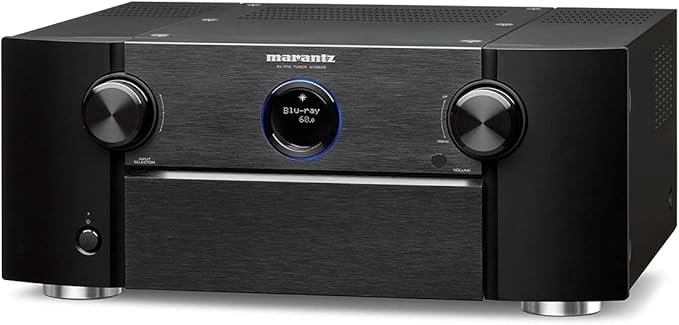
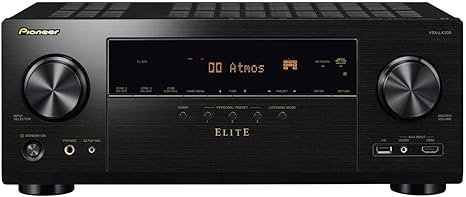
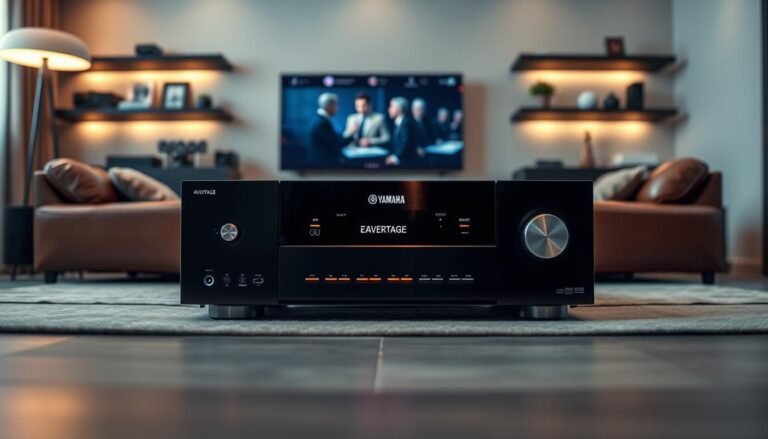
This introduction lays out a clear, expert take on the slimline receiver and what buyers should expect. We cover how the unit fits tight living-room setups, its industrial design with an iconic porthole display, and the balance of modern features for TV, movies, and music.
At a listed price of $1,200, the 7-channel, half-height chassis packs 8K/4K120 support and HEOS streaming. Firmware updated in about 10 minutes during setup, and the guided OSD plus Audyssey calibration make for a quick start.
The intro previews sound character and use cases: strong performance for music and movies, expandable via full 7.2 pre-outs and external amplification if more headroom is needed. Note the single HDMI eARC output when planning a TV-plus-projector system.
What follows: detailed sections on design, HDMI and gaming, connectivity and calibration, streaming and multiroom, sound quality, measurements, power and pre-out strategies, pricing, competitors, and the final verdict.
Marantz Cinema 70S Review
This slimline receiver brings full-featured home theater hardware into tighter living spaces. It traces the slimline lineage back to NR-series models and packs 7 channels of Class AB amplification into a compact chassis.
Who this unit is for
The cinema 70s is built for apartment dwellers, family rooms, and multipurpose living areas where a full-size AVR won’t fit but movies and music still matter.
With 7x50W Class AB power and full 7.2 pre-outs, small-to-medium rooms get clean headroom when speakers are set to small and a subwoofer handles the bass.
What shoppers want now
- Can it drive a 5.1.2 layout? Yes for modest rooms, though larger spaces may need more power.
- Is the single HDMI output a limit? It can constrain complex TV/projector setups.
- Gaming and 8K/4K120 support? The unit covers current gaming needs and streaming experience.
In this review we test day-to-day use, listening impressions, and bench results to help you decide if the 70s fits your home setup or if a higher-tier receiver from the same range or competing receivers like Denon and Yamaha is a better match.

Key Features and Specs at a Glance
This compact unit packs a long list of modern connectivity and power specs aimed at small-to-medium rooms.
Power and channels: A 7.2-channel platform delivers 7x50W Class AB amplification (8 ohms, 20Hz–20kHz, 0.08% THD). At least 70% of that power is guaranteed with five channels driven. This makes the 70s a good fit with efficient speakers and a single subwoofer for most living rooms.
- Bass and expansion: Two subwoofer outputs plus full 7.2 pre-outs allow flexible bass management and future external amplification.
- HDMI and routing: Six hdmi inputs total, three are 40Gbps 8K/4K120-capable; the lone HDMI output supports ARC/eARC for simple TV audio.
- Video processing: 1080p→4K and 4K→8K upscaling with HDR passthrough for HDR10+, Dolby Vision, and HLG to keep the picture chain intact.
- Formats and inputs: Dolby Atmos and DTS:X are supported for immersive sound. Analog, optical, coax, MM phono, USB, and network inputs cover legacy and modern sources.
- Networking and streaming: Dual-band Wi‑Fi, Ethernet, Bluetooth RX/TX (SBC), HEOS, AirPlay 2, and major services like Spotify Connect and TIDAL are included.
Bottom line: The marantz cinema 70s prioritizes clean signal routing and useful outputs, making it a compact receiver that supports growth and everyday ease.
Slimline Design and Build Quality
A compact, industrial look helps this slimline receiver fit where taller models can’t, without losing a refined presence.
The chassis is slim and light at roughly 19.2 lbs, so it slides into low cabinets and narrow credenzas with ease. Its industrial aesthetic and twin dials keep a purposeful, appliance-like feel that suits modern living rooms.
Front Controls and Materials
The fascia uses plastic rather than metal. That choice lowers weight and cost but does not harm core function. Front-panel controls are clearly labeled for quick access to volume, inputs, and key modes.
Display, Remote, and OSD
The minimalist porthole display favors style over dense readouts. It matches the unit’s updated look but gives less on-screen detail at a glance.
The backlit remote shares ergonomics across the cinema series and feels balanced in hand. It works best with a direct line of sight; placing the receiver centered under the TV or using the remote from the room’s main seating keeps commands reliable.
Practical Notes and Styling
- Thermals: Leave a few inches of clearance for ventilation to keep the unit cool and reliable.
- Compatibility: Visual harmony is strong when paired with other marantz cinema products or stereo components.
- Placement: Slimline design avoids blocking TV IR receivers and keeps shelves uncluttered.
| Feature | Effect | Tip |
|---|---|---|
| Plastic fascia | Lightweight, cost-effective | Use shelf pads to avoid scratches |
| Porthole display | Stylish but concise info | Rely on OSD for setup details |
| Backlit remote | Good ergonomics, needs sightline | Center unit under TV for best control |
| Slim chassis | Fits tight media cabinets | Maintain 2–3″ clearance for airflow |
Overall, the design balances aesthetics and function. The cinema 70s keeps a consistent identity with the rest of the series while remaining practical for both stereo and multichannel use.
HDMI Inputs, Video Support, and Gaming Readiness
Video performance centers on three high-bandwidth HDMI inputs that handle the heaviest 4K/120 and 8K/60 sources. These three 40Gbps inputs are ideal for high-frame-rate consoles and gaming PCs where bandwidth matters.
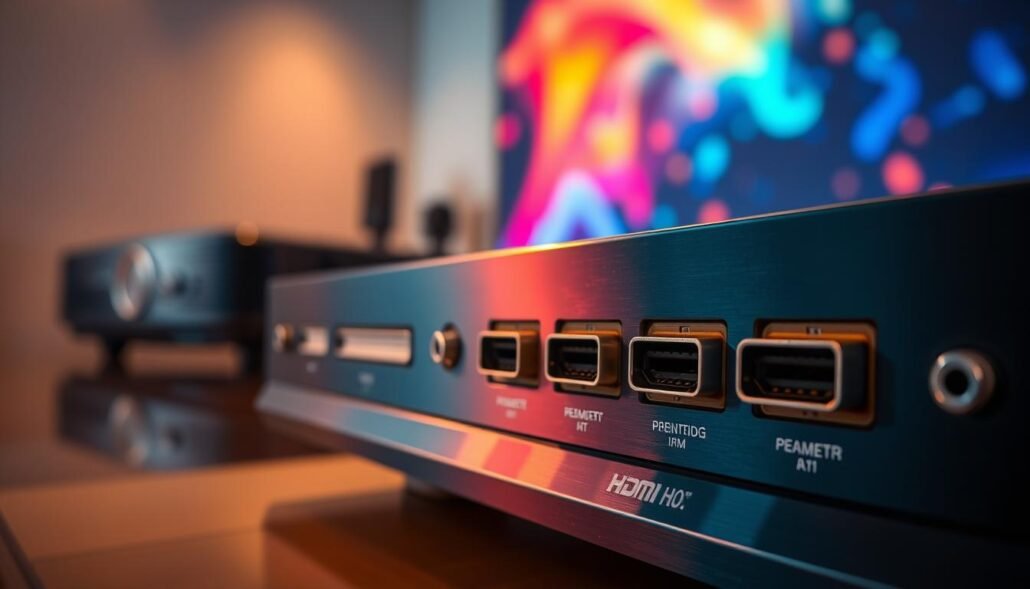
40Gbps ports, passthrough, and upscaling
The three 40Gbps hdmi inputs support 8K/60 and 4K/120. This benefits PS5, Xbox Series X, and high-frame-rate PCs that push 4K120 or VRR. The other three inputs handle up to 4K/60.
Upscaling can convert 1080p→4K and 4K→8K in the receiver, but sometimes the TV or console does a cleaner job. Use the receiver’s scaler when routing multiple sources through the AVR; otherwise let the display do the heavy lifting.
ARC/eARC behavior and single output limits
The single hdmi output supports ARC/eARC for returning TV app audio like Netflix and Prime Video with full-resolution formats when available. eARC generally preserves lossless tracks and Dolby Atmos where the TV passes them cleanly.
One HDMI output can complicate setups with both a TV and projector. Workarounds include an HDMI switch, routing one source direct to the display, or using a splitter for duplicate video feeds.
| Feature | Benefit | Practical tip |
|---|---|---|
| Three 40Gbps inputs | 4K/120 and 8K/60 capable | Use for PS5, Xbox Series X, or gaming PC |
| Remaining HDMI inputs | Up to 4K/60 support | Connect streaming boxes or older players |
| Single HDMI output (eARC) | Return path for TV apps and lip-sync | Use HDMI switch for multi-display setups |
- Gaming setup tip: Enable 4K120, VRR, and ALLM on both console and display. Use high-quality cables rated for 48Gbps to avoid handshakes failing at high frame rates.
- Lip-sync: eARC is stable, but use OSD delay controls if audio lags during competitive gaming or live sports.
- Maintenance: Keep firmware updated and verify the AVR’s on-screen video info to confirm proper 4K120 or 8K handshakes.
Summary: The 70s’s HDMI layout favors modern consoles and mixed video sources, offering strong passthrough and HDR compatibility (Dolby Vision, HDR10+, HLG) despite the single output constraint.

Audio Connectivity, Inputs/Outputs, and Subwoofer Integration
Connection flexibility is a core strength of the cinema 70s. Three analog RCA inputs and an MM phono input handle turntables and legacy sources with ease. A single optical and one coaxial digital input cover TVs, CD transports, and streamers.
Pre-outs and amplifier routing
The receiver offers full 7.2 pre-outs, so you can add external amplification for fronts or a dedicated stereo amp later. Internal Class AB amplification delivers 50W per channel (8 ohms), and the manufacturer guarantees at least 70% power when five channels run.
Use the per-pair “Pre-out Only” mode to turn internal amps off for a cleaner pre-out signal. This reduces noise and avoids the 1.8V pre-out limit seen when internal amps are active.
Dual subwoofer setup and bass management
Two subwoofer outputs let you tame room modes and spread bass more evenly. Start crossovers at 80Hz for small to medium main speakers, then tune by ear or measurement. Match levels and set distances identically to maintain phase coherence.
- Pure Direct gives the cleanest analog path for stereo listening, bypassing extra processing.
- Enabling crossovers routes signals through the ADC for bass management—expect processing to occur.
- Keep cables tidy and separate signal and power runs to minimize ground-loop hum with phono, subs, and external amps.
| Item | Why it matters | Practical tip |
|---|---|---|
| MM phono input | Connects turntables directly | Use a proper ground lead to avoid hum |
| Full 7.2 pre-outs | Easy external amp expansion | Turn on Pre-out Only for cleaner outputs |
| Dual subwoofer outputs | Smoother bass and room-mode control | Match levels/distances and start at 80Hz |
| Pure Direct mode | Lowest noise path for stereo | Use for critical music listening |
Setup Experience and Room Calibration
A crisp HD setup guide makes the initial install straightforward and quick. The onscreen installer walks you through speaker assignment, channel test tones, network join, and source naming to save time.
Guided GUI and mic placement
The included mic works with Audyssey MultEQ and supports multiple measurement spots. Measure at ear height and start at the primary seat.
Move the mic across the couch and record 6–8 positions for better room averaging. This improves the final curve and imaging.
MultEQ, modes, and Pure Direct
MultEQ sets levels, adjusts distance, and applies EQ corrections. Save and compare curves with the Audyssey Editor app or upgrade to MultEQ‑X on PC if you want deeper control.
Pure Direct mode bypasses processing to keep analog paths undigitized. Use standard modes when you need bass management or crossovers.
Practical tips and input path notes
- Set most compact mains to Small and start crossovers at the manufacturer’s recommendation.
- Enabling crossovers routes signals through ADC for processing; listen for subtle changes and accept them when room balance improves.
- Re-run calibration after moving furniture or swapping speakers to retain consistent results.
| Check | Why | Action |
|---|---|---|
| Channel mapping | Ensures correct sound placement | Use test tones and a familiar clip |
| Phase | Preserves imaging | Reverse wiring if a speaker sounds thin |
| Saved curves | Compare settings | Use the Editor app to store profiles |
Proper calibration unlocks clearer imaging, tighter bass, and a more convincing dynamic range in the marantz cinema 70s. A short setup time yields a long-term listening experience that benefits both movies and music on the 70s receiver.
Streaming, Network, and Smart Services
Networked playback and app control make daily listening simple whether you prefer phone casting or built-in services.
HEOS centralizes core streaming services—Spotify Connect, TIDAL, and Deezer—into one app for easy browsing and multiroom playback across compatible products. Internet radio and DLNA support let you access broadcast stations and local libraries without extra boxes.
AirPlay 2 and Roon
AirPlay 2 provides seamless casting from Apple devices and lets the unit act as a Roon-tested endpoint via AirPlay. This expands library options and keeps control intuitive for iPhone and Mac users.
Bluetooth RX/TX and headphone use
The 70s supports Bluetooth 4.2 with SBC for both receive and transmit. You can stream from a phone or send audio to wireless headphones for late-night listening.
Headphone options: choose headphones-only or simultaneous speakers + headphones in the menu to fit different listening situations.
- Network tip: use Ethernet for high-traffic households and Wi‑Fi for convenience.
- Codec note: SBC limits Bluetooth quality, so prefer AirPlay 2 or HEOS for higher-fidelity music streaming.
- Pairing tips: keep firmware updated, avoid congested channels, and re-pair if interference occurs.
| Feature | Benefit | Practical tip |
|---|---|---|
| HEOS services | Unified control of popular streaming services | Use presets for favorites |
| Bluetooth RX/TX | Phone streaming and headphone transmitter | Set output mode in menu for headphones-only |
| FM/AM tuner | Local radio without internet | Save presets for quick access |
Summary: The streaming and network features simplify everyday music and TV workflows. Whether you run a stereo-first system or favor movie setups over multichannel, the 70s blends HEOS, AirPlay 2, Bluetooth, and legacy radio to cover common use cases with few compromises.
Sound Quality: Movies, Music, and Everyday Listening
A warm, musical tilt gives this slim receiver a listening profile that works well for both movies and albums. The midrange is forward and pleasing, and treble stays smooth to avoid fatigue during long sessions.
Dolby Atmos immersion and cinematic dynamics
The dolby atmos staging in a 5.1.2 room is convincing. Height effects sit naturally above a stable front stage and effects track cleanly around the score.
Dialog remains clear during dynamic swings. Thoughtful calibration and dual subwoofer use tame bass blooms and preserve impact from quiet to loud scenes.
Stereo performance and high-volume stability
In stereo, the unit favors warmth and detail. Instrument separation is good and imaging holds steady across the soundfield.
Power is best matched to small-to-medium rooms and efficient speakers. For louder reference listening, use sensible crossovers, a powered sub, or add external amplification for the front pair.
- What to listen for: Atmos music mixes, jazz ballads, and dynamic film scores to judge spatial resolution and smoothness.
- Room tips: Rugs, curtains, and basic absorption improve clarity and reduce listening fatigue.
| Attribute | Effect | Tip |
|---|---|---|
| Midrange richness | Engaging vocals and instruments | Use Pure Direct for two-channel music |
| Height staging | Coherent overhead cues | Calibrate heights carefully and match levels |
| Power/headroom | Good for small rooms | Set speakers to Small and add amp if needed |
Bench Tests, Measurements, and Objective Performance
Bench work highlights competent DAC and amp performance, plus a few edge-case behaviors when driven hard.
DAC and pre-out results
Using HDMI to reach a 2V pre-out required a volume setting of 82.5. Measured SINAD stayed below 100 dB, which is solid but not class-leading.
Toslink lowered the FFT noise-floor “grass” a little, though SINAD did not improve much. Jitter susceptibility was visible in some streams, and linearity trailed top-tier DACs while still beating many AV products.
The digital filter is improved versus earlier generations, but modest out-of-band attenuation raised wideband THD+N numbers in our sweeps.
Amplifier behavior and headroom
The amplifier showed a distortion rise after several minutes when driven 5–10W into 4 ohms. Distortion settled after about seven seconds of signal, yet once the unit entered the higher-distortion state only a full power cycle restored normal readings.
Crosstalk and multitone tests revealed audible intermodulation “grass” in the FFT. Still, two-channel headroom was decent and an 8-ohm continuous sweep exceeded the rated spec by roughly 15%.
| Metric | Result | Practical note |
|---|---|---|
| SINAD (pre-out) | <100 dB | Acceptable; not reference-class |
| Digital filter | Improved shape | Modest out-of-band attenuation affects wideband THD+N |
| Amplifier warm behavior | Distortion rise into 4Ω | Power cycle required if triggered |
| Power sweep (8Ω) | ~15% above spec | Conservative factory ratings; good headroom for small rooms |
Pure Direct confirmed analog inputs bypass the ADC. Enabling a crossover engages the ADC path; measured bandwidth suggests sampling near the 88/96 kHz range, preserving wide detail.
In short, lab data shows a usable, well-priced performer for everyday listening. Measurement purists may find limitations, but matched speakers and sensible gain staging avoid most edge-case behaviors in real rooms. For demanding sessions, consider external amplification or the pre-out-only mode to reduce signal-chain stress.
Power, Amps, and Using Pre-Outs with External Amplifiers
A clear upgrade path using pre-outs lets owners mix internal amplification with external power where it matters most. The unit is rated at 7x50W into 8 ohms (two channels driven) and guarantees roughly 70% of that output when five channels are active. That balance makes the receiver versatile for most setups.
When 7x50W is enough—and when to offload front channels
7x50W suits small-to-medium rooms, especially with speakers rated 88–92 dB sensitivity and one or two subs handling bass. This power works well for typical living rooms and most TV/movie use.
If you run lower-sensitivity speakers, listen near reference levels, or have a large room, add external amps for fronts or center. Loud, dynamic orchestral tracks and explosive movie scenes are good stress tests to reveal power compression or strain.
“Pre-out Only” configuration for cleaner output and system growth
The full 7.2 pre-outs let you route any channel to an external amplifier. Enabling Pre-out Only for a channel pair disables the internal amps and yields cleaner pre-out voltage. That avoids the ~1.8V distortion ceiling seen with internal stages active and improves headroom for high-quality stereo playback.
When adding an amplifier, match gain and polarity between the AVR and external amp to avoid level jumps or hum. Use balanced cables where possible, keep signal and power runs separate, and confirm level matching with test tones or a SPL meter.
- Bass routing: Send low frequencies to subwoofer(s) and set crossovers (start ~80Hz) so internal amps focus on mids and highs.
- Staged upgrades: Keep internal amps for surrounds/heights first, then move front L/R and later center to external amplification as needs grow.
- Amp matching: Choose clean, stable amplifiers that complement the receiver’s warm voicing for balanced audio.
| Scenario | Action | Benefit |
|---|---|---|
| Small room, efficient speakers | Use internal 7x50W | Simple, cost-effective setup |
| Large room or low-efficiency speakers | Add external amp for fronts | More headroom and cleaner dynamics |
| Stereo-critical listening | Enable Pre-out Only for front L/R | Lower noise, higher pre-out headroom |
Practical tips: Allow extra rack ventilation and dedicated power circuits when adding amplifiers. Use dynamic movie scenes and dense orchestral passages to test for compression. Thoughtful use of pre-outs and selective external amplification extends the lifespan and capability of the marantz cinema platform.
Price, Competitors, and Value in the Cinema Series
Street price and retailer options shape the practical value of this slimline model.
Price in the United States sits at about $1,200. You can buy it from the brand site and major retailers like Amazon, Crutchfield, and Best Buy for easy returns and warranty support.
Where the money goes
The package pairs a compact chassis with full 7.2 pre-outs, two subwoofer outputs, and three high-bandwidth hdmi inputs. Those I/O choices support long-term upgrades and gaming/video use, which improves overall product value at this price.
Series step-ups and when to upgrade
Within the cinema series, stepping up to the Cinema 60 buys more power, extra inputs, and MultEQ XT for tighter room correction. Moving to the Cinema 50 (and above) adds more channels and advanced processing for large-room systems.
Key competitors
The Denon AVR-X2800H often costs less and matches many streaming and hdmi features, making it a cost-saving alternative for buyers who can accept fewer pre-out options.
The Yamaha RX-A2A offers higher rated power and YPAO correction but provides fewer pre-outs—important if you plan to add external amplification later.
The NAD T758 V3i sits higher in price and appeals to buyers focused on modular amps and a different amplifier signature.
| Model | Strength | Consider if you want |
|---|---|---|
| 70s (this unit) | Compact, full pre-outs, 3x high-bandwidth hdmi inputs | Slim spaces and future expansion |
| Denon AVR-X2800H | Lower price, solid features | Save money, similar streaming/hdmi |
| Yamaha RX-A2A | More rated power, YPAO | Higher SPL in larger rooms |
Bottom line: For a mixed movie/music home that needs a compact footprint and room to grow, the 70s offers strong sound and connectivity at $1,200. Choose the 70s for slim spaces and pre-out flexibility. Step up to the 60 or 50 if you need more power, inputs, or advanced correction for larger rooms.
Conclusion
Compact by shape but flexible by design, the cinema 70s serves mixed movie-and-music rooms with sensible features.
The 70s pairs a warm, musical stereo signature with convincing Dolby Atmos staging in a 5.1.2 setup when calibrated properly. Its slimline design, HEOS and AirPlay streaming, plus three high-bandwidth HDMI inputs and full 7.2 pre-outs make growth easy.
Lab results show modest DAC and amp quirks under stress, so match efficient speakers and use a subwoofer and crossovers for best results. If you need more headroom, add external amps via the pre-outs.
At the current price, this unit is a good pick for small-to-medium rooms that value expandability, simple setup, and daily streaming convenience. For more power or channels, step up within the range; otherwise the 70s closes the book as a balanced, practical end point.
FAQ
What are the main channel and power specifications for this slimline receiver?
It’s a 7.2‑channel design with seven amplifier channels rated at about 50 watts each into typical home‑load impedances. You also get full 7.2 pre-outs so you can add external amps or bi-amp key speakers if you need more headroom.
How many HDMI inputs and outputs does it have, and what video formats are supported?
The unit offers six HDMI inputs with three supporting full 40Gbps 8K/4K120 bandwidth and a single HDMI eARC output. It supports HDR10+, Dolby Vision, and HLG passthrough for modern video sources and gaming consoles.
Can I use two subwoofers, and how does bass management work?
Yes — there are dual subwoofer outputs. You can place two subs to smooth room response and use the receiver’s crossover settings and Audyssey measurement to manage low‑pass routing and phase alignment for tighter bass.
Does it support immersive formats like Dolby Atmos and DTS:X?
Yes. The receiver decodes Dolby Atmos and DTS:X and will drive a 5.1.2 or similar speaker layout to deliver height channels for immersive movie soundscapes.
What streaming and network features are available?
You get built‑in HEOS streaming, AirPlay 2, Ethernet and Wi‑Fi connectivity, plus support for services such as Spotify Connect, TIDAL, and Deezer. There’s also Bluetooth with TX/RX capability for wireless headphones or source pairing.
How is the setup and room calibration experience?
Setup uses a guided on‑screen GUI and includes Audyssey MultEQ room calibration. The process guides mic placement and lets you adjust speaker sizes, crossovers, and trim to tune the system for your room.
Is the receiver a good fit for gamers who need 4K/120Hz or 8K gaming?
Yes. With three high‑bandwidth HDMI inputs that support 4K/120Hz and 8K passthrough, it’s ready for current consoles and GPUs. Note the single HDMI output and eARC behavior when routing TV sound back to the AVR.
How does it sound for music versus movies?
For movies it delivers dynamic, immersive sound with solid Atmos staging. In stereo, it leans toward a warm, detailed presentation with able dynamics and stability at higher listening levels, though dedicated power amps can improve extreme headroom.
What are the physical design and usability highlights?
The chassis is slim and compact for tight spaces, featuring an industrial aesthetic and a porthole-style display. The front panel and remote are user-friendly, and the on‑screen display helps navigation during setup and daily use.
Can I add external amplifiers, and when should I do that?
Yes — use the full set of pre-outs to add external power. Consider offloading the front L/R or height channels if you want higher continuous power, lower distortion, or the ability to drive large floor‑standing speakers at loud volumes.
What inputs exist for analog sources and turntables?
The receiver includes multiple analog inputs and a moving‑magnet (MM) phono stage for vinyl playback, plus optical/coaxial digital inputs for legacy sources.
Are there any quirks to be aware of with HDMI eARC or ARC on the single output?
The single HDMI eARC output passes TV audio back to the AVR, but with only one output you must plan source routing or use an external HDMI switch if you need multiple displays or complex signal chains. Some ARC/eARC TV behaviors depend on the TV firmware and may require menu tweaking.
How does wireless headphone support work?
Bluetooth TX allows you to stream the AVR’s audio to compatible headphones. Pairing is straightforward via the receiver’s Bluetooth menu, and it’s a convenient option for late‑night listening or private viewing.
What measurements or bench results should buyers consider?
Objective tests typically look at DAC linearity, SINAD, jitter, and amplifier distortion/headroom. While this model offers competitive performance for its class, audiophiles may compare measured noise and distortion figures if they plan to push levels or value ultra‑low noise.
How does the price compare to competitors and other models in the series?
Street pricing positions it as a mid‑to‑upper tier slimline option, offering a strong feature set versus similar Denon and Yamaha models. Comparing features like HDMI bandwidth, pre‑outs, and network streaming helps judge relative value when shopping.