Your space guides performance more than gear. The dimensions, surfaces, and layout of a listening area change audio results as much as any amplifier. Treat the listening area and electronics as one system to get the best experience.
Small spaces can tighten the soundstage and boost bass peaks. Large areas can feel immersive yet bring echo and muddiness if left untreated. Rectangular layouts behave predictably, while irregular plans scatter energy and complicate tuning.
Targeted fixes — bass traps, diffusers, and panels — often beat expensive upgrades. Speaker and listener placement, early-reflection control, and bass management give the biggest gains before changing electronics.
Practical next step: measure your dimensions and listening distance now. That simple data helps estimate required power headroom, spot likely problem frequencies, and plan where treatments will help most.
Understand Sound in Rooms: Waves, Reflections, and Your Acoustic Environment
Vibrating objects release energy that moves as waves and interacts with every surface it meets.
Sound waves are pressure variations. High-frequency waves cycle fast; low-frequency waves move slower and travel longer distances. These differences change how energy behaves near boundaries.
Wave behavior and boundaries
When waves hit a surface they can be absorbed, reflected, diffused, or refracted.
- Absorption reduces reverberation; soft, porous materials absorb most mid and high content.
- Reflections from hard walls, ceilings, and floors add echoes and flutter if left unchecked.
- Diffusion uses uneven surfaces like bookcases to scatter energy, keeping rooms lively without harsh spots.
Practical surface strategy
Use absorption at early-reflection points and selective diffusion elsewhere. Low frequencies often bypass thin absorbers, so target bass with traps or volume changes.
Verify results with simple listening tests or an RTA app to see how frequencies respond in your home acoustics environment.
Room Size and Your Audio Experience: Small, Medium, and Large Spaces
Different room proportions change how low and high frequencies behave, so a quick assessment helps set priorities.

Small spaces: standing waves, bass build-up, and “boxy” sound
Compact areas produce rapid reflections. Early arrivals create comb filtering and a boxy coloration.
Standing waves concentrate bass in corners, creating boomy peaks and deep nulls that shift seat to seat.
Large spaces: reverb, echoes, and uneven distribution
Open volumes have longer decay times. Overlapping arrivals can blur dialog and reduce imaging precision.
Big rooms also develop hot and cold zones where level and timbre vary across seating, which hurts the home theater experience.
Balancing clarity and immersion with targeted acoustic treatment
Practical treatment pairs thick corner traps for lows, broadband panels at first reflections, and selective diffusion to keep life without glare.
Measure decay with simple tones and an RTA app to find problem frequencies, then tune placement or add subs for smoother bass control.
| Characteristic | Small | Medium | Large |
|---|---|---|---|
| Common issues | Rapid reflections, modal peaks | Mixed reflections, some modes | Long decay, echoes |
| Low‑frequency control | Corner traps, single sub | Multiple traps, one or two subs | Extensive trapping, multiple subs |
| Best fixes | Early reflection panels, bass traps | Balanced absorption and diffusion | Reverb control, strategic diffusion |
How does room size and shape affect sound quality and receiver choice?
Geometry drives how waves behave, so the layout you choose changes what you hear most.
Rectangular plans give predictable boundary distances. That predictability helps with speaker placement, sub integration, and balanced stereo imaging.
Simple shapes and placement
Start with symmetrical speaker and listener positions in a rectangular space. Measure wall distances to avoid placing speakers at exact multiples of dimensions. This prevents strong resonances and makes calibration simpler.
Irregular spaces and control
Alcoves, pillars, and angled walls scatter energy. These features cause uneven frequency response and seat-to-seat changes. Add diffusion and broadband absorption to manage scattered reflections.
- Predictability: rectangular geometry simplifies tuning for home audio systems.
- Pitfalls: irregular areas create complex modes and timing anomalies.
- Tuning: run receiver calibration after placement, then refine crossovers, sub phase, and EQ manually.
Dimensions That Work: Ratios, Proportions, and Symmetry
Proper dimensional ratios spread modal energy so peaks and nulls are less severe. Using thoughtful proportions reduces concentrated resonances and makes treatments more effective.
Golden mean guidance
The golden mean—about 1:1.6:2.6—helps distribute modal frequencies across the low spectrum. Rooms built near this ratio tend to show fewer dramatic peaks and nulls.
Avoiding multiples
Steer clear of integer multiples like 1:2:3. Those direct multiples stack modes and amplify standing waves, creating boomy low-end regions that are hard to fix with EQ alone.
Practical example: with an 8-foot ceiling, an 8 x 13 x 21 ft layout roughly follows the golden mean and yields smoother low-frequency behavior.
Symmetry vs. asymmetry
Control rooms benefit from symmetry around the listening axis. Even left/right balance improves imaging and simplifies treatment placement.
Live rooms often use mild asymmetry and non-parallel surfaces to scatter energy and reduce flutter. That approach favors a more diffuse, lively field at the expense of pinpoint imaging.
- Plan bass traps and broadband absorption even in well-proportioned spaces.
- If proportions are poor, increase low-frequency control and avoid placing speakers at modal hot spots.
- Prioritize symmetry for critical listening; choose controlled irregularity when a lively acoustic is desired.
For practical guidance on treatments and tuning after assessing dimensions, see room acoustics advice.
How-To: Measure, Model, and Diagnose Your Room Today
Collect basic measurements and simple tests first. Start with a tape measure and an SPL app. That quick data helps you predict low-end modes and where reflections will hit.
Measure dimensions and estimate volume for planning
Record length, width, and height to estimate volume. Use those numbers in a room mode calculator to find primary axial modes that shape bass.
Identify modes, reflection points, and problem frequencies
Use a mirror from the listening seat to map first reflections on front, side, back walls, and ceiling. Mark those spots for broadband absorbers.
Run sweep tones to hear boomy peaks or nulls. Note lingering decay times that signal excessive low-frequency ringing.
Use simple tools: SPL apps, room simulators, and test tones
Free or low-cost RTA apps visualize frequency response. Room-simulator tools and mode calculators highlight troublesome bands tied to your dimensions.
- Corner strategy: plan thick bass traps in all vertical corners where pressure builds.
- Placement passes: iterate speaker toe-in and listener position before applying EQ.
- Materials: prioritize thick porous absorbers; add diffusion once reflections and bass are controlled.
| Step | Tool | Goal |
|---|---|---|
| Measure dimensions | Tape measure, calculator | Estimate volume and predict modal frequencies |
| Map reflections | Mirror, tape | Identify first-reflection surfaces for panels |
| Scan response | SPL/RTA app, sweep tones | Locate peaks, nulls, and decay issues |
| Treat and iterate | Bass traps, absorbers, diffusion | Reduce ringing, preserve natural ambience |
Document each change and re-measure. Adjust one variable at a time so you learn what improves your acoustic environment. Even small spaces can reach excellent sound with focused effort and the right placement.
Speaker and Listener Placement for Better Sound Quality
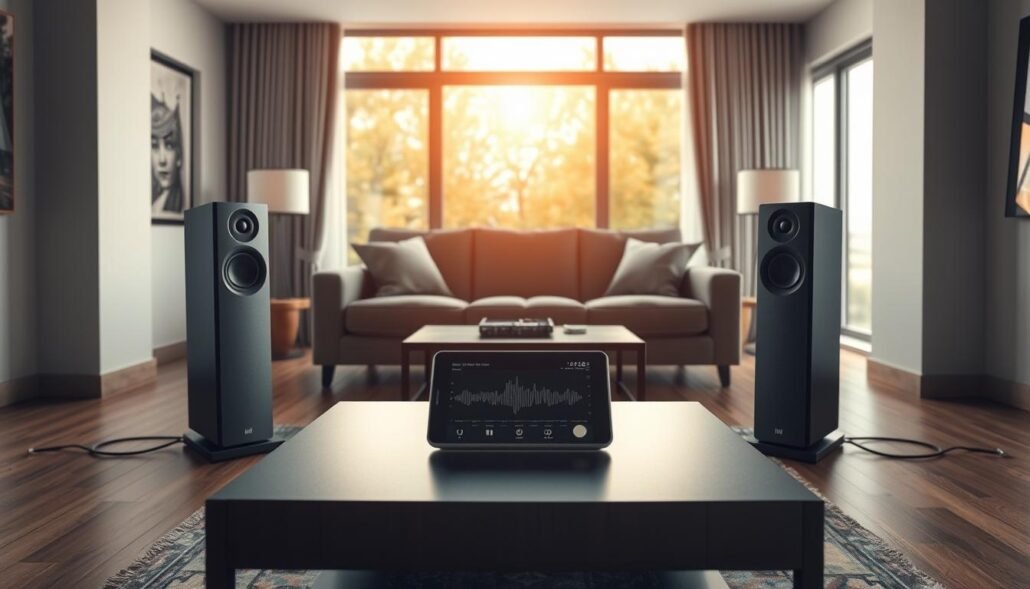
Place the listening seat with purpose: a small shift forward or back can tame bass peaks and reveal cleaner midrange. For most rectangular spaces start by locating the listener about 38% of the room length from the front wall. This simple move reduces strong modal influence and gives a more even bass field across seats.
The 38% rule for listening position and balanced bass
Anchor the seat at roughly 38% to lower prominent room modes near the primary position. From there, set speakers to form an equilateral or near-equilateral triangle with that seat for stable imaging.
Front wall, side wall, ceiling reflection control and imaging
Control primary sidewall and ceiling reflection points to sharpen stereo image and improve clarity. Use broadband panels near first reflections and add bass traps in vertical corners to absorb low-energy build-up.
- Speakers: toe-in for focus and smoother high frequencies.
- Front/back walls: absorb behind speakers; use diffusion on the rear wall to keep life without harsh echoes.
- Fine-tune: avoid exact multiples of dimensions; inch-level changes can reduce comb filtering and unwanted sound reflections.
- Verify: listen with pink noise and check an RTA to match measurements with perceived gains.
Match the Receiver to the Room: Power, Channels, and Room Correction
Pick receiver power and channels that suit how you use the space, not just spec sheets. Matching electronics to your listening habits and the physical environment keeps dynamics clean and prevents distortion at higher levels.
Power needs by volume and listening distance
Estimate required power from room volume and seating distance so peaks stay undistorted. Larger volumes need more headroom to reach reference peaks without compression.
Rule of thumb: add 20–30% headroom for big theaters or long listening distances, and use speakers with higher sensitivity to reduce strain on the amp.
Channels and layouts for seating and space
Choose layouts that match seat count and spacing. A 5.1 setup often fits compact home theater areas well. Move to 7.1 or Atmos in larger theaters where speaker placement and spacing are viable for immersive coverage.
Room correction and calibration
Run full calibration with a measurement mic across multiple seats. Let the receiver apply gentle EQ to smooth response.
Avoid heavy low-frequency EQ when bass modes are untreated—electronic fixes can mask standing waves but not eliminate nulls or long decay times.
When to prioritize acoustic treatment over electronics
- Treat first: install bass traps, broadband panels, and diffusers to control reflections and standing waves.
- Sub integration: use proper crossover points, phase and delay alignment, and consider multiple subs for even bass across seats.
- Iterate: treat, place, calibrate, then fine-tune crossovers and tone controls while checking with both movies and music for consistent clarity.
| Area | Recommended focus | Expected result |
|---|---|---|
| Small listening spaces | Bass traps, reflection panels | Reduced bass build-up; tighter midrange |
| Large theaters | Multiple subs, diffusion, wide-coverage power | Even bass, controlled echoes, immersive field |
| All setups | Calibration mic + measured EQ | Smoother response, safer levels |
Conclusion
A well-tuned listening space makes modest gear perform like high-end equipment.
Start by learning basic acoustics, measure your space, then set speakers and the primary seat using the 38% guideline. Treat first-reflection points on walls and ceilings before adding electronic fixes.
Focus on corner bass traps to tame standing waves, broadband absorption for mid/high control, and diffusers to keep life without echoes. These steps improve tonal balance and imaging across seats.
Size power and channels to match your household layout, then run calibration after physical treatments. Measure, listen, tweak in small steps for repeatable gains in your audio experience.
FAQ
What role do dimensions play when matching gear to my listening space?
Dimensions determine resonance behavior, low-frequency build-up, and required amplifier power. Smaller volumes boost bass energy and can make systems sound ‘boomy’ unless corrected. Larger volumes need more amplifier headroom and speaker output to maintain clarity at realistic levels. Use room volume and intended listening levels to guide receiver wattage and headroom choices.
Which acoustic phenomena most influence clarity and imaging?
Reflections, reverberation time, and standing waves are the main factors. Early reflections blur stereo imaging, long reverberation smears transient detail, and standing waves create peaks and dips in bass. Controlling these with absorbers, diffusers, and strategic placement improves articulation and sense of space.
How do surface materials affect tonal balance?
Hard surfaces like plaster, tile, and glass reflect high and mid frequencies, increasing brightness and edge. Soft furnishings and carpets absorb mids and highs, reducing harshness. Thick curtains, bookshelves, and rugs help tame reflections without deadening the room, producing a more natural tonal balance.
Why do small spaces often sound boxy, and what fixes help most?
Small enclosures emphasize room modes and pressure zones at low frequencies, causing uneven bass and a boxy character. Bass traps in corners, careful speaker placement away from boundaries, and moving the listening position can reduce peaks. Subwoofer calibration and parametric EQ also smooth problem bands.
What problems arise in larger rooms and how can I address them?
Large spaces tend to have longer reverberation and delayed reflections, which reduce intelligibility and contrast. Distributed speakers, delay alignment, and absorption at first-reflection points help. Diffusion across rear surfaces preserves liveliness while controlling slap echo.
How does room geometry alter mode distribution and predictability?
Rectangular proportions produce predictable axial modes that are easier to measure and treat. Irregular or vaulted geometries scatter modes, which can reduce strong resonant peaks but create complex reflection patterns. Modeling or measurement reveals where treatment or speaker adjustments are needed.
Are certain dimension ratios better for listening rooms?
Yes. Non-simple ratios—like 1:1.6:2.6—spread modal energy and reduce coincident resonances. Avoid simple multiples such as 1:2:3, which stack modes and amplify certain frequencies. Aim for asymmetric dimensions where feasible to distribute resonances more evenly.
How can I detect and map problematic frequencies without expensive gear?
Use free SPL apps and test-tone sweep files to listen for boom or nulls while moving a microphone or phone around the room. Clap and listen for flutter echoes. Online room simulators and basic measurement software with a USB mic or smartphone can identify dominant problem bands for targeted treatment.
What placement rules improve bass balance and imaging?
Place the listening seat near 38% of the room length from the front wall to reduce modal peaks. Keep speakers off the front wall by at least a small distance to minimize boundary loading. Toe-in and height adjustments fine-tune imaging, while subwoofer placement and crossover tuning handle low-frequency integration.
How should receiver power be chosen relative to room volume?
Choose an amplifier with enough continuous power to achieve typical listening levels comfortably without clipping. Larger rooms or louder preferences require greater headroom. Look for receivers that deliver clean power at speaker impedance and offer dynamic headroom rather than relying solely on peak specs.
When is room correction preferable to acoustic treatment?
Room correction systems and digital EQ help tame measurable frequency response issues but cannot fix time-based problems like early reflections or long reverberation. Prioritize physical acoustic treatment for echoes and imaging; use room correction to refine frequency balance after treatment and speaker placement.
How do multiple seating positions affect system layout choices?
Multiple listeners require even coverage. Consider wider speaker arrays, additional surround channels, or subwoofer distribution to smooth bass across seats. Use delay settings and level calibration in the receiver to align timing and balance for all listeners.
What surfaces should I treat first for the biggest improvement?
Start with first-reflection points on side walls and ceiling, then add bass trapping in corners. Treating these areas yields noticeable gains in imaging, clarity, and low-frequency control. After that, address rear reflections and diffusion to retain a natural room ambiance.
Can irregular furnishings replace purpose-built acoustic panels?
Bookshelves, couches, and curtains help by diffusing and absorbing sound, but they seldom match the broadband performance of designed panels and traps. Use furnishings as a first step, then supplement with tuned panels and bass traps where measurement shows deficiencies.
How often should I re-evaluate calibration and placement?
Reassess whenever you change speakers, seating, or major furniture, or after adding treatment. Seasonal changes in humidity or room content can subtly alter response, so a quick check and re-calibration every 6–12 months keeps performance consistent.