Matching speakers and receivers starts with clear specs, not hype. Read impedance, sensitivity and RMS power before you buy. Most home speakers list 4–8 ohms; low-impedance loads can stress some receivers, so make sure the manual supports your choice.
Modern AVRs include protection circuits, but pairing right up front improves sound quality and long-term reliability. Use continuous RMS numbers rather than peak or PMPO figures when matching amp power to speaker handling.
High-sensitivity models (around 90 dB+) need less power for the same volume. Room size, listening levels and brand design philosophies change final choices, yet ohms, wattage and sensitivity remain the backbone of smart system builds.
Next, we will walk through power matching, room impact and practical examples so you can balance performance and safety over the years.
Buyer’s guide overview: how to pick speakers that match your receiver today
Begin by checking your receiver’s manual; its supported impedance and RMS numbers set the safe limits for any speaker choice. Note footnotes about multi‑channel loads and per‑channel wattage before you shortlist options.
Next, match nominal impedance and recommended continuous power. Aim for speaker recommendations that sit inside your receiver’s steady output range. That reduces stress on the amplifier and keeps long‑term reliability high.
Prioritize sensitivity. Higher sensitivity speakers need less power to reach the same loudness, which helps if your amplifier has modest output. Room size and listening levels then shape final choices more than brand names.
- Plan the system: stereo or multichannel, plus center and sub plans.
- Check placement, size, and furniture impact on low frequencies.
- Balance price against expected performance and future upgrades.
In short: keep within published specifications, use sensible volume, and let measurable performance guide decisions. In a crowded world of product options, this way avoids common pitfalls and delivers steady audio quality for years.
Specs that matter for pairing: impedance, sensitivity, and power
The right match begins at the spec sheet: impedance, loudness rating, and RMS power matter most.
Impedance and ohms
Impedance is the load your speakers present to the amplifier. Most consumer designs sit at 6–8 ohms nominal. Low‑impedance (4 ohms) models can strain receivers unless the manual lists that support.
Sensitivity and loudness
Sensitivity is a loudness rating in dB measured at 1 watt/1 meter. Typical ranges fall from 87–93 dB; anything over 90 dB is efficient and needs less amplifier power to reach listening levels.
Continuous (RMS) vs peak
RMS/continuous power is the realistic baseline for matching amp output and speaker handling. Peak or PMPO shows short bursts only. Pay attention to per‑channel numbers; multi‑channel operation often lowers real wattage.
- Read footnotes and specs for true conditions of rated power and ohms support.
- Match speaker power handling to amplifier continuous output to avoid distortion and damage.
Power matching made easy: safe ranges and the “rule of two”
Aim for sensible amp-to-speaker ratios so short crescendos don’t force clipping or stress parts. Start with continuous RMS ratings rather than peak numbers when you compare specs.
Recommended amp power vs speaker power handling
Use the speaker’s RMS rating and the receiver’s RMS output to set a safe operating range. As a rule, an amplifier output roughly 1.5–2× the speaker’s continuous handling gives reliable headroom.
Avoiding clipping and burnout with sensible volume limits
Underpowered amplifiers driven too hard create clipped waveforms that can damage tweeters. Keep listening levels moderate—often under 70–75% of maximum—to reduce risk.
Headroom for dynamics in music, home theater, and games
Create margin for sudden peaks so transients stay clean and the system’s thermal limits aren’t taxed. Also, make sure you compare continuous ratings at the same impedance to avoid apples-to-oranges errors.
- Mind multi-channel drops: AVRs deliver less per channel when many channels run.
- Choose speakers with handling high enough to cover your amplifier’s real output for peace of mind.
- Balance price and performance: efficient speakers often need less raw power for great sound.
Room size, listening distance, and placement: getting reference-level sound
Room volume and seating distance determine how much amplifier output you need for true reference playback.
Small, medium, large spaces
Small rooms need less power to reach the same sound level than large ones. Move farther from the sources and required power rises quickly.
Listening distance and SPL
Doubling distance costs roughly 6 dB of SPL thanks to the inverse square law. That shift shapes which sensitivity and power mix will meet your target level.
For example, an 85 dB sensitivity speaker can need about 128 W to top 105 dB nearfield. A 92 dB sensitivity model might reach similar SPL with ~32 W.
Placement basics
Place tweeters at ear height and keep left/right spacing symmetrical. Give speakers some room from walls for cleaner bass and better imaging.
- Create a focused listening area in large spaces to cut required power.
- Decide a target SPL, measure seating distance, then match sensitivity and amplifier power.
- Remember: good setup often outperforms more expensive gear that is poorly placed.
Subwoofers and AVRs: matching LFE, protection circuits, and low-impedance loads
When you offload low frequencies to a powered sub, your amplifier gains headroom and your system delivers cleaner sound. Proper crossover, level matching, and phase alignment make the handoff seamless.
Modern protection and its limits
Receivers often include thermal shutdowns and fuses that prevent catastrophic failure. They help but do not excuse sustained misuse or mismatched loads.
Integrating subs with bookshelf or floorstanding speakers
Cross mains to the sub at an appropriate frequency to free midrange drivers and improve imaging.
- Set crossover, match levels, and check phase for a smooth LFE handoff.
- Verify manual notes on ohms and multi-channel drive before using 4-ohm models; low impedance can overwork power supplies at high levels.
- Consider multiple subs to smooth room modes and provide even bass.
| Feature | Benefit | Limitations |
|---|---|---|
| Thermal shutdown | Prevents heat damage | Won’t stop long-term stress from improper loads |
| Powered sub integration | Frees woofer/headroom | Requires correct crossover and level match |
| Beefy power supply | Handles difficult loads better | Higher cost and weight |
Brand synergy examples: when specific pairings just make sense
Synergy shows up when amplifier timing and driver control match a speaker’s behavior. Marantz and Bowers & Wilkins often illustrate that point.
Marantz receivers with Bowers & Wilkins
Concrete stereo matches: Model 30 or SACD 30n with 702 S2 suits large rooms. PM6007 or PM7000N with the 600 Series offers strong entry-to-mid performance.
Home theater and reference stacks
SR7015 with 603 S2 plus HTM6 S2/CCM663 covers multichannel needs. For separates, AV8805A + MM8077 + MM7055 with 703 S2 delivers reference-grade dynamics.
Why it works: Marantz HDAM speed pairs well with B&W Continuum drivers for cleaner detail and musical timing. That shared engineering often yields coherent sound and less fatigue over time.
- Match electrical specs first.
- Then audition tonal balance and imaging.
- Shortlist two or three combos, test at listening distance.
| Use case | Recommended stack | Key benefit |
|---|---|---|
| Large-room stereo | Model 30 + 702 S2 | Wide dynamics and presence |
| Accessible stereo | PM6007/PM7000N + 600 Series | Balanced clarity at modest power |
| Home theater | SR7015 + 603 S2/HTM6 S2 | Immersive multichannel performance |
Speaker types for your setup: stereo, home theater, and home cinema
Deciding between compact bookshelf units or full-height floorstanders starts with how much space you can give them. Consider listening goals, room volume, and future expansion when choosing a path.
Bookshelf vs floorstanding
Bookshelf models plus a sub deliver tight midrange and flexible bass via crossover. They fit small spaces and budget plans well.
Floorstanders often offer greater low-end and higher sensitivity. They need space but reduce reliance on a sub for full-range music and theater playback.
Center, surrounds, and in‑ceiling
Match center and surrounds inside the same series for consistent timbre in home cinema. In‑ceiling or on‑wall modules work well for Atmos or rear channels when placed and calibrated for even envelopment.
Low‑impedance or high‑efficiency
High-efficiency designs need less amp power to reach listening levels in large spaces. Low‑impedance models demand robust amplifiers and strong current delivery. Pick based on your amplifier’s ratings and room size.
- Stand placement, boundary clearance, and mounting change bass and imaging.
- Compact bookshelf + sub is ideal for tight space and clear midrange detail.
- Choose a series with extras for future upgrades.
| Option | Strength | Space | Power needs |
|---|---|---|---|
| Bookshelf + sub | Flexible, clear midrange | Small–medium | Moderate |
| Floorstander | Extended bass, higher sensitivity | Medium–large | Lower to moderate |
| In‑ceiling / on‑wall | Discrete surrounds, good envelopment | Any (mounted) | Varies by model |
Budget planning: match price tiers to performance and room
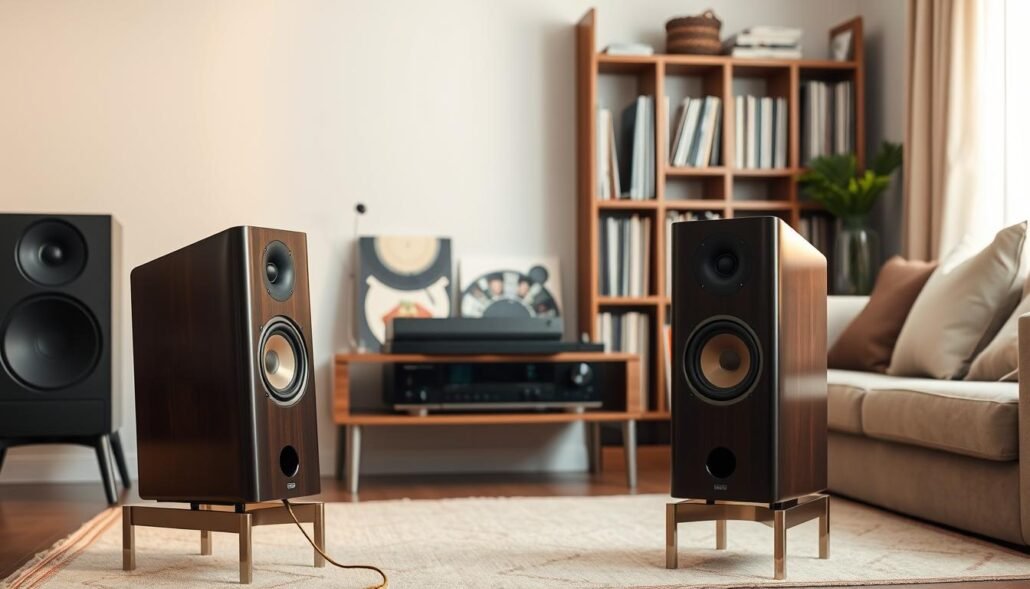
Allocate funds based on target performance and the room you’ll use, then pick sensible options. Think about how much of your total price should go to speakers versus electronics. A balanced spend helps the whole system perform in real rooms.
Entry level: smart pairings that protect your amp and your speakers
Choose speakers with friendly impedance and decent sensitivity. Match recommended power ranges and keep levels moderate.
- Allocate budget so speakers and receiver are roughly balanced.
- Good placement and modest room treatment often improve sound more than spending extra.
Midrange: sensitivity gains, better dynamics, and cleaner detail
Mid-tier products often boost sensitivity and use improved crossovers. That yields better dynamics at normal power levels and clearer detail.
Look for upgrade paths within a product line so centers and surrounds can match later.
Premium: headroom, imaging, and future‑proof specifications
Premium choices deliver more headroom, tighter cabinets, and precise crossovers. Expect higher quality parts and longer useful life.
| Tier | Key win | Typical focus |
|---|---|---|
| Entry | Value & protection | Balanced price |
| Mid | Efficiency & detail | Sensitivity |
| Premium | Headroom & imaging | Build quality |
What are the best speakers to pair with a specific receiver brand?
Begin with the receiver manual. Confirm supported impedance and per‑channel continuous power before any shortlist. These published specifications set safe operating limits and prevent mismatches that stress electronics.
Use manufacturer guides first
Check nominal ohms and RMS power in the manual. If a receiver lists 4–16 ohms and gives continuous wattage at 8 ohms, use those numbers when comparing candidate speakers.
Filter by room, sensitivity, and listening levels
Match speaker sensitivity to your space and desired volume. For large rooms or long listening distances, favor higher sensitivity or add amplifier headroom.
Decide how loud you listen. If you prefer high levels, choose speakers rated for higher sensitivity and confirm your amplifier can supply the needed power without clipping.
- Shortlist speakers whose nominal impedance and recommended power handling fit the receiver specs.
- Treat stereo imaging and theater use differently; each has unique demands.
- Use published measurements and reviews to refine choices and avoid surprises.
| Step | Why it matters | Action |
|---|---|---|
| Check manual specs | Prevents electrical mismatch | Confirm impedance and RMS per channel |
| Match sensitivity | Defines real-world loudness | Pick higher sensitivity for large space |
| Verify power headroom | Avoid clipping and distortion | Choose speakers with handling above receiver RMS |
Finally, use known pairings as inspiration but validate in-room performance. If you need a starting point for compatible electronics, see this AV receiver guide for common specs and platform options.
Mistakes to avoid for long‑term reliability
A few common setup errors cause most reliability problems over months of regular listening. Fixing these early saves money and keeps sound on point.
Running 4‑ohm loads on receivers not rated for them
Don’t hook 4‑ohm speakers to gear that lists 6–8 ohms only. Low impedance draws higher current and can overheat the power supply at high output.
Check the manual for any footnotes about multi‑channel loads and thermal limits before you connect new speakers.
Underpowered amps driven into clipping
Driving an underpowered amp hard causes clipping. That distortion damages tweeters and ruins sound quality.
Leave headroom: choose an amplifier with continuous power above the speaker’s handling or pick higher sensitivity speakers if space or budget limits you.
Ignoring RMS specs and focusing only on peak numbers
Use RMS/continuous ratings as your guide. Peak or PMPO figures are marketing numbers and give a false sense of safety.
Verify specifications for both electronics and speaker rating so you match impedance, power, and thermal expectations over time.
- Mind ventilation; keep receivers and amps clear of enclosed spaces.
- Set realistic volume for your room and sensitivity to avoid chronic strain.
- Remember nominal ohms vary with frequency—allow margin when matching gear.
| Risk | Cause | Prevention |
|---|---|---|
| Overheating | 4‑ohm load on non‑rated receiver | Match impedance and check manual |
| Driver damage | Clipping from underpowered amp | Use amp with spare continuous power |
| Poor performance | Relying on peak ratings | Choose RMS ratings for matching |
Quick decision paths: a simple checklist before you buy
Follow a compact decision path to confirm specs, headroom, and real-room needs before you buy.
Start by checking your receiver’s supported impedance and RMS power per channel. Make sure any short list of speakers matches those limits.
- Confirm amplifier range: verify each speaker’s recommended amp power and continuous handling so power delivery is safe.
- Apply the rule of two: aim for roughly 1.5–2× speaker RMS for useful headroom, then refine by sensitivity and room size.
- Estimate seating distance. Doubling distance costs about 6 dB; choose sensitivity so the system reaches your target without strain.
- Plan setup including sub integration for stronger bass and extra headroom for the mains.
- Check ventilation and rack space and compare two to three options; audition if possible to confirm tonality and dynamics.
- Set a practical volume ceiling and listen for distortion—if you hear it, step up efficiency or power rather than push harder.
| Check | Why it matters | Action |
|---|---|---|
| Impedance / ohms | Protects receiver | Match nominal ohms in manual |
| Power / amp headroom | Prevents clipping | Choose amplifier within recommended range |
| Sensitivity & distance | Real-world loudness | Pick higher sensitivity for larger rooms |
Conclusion
strong, Smart pairing begins with matching impedance, RMS power and sensible sensitivity. Do that first and then tune placement for your space and listening level.
Use the “rule of two” for headroom and add a powered sub for cleaner lows. Keep ventilation and volume discipline to protect amplifier and drivers over years.
Brand synergies offer useful starting points, but your room and daily listening experience decide final choices. Take time to audition, compare, and refine until the sound and performance match your expectations.
Takeaway: match the fundamentals, optimize the room, and enjoy better audio and home cinema results over time.
FAQ
How do impedance and ohms affect compatibility between receivers and speakers?
Impedance tells the receiver how much current a speaker will draw. Check your receiver’s supported range—most modern AVR models handle 6–8 ohms comfortably, while some can drive 4‑ohm loads. Using a speaker below the supported ohms risks overheating the amplifier or triggering protection circuits. Match the speaker nominal impedance to the receiver specs and, if unsure, choose speakers with 6–8Ω ratings for broader compatibility.
Why does sensitivity matter when choosing speakers for an amplifier?
Sensitivity, measured in dB, shows how loud a speaker will play from 1 watt at 1 meter. Higher sensitivity (around 88–92 dB or more) lets modest amplifiers reach listening levels without strain. Low‑sensitivity speakers need more power for the same SPL. Pick a sensitivity that fits your receiver’s output and your room size to avoid clipping and preserve dynamics.
Should I use peak power or RMS when matching amp power to speakers?
Use RMS (continuous) power for realistic matching. Peak numbers are marketing figures and don’t reflect sustained performance. Ensure your receiver’s clean RMS output falls within the speaker’s continuous power handling range. A safe rule: the amp’s RMS should sit near the speaker’s lower-to-mid RMS rating, giving headroom without overpowering the drivers.
What is the “rule of two” for power matching?
The “rule of two” suggests an amplifier with about twice the speaker’s continuous power rating provides clean headroom and reduces the chance of clipping. That headroom helps transient peaks and dynamic passages without distortion. However, avoid massive overpowering; sensible ranges and conservative listening levels matter more than sheer wattage.
How can I avoid clipping and burning speakers when using a receiver?
Prevent clipping by not pushing the receiver into distortion—if sound becomes harsh at high volumes, back off. Use gain controls and speaker level trims correctly, and match amp power to speaker ratings. Add protection features like speaker fuses or the receiver’s built‑in protection, and prioritize proper ventilation to avoid thermal shutdowns.
How does room size change speaker and amplifier choices?
Larger rooms need more SPL and bass extension, so choose higher‑sensitivity speakers or more powerful amplifiers. Small rooms benefit from compact speakers and moderate power. Consider room acoustics and placement; untreated reflections can make even powerful systems sound poor. Measure listening distance—the farther you sit, the more power required to maintain SPL.
How do I integrate a subwoofer with an AVR and main speakers?
Use the AVR’s LFE or subwoofer output and set crossover frequency based on your mains’ low‑end rolloff (often 60–120 Hz). Calibrate level and phase with the receiver’s room correction or manual adjustments. Ensure the sub’s impedance and amplifier type won’t add excessive load to the AVR; powered subs isolate amplifier concerns and simplify matching.
Can I mix brands, for example pairing Marantz receivers with Bowers & Wilkins speakers?
Yes. Marantz receivers often emphasize musicality and warmth, which pairs well with neutral, detailed speakers like Bowers & Wilkins. Cross‑brand matching works when you compare specs—impedance, sensitivity, and tonal balance—rather than relying on logos. Listen when possible to confirm synergy in your listening room.
What tradeoffs exist between bookshelf and floorstanding models for AVR setups?
Bookshelf speakers save space and often need a subwoofer for strong bass. Floorstanding models deliver deeper bass and higher sensitivity, reducing subwoofer dependence. Choose based on room size, bass needs, and aesthetic constraints. Floorstanders suit larger rooms and higher SPLs; bookshelves fit smaller rooms and nearfield listening.
How important is amplifier headroom for music and home theater?
Headroom is crucial. Music and movie soundtracks have transient peaks that demand extra power above average levels. Amps with healthy headroom reproduce those dynamics without distortion. Look for receivers with conservative RMS ratings and dynamic power specs to ensure lively, undistorted playback.
What common mistakes shorten speaker and receiver lifespan?
Typical errors include driving speakers with underpowered amps until clipping occurs, using 4‑ohm speakers on receivers not rated for them, and ignoring RMS ratings in favor of peak numbers. Overdriving without ventilation and mismatched impedance can overheat and damage components. Follow manufacturer specs and use conservative levels.
How do I match budget levels between receivers and speakers?
Align tiers: entry‑level receivers pair well with efficient, affordable speakers that won’t demand excessive power. Midrange systems benefit from higher‑sensitivity speakers and receivers with better DACs and headroom. Premium setups need speakers with refined imaging and receivers with robust power and advanced room correction. Spend proportionally across components rather than putting most budget into one item.
What quick checklist should I run through before buying speakers for an AVR?
Verify receiver supported impedance and RMS output, compare speaker sensitivity and continuous power handling, measure room size and listening distance, plan placement and sub integration, and audition models when possible. Confirm warranty and return policies for risk‑free testing in your space.