Mixing up ports can kill picture and sound instantly. This short guide fixes that by showing which jack receives content and which sends it to your TV. You will learn how signal flow works and why ARC/eARC matters for modern setups.
Quick preview: Sources like a Blu‑ray player or game console plug into the input, while the output feeds the display and may carry TV audio back via ARC or eARC. Using the right hdmi cable and the correct hdmi input avoids common faults.
Expect clear steps for spotting ports on the back panel, tracing audio paths, and handling setups that mix streaming apps, a disc player, and a console. This keeps audio and video signals flowing so your home theater works as promised.
What is the difference between “HDMI In” and “HDMI Out” on a receiver?
A simple signal map makes setup painless.
hdmi input ports on the receiver act like listeners. Plug sources such as a Blu‑ray player, Apple TV, Xbox, or cable box into these jacks. The receiver accepts audio video signals and chooses which feed to process.
HDMI Out ports do the talking. They transmit audio video to your TV or projector and often carry CEC control data so one remote can manage power and volume.
Think of signal direction as a line: sources → receiver hdmi input → receiver HDMI Out → tvs. For example, selecting “GAME” on the receiver sends the console’s picture to the display while decoding surround sound for speakers.
Labels get more important with hdmi arc and enhanced audio return. An output labeled Out (ARC) or Out (eARC) still sends video to the display but also supports the audio return channel so TV audio can flow back to the receiver. Both endpoints must support arc or earc for that two‑way link.
| Port Type | Primary Role | Typical Connected Device | Notes |
|---|---|---|---|
| HDMI Input | Receive A/V | Blu‑ray, console, streamer | Listens for source signals |
| HDMI Output | Send A/V | TV or projector | Sends selected video and CEC |
| Out (ARC/eARC) | Send + Receive (TV audio) | TV with ARC/eARC support | Enables audio return channel and higher bandwidth with eARC |
Quick way to identify HDMI In vs HDMI Out on your receiver
A quick glance at the back panel tells you which sockets accept sources and which one connects to the display.
Fast identification checklist:
- Find the cluster of many jacks labeled for sources — these are almost always hdmi input ports.
- Look for a lone jack labeled “HDMI Out,” “Monitor Out,” or “Out (ARC/eARC)” — that links to the TV.
- If you need ARC, pick the port marked ARC or eARC for the TV connection and use a single hdmi cable between devices.
Where to look on the back panel and why “Out (ARC/eARC)” is a giveaway
Most receivers place inputs together with names like BD/DVD, GAME, and CBL/SAT. The separate Monitor or Out area is your display feed.
Even when ARC sends audio back from the TV, the labeled Out still functions as the video output in normal cases. That label is the clearest sign you should connect the TV there.
Common port layouts and connection order
Typical layouts show many inputs in one row and one monitor output alone. Some models have two outputs; only the ARC/eARC-marked output supports return audio.
Connect the TV to the correct output first, then plug sources into inputs. If ARC or CEC won’t handshake, power-cycle devices in that order to force a new connection.
| Item | Where to Find | Quick Action |
|---|---|---|
| Multiple inputs | Cluster labeled by source | Plug Blu‑ray, console, streamer here |
| Monitor/Out | Separate jack near edge | Connect to TV or projector |
| Out (ARC/eARC) | Same area as Output | Use for TV audio return with a single hdmi cable |
How HDMI signal flow works in a home theater system
Signal paths determine where picture and sound travel in your living room setup.
Three roles exist in any system: source devices create audio and video, display devices show the picture, and audio devices play sound. A receiver often acts as both a switch and the main audio processor.
In a typical flow the game console outputs video and audio to the receiver. The receiver selects that input, sends video on to the TV, and decodes audio for the speakers. This lets the receiver handle surround decoding and amplification for the best sound.
Most tvs are the video end because they display the picture. They are not always the audio end since apps or tuners inside the set produce sound you may want routed to better speakers.
Audio return through ARC or eARC lets TV-created audio travel back to the receiver over the same cable. That keeps the setup simple and improves the listening experience when you use TV apps.
| Role | Primary function | Typical example |
|---|---|---|
| Source devices | Create and send A/V | Blu‑ray player, console |
| Display devices | Show video (video end) | TV or projector |
| Audio devices | Decode and play audio (may be receiver) | AV receiver, soundbar |
Connecting typical devices to a receiver using HDMI
Good wiring preserves both picture and immersive audio.
Blu‑ray player best practice: connect the player HDMI Out to a receiver HDMI In, then run the receiver HDMI Out to your TV. This lets the receiver decode high‑fidelity formats that some TVs or older ARC ports cannot pass.
Blu‑ray to receiver to TV for best audio formats
Use this chain when you want lossless surround and full audio bitstreams from discs. It avoids TV pass‑through limits and keeps audio quality high.
Gaming console setups and 4K 120Hz / variable refresh rate
If the receiver supports hdmi 2.1 features, route the console through the receiver to keep audio and gaming features together.
If not, plug the console straight into the TV for 4K 120Hz and variable refresh rate, then use ARC or eARC to send sound back to the receiver.
Streaming apps on smart TVs and when the TV becomes the hub
When apps run on the TV, the set becomes the source. Enable ARC/eARC so TV app audio returns to the receiver for better speakers.
- Sanity check: every external device plugs into an HDMI In on either the TV or receiver; only one main HDMI goes from receiver to TV when the receiver is the switch.
- For hdmi 2.1 gaming, use Ultra High‑Speed hdmi cable to avoid dropouts; older cables may handle 4K/60 but not 4K 120Hz or VRR.
| Scenario | Recommended wiring | Why |
|---|---|---|
| Blu‑ray disc | Player → Receiver → TV | Receiver decodes premium audio |
| Console (hdmi 2.1 supported) | Console → Receiver → TV | Keep 2.1 features and audio together |
| Console (old receiver) | Console → TV; TV → Receiver (ARC/eARC) | Enable 4K 120Hz/VRR, send audio back |
HDMI ARC and audio return channel explained for receivers
ARC turns a single HDMI link into a two-way lane for audio and picture.
How ARC works: The audio return channel lets the TV send sound back to an audio device such as an AV amp or soundbar receiver over the same cable that sends video to the display.
Find the ports: On the TV, look for an HDMI jack labeled “ARC” or “eARC.” On the audio device, the HDMI Out will often include the same label. Both ends must support the return channel for two-way audio to work.
ARC with consumer electronics control
ARC commonly pairs with consumer electronics control so one remote can manage volume and power. Cross-brand setups sometimes create handshake issues, so toggling CEC in menus may fix control problems.
When optical still helps
ARC usually replaces optical digital audio. Still, an optical cable can be a handy fallback when ARC handshake or CEC issues cause dropouts or limited formats.
| Feature | ARC behavior | When to use optical |
|---|---|---|
| Audio flow | TV → audio device via return channel | When ARC handshake fails |
| Control | Works with CEC for one-remote use | Use manual control if CEC is unreliable |
| Compatibility | Both devices must support ARC/eARC | Optical works with older equipment |
Quick settings to confirm: enable HDMI-CEC and ARC on the TV, and enable ARC/TV Audio on the receiver input assignment.
eARC, HDMI 2.1, and higher-quality surround sound formats
eARC upgrades the return path so high‑fidelity surround travels intact from TVs and sources back to your amp.
Define eARC: enhanced audio return provides far more bandwidth than classic arc. That bandwidth lets lossless formats reach the receiver without heavy compression.
Format capabilities and practical impact
On arc, many TVs fall back to compressed streams like Dolby Digital Plus for Atmos. With eARC, you can get Dolby TrueHD and dts-hd master audio reliably delivered to the receiver.
Lip-sync and timing
Video and audio must match. eARC requires lip-sync compensation so dialogue stays tied to picture. That reduces annoying delays you sometimes hear with older setups.
Backward compatibility and real-world wiring
eARC is part of hdmi 2.1 and works with older arc gear in fallback mode. If a TV supports eARC but the amp only supports arc, the chain will usually drop to arc limits.
| Feature | ARC | eARC |
|---|---|---|
| Max audio bandwidth | Lower, often compressed | Higher, supports lossless |
| High-bitrate formats | Limited (may transcode) | Dolby TrueHD, dts-hd master audio |
| Lip-sync | Optional | Required |
Bottom line: if you use TV apps as main sources and want top-tier surround, confirm both tvs and amp support enhanced audio return and hdmi 2.1. Also check cable quality and settings so the full signal chain negotiates the best formats.
Choosing the right HDMI cable and understanding “HDMI cable with Ethernet”
Cable choice matters more when you want lossless audio or the fastest gaming modes.
What “HDMI cable with Ethernet” means: this cable adds a data channel that helps devices talk to each other. It can support device communication and some ARC/eARC features without extra network wiring.
For typical ARC use, you usually do not need a new hdmi cable. Many High Speed cables with ethernet handle TV app audio and return channels fine. Replacing cables often brings no benefit if your setup runs at 4K/60 or you only send TV audio to the amp.
When to replace a cable: if you want hdmi 2.1 gaming features like variable refresh rate or 4K 120Hz, buy an Ultra High‑Speed cable. Older cords may cause blank screens, flicker, or dropped features during intense gaming.
Selection tips: choose certified cables for long runs, avoid unknown brands, and match the cable rating to the most demanding device in the chain. Marginal cables or loose connectors often cause intermittent audio or video, so testing with a known-good cable helps troubleshooting.
| Use case | Recommended cable | Why |
|---|---|---|
| ARC / TV app audio | High Speed with Ethernet | Handles return channel and device control |
| eARC / lossless audio | High Speed with Ethernet or Ultra High‑Speed | Many existing cables work; ensure certification for best results |
| hdmi 2.1 gaming | Ultra High‑Speed | Needed for VRR and reliable high‑frame rate gaming |
Recommended wiring patterns for the cleanest setup
Decide whether the TV or the amp will act as the hub before you run cables through the wall.
Using the TV as the HDMI switch
Setup A: Plug sources into TV HDMI ports, then run a single hdmi cable from the TV ARC/eARC jack to the receiver or soundbar receiver.
This works well when the receiver has few inputs or when a console needs direct 2.1 features on the TV. It also makes the TV remote the primary controller.
Using the receiver as the HDMI switch
Setup B: Connect all devices into the receiver, then use one HDMI Out to the TV. This gives the receiver full control for decoding Atmos and multichannel formats.
This pattern often yields the best audio in a home theater system and reduces format loss from TV pass-through.
How to decide quickly
- Count how many hdmi devices you own and compare to receiver inputs.
- If high-bitrate surround matters, prefer receiver-as-hub.
- If TV apps are primary, TV-as-hub plus a single hdmi cable to the amp can simplify the experience.
| Goal | Best pattern | Why |
|---|---|---|
| Max audio quality | Receiver as switch | Full decoding and stable pass-through |
| Simple control | TV as switch | Fewer remotes, fewer cables |
| Limited inputs | TV as switch | Works around small receivers |
Common issues and fixes when HDMI In/Out or ARC isn’t working
Many problems trace back to one wrong port, a bad cable, or a menu setting.
First 60 seconds diagnostic:
- Confirm the TV is connected to the receiver HDMI Out labeled ARC/eARC.
- Make sure you used the TV’s ARC/eARC HDMI port.
- Set the receiver input to TV Audio or ARC and try a quick power cycle.
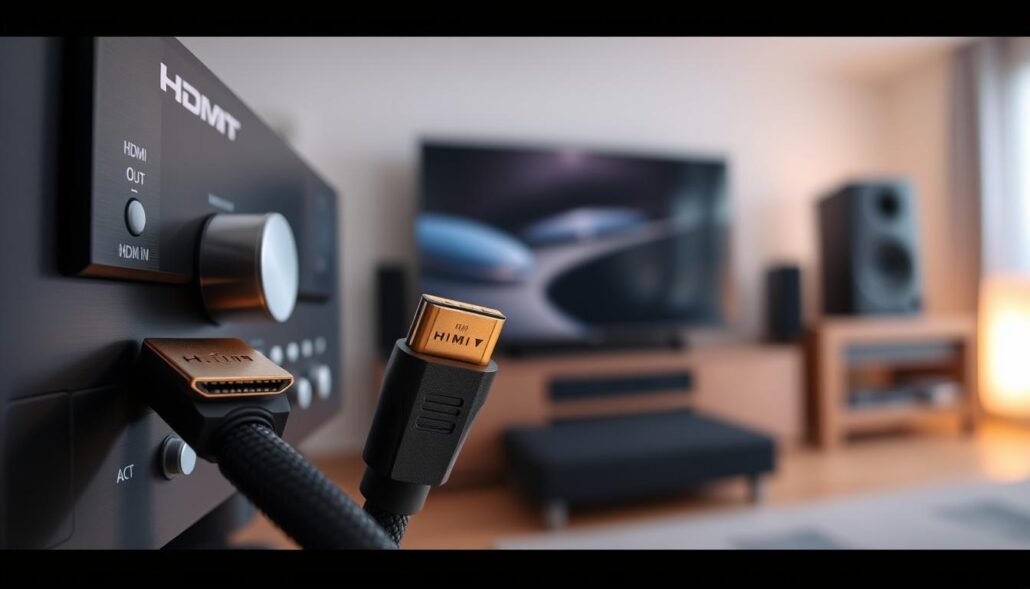
No sound over ARC: quick setting checklist
Check TV audio output and enable external speakers. Turn on ARC/eARC and HDMI-CEC in both device menus.
If still silent, power devices off, then on in this order: TV first, receiver second, sources last. Try a different cable or hdmi port if needed.
CEC problems: control not syncing
CEC varies by brand. Toggle it off then on, update firmware, or use a universal remote if power and volume fail to follow. Experimentation often fixes cross-brand quirks.
Format mismatches and 5.1 limits
If audio drops out, switch the TV or source from bitstream to PCM. Many TVs downmix when sources plug into the TV first. Direct-to-receiver connections or eARC restore true 5.1 or surround formats.
Signal dropouts and when to go optical
Dropouts often come from long or low-quality cables or wrong port selection. For HDMI 2.1 features, use Ultra High‑Speed cable. If ARC remains unstable, optical works as a reliable fallback for stereo or 5.1, though it won’t carry the highest-end formats.
| Symptom | Quick fix | When to escalate |
|---|---|---|
| No sound | Check ARC settings, toggle CEC | Try new cable or port |
| Control fails | Toggle CEC, update firmware | Use universal remote |
| Intermittent signal | Replace cable, test ports | Use Ultra High‑Speed for 2.1 needs |
Conclusion
Conclusion
A clean wiring plan saves time—route players and consoles into input ports and connect the dedicated output to the display.
In short: a hdmi input on your receiver takes in source signals, while the output sends picture to the TV and can serve as the hdmi arc link for returning TV audio.
For best surround, plug sources into the receiver. If you need latest gaming modes and your amp lacks hdmi 2.1, connect the console to the TV and rely on eARC for sound back.
Most setups do not need new cable for TV app audio, but upgrade to certified cables for high‑bandwidth gaming. When things fail, check port labels, enable ARC/CEC and audio output, then swap cables or ports to isolate the issue.
FAQ
What does an “In” port do on my receiver?
The “In” port accepts audio and video from source gear such as a Blu‑ray player, game console, or streaming box. Plugging sources into inputs routes their signals into the receiver so it can switch, decode, and send audio to speakers while passing video onward to a TV or projector.
What does an “Out” port do on my receiver?
The “Out” port sends processed video and sometimes audio from the receiver to a display. One HDMI Out typically carries video to a TV or projector; if labeled ARC or eARC it also accepts return audio from the TV back to the receiver for apps or TV tuners.
How do ARC and eARC change labeling and hookup?
ARC (Audio Return Channel) lets a single cable both send video to the TV and receive TV audio back. eARC expands bandwidth for lossless formats like Dolby TrueHD and DTS‑HD Master Audio. Ports labeled “ARC” or “eARC” on either device mark that bidirectional capability.
Where should I look on the back panel to spot inputs versus outputs?
Inputs are grouped and labeled with source names (Blu‑ray, Game, Aux). Outputs sit near speaker or preout areas and one will be labeled Out, Monitor Out, TV Out, or Out (ARC/eARC). The ARC/eARC label is the fastest giveaway that a port handles return audio.
How are typical receiver port layouts organized?
Manufacturers often place HDMI inputs in a block for easy access and the single HDMI Out near video controls. Some receivers include a dedicated Out for zone 2 or a monitor; others add HDMI eARC on the front or back depending on design.
Who transmits audio and video in a standard home theater chain?
Source devices transmit audio/video into the receiver (inputs). The receiver processes audio for speakers and transmits video to the display (output). A TV can return audio via ARC/eARC when you use onboard apps, making the TV act as an audio source.
What does “transmit audio video” mean in practical setups?
It means sending encoded video and audio over a single HDMI cable. For example, a Blu‑ray player transmits 4K video and multi‑channel audio to the receiver, which then routes video to the TV and audio to the speaker system.
Why is the TV usually the end for video but not always for audio?
Displays typically render video, so they sit at the end of the video chain. Audio can be routed back to a receiver via ARC/eARC; in setups where sources plug directly into the TV, the TV forwards audio to the receiver instead of the receiver being first in line.
How should I connect a Blu‑ray player for the best audio?
For full surround formats, plug the Blu‑ray player into a receiver input. Let the receiver handle decoding and output video to the TV. This preserves lossless formats such as Dolby TrueHD and DTS‑HD Master Audio when supported by your receiver and eARC setup.
What changes with gaming consoles at 4K 120Hz and VRR?
High refresh and features like VRR require HDMI 2.1 or certified cables. For lowest latency and full feature support, connect the console to a receiver with HDMI 2.1 inputs and an HDMI 2.1 Out to the TV, or connect the console to the TV and use eARC if your TV and receiver support full audio formats.
When does a smart TV become the hub for sources?
If you use built‑in streaming apps or connect multiple devices to the TV, the TV acts as the hub. Use ARC/eARC to send the TV’s audio back to the receiver so the sound system handles playback despite the sources being plugged into the display.
How does ARC let TV audio reach the receiver?
ARC creates a return path on the HDMI cable so audio from TV apps, tuners, or external inputs plugged into the TV flows back to the receiver. Enable ARC/eARC and HDMI‑CEC on both devices for automatic routing and remote control functions.
How do I find the ARC port on a TV and the ARC‑labeled Out on a receiver?
Look for an HDMI port labeled “ARC” or “eARC” on the TV’s input panel. On the receiver, the HDMI Out that supports return audio will be labeled Out (ARC/eARC), Monitor Out, or TV Out with the ARC/eARC indicator nearby.
What role does HDMI CEC play with ARC?
CEC (Consumer Electronics Control) lets a single remote control power and volume across devices. When ARC is active, CEC links the TV and receiver so switching sources and controlling playback becomes seamless, though brand implementations sometimes differ.
Can ARC replace an optical cable?
Yes, ARC often replaces optical for two‑way audio over one cable. However, optical still supports common surround formats and can help when ARC/eARC isn’t available or when devices have compatibility quirks.
Why does eARC matter for surround quality?
eARC carries higher bandwidth and supports uncompressed, lossless multichannel codecs. That means Dolby TrueHD and DTS‑HD Master Audio can pass intact from TV or source to receiver when both devices support eARC.
What audio formats need eARC versus ARC?
Lossless formats like Dolby TrueHD and DTS‑HD Master Audio require eARC bandwidth. Compressed or downmixed formats such as Dolby Digital or Dolby Digital Plus work over ARC, but may lose fidelity compared with eARC pass‑through.
How does lip‑sync improve with eARC?
eARC supports better timing metadata and automatic lip‑sync correction. That reduces audio delay relative to video, ensuring dialogue matches on‑screen action without manual adjustments in many systems.
Will ARC and eARC devices mix without issues?
They’re backward compatible, but feature levels drop to the lowest common denominator. An eARC receiver with an ARC TV will fall back to ARC bandwidth and capabilities, possibly limiting lossless formats.
Do I need a new cable for ARC or eARC?
ARC works with existing High Speed HDMI cables. eARC and HDMI 2.1 features perform best with certified Ultra High Speed HDMI cables to handle higher bandwidths like 48Gbps for 4K 120Hz and uncompressed audio.
Should I buy a High Speed or Ultra High‑Speed cable for gaming?
For 4K 120Hz, VRR, and low latency features use Ultra High‑Speed HDMI cables. For older 4K/60Hz setups, High Speed cables are usually sufficient. Check console and TV specs before buying.
When is it better to let the TV act as the HDMI switch?
Use the TV as the switch when you rely on smart apps or have more HDMI sources than receiver inputs. Enable eARC/ARC to send audio back to the receiver. This reduces cable runs but may limit full surround if the TV downmixes audio.
When should the receiver be the HDMI switch?
Route all sources into the receiver when you want consistent surround decoding and minimal compromises for audio formats. The receiver then sends a single video output to the TV and handles speaker processing directly.
How do I choose wiring based on my device count and surround goals?
Count inputs, check eARC support, and prioritize where you want lossless audio decoded. If you want best audio from discs and consoles, use the receiver as the hub. If convenience and TV apps matter more, use TV‑hub wiring with eARC.
Why might ARC produce no sound and how can I fix it?
Common fixes: enable ARC/eARC and CEC in both TV and receiver menus, select the TV as the receiver’s input, and use the HDMI port labeled ARC. Also try swapping cables, rebooting devices, and updating firmware.
What causes CEC power or volume problems across brands?
Brands implement CEC differently. Ensure CEC is enabled on each device, check remote control settings, and try toggling power modes. If issues persist, use direct connections or program universal remotes as a workaround.
How do I handle audio format mismatches like bitstream versus PCM?
If a receiver won’t decode a source format, switch the source output to PCM or change audio output to a supported bitstream format. Use eARC and matching device settings to pass through original, high‑quality codecs when possible.
Why does 5.1 fail when sources connect to the TV first?
Some TVs downmix or don’t pass multichannel bitstreams over ARC. Use eARC for higher bandwidth pass‑through, or connect critical sources directly to the receiver to preserve full 5.1 or 7.1 signals.
What causes HDMI signal dropouts or “no signal” errors?
Faulty or low‑quality cables, incorrect port selection, outdated firmware, or improper HDMI handshakes cause dropouts. Try a different certified cable, verify port labels, power cycle devices in the proper order, and update firmware.