This roundup focuses on music-first listening while respecting home theater needs. Expect models that are simple to set up, deliver strong audio performance for their price, and are built to last.
The guide is aimed at U.S. listeners who stream a lot, own vinyl, favor stereo sound, or want next‑gen HDMI for gaming.
We judge gear by real use: small apartments, dedicated rooms, stereo vs immersive setups, and budget through flagship options.
Key differences you should care about include room correction, subwoofer integration, preamp upgrade paths, and reliable setup workflows. Our evaluation lens measures musicality, clarity, dynamics, and soundstage in stereo, plus how well those traits hold up when decoding surround formats.
Takeaway: You will leave knowing which model fits your speakers, room size, and preferred sources.
Best AV Receivers for Music in 2026 at a Glance
This quick guide ties listening habits to the right receiver models and features. Use the snapshot below to match a unit to your room, sources, and budget.
Why it matters: some people want pure stereo warmth, others need flexible channels or vinyl support. Modern surround processing still helps with concert films and Atmos music mixes even when stereo is the priority.
Best overall sound quality
Arcam AVR11 — exceptional two‑channel focus and refined sound. Trade-off: fewer streaming frills vs pure musicality.
Value for powerful surround and features
Denon AVR-S770H / AVR-X2800H — strong features and room EQ. Trade-off: simpler setup vs extra power at higher price.
Upgradeability with preamp outputs
Onkyo TX-RZ50 — Dirac Live and multi-channel preamp outs for future expansion. Trade-off: higher cost and setup complexity.
Vinyl playback with phono
Marantz Cinema 50 — built‑in phono and warm voicing, plus discrete sub outputs for better bass control.
Gaming and next‑gen HDMI
Sony STR-AZ5000ES — robust HDMI pipeline, low latency mapping, and long warranty. Trade-off: premium price for pro-level build.
| Scenario | Recommended model | Key deciding factor | Trade-off |
|---|---|---|---|
| Stereo-first listener | Arcam AVR11 | Two-channel refinement | Fewer streaming extras |
| Feature-rich surround on a budget | Denon AVR-S770H (read Review) | Value features and EQ | Less headroom than flagship |
| Expandable system | Onkyo TX-RZ50 (Read Review) | Dirac + preamp outs | Higher setup complexity |
| Vinyl lovers | Marantz Cinema 50 (Read Review) | Built-in phono, warm sound | Warmer voicing may mask detail |
| Gaming and TV apps | Sony STR-AZ5000ES (Read Review) | Next-gen HDMI, low latency | Premium price |
Daily conveniences to watch for: streaming platform support, Bluetooth transmit for headphones, and eARC for TV apps. Jump to the full “10 best” list for specs, compatibility notes, and system matching guidance to finalize your choice.
How We Chose and Tested These Receivers
We ran repeatable listening trials and stress tests to measure sonic traits and real use reliability. Our goal was to judge each unit by how it treats music first, without losing sight of home theater needs.
Music-first evaluation criteria
Listening was done in two-channel mode across genres to assess tonal balance, imaging, low-level detail, and dynamic headroom. We used real records, lossless streams, and live concert tracks to spot strengths and weaknesses.
Room correction was applied when available to see how much EQ could improve realism. That matters because no room is neutral and speaker placement alters results.
Setup experience and long-term reliability
Setup checks rated on-screen guidance, calibration microphone workflow, and app clarity. A good setup saves time and reduces frustration.
We also inspected heat management, chassis weight, and power supply design as signals of build quality. Warranty length was noted, especially for higher-end lines with multi-year coverage.
Performance per dollar and spec context
We judged performance across tiers so budget picks aren’t penalized for cost. Specs like watts per channel were taken with caution; real-world amplifier behavior and preamp outputs often matter more for long-term system growth.
| Test Area | What We Measured | Why It Matters |
|---|---|---|
| Sound quality | Tonal balance, imaging, headroom | Defines musical realism and listener engagement |
| Setup | Ease of guidance, calibration workflow | Reduces time to good sound and improves consistency |
| Reliability | Heat, build weight, power supply, warranty | Predicts years of trouble-free use |
| Value | Performance per dollar across tiers | Helps match an amplifier to your system and budget |
10 Best AV Receivers For Music In 2026
Here we define practical criteria that separate music‑friendly receivers from general‑purpose models.
How the roundup is laid out: each model entry includes who should consider it, the core strengths for music, and the key compromises to know before buying. That makes comparisons faster when you cross‑check specs and listening goals.
What “best for music” means: clean preamp and DAC performance, stable amplification into real speaker loads, and room correction that preserves tonal balance rather than overprocessing. We value units that let the recording breathe in stereo first.
We also balance stereo purity with immersive features like Dolby Atmos and upmixing. If you rarely use height channels, you won’t be steered toward oversized, costly models.
How we weigh stereo vs immersive formats
When evaluating, we rate two‑channel realism and then measure how well a receiver decodes dolby atmos or applies upmix modes without hurting music quality. That helps readers decide if extra channels are worth the cost.
Comparison framework used for every model
- Channels and power approach
- Inputs/outputs and preamp options
- Calibration and streaming features
- Upgrade paths for amps or multi‑sub setups
| Focus | What we report | Why it matters |
|---|---|---|
| Who it’s for | Listening habits and room size | Matches model to real use |
| Music strengths | Tonality, imaging, headroom | Shows true listening value |
| Must-know compromises | Feature trade-offs and cost | Prevents buyer regret |
What to Look For in an AV Receiver for Music and Home Theater
Choose function over flashy specs. Match the channel count to your room and how you listen. Avoid paying for channels you never wire.
Channels and speaker layouts that fit your room
Pick layouts like 5.1, 5.1.2, or 7.1.2 based on room size and seating. Smaller rooms rarely need more than seven powered channels.
Watts per channel and why power specs can be misleading
Compare full-bandwidth ratings and note if numbers are for two-channel or all-channel driven. Speaker sensitivity and listening distance affect how much power you need.
Preamp outputs for adding an external amp later
Preamp outputs let you add a dedicated stereo amp for cleaner two-channel sound without replacing the receiver.
Discrete subwoofer outputs and room calibration
Multiple subwoofer outputs smooth bass across seats. Use good calibration to fix room modes rather than chasing raw power.
eARC vs ARC and HDMI/8K inputs
Choose eARC when you stream high-res TV audio or use TV apps. For HDMI, balance how many 8K inputs you actually need today to avoid unnecessary cost.
| Feature | Why it matters | Who benefits | Practical tip |
|---|---|---|---|
| Channels | Determines speaker layout | Home theater with heights | Map your room first |
| Watts per channel | Real output under load | Large rooms or inefficient speakers | Check 20Hz–20kHz spec |
| Preamp outputs | Upgrade path for amps | Music-focused listeners | Look for fixed-level outputs |
| Subwoofer outputs | Smoother, even bass | Living rooms with multiple seats | Use two subs when possible |
Dolby Atmos DTS:X and Upmixing: Do They Matter for Music?
Object-based formats like dolby atmos and DTS:X place sounds as objects in 3D space. For live concert mixes and specially mastered tracks, this can feel immersive and authentic. For many studio stereo albums, processors create extra ambience by redistributing channels, which is more “processed” than original.
Immersive formats vs pure stereo playback
When you play native Atmos or DTS:X music, elements can sit above and around listeners. That can widen the stage without harming detail.
But if a stereo master is upmixed, the result depends on the recording. Some tracks gain space; others lose focus.
Virtual height modes for setups without height speakers
Virtualizers such as Dolby Atmos Height Virtualizer or DTS Virtual:X simulate height channels. They add spaciousness on two-channel systems, but they can soften precise imaging.
Use virtualization for background ambience or movie soundtracks. If pinpoint imaging matters, keep a clean stereo path and stronger amplification instead.
- Practical takeaway: If you stream mostly stereo albums, invest in better room correction and more capable amps first.
- Flexibility note: Many music-first models still include strong atmos dts:x processing so you get options without sacrificing two-channel quality.
Streaming and Connectivity Features That Make Music Easier
How you connect determines daily ease and often affects final audio quality. Choose a streaming path that matches how you listen. Native streaming like spotify connect sends a direct stream to the system and usually sounds cleaner than Bluetooth.
Spotify Connect and built-in streaming ecosystems
Spotify Connect lets the receiver pull lossless or high-bitrate streams from the cloud. Ecosystems such as HEOS, Play-Fi, and Sonos Port offer device sync and multi-room control. HEOS is easy for Denon users, Play‑Fi suits mixed-brand setups, and Sonos Port works when you want Sonos app control.
Bluetooth receive and transmit for headphones
Bluetooth receive gives phone-to-amp convenience. Transmit lets late-night listeners use wireless headphones without rewiring. Both are useful; transmit is a must for shared homes.
Voice and app control in a modern home
Voice control (Siri, Alexa, Google) and solid app control speed switching between TV and audio. A unit that integrates with your home assistants and apps often beats a higher-powered model that does not.
| Feature | Typical benefit | Who it fits |
|---|---|---|
| Spotify Connect | Direct streaming, stable quality | Streamers who use phone apps |
| Built-in ecosystem (HEOS/Play‑Fi) | Multi-room sync, app control | Homes with multiple speakers |
| Bluetooth TX/RX | Headphone flexibility, quick pairing | Shared living spaces, late-night listening |
Denon AVR-S770H for Budget-Friendly Music and Surround Sound
If you want solid musical dynamics on a tight budget, the Denon AVR-S770H hits a rare balance of features and value. This receiver brings seven powered channels and enough power to drive a 5.1.2 Dolby Atmos setup in a typical living room.
The unit delivers 75 W per channel (8 ohms, two channels driven) and includes Audyssey MultiEQ. Audyssey helps tame bass boom and smooth midrange in small to medium rooms, so recordings feel more natural without extra tweaking.

Why it stands out under $750
Key features: eARC for simplified TV audio, three 8K HDMI inputs for modern sources, a built-in phono (MM), PlayFi streaming, and Bluetooth with TX for headphones.
Ideal system match
- Best paired with efficient bookshelf or small tower speakers and a single capable subwoofer for even bass.
- Use a 5.1.2 channel layout to get height effects without overspending on amps.
| Attribute | Detail | Practical note |
|---|---|---|
| Channels | 7 powered | Supports 5.1.2 or 7.1 layouts |
| Room calibration | Audyssey MultiEQ | Tames peaks, smooths tonal balance |
| HDMI / inputs | 3× 8K HDMI inputs, eARC | Good for consoles; connect TV when using TV apps |
| Upgrade limits | No preamp outputs; 1 sub out | Future expansion is constrained |
Denon AVR-X2800H for Stronger Power and Better Room Calibration
If your room needs more headroom and cleaner dynamics, the AVR‑X2800H steps up with stronger amplification and smarter tuning.
Who should upgrade: Move from the S770H to this unit if you have a larger listening space, lower‑sensitivity speakers, or want extra clean power for dynamic music passages. The unit delivers 95 W per channel (8 ohms, 2‑ch) across seven powered channels, giving more reserve without strain.

Audyssey MultEQ XT and practical benefits
Audyssey MultEQ XT provides more measurement points and finer filters than basic EQ. In practice you get clearer midrange, fewer masking peaks, and tighter bass integration between main speakers and the subwoofer.
Flexible height options and Atmos placement
Height speaker configuration choices let you tune how Dolby Atmos content behaves. Correctly choosing height type and placement improves imaging and immersion rather than just adding diffuse reverb.
- Pairing suggestion: use a 5.1.2 or 7.1 layout with moderate‑sensitivity towers and a subwoofer that can keep up during louder passages.
- Modern sources: three 8K HDMI inputs, eARC convenience, HEOS streaming, plus Bluetooth RX/TX and a phono (MM) input for vinyl.
- Main limitation: no preamp outputs, so this receiver is best used as a complete, run‑as‑is system rather than an expandable separates platform.
| Attribute | Why it matters | Practical note |
|---|---|---|
| Power | More headroom for dynamics | 95 W/ch supports louder, cleaner playback |
| Calibration | Cleaner midrange and bass control | Audyssey MultEQ XT improves room tuning |
| Height options | Better Atmos imaging | Choose height type for your room |
For a wider comparison of models and where the X2800H sits in the lineup, see our model roundup here.
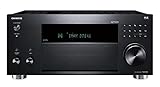
Onkyo TX-RZ50 for Upgradeable Value with Dirac Live
If you plan to grow a system over time, the Onkyo TX‑RZ50 gives a clear upgrade path without asking you to overspend today. It ships with nine powered channels and enough power per channel to drive typical home speakers cleanly.
Expandable channels and preamp outputs
The unit’s 11 preamp outputs let you later add dedicated amplification and create a 7.2.4 layout with external amps. That makes the TX‑RZ50 a smart mid‑term investment for a multi‑channel system.
Why Dirac Live matters here
Dirac Live tightens bass, improves imaging, and evens tonal balance across seats when you measure carefully. Using a higher‑quality measurement mic (for example a MiniDSP UMIK) helps Dirac reach its full potential in tricky rooms.
HDMI and everyday connectivity
Connectivity is practical: six 8K HDMI inputs, two HDMI outputs, and eARC support streamline multiple sources and a second display. Bidirectional Bluetooth and Sonos Port compatibility make streaming and late‑night listening easy.
| Spec | Why it helps |
|---|---|
| 9 powered channels | Enough onboard power for common layouts |
| 11 preamp outputs | Upgrade to more channels with external amps |
| 6× 8K inputs + eARC | Future-proof HDMI and simple TV audio |
Sony STR-AZ5000ES for High-Power Performance and Immersive Processing
If you expect sustained headroom and durable construction, the STR-AZ5000ES delivers both.
Built like a tank: this 11-channel receiver packs 130 W per channel (8 ohms, two channels driven) into a heavy chassis and carries Sony’s five-year ES warranty. That weight hints at a large power supply and conservative thermal design for reliable long-term use.

Durable design and long-term value
The robust build and warranty make the unit a near-separates stand-in when you want punch without a separate amp. Preamp outputs for all 11 channels give a clear upgrade path to dedicated amplification later.
Speaker mapping and calibration
Sony’s DCAC Calibration asks for many measurements to map a 3D layout. That effort yields a more convincing surround field and tighter low end across seats.
- Flexible wiring: wireless surround support and phantom surround modes help when running cables is impractical.
- Use cases: loud listening in larger rooms and driving difficult speakers without losing clarity.
- Gaming: modern HDMI features and low-latency routing keep consoles responsive while preserving sound staging.
| Attribute | Why it matters | Practical note |
|---|---|---|
| Channels / Preouts | 11 channels and full preamp outputs | Upgrade to separates when ready |
| Calibration | DCAC detailed mapping | Creates cohesive surround imaging |
| Power | 130 W/ch (FTC spec) | Headroom for dynamic music and soundtracks |
Marantz Cinema 50 for Warm Sound and Serious Subwoofer Control
Marantz’s Cinema 50 brings a warm, musical character while offering serious bass control for larger living spaces. It pairs 11.4 processing with nine amplifier channels and a hefty power supply to keep dynamics natural at listening levels that matter.

Four discrete subwoofer outputs smooth bass across seats
Four discrete subwoofer outputs let you calibrate each sub independently. That reduces room peaks and the classic “one-note bass” that plagues open-concept rooms.
With subs placed and tuned, low-frequency energy evens out across multiple listening positions. The result is tighter bass and more consistent audio at every seat.
Room correction and upgrade options
Start with Audyssey MultEQ XT to get reliable room tuning from the guided setup. If you want deeper control, the optional Dirac Live upgrade unlocks advanced filters and phase correction.
The built-in MM phono simplifies vinyl hookups, making this receiver friendly to newcomers. For serious two-channel listeners, adding a dedicated stereo amp via the preamp outputs keeps front L/R fidelity while expanding channels for larger layouts.
| Attribute | Detail | Why it helps |
|---|---|---|
| Power | 110 W/ch (8Ω, FTC) | Clean headroom for dynamics |
| Sub outputs | 4 discrete | Smoother bass across the room |
| Room EQ | Audyssey MultEQ XT; Dirac optional | From easy tuning to pro-level correction |
Anthem MRX 740 for Premium Sound with ARC Genesis Room EQ
If you prize precise room tuning and a clear path to separates, the MRX 740 deserves a close look.
Anthem’s ARC Genesis is the headline feature. It corrects bass and midrange problems that most rooms create. ARC Genesis uses many measurements and advanced filters to make recordings sound closer to the original in real listening spaces.
The MRX 740 supplies seven powered channels and strong power (140 W into two channels driven). It also offers 11 preamp outputs so you can add external amplification as you grow your system.
Why ARC Genesis excels in real rooms
ARC Genesis focuses on room-caused coloration rather than just boosting loudness. That improves perceived sound quality and performance across seats.
Preamp outputs and power amp matrixing explained
Preamp outputs let you start with the onboard amps and later add dedicated amps for front left/right or surrounds without replacing the receiver. Power amp matrixing lets you reassign internal amplification where needed.
Use case: run the MRX 740’s internal amps for surrounds and add a separate stereo amplifier for the main speakers. Matrixing keeps sources mapped correctly while improving stereo fidelity.
| Feature | Detail | Why it matters |
|---|---|---|
| Room EQ | Anthem ARC Genesis | Tackles bass/midroom issues for truer tonal balance |
| Power | 140 W (2-ch driven) | Plenty of headroom for dynamic music |
| Outputs | 11 preamp outputs | Easy upgrades to separates and multi-amp systems |
| HDMI / connectivity | 7× 8K inputs, eARC | Handles multiple sources now and later |
Who should buy: listeners focused on sound quality, advanced calibration, and a flexible growth path. The MRX 740 is ideal when precision room correction and expandable amplification matter more than packing the most onboard channels.
Arcam AVR11 for Music-First Listening
For listeners who prize tonal accuracy and a coherent stereo image, the AVR11 focuses squarely on musicality. This receiver is tuned to present a natural midrange and precise timing so recordings feel immediate and alive.

Music-first buyers value a wide stereo soundstage, controlled bass, and an overall presentation that stays engaging at low and high volumes. The AVR11 favors tone and imaging over a long list of surround bells and whistles.
Match the AVR11 with speakers that reveal detail — high‑quality bookshelves or refined towers work best. Careful placement and basic room treatment boost the payoff; stereo gains are often system-dependent.
If your home is mixed-use, the AVR11 still makes sense when music dominates and movies are secondary. Prioritize the receiver’s musical fundamentals, and accept fewer HDMI inputs or extra channels in exchange.
| When to pick AVR11 | When to consider other models | Practical tip |
|---|---|---|
| Music-first listening, tight stereo imaging | Need many channels or extra HDMI inputs | Use good room correction and a capable subwoofer |
| Careful speaker pairing and placement | Require extensive streaming ecosystems | Pair with revealing speakers and a quality amp if upgrading |
Other Notable Models Worth Considering for Music Lovers
Flagship-grade receivers can offer extraordinary power, many channels, and refined processing. That makes them notable even if they aren’t the sweet spot for every music-first buyer.
The Anthem MRX 1140 and Denon AVR-A1H are examples of models that aim high on channels and power. They may be overkill for small living rooms, yet they suit listeners who plan large dedicated rooms, want very high SPL, or intend long-term expansion with many speakers and subs.
Anthem MRX 1140 — more channels, refined tuning
Why it’s notable: the MRX 1140 focuses on advanced room correction and multi‑channel capability, making surround sound and dolby atmos mixes scale well in larger spaces.
Who should consider it: owners with big rooms, multiple subs, or those who want precise calibration across many seats.
Denon AVR-A1H — flagship performance and power
Why it’s notable: the AVR-A1H trades a simpler setup for raw power and top-tier performance. It’s designed for theater-scale systems that demand headroom and detailed processing.
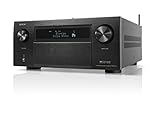
Who should consider it: audiophiles building a full home theater with many channels, or anyone who plans to add dedicated amps and high-end speakers over time.
More channels can matter for immersive concert videos and Atmos music, but only when the room, speaker layout, and treatment support that scale. Flagships add refinement and headroom, yet they raise price and system costs—speakers, subwoofers, and room treatment quickly become the larger budget items.
Decision tip: if music is the true priority, invest first in front speakers, sub integration, and calibration. Then confirm channels, HDMI needs, and room correction priorities in the “How to Pick” section before moving up the ladder.
| Model | Main strength | Ideal listener |
|---|---|---|
| Anthem MRX 1140 | 11–channel scaling and precise room EQ | Large rooms, multi-sub setups, immersive mixes |
| Denon AVR‑A1H | High power and flagship refinement | Home theaters seeking high SPL and long-term expansion |
| Shared trade-off | Higher price and system cost | Requires budget for speakers, subs, and room treatment |
How to Pick the Right Receiver for Your Speakers, Room, and Budget
Begin with the speakers and the room they live in; that pairing sets limits on amplifier choice, channel count, and useful features. Use a simple workflow to turn specs into decisions: speakers → channels → calibration → connectivity.
Matching amplifier power to speaker sensitivity and room size
Check speaker sensitivity and estimate needed power for your room. Low-sensitivity speakers in larger rooms need more power to reach clean levels.
Trust tests that state bandwidth (20Hz–20kHz) and low distortion. Published wattage can vary by test conditions, so prefer conservative margins when choosing an amp.
Choosing the right number of channels for your layout
Match the number of channels to seating and room shape. Small rooms usually do fine with 5.1 or 5.1.2; larger rooms may justify 7.x or more.
More channels add complexity and wiring. Don’t add channels that won’t improve listening quality.
When to prioritize room correction vs raw amplifier quality
If your room is untreated or has strong modes, room EQ can beat small amp gains. Good correction smooths bass and restores clarity more effectively than a modest power upgrade.
Inputs, outputs, and HDMI planning for your sources
Count sources, decide who switches (TV or receiver), and confirm eARC needs. Prioritize receivers with useful inputs and preamp outputs if you plan to expand the system later.
| Step | Action | Why it matters |
|---|---|---|
| 1. Speakers & room | Check sensitivity & room volume | Sets required power and layout |
| 2. Channels | Pick a realistic channel number | Avoid needless complexity |
| 3. Calibration | Prefer proven room EQ | Improves clarity more than small amp gains |
| 4. Connectivity | Count inputs, confirm eARC and preouts | Saves future upgrades and simplifies setup |
Conclusion
Conclusion
Prioritize how you listen at home before chasing specs. The right receiver fits your speakers, room, and daily habits. That simple match delivers the most satisfying sound and long-term value.
Key buying priorities are clear: clean stereo performance, room correction that works in real rooms, and enough power for your speakers and seating distance. For a quick match: Denon for value, Onkyo for Dirac and upgrade paths, Sony for high power and immersive processing, Marantz for multi-sub control, Anthem for premium calibration, and Arcam for stereo-first clarity.
Final checklist: confirm HDMI inputs, eARC support, and Bluetooth transmit if headphones matter. Pick 2–3 models from this roundup and validate them against your channel layout, room limits, and streaming/control needs before you buy.
FAQ
What is the most important feature to prioritize in a receiver aimed at music listening?
Focus on sound quality first — look for low distortion, high dynamic range, clean power delivery and a neutral preamp stage. Good room calibration (Audyssey, Dirac, Anthem ARC) and high-quality DACs help preserve musical detail. Also consider stereo performance and the option for an external power amp via preamp outputs if you plan upgrades.
Do Dolby Atmos and DTS:X improve music playback compared with stereo?
Immersive formats can add spatial cues and height information for compatible mixes, but most music still benefits from high-quality stereo reproduction. Use Atmos/DTS:X for live concert mixes or specially encoded tracks; otherwise prioritize stereo fidelity and upmixing options like Dolby Surround or DTS Neural:X when you want a wider soundstage.
How much amplifier power do I really need for home listening?
Match watts per channel to your speaker sensitivity and room size rather than chasing big numbers. Efficient speakers (90+ dB) need less power; larger rooms and low-sensitivity speakers need more. Look at continuous RMS ratings and headroom rather than peak specs. A receiver with robust, stable power at 8 and 4 ohms gives better real-world performance.
Is room correction necessary for good sound?
Yes. Room EQ corrects peaks and nulls that speakers and rooms introduce, improving clarity and bass balance. Quality systems like Dirac Live, Anthem ARC Genesis, and Audyssey MultEQ make a dramatic difference, especially in modest rooms. Combine EQ with basic acoustic treatment for best results.
What’s the advantage of receivers with preamp outputs?
Preamp outputs let you add external power amplifiers or processors later without replacing the entire unit. That helps if you want higher current for demanding speakers or bi-amping. It’s a smart upgrade path for people building serious two-channel or multi-amp systems over time.
Should I choose a receiver with multiple subwoofer outputs?
Multiple subwoofer outputs help smooth bass across a listening area by allowing placement flexibility and better room integration. Receivers with discrete dual or quad sub outputs make it easier to calibrate multiple subs and reduce room modes for tighter, more even low-frequency response.
How important is eARC compared with ARC on a receiver?
eARC passes full-resolution, uncompressed multichannel audio from TV apps and sources, which matters if you stream high-quality Atmos or multichannel PCM from smart TV apps or gaming consoles. ARC is limited and may downmix or compress audio. For modern setups, pick a receiver with eARC to preserve source quality.
Are built-in streaming services like Spotify Connect reliable for music playback?
Yes. Built-in services and Spotify Connect provide seamless, high-quality streaming and ease of use from mobile devices. Look for receivers that support major ecosystems (TIDAL, Qobuz, AirPlay 2, Chromecast) so you can use lossless and high-res playback options without extra hardware.
Can a receiver double as a good phono stage for vinyl playback?
Some models include a built-in phono preamp suitable for casual vinyl listeners. If you own a high-end turntable or want the best analog fidelity, a separate dedicated phono stage usually outperforms onboard circuits. Choose receivers with a quality MM/MC stage or the option to bypass for an external phono preamp.
How many HDMI inputs and 8K support do I need?
Count current and near-future sources — game console, Blu-ray, streamer, cable box — and add a couple of spare ports. 8K passthrough and multiple 8K inputs future-proof a system for next-gen gaming and media. Prioritize HDMI with HDCP 2.3, eARC, and support for HDR formats (Dolby Vision, HDR10+) for broad compatibility.
Is Dirac Live worth it compared with Audyssey or Anthem ARC?
Dirac Live offers precise time-domain correction and phase control that can significantly improve imaging and bass integration; it’s often favored by audiophiles. Audyssey and Anthem ARC also perform well and are easier to use for many listeners. The best choice depends on budget, willingness to calibrate, and the level of sonic refinement you want.
What receiver features matter most for gaming?
Low-latency HDMI with ALLM, VRR, and 4K/120Hz or 8K passthrough helps gaming performance. Strong power and clear surround imaging make explosions and music more immersive. Also value quick switching, multiple HDMI inputs, and eARC for combining TV and console audio with minimal lag.
How does speaker channel count affect music listening?
Stereo (two-channel) remains the reference for most music. Adding channels for Atmos or surround can create immersive effects for certain mixes and live recordings. Choose the channel count that matches your room, speaker layout, and whether you’ll prioritize two-channel fidelity or object-based immersive formats.
Can Bluetooth transmit audio from a receiver to headphones?
Many receivers offer Bluetooth transmit (TX) to send audio to wireless headphones and Bluetooth receive (RX) to stream from phones. Check for aptX Adaptive, LDAC, or SBC support for better wireless quality. Transmission is convenient but typically not as audiophile-grade as wired headphone outputs or dedicated headphone amps.
What maintenance keeps a receiver sounding its best over time?
Keep ventilation clear, update firmware regularly, and avoid overheating. Clean contacts on speaker terminals and HDMI ports if connections get intermittent. Re-run room calibration after major furniture or speaker moves. Proper care preserves sound quality and extends the unit’s lifespan.