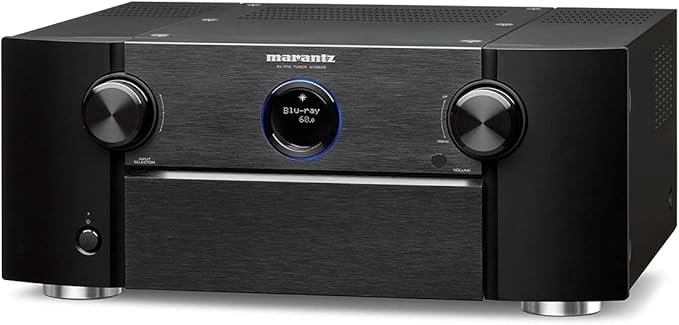
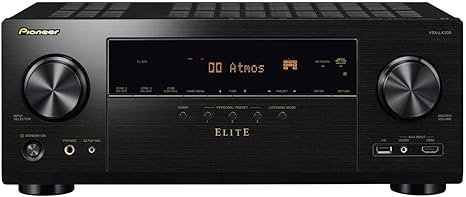
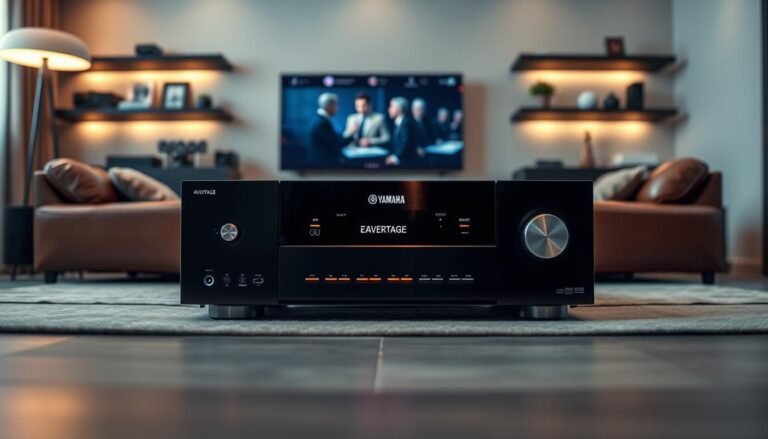
This introduction sets the stage for a full, hands-on review of a flagship receiver in the brand’s lineup. We explain what the unit is, where it sits among other models, and why many listeners call it a reference for sound and setup convenience.
Expect clear coverage of the web-based setup, ARC Genesis room correction, and the upgraded calibrated mic and multiple profile support. Bench data and listening notes guide the evaluation, including preamp voltage, SNR, SINAD, and multichannel power delivery.
We also compare it to the larger sibling and competing units, highlighting differences in processing channels, subwoofer outputs, and power-supply design. Connectivity essentials like HDMI with eARC, Dolby Vision, IMAX Enhanced, and current streaming options are previewed.
Who benefits? Home theater owners and mixed-use living rooms that need accurate calibration, robust preamp output for external amps, and a modern browser-based configuration will find this review useful.
Quick Take: Who the Anthem MRX 740 Is For Today
This model suits home theater fans who want wide processing power and simple setup without paying separates-level prices. It offers 11-channel processing with seven internal amps, ARC Genesis room correction, and flexible routing that scales as needs grow.
Core features matter at this price: a browser-based setup, rock-solid HDMI with eARC and Dolby Vision support, and enough processing for 7.1.4 layouts when you add external amplification. Streaming conveniences include Chromecast and AirPlay 2 now, with Spotify Connect and Roon announced.
Listeners who split time between movies and music will like the cohesive imaging, clean dialog, and stable bass management out of the box. For demanding, low-impedance speakers, plan external amps for the bed channels; the preouts deliver >5 Vrms for easy driving of powered amps.
- Best fit: home owners who want high-quality sound and straightforward calibration.
- Expansion: 11-channel processing and matrixable amps offer flexible options as systems grow.
- Value: world-class preamp tools and ARC Genesis put pro-level tuning inside a sensible price.
Design, Build, and Front Panel Experience
Design borrows from Anthem’s separates, offering a restrained, rack-friendly look that fits both living rooms and gear racks. The clean fascia signals premium lineage without calling attention to itself.
The front panel uses a modest multi-line display that is readable but small. Local control works fine for quick changes, yet the browser interface is the smoother daily driver for deeper setup.
Rear panel layout follows prior MRX units with logical labels and well-spaced connectors. Installers will appreciate the clear inputs, outputs, and speaker terminals for tidy wiring and fast hookups.
Build quality feels solid; buttons are responsive and power behavior is sensible. The included backlit remote is easy to use but a bit utilitarian compared with higher-end universal controllers.
The in-box ARC microphone kit stands out: a calibrated microphone, cables, and a sturdy stand give accurate measurements right away. That addition raises out-of-box calibration and speeds room tuning.
- STR-inspired clean fascia for understated style and reliable signal path.
- Serviceable front panel for quick local control; web interface preferred for full configuration.
- Comprehensive ARC microphone kit included for accurate room correction.
| Feature | Details | Benefit |
|---|---|---|
| Chassis design | STR-inspired, clean fascia | Blends into racks and living rooms |
| Front panel | Small multi-line display, responsive buttons | Quick status checks and local tweaks |
| Rear panel | Well-labeled, spaced connectors | Streamlined installations for a wide range of setups |
| Included kit | Calibrated microphone, cables, stand | Better measurement accuracy day one |
Setup Made Simple: Web Interface, Inputs, and Settings
A networked web interface gives you control over every setting without wrestling with tiny on-screen menus.
Why a browser setup outperforms on-screen controls
Enter the receiver’s IP in any browser to unlock the full configuration suite. The web UI exposes detailed settings that the on-TV OSD hides.
This method is faster and clearer. Changes are safer, and installers spend less time troubleshooting. Firmware updates also download over the network, so the system stays current without a USB drive.
Naming, virtual routing, and real-world flexibility
You can type custom names and edit channel maps in seconds. Clear labels reduce mistakes and make daily operation simpler for everyone in the home.
Up to 30 virtual inputs let you pair video from one source with audio from another. This supports practical workflows like game-day radio overlays or listening to another room while watching TV.
- Access: use device IP to open full web setup.
- Quick tasks: name inputs, assign channels, and manage ARC profiles.
- Profiles: save multiple speaker scenes for A/B listening or different seating.
- HDMI: EDID-friendly naming keeps source selection intuitive.
- First-boot tip: network, name inputs, set layout, check levels, run ARC Genesis planning.
Anthem Room Correction: ARC Genesis in the Home
ARC Genesis simplifies calibration with a guided workflow that turns complex acoustics into practical, repeatable correction. Connect the supplied calibrated microphone, place it at a set of listening positions, and run the guided sweeps to build an accurate model of your room.
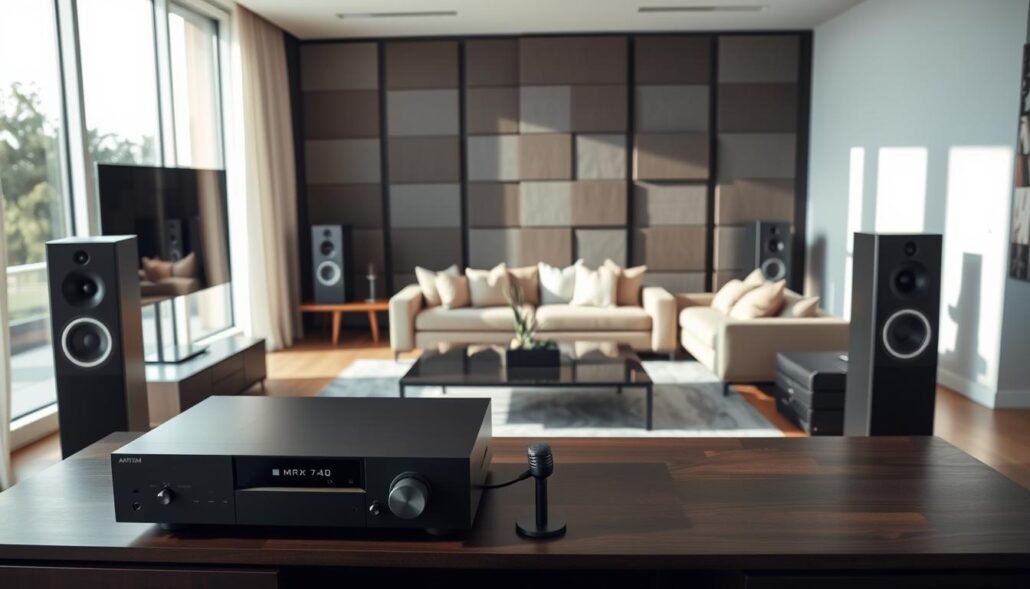
Calibration workflow and the redesigned microphone
Use the mic exactly as instructed. The redesigned microphone carries an orientation dot to improve spatial capture. Correct placement sharpens midrange and crossover corrections where dialog lives.
Multi-profile presets and practical presets
The system supports multiple profiles: single-seat for critical listening, couples, full-room smoothing, and a late-night mode that reduces low-frequency energy without killing impact.
Tuning philosophy: defaults vs Pro-mode
Automatic targets stay conservative and balanced; they deliver reliable results with minimal tweaking. A Pro-mode is available for users who want to tilt targets, but use caution at response extremes to avoid taxing speakers or subs.
- Productivity: open and edit ARC files offline, compare two sessions side-by-side, then upload changes quickly.
- Best practices: use multiple mic heights, 6–8 positions, and consistent sweep counts to reduce variance.
| Feature | Benefit | Result |
|---|---|---|
| Orientation dot | Better mic placement | Improved spatial correction |
| Multi profiles | Flexible listening scenes | Consistent dialog and bass |
| Offline editing | Faster iteration | Quicker final tuning |
Listening Tests: Sound and Video Without ARC
Controlled playback began with precise two-channel music to expose the unit’s intrinsic tonal balance. Laser-measured distances and fixed SPL targets isolated the electronics from room effects. This baseline method lets the hardware speak before any correction.
Stereo music as a baseline: preamp stage and power authority
Stereo tests revealed a fuller, more authoritative presentation than the prior generation. The preamp and amplifier sections showed clearer midrange weight and tighter transient control. Across dynamic peaks the unit stayed composed, thanks to a low-noise preamp architecture that keeps the background quiet.
HDMI stability, codec behavior, and video pass-through
Day-to-day HDMI work was solid. Cable boxes, streamers, and a finicky Xbox all locked codecs reliably with no snow, dropouts, clicks, or pops during long sessions. Video pass-through preserved Dolby Vision on supported sources and avoided handshake loops or resync delays.
The uncorrected timbre and staging were notable: centered vocals, steady imaging, and respectable bass grip that hints at what calibration will tighten. Tests across trailers, concert films, and playlists produced consistent, repeatable results—an underrated trait in any home theater test.
| Subject | Observation | Implication |
|---|---|---|
| Two-channel music | Richer midrange, authoritative delivery | Improved preamp and power design |
| Dynamic handling | Calm at peaks, low noise floor | Good headroom for complex mixes |
| HDMI & video | Stable codec lock, clean pass-through | Reliable daily use with varied sources |
Performance With ARC: Dynamics, Soundstage, and Bass Control
After ARC completes, the difference is immediate. Many listeners say the room feels larger and more immersive. The front-to-back depth becomes cleaner, and effects wrap around the listening area.
How ARC changes imaging and cohesion
How target filters smooth peaks and nulls
ARC applies measured target filters that reduce room-induced peaks and fill nulls. That smoothing unlocks a noticeably wider staging and better envelopment in immersive soundtracks.
Dialog and front-stage focus
Center clarity without cranking the center channel
After calibration, center-channel intelligibility improves. Dialog sits in the mix naturally, so you avoid boosting the center speaker and keep tonal balance intact.
Bass integration and crossover behavior
Automatic crossovers for seamless speaker-sub blending
ARC’s automatic bass management usually nails integration between mains and subs. That reduces localization and gives more even bass across the room. Crescendos feel cleaner and impact is preserved at the same master volume due to fewer room resonances.
Music benefits and practical tips
When to trust automation and when to tweak
Music playback gains tighter bass lines and clearer image placement. Trust the automatic crossover in most setups. Experiment only if you use unconventional speaker/sub combos or want a specific tonal range.
Profiles and listening modes
Quick A/B with multiple ARC profiles
Saved profiles make it simple to compare tonal balances for late-night mode or full-room listening. Switching profiles is fast, so you can match the system to the occasion.
| Effect | What ARC does | Result |
|---|---|---|
| Staging | Smooths peaks/nulls across frequencies | Wider, more enveloping soundfield |
| Dialog | Aligns timing and EQ on center | Clearer speech without center boosts |
| Bass | Auto crossover and low-frequency smoothing | Even bass, fewer localization issues |
| Dynamics | Reduces room resonance, improves time coherence | Cleaner crescendos and preserved impact |
Bench Data and Power: What the Measurements Reveal
Objective tests map the receiver’s output, noise floor, and amp headroom under load.
Preamp performance stands out. Preouts deliver over 5 Vrms unclipped with vanishing distortion (
Amplifier and channel behavior
Class AB bed amplifiers produce ~145 W/channel single‑ended and ~130 W/channel two‑channel into 8 Ω at
Height amp characteristics and inputs
Class D height amps meet rated output (~70 W/ch two‑channel) with a limited bandwidth (≈20 Hz–17 kHz), ideal for presence duties. Analog inputs are digitized at 96 kHz; ADCs keep bandwidth to ~50 kHz and THD+N <0.01% at 20 kHz.
| Metric | Measured Result | Listening Impact |
|---|---|---|
| Preout voltage | >5 Vrms, | Drives external amps with headroom |
| SNR / SINAD | 110 dB @2 Vrms / ~105 dB SINAD | Very low noise, clean dynamics |
| Crosstalk | 95 dB @1 kHz, >70 dB @20 kHz | Strong stereo separation across channels |
| Power (bed) | 130–145 W/ch steady, 212 W bursts | Ample headroom for music and film peaks |
What this means: test data shows a transparent signal path, low noise, and robust amp range. For demanding mains or low‑impedance loads, consider efficient speakers or adding external amplifiers to protect against current limiting.
Bass Management, Subwoofer Options, and “Super Sub Fronts”
The latest firmware adds a 24 dB/octave low-pass on the sub output, with the -6 dB point set at the selected crossover (for example, 80 Hz). This change reduces overlap and yields cleaner summation when you use a typical 80 Hz crossover.
Slopes and speaker integration
The system still applies a 12 dB/oct high-pass to bass-managed speakers. That pairing — 12 dB HPF on mains plus 24 dB LPF on subs — creates a smoother transition and steadier in-room response.
“Super Sub Fronts” behavior
Super Sub Fronts lets subs play alongside full-range mains. In two-channel mode, if you leave mains full-range, the sub defaults to a 40 Hz LPF. Enable this only when you want mains to remain unfiltered and let subs add extension for music.
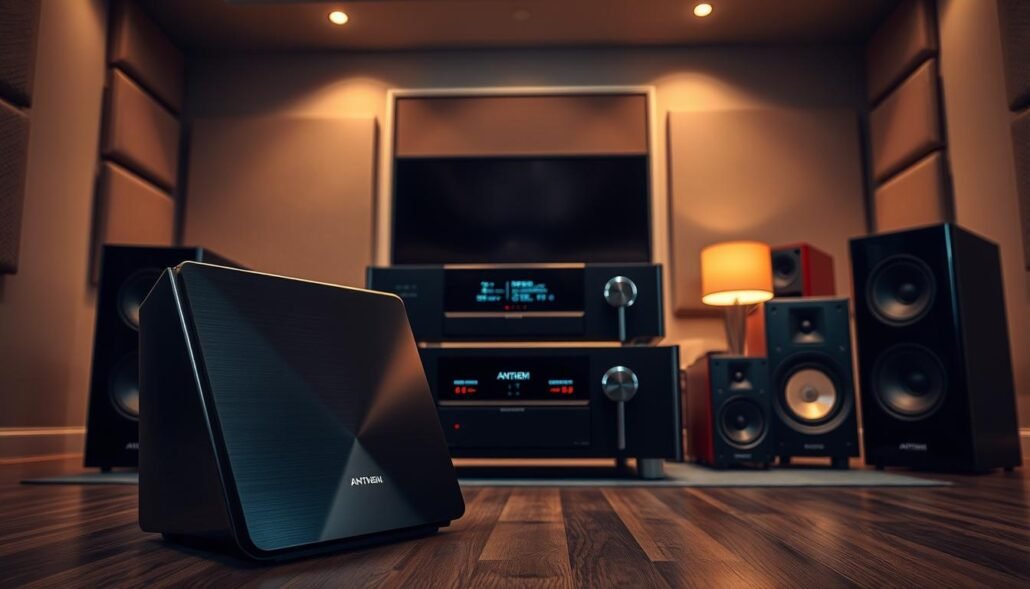
Setup checklist and differences
Choose a sensible crossover (often 80 Hz), confirm phase and level, then run ARC Genesis so room correction refines integration across multiple mic positions.
The MRX 740 offers dual linked sub outputs; the larger model provides independent sub outputs with separate level/phase and ARC calibration. Use independent outs when two subs sit in asymmetrical rooms for better seat-to-seat uniformity.
| Step | Why | Quick result |
|---|---|---|
| Set crossover (80 Hz) | Standard blend point | Smoother handoff |
| Confirm phase & level | Align timing | Clearer low end |
| Run ARC Genesis | Apply room correction | Even bass across seats |
Amp Matrixing and Channel Strategy for Dolby Atmos Systems
Amp matrixing lets you reassign onboard amps so a single receiver adapts as you add external amplification.
Use the web UI to map outputs logically. The interface allows flexible roles: Front can become Front Wide or Height 3; Surround can serve Height 3; Back supports Front Biamp or Zone2. Height1 and Height2 also accept Zone2 or biamp roles.
Practical channel allocation
Prioritize Class AB channels for the front stage and main surrounds. Those channels offer higher current and better dynamic headroom for the speakers that carry most of the load.
Assign Class D modules to heights or Zone 2. This is an efficient way to use internal amp resources without stressing the power supply.
Bi-amp caution and expansion plan
Do not bi‑amp main speakers using internal Class D modules. That approach causes about a 3.7 dB dynamic range penalty. For LCR or heavy mains, use a dedicated external amplifier instead.
Start with internal amps powering heights. Later add a 3‑ to 5‑channel external amp for bed channels when you need more continuous power.
Step‑by‑step reassignment in the web UI
- Open the receiver’s IP and enter Amplifier Assign.
- Label each output (Front, Surround, Back, Height1, Height2).
- Choose the role for each output (e.g., Height, Zone2, Front Biamp).
- Save and reboot the amp matrix to apply changes.
After reassignment, verify levels and delay for each channel. Re-run ARC Genesis so the audio filters and crossover settings match the new topology.
| Use Case | Recommended Channels | Why |
|---|---|---|
| 5.1.4 small room | Front: AB, Surround: AB, Heights: Class D | AB for core imaging; D for heights saves power for bed channels |
| 7.1.4 larger room | Front/Surround: AB or external amp, Back: AB, Heights: Class D | External or AB ensures headroom across multiple listening rows |
| Bi-amp LCR | Use external multi‑channel amp for bi-amping | Avoid Class D internal bi-amp to preserve dynamic range |
Streaming, HDMI, and Video: Today’s Features and Tomorrow’s Upgrades
Streaming and HDMI features define how you use a modern receiver day to day and set expectations for future upgrades.
The unit ships with Chromecast, AirPlay 2, and Bluetooth for instant music and audio playback from phones, tablets, and computers. Pairing is quick and reliable for casual listening and casting playlists from mobile apps.
Spotify Connect and Roon are announced for future firmware updates. When added, they will expand high-res library access and multi-room control for more serious music setups.
HDMI and video capabilities now, and a practical upgrade path
The receiver offers seven HDMI inputs using HDMI 2.0b/HDCP 2.2 with eARC support. It passes Dolby Vision and IMAX Enhanced content cleanly while eARC handles object-based formats like Dolby Atmos from compatible TVs.
Anthem plans a hardware upgrade to HDMI 2.1 for future-proofing. For many users, eARC reduces pressure to upgrade immediately when 8K sources feed the television first.
- Virtual inputs let you pair a separate audio source with any HDMI video feed for flexible daily use.
- Use certified Ultra High Speed HDMI cables, label inputs clearly, and enable eARC on the TV for best results.
- These connectivity choices keep the receiver usable with new consoles and streaming services without sacrificing current performance.
| Feature | Current State | Why It Matters |
|---|---|---|
| Streaming | Chromecast, AirPlay 2, Bluetooth | Simple casting and phone playback today |
| Planned services | Spotify Connect, Roon (firmware) | High-res access and multi-room control |
| HDMI | 7 inputs, HDMI 2.0b, eARC, Dolby Vision, IMAX Enhanced | Stable 4K pass-through and lossless audio return |
| Upgrade path | Optional HDMI 2.1 hardware upgrade | Prepares system for future 8K and higher frame-rate sources |
Anthem MRX 740 Review: Value, Comparisons, and Who Should Buy
Deciding between compact power and higher channel count hinges on practical needs, not just headline specs.
MRX 740 vs MRX 1140: channels, power supply, sub outs, and headroom
Processing and amps: The smaller unit provides 11 channels of processing and seven onboard amps (five 140 W AB channels and two 60 W channels). The larger model ships with 15 channels of processing and 11 onboard amps (five 140 W + six 60 W), which makes it easier to run 7.1.4 or 9.1.4 without extra hardware.
Subwoofer outputs: The compact unit uses dual linked sub outs, which simplifies setup but limits independent level or delay per sub. The bigger model offers independent dual sub outs for tighter seat-to-seat consistency in asymmetric rooms.
Power supply and headroom: The smaller unit uses an E-core transformer; the larger one uses a toroidal supply. Lab data favor the toroidal design for slightly better two-channel power and lower power-supply harmonics when driving hard.
Best speaker matches, room sizes, and upgrade paths
For speakers, the internal amps pair best with efficient towers or bookshelf speakers (nominal ≥6 Ω). If your mains are low-impedance or low-sensitivity, plan to add external amplification for the front stage.
Room guidance is straightforward: the unit shines in small-to-medium rooms at typical listening levels. For larger rooms or high SPL targets, the larger model or added external power is the safer choice.
Common upgrade path: start with the compact unit, add a 3- or 5-channel external amp for the LCR, reassign internal amps to heights via the web UI, and re-run ARC Genesis to match filters and crossovers.
| Factor | Compact unit | Larger model | When to pick |
|---|---|---|---|
| Processing channels | 11 | 15 | Pick larger for full 9.1.4 without extras |
| Onboard amplification | 7 channels (140 W x5, 60 W x2) | 11 channels (140 W x5, 60 W x6) | Choose larger if you need more internal amps |
| Sub outputs | Dual linked | Independent dual outs | Independent outs aid multi-sub tuning |
| Power supply | E-core | Toroidal | Toroidal reduces harmonics, gives marginally more two-channel power |
Value summary: The compact unit delivers high-quality preamp features and calibration that approach separates, making it a smart choice for buyers who want strong performance and a sensible price. Add targeted external power as needs grow for the best long-term performance.
Conclusion
Conclusion
In sustained use the system’s web-driven setup and ARC tuning produced a predictable, musical result across sources.
The unit delivers a huge, balanced soundstage with ARC engaged and stable HDMI operation that inspires confidence as the center of a home theater setup.
Core strengths are clear: superb preamp performance, user-friendly ARC Genesis, and a streamlined browser setup that makes living with the receiver easy day to day.
Matrixable amps and strong preouts leave a path for growth. Add external power without replacing the main receiver and the system scales cleanly for larger rooms or higher SPL targets.
Choose by channel needs and sub flexibility. Run sensible crossovers, place the mic carefully, and keep firmware current to get the most from this review-tested platform.
FAQ
What room correction system does this receiver use and how does it improve sound?
The unit uses ARC Genesis room correction, a microphone-based calibration suite that measures your room and speaker response. It creates FIR filters and crossovers to smooth frequency response, tighten bass, and improve imaging. The process offers several profiles including safe defaults for most listeners and a Pro mode for custom target curves and advanced tuning.
Is setup difficult for non-technical users?
No. The setup runs through a browser-based IP interface that many find easier than on-screen menus. Basic steps include network connection, speaker configuration, and running the ARC calibration with the supplied microphone. Routing and input naming are straightforward, and presets let you recall common configurations.
Can I use this with Dolby Atmos and add external amplifiers?
Yes. It supports object-based formats like Dolby Atmos and offers amp-matrixing options for expanding channels. Add external amps when you need more power or want dedicated Class AB amplification for front channels. The processor can route outputs flexibly without forcing bi-amping inappropriate channels.
How many subwoofer outputs are available and how do they work?
The design provides dual subwoofer outputs with independent control. You can set separate low-pass filters and levels, or use linked operation for simpler setups. ARC can measure and time-align multiple subs for better integration and consistent bass across the listening area.
What are the power and amplifier types inside?
The preamp stage delivers healthy voltage swing (>5Vrms) with low noise and high SNR. Power sections mix Class AB for key channels with Class D modules for height channels, balancing audible performance and efficiency. Bench measurements show low distortion and robust dynamic headroom suitable for demanding speakers.
Does the receiver support modern streaming and video features?
It includes Chromecast, AirPlay 2, and Bluetooth today, while Spotify Connect and Roon support are planned. Video features include HDMI 2.0b inputs, eARC support, Dolby Vision passthrough, IMAX Enhanced, and a clear upgrade path for future 2.1 or higher compatibility.
How does ARC handle crossover slopes and bass management?
Firmware supports selectable crossover slopes, including 12dB/oct and 24dB/oct, applied in a way that preserves phase and time alignment. You can choose crossover points per channel and subwoofer, and ARC will compensate for driver behavior so bass blends with mains without boomy peaks.
Will the ARC microphone kit work in large living rooms?
Yes. The included calibrated microphone captures measurements across multiple listening positions, and ARC averages or applies multi-point correction depending on the chosen profile. Larger rooms may benefit from additional sub placement runs and careful speaker positioning to maximize correction effectiveness.
How stable is HDMI performance with different codecs and sources?
HDMI handling is stable for most codecs and formats. Expect reliable passthrough for high-bitrate audio and video signals, though some edge cases with future codecs or very new sources may require firmware updates. eARC compatibility improves TV-sourced object audio handling.
What speaker pairings work best with this design?
Neutral-to-accurate monitors and well-braced floorstanders pair exceptionally well, thanks to the strong preamp headroom and ARC’s correction. Speakers with controlled bass and a clear midrange let the processor and power stages show their strengths in clarity, dynamics, and imaging.
How does this model compare to higher-channel options in the same lineup?
Compared with larger models, this unit offers similar processing and room-correction features but with fewer internal amplification channels and slightly different power reserves. If you need extra channels or higher sustained power for very large rooms, consider the higher-channel sibling for increased headroom and more sub outputs.
Is the front panel and remote user-friendly?
Yes. The front panel has a clear display and intuitive controls inspired by higher-end designs, while the remote provides logical access to input selection, profiles, and basic ARC recall. Most advanced configuration is easier through the web interface.
How often does the unit need firmware updates, and how are they applied?
Firmware updates arrive periodically to add features, improve HDMI compatibility, and refine ARC algorithms. Updates are applied via the networked web interface and are straightforward—back up settings first, then follow on-screen prompts to install and reboot.
Can I use the preamp outputs as a two-channel system without engaging room correction?
Yes. You can bypass ARC and use the preamp outputs for pure two-channel listening. This configuration relies on the high-quality preamp stage for clean signal transfer and is ideal for audiophiles who prefer half of the system unprocessed or who use an external DAC or processor.