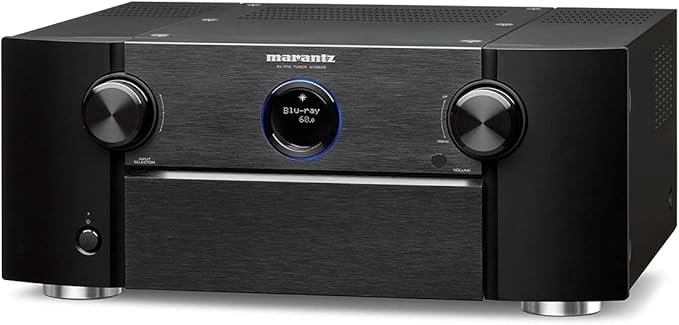
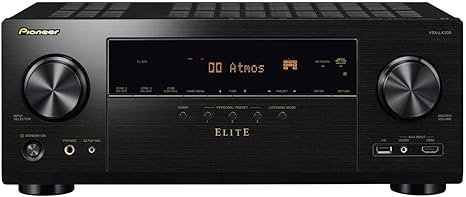
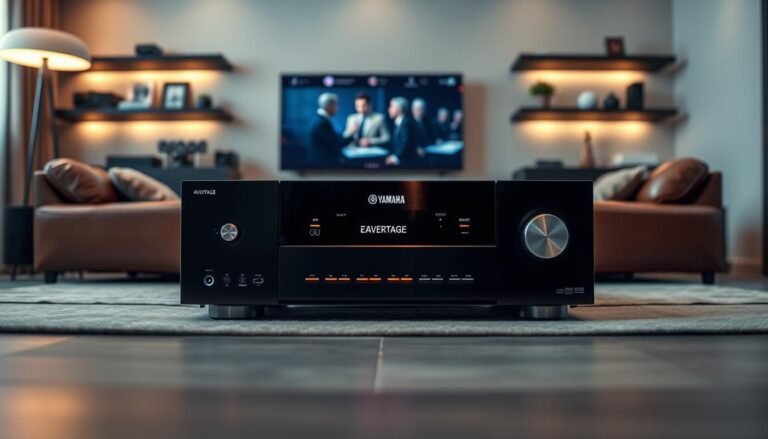
Meet an upper‑mid Aventage AVR built for enthusiasts. This model blends modern HDMI 2.1 throughput, immersive decoding, and flexible wiring options in a single chassis.
The unit ships with seven HDMI 2.1 inputs and three outputs (one with eARC) at 40Gbps, so 4K/120 and 8K/60 video are supported. Firmware updates enabled HDR10+ and Dolby Vision, and gaming staples VRR and ALLM are active; QMS and QFT remain pending.
Under the hood, it processes 11.2 channels and amplifies nine on board at a rated 150W per channel (2ch driven, 8 ohms). That lets you run 5.1.4 or 7.1.2 natively, or expand to 7.2.4 with an external amp.
Format support and streaming include Dolby Atmos, DTS:X, Auro‑3D, Cinema DSP HD3, Surround: AI, MusicCast, AirPlay 2, and hi‑res codecs. Expect spacious, rhythmic sound with clear transients and strong dialogue—ideal for buyers comparing upper‑mid AVRs on features, power, and daily use.
Design and Build Quality of the Aventage RX-A6A
From the top cover to the feet, the design focuses on stability and low vibration. This receiver weighs about 20.3kg and uses a rigid H‑frame chassis with a multi‑part metal top cover to boost structural integrity.
Vibration control matters. Five feet include a central Anti Resonance Technology (A.R.T.) wedge to damp transformer and heatsink movement. That helps keep imaging tight and preserves microdetail when driving large speakers.
Chassis, A.R.T. wedge, and vibration control
Internals show thoughtfulness: amp modules and the transformer are isolated from the audio path and the PCB is multi‑layered compared to prior models. Those choices limit hum and crosstalk for cleaner backgrounds and stronger dynamics.
- Front panel: large volume knob, input selector, a clear display, 6.3mm headphone jack, USB‑A, and YPAO mic input.
- Ergonomics: a backlit remote with recessed and raised keys gives tactile control and quick access to core options and effects.
- Hookup ease: well‑spaced rear terminals with 11 posts simplify bi‑amping/bi‑wiring and adding height/surround speaker pairs.
The overall quality and heft suggest a long service life and thermal stability across a wide range of use cases.
Yamaha RX-A6A Review: Features, Connectivity, and Formats
This model centralizes modern sources with a complete set of high‑speed and legacy connections. All seven HDMI 2.1 ports and three HDMI outputs handle up to 40Gbps, so 4K/120 and 8K/60 passthrough are supported along with HDR10+ and dolby vision.

High‑bandwidth video and gaming
One main output includes eARC for lossless audio to soundbars or processors. Firmware enabled VRR and ALLM for smoother gaming; QMS and QFT are still pending, which may affect some frame transport needs.
Immersive audio and DSP
The unit decodes dolby atmos, DTS:X, and Auro‑3D natively. Yamaha’s Cinema DSP HD3 and Surround: AI upmix legacy tracks for fuller surround staging and clearer dialogue in mixed material.
Streaming, I/O and channel architecture
Streaming options include MusicCast, AirPlay 2, Bluetooth, and major services for hi‑res music. Hardwired I/O covers balanced XLR, three optical, two coax, five analog inputs and an MM phono jack.
- Processing: 11.2 channel processing with nine on‑board amps (150W, 2ch driven).
- Expansion: Terminals for 11 speakers and pre‑outs allow 7.2.4 setups with an external amp.
These connectivity and format choices give flexible options for home theater, gaming, and multiroom audio control.
Measured Performance, Power, and Bench Insights
Measured bench data highlight the receiver’s headroom and how protective limits change with load. Two‑channel sweeps beat the rated spec: roughly 186W/ch into 8 ohms and about 282W/ch into 4 ohms at 1% THD+N. That gives clear headroom for stereo listening and front‑heavy movie moments.
With more channels driven, built‑in limiters step in. Continuous multi‑channel test tones fall to roughly 52W/ch across seven channels. In real program material this rarely matters, but steady test tones expose the conservative protection.
- Must‑do settings: keep the impedance selector at the default 8‑ohm minimum and set Eco to Off to avoid throttled output and reduced dynamics.
- Preamp/DAC: Pure Direct minimizes noise (~0.001% THD+N), while Straight routes through ADC/DSP and narrows bandwidth to ~48kHz.
- Bass & PEQ: 12dB/24dB crossover slopes are correct; use Extra Bass only with mains set to Large. The manual parametric EQ is precise for room fixes.
HDMI inputs stay very clean; some center and surround channels show mild harmonic rise near 0dBFS but remain low. For DAC filters, choose Sharp to best preserve bandwidth. For practical setups, pair efficient speakers or add an external 2‑channel amp to expand to 7.2.4 while keeping internal amps for surrounds.
Setup, Calibration, and Daily Use
Start your system setup by placing the included mic on its stand at ear height and running YPAO’s guided sweep. The on‑screen prompts walk you through speaker size, distance, levels, and EQ.
Verify the measurements manually. Compare YPAO distances with a tape measure, confirm crossovers at or above speaker bass limits, and spot‑check sub phase and level for smooth bass in the room.
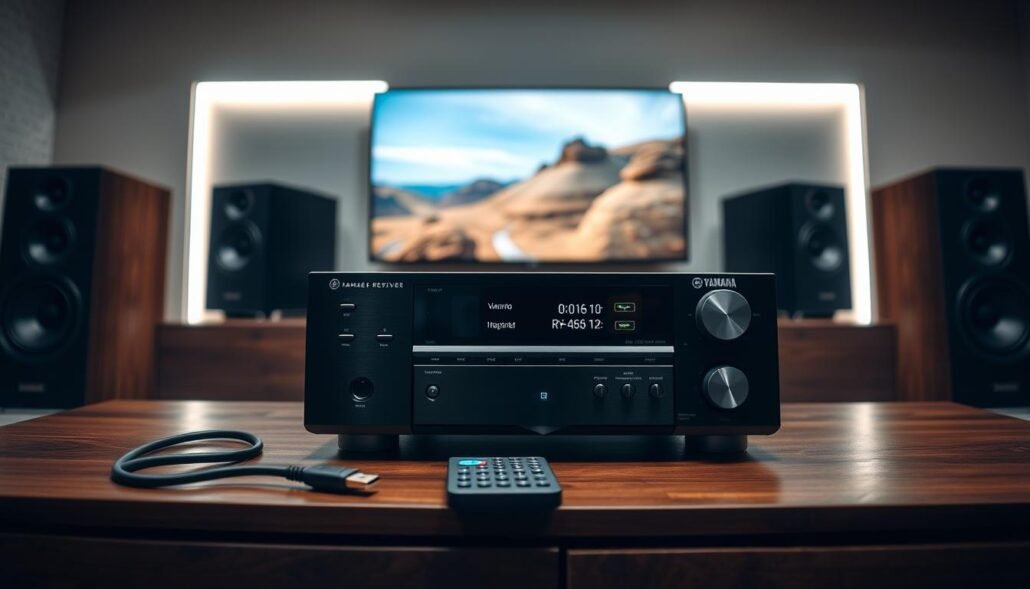
YPAO tips and verification
Run multi‑position measurements when available for better coverage. Then confirm trims and crossovers match your loudspeakers. Small manual tweaks often improve results.
Gaming features and video readiness
Firmware added VRR and ALLM, so current consoles gain smoother frame pacing and lower input lag. QMS and QFT remain pending, so instant source switching may be limited for some setups using hdmi 2.1.
Remote, UI, and app control
The backlit remote control has tactile keys for fast adjustments in low light. The on‑screen display and menus provide clear information and explanations for each option.
Use the MusicCast app for IP control, multiroom grouping, and streaming hi‑res music from Spotify, Tidal, Qobuz, or Deezer. Map Scenes (for example, a Movie Night mode) to recall inputs, audio mode, and volume quickly.
- First‑time setup: mic at ear height → run YPAO → confirm distances and crossovers.
- Verification: tape measure distances, check sub phase/level.
- Daily use: map Scenes, use remote control for quick changes, and rely on the UI for clear information when tweaking advanced options like HDMI PLL or DAC filters.
Price, Value, and Competitors in the Upper‑Mid AVR Range
Street pricing and dealer deals place this Aventage model well below its original MSRP, so buyers get near‑flagship features for less. The unit launched around $2,200 and is often discounted, making it a practical choice for serious home theater builds.
Positioning: the A6A sits between mainstream and flagship siblings. It mirrors many A8A features but trades some damping, transformer separation, and DAC choices for a friendlier price. That makes it ideal for 5.1.4 or 7.1.2 setups where adding amps later is an option.
Competitors and practical tradeoffs
Against Denon’s AVC‑X6700H, this receiver offers broader HDMI 2.1 inputs but two fewer built‑in channels. Arcam appeals to buyers who prefer Class G power and a different tonal signature.
- Value: seven 2.1 HDMI inputs reduce source compromises for gaming and 8K video.
- Sonic: expect airy, crisp staging versus Denon’s warmer, weightier sound for movies and music.
- System planning: budget for an external 2‑ch amp if you aim for full 7.2.4 capability.
For long‑term ownership, the company’s app support and firmware cadence keep this receiver a solid centerpiece for an enthusiast audio system. See a close comparison in our detailed AVR guide.
Conclusion
In short, the review finds the yamaha rx-a6a is a flexible, feature‑rich receiver that anchors modern home systems with seven HDMI 2.1 inputs, immersive format support, and thoughtful DSP.
Measured performance shows strong stereo power and very clean Pure Direct analog output. Multi‑channel continuous tones trigger conservative protection, but that rarely limits real movies or TV playback.
The sound is crisp, dynamic, and spacious with accurate dialogue placement. Pair with balanced or smoother speakers if you want a gentler treble for long music or movie sessions.
YPAO gets you close; verify levels and crossovers, use manual PEQ for room modes, and save Scenes for quick control. Add an external amp to enable full 7.2.4 channels and improved atmos height effects.
Final take: if HDMI coverage, reliable eARC, Dolby Vision passthrough, and bench‑tested bass management matter, this receiver is a confident, value‑forward alternative to costlier flagship units.