This question asks whether a software change can make an older AV device behave like it has modern video inputs and features such as 4K/120 and VRR. Readers want a clear yes-or-no and practical next steps.
Short answer: software patches can improve stability and unlock some features, but they cannot create missing bandwidth or replace chip-level hardware. Most enhancements are limited by the guts of the unit, not its menu.
This matters now because consoles like PS5 and Xbox Series X push video limits, and many people own older receivers that sit in the middle of the HDMI chain. This guide will show how to identify true capabilities, safely run an update, test pass-through, and pick practical workarounds when full hdmi 2.1 video won’t pass.
In practical terms, “older” usually means models built around the HDMI 2.0/2.0b era. Keep the weakest link idea in mind: the signal can only be as strong as the least capable device or cable in the chain.
What HDMI 2.1 Actually Adds Compared to HDMI 2.0
Think of the connection as a data pipe: wider pipes let higher-resolution, faster-rate video flow without choking.
Key numbers matter: old ports top out at 18 gbps, while the newer spec climbs to 48 gbps. That extra bandwidth is what enables 4K at 120Hz and 8K at 60Hz without heavy compression.
In practical terms, 4K/120 is mostly for gamers using modern consoles and high-end GPUs. 8K content is still rare in most homes, so movie watchers often see little benefit right now.
The connector stays the same, so everything plugs together. That does not mean older gear can pass full signals. Connection is physical; negotiation is digital.
Handshake and EDID negotiation decide the final mode between devices and displays. Some features like VRR or ALLM may work even without full 48 gbps, while full-bandwidth formats need true end-to-end support.
| Spec | HDMI 2.0 | HDMI 2.1 |
|---|---|---|
| Max bandwidth | 18 Gbps | 48 Gbps |
| Common high-rate mode | 4K/60 | 4K/120, 8K/60 |
| Primary beneficiaries | Most TVs, streaming devices | Gamers, high-end GPUs, next-gen consoles |
| Connector change? | No | No |
Can a firmware update add HDMI 2.1 to an older receiver?
Most owners hope a software patch will unlock full next‑gen video, but that depends on what the hardware actually contains.
What software can change versus what hardware must support
Short answer: a firmware update typically cannot turn HDMI 2.0-era ports into full HDMI 2.1 bandwidth for high-rate video pass-through.
Software can fix bugs, improve handshake logic, broaden compatibility with some displays, and sometimes enable dormant features if the silicon already supports them.
By contrast, true support for higher-rate transport depends on the device’s HDMI transmitter/receiver chipset, internal switching bandwidth, board traces, and power/thermal margins.
Why many features rely on new chipsets and signal paths
Features like fixed-rate link (FRL), uncompressed 4K/120, and full VRR operation use different physical layers than TMDS. Code cannot create missing lanes or higher signal integrity.
Model revisions matter: two units with the same model number can have different HDMI boards. Always confirm exact hardware revision before assuming full support hdmi 2.1 features.
| What software handles | What hardware must provide |
|---|---|
| Handshake fixes and compatibility | Chipset FRL/TMDS physical support |
| Bug patches and minor feature unlocks | Internal switch bandwidth and signal routing |
| Improved EDID negotiation | Power, thermal headroom, and port design |
How to Tell What HDMI Version Your Receiver Really Supports
Start by finding concrete proof rather than trusting marketing words. Look in the printed manual, online spec sheet PDFs, and the manufacturer’s support pages for your exact model number. On-screen menus can also show the negotiated signal format when a source is connected.
Where to check
- Manual and spec sheet: search for explicit pass‑through claims like “4K/120,” “VRR,” “ALLM,” “eARC,” or “FRL.”
- Support pages: look for firmware notes or hardware revision details tied to specific models.
- On-screen info: connect a console and check the input info for the negotiated resolution and refresh rate.
Red flags and quick checks
- “HDMI 2.1 compatible” with no list of supported features.
- No mention of 4K/120 or VRR, or footnotes that limit those modes to specific inputs.
- Port labels like “8K” or “4K” with no bandwidth or FRL statement.
Actionable tip: search your exact model plus “4K120 pass‑through” or “VRR pass‑through” to find real-world tests and known board revisions. After that, you should be able to state your receiver’s max pass‑through resolution and refresh rate in one sentence.
For guidance on useful feature sets when choosing new equipment, see features you will want in your next AV.
HDMI 2.1 Features That Might Be Added (Or Expanded) via Firmware
Not every feature needs raw bandwidth; some rely mainly on smarter handshakes and timing fixes. That distinction is key when evaluating whether a small software change can bring new user-visible benefits.
Quick Media Switching explained
Quick Media Switching (QMS) removes the brief black screen when the source changes frame rate or resolution, for example when a game menu drops from 120Hz to 60Hz content.
In practical terms, QMS feels like a faster, smoother transition. On some modern devices this can be enabled by an update because it mostly adjusts control-layer timing rather than increasing link bandwidth.
Bug fixes versus true feature gains
Most releases deliver interoperability improvements: fewer handshake failures, better HDR detection, fewer audio dropouts, and improved support for specific tvs and sources.
These changes often make your setup more reliable. But they do not create full 48 Gbps pass-through. If you need full hdmi 2.1 performance, hardware changes remain the way forward.
- Dependency chain: QMS and similar perks usually require the source, the receiver, and the display all to support the same modes.
- Read release notes: look for explicit language like “adds VRR pass-through” rather than vague claims about stability.
- Buying tip: useful updates can extend the life of devices even when true spec upgrades are impossible.
HDMI 2.1 Features That Usually Require New Hardware
Beyond the plug, the transmission method inside your gear determines whether next‑gen video modes will pass.
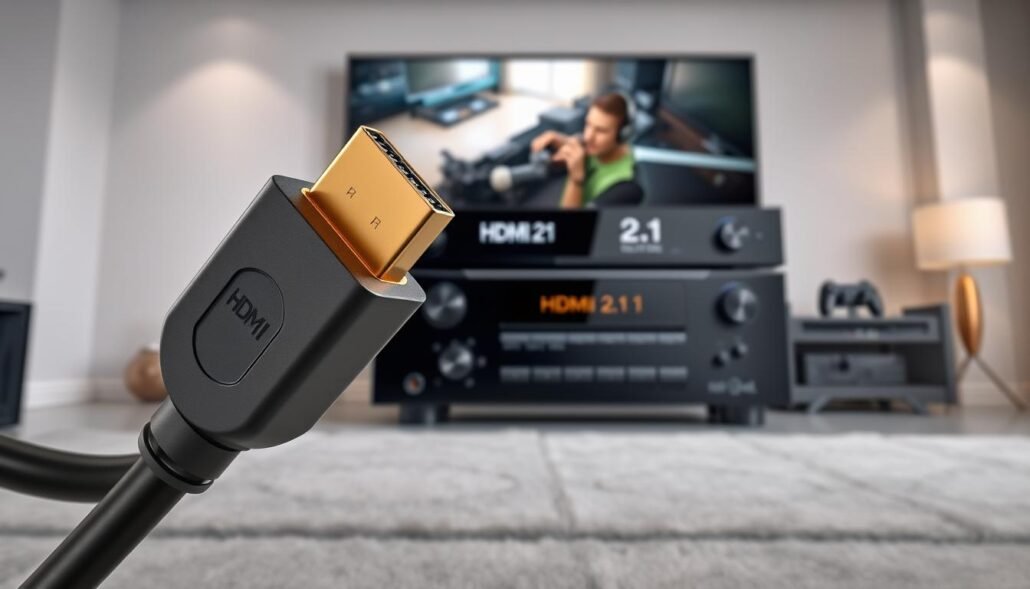
Fixed Rate Link (FRL) replaces the older TMDS method and changes how signals flow at high speed. FRL carries higher resolutions and faster refresh rates by sending data in lanes that differ from TMDS. That makes FRL a hardware-level shift, not just a software tweak.
Why FRL matters for 4K/120
Gamers who want stable 4K/120 from a PS5 or Xbox Series X need FRL support through the chain. Without FRL-capable silicon and proper PCB routing, the link drops back to lower modes.
Internal constraints that block full performance
Even when ports look identical, internal switch chips, trace layout, and power margins limit bandwidth. A port can be physically the same while the electronics behind it are not.
Selective feature support
Some equipment may support eARC or other standards without FRL. That means audio gains are possible while high-bandwidth video remains blocked.
| Element | Legacy (TMDS era) | Modern (FRL-capable) |
|---|---|---|
| Transmission method | TMDS | FRL |
| Max practical bandwidth | Up to 18 gbps | Up to 48 gbps |
| Common supported modes | 4K/60, limited VRR | 4K/120, 8K/60, full VRR |
| Upgradeable by software? | No for FRL-based modes | Requires hardware support |
Quick diagnostic: if the product never listed 4K/120 pass-through at launch, it is very unlikely to gain that mode later. Every link—source, receiver, display, and cables—must match for top performance.
Understanding the “Weakest Link” Problem in Your HDMI Chain
A single weak link in your HDMI chain can force every device down to the lowest common mode.
Typical map: console → receiver → TV. If one component cannot handle the path, hdmi 2.1 features stop at that point.
Where features get blocked
The signal that appears at your display is the negotiated signal. Devices compare capabilities and fall back to what all support.
Common symptom checklist
- Console offers 4K/60 instead of 4K/120.
- VRR toggle is disabled or HDR behaves inconsistently.
- Screen blackouts during mode switches or unstable frame rates.
Many setups still work fine at 4K/60 HDR, so limits often show only when 120Hz modes are requested.
If you suspect the middle device, bypass it: connect the console directly to the display and test the input. If the problem follows the receiver, you have your culprit.
This test helps people decide whether hdmi 2.1 is truly needed for their viewing habits and prepares you for the next steps.
How to Check If Your Setup Needs HDMI 2.1 at All
Before spending on new gear, check whether your actual usage will benefit from the higher rates that modern specs deliver.
Gamers: when it matters
Most of the near-term gains are for game play. Consoles like PS5 and Xbox Series X can output 4K at 120Hz, enable VRR, and lower input lag when paired with compatible tvs and displays.
If you play fast-paced titles or competitive games, the jump to 120Hz is noticeable. If you mostly play cinematic single-player games at 60fps, the benefit is small.
Movie and streaming reality check
Most streaming content and films arrive at 24–60 fps. That means the extra bandwidth and gbps headroom of hdmi 2.1 rarely affects picture quality for typical movies and shows.
- Inventory your gear: check console output, TV model, and any PC GPU limits.
- Weigh future-proofing against cost and how many years you keep gear.
- If you decide HDMI 2.1 is needed, a low-cost next step is to try a safe firmware update and then test pass-through.
For deeper technical background on connector generations and specs, see the finalized hdmi 2.0 specifications.
Step-by-Step: Update Your Receiver Firmware Safely
Start any system refresh by confirming exactly which model you own and the current firmware version shown in the system menu.
Confirm model and version
Write down the full model code including suffix and the installed version shown in the system info. This avoids mismatches when you search support pages.
Back up settings and document inputs
Backup matters. Export or note key settings, input names, speaker layout, and audio modes. Some equipment may reset labels or signal-format choices during the process.
Choose the correct update method
Check the manufacturer’s U.S. support page for the latest firmware, release notes, and whether network or USB is required. Follow that method for your models and version.
Safe-update best practices
- Use stable power; avoid storms and power cycling during the procedure.
- Do not interrupt the process; allow extra time if progress stalls.
- Keep the controlling device nearby in case on-screen prompts appear.
Post-update checks
After the install, verify input naming, HDMI signal format modes, pass-through choices, and audio output modes in menus. Confirm your device retained critical settings.
| Step | What to record | Why it matters |
|---|---|---|
| Before | Model, version, input map | Prevents wrong file use and eases rollback |
| During | Stable power, no interruptions | Avoids bricking or partial installs |
| After | Signal modes, audio settings | Confirms compatibility and restores function |
Expectation: the firmware update may fix handshake issues and improve stability, but it will not change the underlying bandwidth limits of the HDMI path. If top-tier video modes still fail, plan next steps for display or cabling upgrades.
Step-by-Step: Verify What Your Receiver Can Pass After Updating
A clear test order removes guesswork and helps isolate what each component truly passes. Start simple, record results, then move to higher modes. That way you know whether the problem is the cable, the source, or the device in the chain.
Test 4K/60 HDR first, then try higher frame-rate modes
Begin with 4K/60 HDR. Confirm the console outputs the expected resolution and HDR flag. If that baseline fails, stop and fix that before pushing for 4K/120.
Use console video output menus to confirm negotiated signal
Open PS5 or Xbox video settings and read the reported rate, resolution, and HDR status. Trust the console menu over what the TV looks like; it shows the negotiated hdmi link.
How to spot handshake failures vs cable bandwidth issues
Handshake failures cause intermittent black screens, “no signal,” or repeated switching. Bandwidth limits show as modes that are simply unavailable or always fail at higher rate.
Practical checks: swap the cable, try a different input on the receiver, or bypass the receiver to the TV. If 4K/60 HDR works but 4K/120 does not, the receiver is likely the limiting link rather than the TV.
Record every test: chosen resolution, refresh rate, HDR on/off, and whether VRR or ALLM show in the console. Clear notes make it easier to decide if you need another workaround or hardware that truly supports hdmi 2.1.
Cable Requirements: When You Need Ultra High Speed HDMI
Cables often get overlooked, yet they decide whether your system can actually deliver 4K at 120Hz.
Ultra High Speed HDMI refers to certified 48G cables designed for higher modes tied to hdmi 2.1. These cables support the extra gbps needed for 4K/120 and other high-rate gaming use cases.
What Ultra High Speed cables enable for 4K/120
Short answer: they carry much higher throughput. If your source and tvs both support 4K/120, a certified cable usually unlocks that mode.
Why many setups still work fine on existing High Speed cables
Most streaming and movie content stays at 4K/60 or lower. In those cases, current High Speed cables often work fine and show no visible difference in picture quality.
| Need | High Speed cable | Ultra High Speed (48G) |
|---|---|---|
| Typical content | 4K/60 streaming | 4K/120 gaming |
| Max throughput | Up to 18 gbps | Up to 48 gbps |
| When required | Most movies and shows | When pushing high refresh rates |
- If 4K/120 is your goal, upgrade the cable even if lower modes still work.
- Under-spec cable symptoms: refusal to enable top mode or drops when switching to higher bandwidth.
- Keep runs short and avoid extra adapters or couplers that harm signal integrity.
- Remember: the best cable cannot override internal limits in other devices; check the chain before spending time or money.
Workaround If Your Receiver Can’t Pass HDMI 2.1 Video
A straight path from console to TV often unlocks features that intermediaries cannot pass. If your receiver blocks high-rate modes, this reroute restores 4K/120 and often VRR for PS5 and Xbox Series X.
Connect PS5/Xbox Series X directly to the TV for 4K/120
Plug the console into a TV HDMI 2.1 input. This gives the best chance for high refresh rates and low latency. The TV becomes the primary video hub while the receiver steps back.
Send audio back using eARC
Enable eARC on the TV and set audio output to bitstream if you use Dolby Atmos or other high-bitrate formats. The TV sends multichannel audio back to the receiver so it still handles decoding and amplification.
When an HDMI switch helps and when it won’t
An Ultra High Speed switch can expand inputs if the TV has too few ports. Only buy one that explicitly supports high bandwidth and VRR. A switch cannot upgrade a non-2.1 receiver’s pass-through and adds another handshake point that can fail.
- Wiring checklist: console → TV (video); TV eARC → receiver (audio).
- Confirm TV eARC is on and audio format set for your equipment.
This approach preserves gaming features while delaying full replacement of the receiver.
eARC and Audio: Future-Proofing Sound Without Replacing Everything
For many setups, switching video routing and using eARC keeps top-tier sound while avoiding an immediate gear overhaul.
What eARC changes for Dolby Atmos and high-bitrate audio
eARC moves multichannel, object-based audio such as Dolby Atmos and high-bitrate PCM through the TV back to your amp. This lets people route consoles or streaming boxes straight to the display for best video, while preserving the highest-quality audio path.
This is more than convenience. eARC follows the modern hdmi standard and offers a more reliable way to carry lossless formats than legacy ARC. When both TV and equipment support eARC, you get richer sound without sending every source through the amplifier.
When your existing cables are enough
Many current High Speed cables already handle eARC because audio bandwidth needs are far lower than 4K/120 video. You often do not need immediate cable replacement just for high-bitrate audio.
- Enable eARC in the TV audio menu and turn on HDMI control/CEC if required.
- Confirm both TV and amp list eARC in their spec sheets; otherwise the link falls back to ARC behavior.
- Expect occasional lip-sync workarounds; TV and amp clocks can differ.
| Item | Legacy ARC | eARC |
|---|---|---|
| Max audio formats | Compressed surround, limited Atmos | Lossless multichannel, full Dolby Atmos |
| Cable need | High Speed usually ok | High Speed usually ok; Ultra High Speed not required for audio |
| Best use | Older TV/amp combos | Future-proof audio while routing video direct to TV |
Practical takeaway: eARC is a cost-effective way to keep great sound. It lets you delay buying a full hdmi 2.1 upgrade when the amp still sounds great. Follow simple setup steps and check support in device menus for the best result.
Interoperability and “HDMI 2.1” Label Confusion
Seeing “hdmi 2.1” on spec sheets can feel reassuring, yet many products implement only selected capabilities. That makes the label less useful than shoppers expect.
Why devices may support only some features
Partial implementation is common. Makers may enable VRR or eARC while leaving out full 48 Gbps pass-through. This saves cost but creates head-scratching failures during setup.
Real-world takeaway: verify features, not just the version
Practical test: look for explicit claims for VRR, ALLM, eARC, and 4K/120 pass-through. Independent reviews often show which ports and years really work.
How compliance language can differ from real compatibility
HDMI is governed by an industry association. Compliance testing exists, but it does not guarantee seamless cross-brand use. Mix-and-match equipment can still fail handshakes.
- Read specs for exact port-level support.
- Check real-world reviews that test pass-through modes.
- Expect firmware maturity and handshakes to vary by model year.
| Claim | What to confirm | Why it matters |
|---|---|---|
| hdmi 2.1 label | Listed features per port | Ensures expected modes will pass |
| Vendor compliance | Independent testing | Shows real interoperability |
| Mixed brands | Compatibility notes | Reduces troubleshooting time |
Receiver Upgrade vs Replace: How to Decide in the Present
Deciding whether to upgrade your amplifier or buy a new unit starts with what you actually watch and play. List your primary consoles, the TV you own, and the types of content you watch most often.
When a new unit is justified for your tv, consoles, and content
If you need reliable 4K/120 pass-through for multiple consoles and inputs, replacing makes sense.
Strong reasons to replace:
- You use several consoles that require high refresh rates for competitive play.
- You want one device to handle all switching without frequent bypassing.
- Your TV has few high-bandwidth ports, forcing complex wiring.
Cost-saving strategy: prioritize display and console needs over spec chasing
Keep the decision practical. If most content is movies or streaming at 4K/60, keep the current receivers and route consoles directly to the TV.
- Use eARC for full audio while routing video direct.
- Swap cables or add an Ultra High Speed switch before buying new equipment.
- Verify models by measured performance in reviews, not only spec sheets.
| Decision | When it fits | Quick action |
|---|---|---|
| Replace | Multiple consoles need 4K/120 | Buy verified model with port-level support |
| Keep | Mostly 4K/60 content or limited ports | Direct console→TV, use eARC |
| Temporary fix | One console needs high rate | Add certified cable or switch |
Final tip: match spending to real needs for the next few years. Avoid paying for bandwidth you will not use, and check independent tests for true support before you replace.
Looking Ahead: HDMI 2.1b Today and HDMI 2.2 on the Horizon
Right now, most TVs and many amps ship with HDMI 2.1b-level features aimed at gamers and modern AV chains. That landscape focuses on reliable 4K/120 gaming, VRR tweaks, and better eARC audio handling rather than pushing new raw bandwidth limits.
What HDMI 2.2 changes and why it won’t upgrade older ports
Announcement and numbers: announced at CES 2025 (Jan 6, 2025), HDMI 2.2 doubles the top link to 96 gbps and opens room for higher refresh rates and future resolutions. New certification called Ultra96 will be required for cables that carry full 96 gbps performance.
That extra bandwidth matters only when the internal chipsets, switch fabric, and board traces support the new physical link. Software cannot create missing lanes or higher signal integrity. In short, new standards do not upgrade legacy ports; hardware must be replaced for full benefit.
Practical timing: what to wait for vs what to buy now
Backward compatibility: HDMI 2.2 devices will connect with older gear but will default to the lowest-capability link in the chain. The weakest link rule still controls final modes.
For most households, buying for today’s needs is the best way forward. If 4K/120 and eARC are your priorities, invest in verified equipment and Ultra High Speed cabling now. If you plan to adopt 2.2-class sources or displays within a few years, wait until multiple devices and certified Ultra96 cables are widely available.
| Item | Now (HDMI 2.1b era) | Future (HDMI 2.2) |
|---|---|---|
| Max bandwidth | Up to 48 gbps | Up to 96 gbps |
| Typical benefits | 4K/120, VRR, eARC improvements | Higher refresh/resolution headroom, new color/transport modes |
| Cable | Ultra High Speed (48G) | Ultra96 certification required |
| Upgrade path | Firmware and minor fixes for some features | Requires new hardware and certified cables |
Conclusion
Practical answer: software patches often improve handshake logic and stability, but they rarely convert legacy ports into full hdmi 2.1 hardware. Expect better compatibility, not new physical lanes.
Key takeaway: verify real features like 4K/120, VRR, ALLM, and eARC in specs and by testing pass‑through rather than trusting a version label. Check model pages, release notes, and on‑screen info.
Use a methodical approach: confirm support, perform a safe firmware update, test direct and bypass paths, and identify the weakest link before spending money. For gamers, route consoles direct to the TV for 4K/120 and send audio back via eARC.
Final note: Ultra High Speed cables may be required for top modes, but they cannot fix internal bandwidth limits. Replace a unit only when your TV, consoles, and habits truly need full hdmi 2.1 pass‑through.
FAQ
Can a firmware update make an older receiver support HDMI 2.1 features?
Firmware can enable some HDMI 2.1 features on existing hardware, like improved handshakes, bug fixes, VRR/ALLM toggles, or eARC support if the internal silicon and PCB traces already handle the required signals. However, full native support for high-bandwidth features such as full 4K@120Hz or 8K@60Hz pass-through usually needs newer chipsets and higher-bandwidth signal paths that only hardware changes provide.
What does HDMI 2.1 add over HDMI 2.0 that matters most?
The key additions are much higher bandwidth, support for higher frame rates (4K@120Hz, 8K@60Hz), Variable Refresh Rate (VRR), Auto Low Latency Mode (ALLM), Quick Frame Transport (QFT), Dynamic HDR metadata, and enhanced audio return channel (eARC). These features improve gaming responsiveness, high-frame-rate video, and lossless multichannel audio delivery.
Why is the bandwidth jump important?
Higher bandwidth lets devices carry higher resolution and frame-rate combinations (like 4K@120) without heavy chroma subsampling or compression. Older receivers designed around 18 Gbps lines can’t reliably carry the full 48 Gbps signal required for uncompressed 4K@120 with full chroma and HDR, so they fall back to lower-quality modes or simply block the signal.
Which HDMI 2.1 features might be added through software on some receivers?
Manufacturers often add features like VRR, ALLM, improved handshake behavior, firmware-level QMS/QFT toggles, and software support for eARC or codec recognition. These are possible when the receiver’s existing hardware already supports the necessary signaling and the vendor enables it in software.
Which features almost always require new hardware?
Fixed Rate Link (FRL) for full 48 Gbps lanes, native 4K@120/8K@60 uncompressed pass-through, and internal routing capable of handling the full bandwidth are hardware-dependent. Upgrading to these requires new receiver chipsets, HDMI ports, and PCB design that support higher line rates and heat/power budgets.
How can I tell what my receiver truly supports?
Check the spec sheet, user manual, and port labels for explicit mentions of supported resolutions, frame rates, VRR, ALLM, eARC, and the advertised bandwidth. Beware of vague marketing like “HDMI 2.1 compatible” without a feature list; contact the maker or look for official firmware release notes for confirmation.
What are the signs my chain is blocking HDMI 2.1 features?
Common symptoms include reduced resolution or frame rate (e.g., down to 4K@60), missing VRR or HDR, handshake errors, intermittent black screens, or consoles forcing lower color formats. The weakest component—cable, receiver, or display—often dictates the negotiated mode.
Do gamers need full HDMI 2.1 in their receiver?
Gamers who want native 4K@120 or full uncompressed visuals from PlayStation 5 or Xbox Series X usually benefit from full 2.1 pass-through. If you use a TV that supports 4K@120 and want the lowest latency and full chroma, route the console directly to the display and use eARC or optical for audio if the receiver can’t pass the signal.
How should I safely perform a firmware upgrade on my receiver?
Confirm the exact model and current firmware version, back up settings if possible, follow the manufacturer’s instructions for network or USB installs, and avoid power loss during the process. After the update, verify HDMI input labeling, signal format modes, and audio settings to ensure nothing reset or regressed.
How do I test what my receiver can pass after an update?
Start by testing 4K@60 HDR, then try higher frame-rate modes. Use console output menus to force 4K@120 or VRR and check what the receiver and TV report as the negotiated signal. Swap cables and try connecting the console directly to the TV to isolate whether the receiver, cable, or TV limits the chain.
What cable do I need for high-bandwidth modes?
Ultra High Speed HDMI cables are required for full uncompressed 4K@120 and 8K modes. Many existing High Speed cables handle 4K@60 fine, but for guaranteed full-bandwidth performance use certified Ultra High Speed cables and avoid long low-quality leads that can cause signal loss.
What is a practical workaround if my receiver won’t pass 4K@120?
Connect the console directly to the TV for video, then route audio back to the receiver via eARC. If your TV lacks eARC or has limited passthrough, an HDMI 2.1-capable switch or external audio extractor can help, but these only work if they support the required bandwidth and audio formats.
How does eARC help future-proof audio?
eARC carries high-bitrate, lossless multichannel audio formats like Dolby TrueHD and uncompressed Dolby Atmos from the TV to the receiver, reducing the need to reroute sources through the AVR. If your receiver and TV both support eARC, you can keep high-quality sound even if video goes direct to the display.
Why do products advertise “HDMI 2.1” but only support some features?
The HDMI 2.1 spec includes many optional features. Manufacturers often implement a subset—VRR, ALLM, or eARC—depending on hardware and market needs. Always verify specific features rather than assuming full compliance from the version label.
When should I replace my receiver rather than rely on firmware?
Replace the receiver if you need native full-bandwidth pass-through for 4K@120 or 8K, or if your setup requires multiple HDMI 2.1-capable inputs with full feature support. If you mainly need better audio or occasional VRR/ALLM, a firmware-enabled improvement or routing video direct to the TV may suffice.
What’s the near-term outlook beyond HDMI 2.1?
Newer revisions like HDMI 2.1b tweak feature behavior and signal handling, and future versions may push bandwidth further (e.g., proposals above 48 Gbps). Still, older ports won’t gain those physical capabilities via software. Upgrade hardware when you need guaranteed full-bandwidth performance.