The arcam AVR5 positions itself as an entry-level receiver that aims to feel more like hi‑fi than a typical AV unit. It packs seven Class AB powered channels and supports 12-channel decoding up to 7.1.4, so larger Atmos arrays will need an external amp.
Key trade-offs: expect excellent audio clarity and musicality, but note the HDMI ports are HDMI 2.0 only—no 4K/120, VRR, or ALLM for gamers.
We’ll also flag the big differentiators buyers care about: ESS ES9026PRO DACs, Class AB amplification, eARC, and Dolby Vision support. Finally, this piece will help you decide if this receiver fits your home theater goals or if a different path better serves gaming and automation needs.
Quick Take: Who This Unit Is For (and Who Should Skip It)
This receiver is built for listeners who put sonic refinement ahead of headline specs. It suits people assembling a focused home theater or home cinema setup where clarity and musical detail matter more than gaming extras.
Best fit
Movie-first buyers who want clean, agile sound will find this a strong match. Music movies and stereo tracks retain natural timing and texture. Small-to-medium rooms and speakers that favor finesse over brute force are ideal.
When to skip
- Gamers: people who need hdmi 2.1 features like 4K@120Hz, VRR, or ALLM should look elsewhere.
- Large Atmos builds: seven onboard channels handle 5.1.2 fine, but 7.1.4 setups need extra amplification.
- Convenience seekers: buyers who expect bundled room correction in the box may prefer competitors with included automated calibration.
In short, if your content mix is mostly streaming movies, TV, and music, this receiver fits. If competitive gaming or an all-in-one spec list drives your purchase, consider other options.
Arcam AVR5 Review: Price, Positioning, and What You Get for $2,000
For two grand, this receiver bets on sound quality and build rather than every cutting-edge HDMI trick.
What $2,000 buys: a premium chassis, ESS ES9026PRO DACs, and a tuning focus that favors low noise and musical clarity over headline specs. That price places this product as an entry-level model in a lineup whose higher-tier products cost significantly more.
How it sits in the lineup
This product is the brand’s entry point. Higher models—priced roughly at £2799 (~$3,736), £3799 (~$5,071), and £5799 (~$7,740)—add bigger power supplies, more sophisticated amplification, and newer HDMI features.

Seven channels by design
Limiting the number of powered channels to seven is deliberate. The maker says seven is the most it can supply without compromising stereo-style amp performance.
- Buyer value: fewer channels means more consistent power per channel, clearer dynamics, and a lower noise floor in typical home theater setups.
- Expansion note: if you plan a 7.1.4 array, budget for external amplification and possible room-correction licensing—this raises the total cost-to-performance.
- Decoding vs. powering: the receiver can process more channels than it actually powers; that distinction matters when planning a multi-speaker home system.
| Model Tier | Approx. Price (USD) | Key Differentiator |
|---|---|---|
| Entry model | $2,000 | Premium DACs, sound-first tuning, seven powered channels |
| Mid tier | ~$3,736 | Stronger power supply, higher power per channel |
| Upper mid | ~$5,071 | More amp sophistication and added features |
| Flagship | ~$7,740 | Top-end power, advanced video/HDMI capabilities |
Design, Build Quality, and Front Panel Experience
The unit’s clean metal chassis and considered layout give it a restrained, high-end presence in any home rack. The gray/gunmetal casework and tight panel gaps read as deliberate, not flashy, so it blends into serious home theater furniture without screaming “AV gear.”
Chassis, fit and finish, and the 4.3-inch color TFT
The 4.3-inch color TFT front panel display shows status and album artwork, which is handy when you want quick info without turning on a TV. The single large volume dial and neatly placed function/transport buttons feel solid underhand.
The front panel is readable from a couch and gives immediate feedback during music or movie playback. That front panel display helps mixed listening and viewing sessions stay simple and focused.
Remote control basics and day-to-day usability
The included back-lit remote covers essentials and is intuitive for daily use. Menu navigation can be slower than TV-first systems, so expect to use the front panel or web GUI for deeper tweaks.
For networked control, an app and browser interface exist, but the web GUI is often the best way to change advanced settings. This setup is a deliberate design choice that favors tactile, long-term ownership over flashy onboarding.
- Presence in a rack: understated metal chassis, premium fit/finish, audio-first layout.
- Everyday value: readable front panel display, album art, clear status without a TV.
- Control options: back-lit remote for basics, web GUI and app for fuller control.
- Build quality: robust knobs and buttons that justify the $2,000 quality argument for serious home theater owners.
Features and Specs That Matter for Home Theater
Under the hood you get serious decoding and clean amplification, but the trick is how those specs map to real home theater setups.

Decoding vs. powered channels
The unit can decode up to 12 channels and handle formats like dolby atmos and DTS:X to 7.1.4. That means it will process large immersive mixes correctly.
However, only seven channels are powered on board. Practically, 5.1.2 setups run fully from the receiver. For 5.1.4 or 7.1.4 you must add an external amp and use pre-outs for the extra channels.
Amplification and real-world power
Seven Class AB channels prioritize control and musicality over headline wattage. Published figures show about 60W per channel (rising to ~86W with two channels driven under certain test conditions).
That translates to refined audio in small-to-medium rooms. Very large rooms or low-sensitivity speakers may need beefier amps or a higher-tier unit for consistent dynamics and headroom.
DACs, HDMI, and video support
Dual ESS ES9026PRO dacs are a real advantage for clarity and low noise, helping the system sound more “hi‑fi” than many AV units.
The video side includes seven hdmi inputs, two outputs with eARC, and support for HDR10, HLG, and dolby vision. That covers modern streaming and disk content cleanly.
HDMI 2.1 reality check and upgrade path
All HDMI ports are HDMI 2.0, so features like 4K@120Hz, VRR, and ALLM are absent—important if gaming on PS5, Xbox Series X, or high-refresh PC setups is a priority.
An authorized service center can add hdmi 2.1 later, but this requires cost and downtime and should be treated as a long-term option rather than an immediate fix.
| Spec | What It Means | Practical Impact |
|---|---|---|
| 12-channel decoding (7.1.4) | Processes large immersive mixes | Needs extra amp for >7 powered channels |
| Seven Class AB channels | Refined amplification per speaker | Great for small/medium rooms; limited headroom in large rooms |
| ESS ES9026PRO DACs | High-quality digital-to-analog conversion | Cleaner detail, lower noise floor, more musical playback |
| 7 HDMI inputs / 2 outputs (eARC) | Multiple sources and TV return | Supports Dolby Vision/HDR10/HLG; no HDMI 2.1 gaming features |
Streaming, Multi-Room, and Connectivity for Music and TV
Think of this receiver as a central node for streaming music and TV sources around the house. It supports mainstream wireless streaming so phones, tablets, and computers can play directly to the system.
Wireless paths that just work
AirPlay 2 handles Apple devices. Chromecast serves Android and Chrome users. For casual listening, Bluetooth aptX HD offers higher-quality wireless audio than standard Bluetooth. Spotify Connect plays directly to the unit without routing through a phone.
Apps, internet radio, and high-res options
The Harman MusicLife app provides UPnP playback and quick access to internet radio and podcasts. For enthusiasts, Roon Ready plus MQA support enables Tidal Masters and tighter library control, which makes the unit behave like a serious audio product.
Wired I/O and multi-room tools
Inputs and outputs include HDMI for video, four coax and two optical digital inputs, six analog RCA inputs, analog/optical outputs, Ethernet, USB, and an FM/DAB antenna connector. Control ports include RS-232, triggers, and IR extenders for two zones, making custom installs easier.
| Feature | Use Case | Practical Benefit |
|---|---|---|
| AirPlay 2 / Chromecast | Phone/tablet streaming | Low-latency, platform-native playback |
| Bluetooth aptX HD | Casual wireless listening | Better-than-standard Bluetooth quality |
| Roon Ready + MQA | High-res music and library management | Access to Tidal Masters and refined playback |
| Zones, triggers, RS-232 | Multi-room and custom control | Flexible whole-home integration |
Bottom line: if you want a home theater product that also excels at streaming and multi-room music, this unit balances modern wireless services with plenty of wired inputs. For buyers who value streaming and robust connectivity, it is a focused alternative to more feature-bloated products — learn more about useful receiver features here.
Setup and Room Correction: Dirac Live Options vs Manual Calibration
Getting great sound starts with a clear plan. The biggest surprise for new owners is that dirac live room correction is optional. That means you either budget for a license or learn a practical manual setup workflow that still yields big improvements.
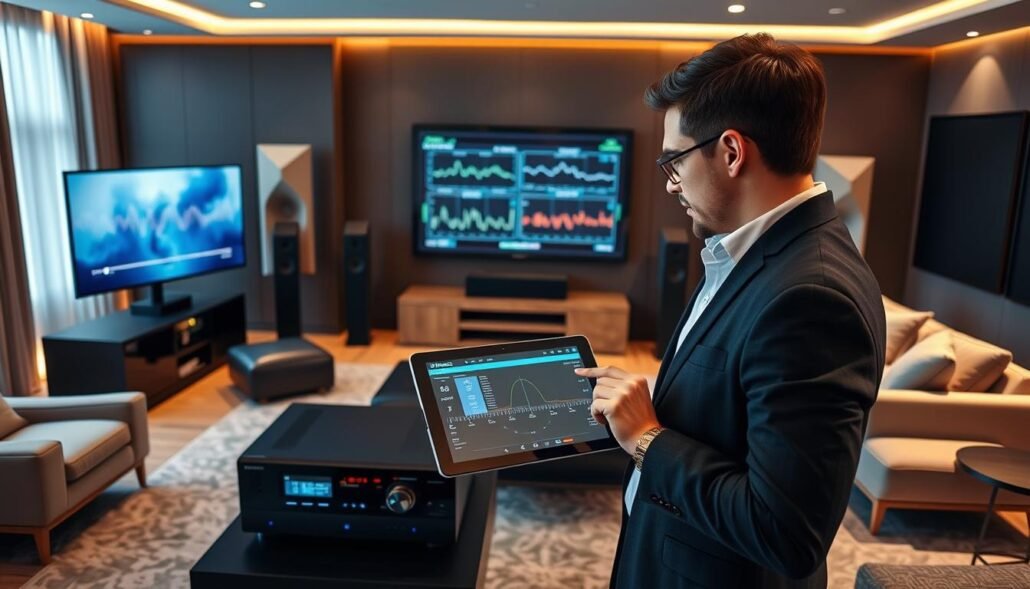
Dirac Live licensing: what each tier does and when it matters
- Limited bandwidth (20Hz–500Hz) — $259: targets bass and lower mids. Useful if bass control is your main problem.
- Full bandwidth to 20kHz — $349: corrects the entire spectrum for clearer imaging and timbre.
- Bass Control (single sub) — $349: focused sub integration for tighter low end.
- Bundle (full + single sub) — $649: all corrections and sub management in one package.
Manual setup workflow: practical, approachable steps
Start by measuring speaker distances and entering those values in the AVR menu. Use an SPL meter or a reliable phone app to set speaker level so each channel reads the same test-tone level.
Choose crossovers next — that single step often yields the biggest clarity gains without paid correction. Run the receiver’s internal test tones to confirm timing and level, then listen and tweak.
Control interfaces and app caveats
The easiest full setup path is the web GUI via the unit’s IP address. The front panel gives basic navigation, but it does not present the entire system menu on a TV or projector.
App control exists, but users have reported intermittent iOS connectivity. For predictable control, the browser method is the most dependable way to finish calibration and daily tweaks.
| Task | Recommended Way | Why it Helps |
|---|---|---|
| Distance & Level | SPL meter + AVR test tones | Aligns timing and perceived volume |
| Crossovers | Set by speaker spec, then fine-tune by ear | Improves clarity and bass integration |
| Full correction | Dirac Live full bandwidth | Best for overall tonal balance and imaging |
Performance: Movie and Music Listening Impressions
What stands out in playback is a focused, agile character that makes both movies and music feel immediate. The system shows fast transients and clear dialogue, so action sequences land with convincing punch without becoming harsh at higher volume.
Home cinema dynamics and transient response
During tests with Ready Player One and Dune the unit proved surefooted. Sudden shifts from quiet ambience to explosive peaks stayed controlled. That steady time-domain control keeps dynamic scenes readable and satisfying.
Soundstage and detail retrieval
The receiver pulls forward low-level textures and ambient cues. Subtle effects and directional movement become easier to track, which improves immersion in home theater mixes.
Bass and subwoofer integration
Expect honest bass: without Dirac Live Bass Control, subwoofer blending relies on placement and crossover tuning. Manual setup yields good results, but it takes care and time to match low-end slam to the rest of the system.
Music playback: timing and tonal balance
For music the unit sounds more like hi‑fi than a typical receiver. Rhythm, warmth, and coherence make vocals and acoustic instruments engaging. Compared with some competitors that favor bulkier bass, this approach favors pace and detail.
| Listening Aspect | What You Hear | Practical Note |
|---|---|---|
| Dynamics / Transients | Snappy, controlled peaks | Good for action films; avoids fatigue |
| Dialogue / Midrange | Clear, warm vocals | Improves speech intelligibility in mixes |
| Soundstage / Detail | High low-level retrieval | Enhances immersion and spatial cues |
| Bass / Subwoofer | Accurate but less boomy | Requires manual tuning for tight integration |
Conclusion
When sound quality leads your checklist, this receiver feels more like hi‑fi than a typical AV component. It delivers engaging, clear audio, controlled dynamics, and a refined musicality that rewards movie and music sessions at home.
, Top reasons to buy: strong musical detail, steady power for small-to-medium rooms, robust connectivity, and a useful front display that helps everyday use.
Top reasons to pass: no built-in full bandwidth room correction by default, only seven powered channels, and absence of HDMI 2.1 gaming features unless you plan an upgrade via service.
For movie-first households and serious music listeners, this is a smart choice. Spec-driven buyers should compare other receivers in the same price band. Plan for external amplification or an HDMI service upgrade if you expect to grow the system over time.
FAQ
What channels and speaker configurations does the receiver support?
The unit offers seven powered channels and supports object-based formats like Dolby Atmos and DTS:X up to a 7.1.4 layout via external amplification for additional height or surround channels. Its onboard seven channels cover typical 5.1 and 7.1 setups directly.
Does it include HDMI 2.1 features for modern gaming consoles?
It supports HDR formats including Dolby Vision, HDR10 and HLG, plus eARC for high-resolution audio passthrough, but it lacks full HDMI 2.1 bandwidth and features such as 4K@120Hz or VRR native support. Gamers wanting those must consider external HDMI 2.1 switching or a future hardware upgrade.
Can I upgrade HDMI to full 2.1 compatibility?
There is an authorized service upgrade path through the manufacturer’s service centers. This process typically requires sending the unit in and may incur parts and labor charges; check with an authorized dealer for availability and cost.
Is Dirac Live included, and what are the licensing options?
Room correction via Dirac Live is available as an optional license. There are tiered offerings—basic correction and more advanced packages—so buyers can choose the level of room correction they need or opt for manual setup instead.
How effective is manual calibration without Dirac Live?
Manual setup remains straightforward: set speaker distances, levels, and crossovers, then use test tones to align levels and polarity. The receiver’s tuning and onboard controls yield very good results for well-treated rooms, though Dirac adds measurable improvements in room resonances and tonal balance.
What kind of DACs and audio performance should I expect?
The design uses high-performance ESS DAC components that prioritize low noise and detail retrieval. Expect clear mids and highs, tight transient response, and a sound that leans toward hi‑fi sensibilities rather than a colored, consumer-Receiver sound.
How much power does each channel deliver, and how does that translate to real listening?
Power ratings are conservative and reflect stable, musical performance from Class AB amplification. In real rooms this translates to effortless dynamics, clean headroom for movie peaks, and reliable drive for most bookshelf and floorstanding speakers.
What streaming services and network features are supported?
The unit supports Apple AirPlay 2, Chromecast, Spotify Connect, and Bluetooth aptX HD for local streaming. It also integrates with the Harman MusicLife app, internet radio and podcasts, and offers Roon Ready compatibility with MQA support for high-res music lovers.
How many HDMI inputs and outputs are available?
There are seven HDMI inputs and two HDMI outputs. One output handles the main display while the second can be used for a secondary zone or projector. eARC support is included on the main output for audio return from modern TVs.
Does the receiver handle multi-room or zoned audio?
Yes. It offers zone outputs and trigger ports for multi-room setups. You can play separate sources in a secondary zone while the main room runs the home theater mix, though full multi-room features depend on connected speakers and system configuration.
How is subwoofer integration and bass control handled?
The receiver provides subwoofer outputs with level and crossover controls. Without Dirac Live Bass Control, integration relies on manual tuning and placement. Proper setup yields tight, well-timed bass, but Dirac improves low-frequency room-mode management.
What is the front panel like for daily use?
The front panel features a 4.3-inch color TFT display that shows input, format, and basic settings. Navigation is intuitive, and the remote covers common functions. More advanced setup is easier via the web GUI or app.
Are there inputs for legacy sources like coaxial and optical digital or analog RCA?
Yes. In addition to multiple HDMI inputs, the receiver includes digital coax and optical inputs plus analog RCA options for older gear. This makes it easy to incorporate turntables (with a phono preamp), CD players, and legacy components.
Does it support wireless Bluetooth streaming with high-quality codecs?
Bluetooth capability includes aptX HD support for higher-quality wireless music streaming from compatible devices, alongside AirPlay 2 and Chromecast for higher fidelity and multi-room integration.
How does the receiver perform for music compared with movies?
The design leans toward a sound-first, music-friendly presentation: tight timing, a natural midrange and engaging musicality. For movies it delivers strong dynamics, clear dialog and precise imaging, making it a dual-purpose unit for serious listeners and home cinema fans.
What control interfaces are available for advanced setup?
You can use the front panel, included remote, the Harman MusicLife app, or the web GUI via the unit’s IP address. Note that some app functions vary by platform and firmware, so the web GUI often provides the most complete tuning tools.
Is there support for Roon and high-resolution audio formats?
Yes. The receiver is Roon Ready and supports MQA playback, enabling high-resolution streaming and tight integration with advanced music libraries and multi-room systems.
What should buyers know about price and where it sits in the lineup?
Priced around ,000, the unit is positioned as a sound-first, seven-channel integrated AV solution. It targets listeners who prioritize audio quality and build over the latest gaming-specific HDMI features, sitting below higher-channel or feature-rich models in the range.
Can I add more powered channels later for a 9.1 or 7.2.4 setup?
Yes. You can expand to additional channels by adding an external power amplifier. The pre-outs allow integration with outboard amps to create larger configurations like 9.1 or full 7.2.4 with powered height channels.