This 2025 US-market roundup focuses on practical buying decisions for people building or upgrading a home theater. We look past hype to test real outcomes: stable hdmi switching, low-latency gaming support, reliable TV-to-receiver audio, and clear upgrade paths.
Expect a spec-first comparison that connects checkboxes to results: fewer handshake issues, better surround sound, and easier setup. We spotlight top picks from Denon, Onkyo, Sony, Marantz, Anthem, Yamaha, and Arcam and preview specific models like Denon AVR-S770H/X2800H/A1H and Onkyo TX-NR6100/TX-RZ50.
Price tiers run from value units under $750 to premium statement builds. The guide calls out use-case wins — gaming, movies, or music — so you can match features to needs fast.
Read on for checklists that help you shortlist a receiver in minutes and compare the real-world benefits of each choice.
What “leading” means in HDMI AVR technology right now in the US market
A true leader mixes modern port capability with rock-solid real-world performance. It must handle handshakes, fast switching, and tight lip-sync without surprises. A top pick proves that specs translate to reliable daily use in the home.
HDMI 2.1 switching for 8K and 4K/120 gaming
HDMI 2.1 matters when you want 4K/120 for console gaming routed through the receiver. It keeps frame rates and VRR intact so gameplay stays smooth when you avoid direct TV connections.
eARC reliability for Dolby Atmos from TV apps
eARC is the better path for TV-app audio because it carries full, uncompressed dolby atmos tracks. That reduces dropouts and makes streaming apps act like a native source to the receiver.
HDR pass-through expectations: Dolby Vision, HDR10, HLG
In 2025, pass-through must include dolby vision, HDR10, and HLG. Video enhancements only matter if the unit negotiates formats without black screens or audio cutouts.
Finally, leadership is about the right mix of home inputs and outputs — enough HDMI ports for consoles, streamers, disc players, and a PC. These practical features set the stage for the brand roundup that follows.
Which brands are currently leading in HDMI AVR technology?
Across 2025 reviews, a short list of manufacturers keeps appearing because they solve everyday problems: stable switching, usable calibration, and clear upgrade paths.
Frequent names: Denon, Onkyo, Sony, Marantz, Anthem, and Arcam. Audio Advice spotlights Denon for value and flagship models, Onkyo for upgradeable platforms with Dirac Live, Sony for high‑channel value, Marantz for multi‑sub control, Anthem for top-tier sound, and Arcam for music-first fidelity.
How repetition across reviews helps shoppers
When multiple outlets test the same receivers, shoppers get consistent signals. Repetition reduces risk and shows which units balance features and reliability.
Where leadership shows up
- Inputs and switching: fewer dropouts during gaming or source swaps.
- Processing headroom: headroom for extra channels and future upgrades.
- Calibration: room correction and bass management that actually improve sound quality.
- Expansion: pre-outs and processor modes to add power amps, subs, or height channels.
Some makers pack the most features per dollar (Denon, Onkyo). Others focus on premium sound ecosystems (Anthem, Arcam). Streaming ecosystems now matter because many users play music daily through their receiver.
Next: a spec checklist, then deep dives by maker, and practical picks to match systems to rooms. For a curated list of the best receivers of 2026, read on.
Key specs to compare before you buy a receiver
Prioritize the handful of specs that change everyday reliability and sound performance. Start by mapping gear to the space and uses you actually have, not the showroom wishlist.
Number of channels vs real system layouts
Match the number channels to layouts like 5.1.2 or 7.2.4. If you want future expansion, prefer processors that list processing channels separate from powered channels.
Tip: A 7.2.4 processor can output more channels than a unit that only powers seven speakers. That matters if you plan to add amps later.
Watts per channel and power rating pitfalls
Watch for specs quoted as “2 channels driven” at low distortion. Real-world watts per channel across all channels at full bandwidth matters more.
A listed power rating can mislead. Check distortion figures and whether the spec covers full 20Hz–20kHz output.
HDMI inputs and outputs: count your sources
Inventory consoles, streamer, disc player, cable box, and a second display. That gives the number of hdmi inputs and outputs you need.
Room EQ that moves sound quality
Room correction is the biggest single lever for sound quality in typical living rooms. Look for multiband EQ, discrete subwoofer channels, and good measurement tools.
Streaming and control
Expect Spotify Connect and AirPlay for everyday convenience, Bluetooth for quick playback, and voice-assistant options if you want hands-free control.
- Spec priority: HDMI stability + channels + room EQ + enough power + streaming usability.
- Expansion: Pre-outs and discrete sub channels let you grow without replacing the receiver.
Denon’s HDMI-forward lineup for value and big-system builds
Denon’s lineup balances everyday usability with upgrade paths for larger systems. These units focus on stable switching, eARC behavior with TVs, and wide codec support for streaming and discs.
AVR-S770H (under $750) — A practical receiver that packs three 8K inputs, Dolby Vision pass-through, Audyssey MultiEQ, and eARC. It powers seven channels at 75 watts per channel (2ch driven) and adds handy features like Bluetooth transmit for headphones. For most living-room setups, this model delivers modern video and reliable daily performance.
Denon AVR‑X2800H
The X2800H raises amplifier headroom to 95 watts per channel and upgrades room correction to Audyssey MultEQ XT. That extra power helps with low-sensitivity speakers and larger rooms. It also offers more flexible height speaker routing for Dolby Atmos layouts, making it a better pick when you plan for more channels or tougher speaker loads.
AVR‑A1H: big-system processing
The A1H is the flagship cited in 2025 roundups for large cinema builds. It favors scale: more processing channels, stronger power delivery, and the kind of I/O you want when adding external amps or multiple subs. Choose it when you need a robust core for a dedicated home cinema.
- When S-series is enough: typical living rooms, mixed TV/gaming/music use, limited expansion needs.
- When X-series makes sense: larger rooms, lower-sensitivity speakers, or plans to add height channels or external amplification.
- Tradeoff: lower-tier models may lack preamp outputs for future growth.
| Model | Key features | Watts / channel | Best fit |
|---|---|---|---|
| AVR‑S770H | 3×8K HDMI, Dolby Vision, Audyssey MultiEQ, eARC, BT TX | 75 W/Ch | Value home setups, mixed-use rooms |
| AVR‑X2800H | 8K inputs, MultEQ XT, flexible Atmos routing, stronger amp headroom | 95 W/Ch | Bigger rooms, lower-efficiency speakers |
| AVR‑A1H | Flagship processing, expanded channels, high-scale cinema features | High power & headroom | Dedicated home cinema, large systems |
Bottom line: Denon often serves as a safe default for mainstream buyers who want reliable video pass-through, solid sound, and straightforward setup. For mixed households that stream, game, and watch movies, these models cover most needs while leaving room to grow.
Onkyo’s HDMI connectivity and streaming ecosystem leadership
Onkyo focuses on wide connectivity and a deep streaming stack that fits multiroom homes without a luxury price tag.
TX‑NR6100: a practical 7‑channel hub
The TX‑NR6100 is a value-minded receiver that still packs useful heft. It lists 7 x 100 W/Ch and six hdmi inputs, with three ports able to pass 8K. HDR10 and Dolby Vision support remain on the other ports, and there’s a phono input for vinyl.
The unit’s streaming roster is deep: Google Cast, DTS Play‑Fi, Sonos integration, AirPlay, Bluetooth, and Spotify Connect. That makes music playback easy across rooms.
TX‑RZ50: step up with Dirac and more muscle
The TX‑RZ50 moves up to nine powered channels and preouts for 11. It also offers six 8K hdmi inputs (HDCP 2.3), dual 8K outputs, eARC, and Dirac Live room correction.
Dirac can take longer to set up, but it often delivers clearer imaging, tighter bass, and improved overall sound quality when measured properly.
Why Onkyo for immersive decoding
Onkyo shines when you want convincing dolby atmos and atmos dts:x performance without spending at flagship prices. Fast switching and stable ports help gaming and multi‑source setups.
Choose the NR6100 for modest layouts and value rooms. Pick the RZ50 if you plan a 7.2.4 system with added amplification and serious calibration.
Sony’s new-school HDMI 2.1 receivers for gaming and immersive setup
For console-first setups, Sony focuses on fast switching, broad video support, and calibration that tightens spatial imaging. These models aim to keep gameplay responsive while delivering convincing surround when tuned.
STR‑AN1000
The STR‑AN1000 is a 7.2 Dolby Atmos receiver with HDMI 2.1 for 4K/120. It packs six HDMI inputs (two 8K capable) and two 8K outputs, plus Dolby Vision/HDR10/HLG support.
Notable: Digital Cinema Auto Calibration IX speeds setup and improves imaging for real rooms. No phono input.
STR‑AZ5000ES
The STR‑AZ5000ES targets bigger installs with 11 channels and 11-channel preouts. It lists 130 W/Ch (2ch FTC), multiple 8K-ready HDMI ports, eARC, and a DCAC-style calibration process.
Practical signal: heavy chassis, longer warranty, and room-first tuning make it a solid choice when you want scale without immediate external amps.
- Calibration advantage: DCAC-like workflows ask for speaker and seat data to yield cohesive surround.
- Tradeoff: phono omission affects vinyl users.
- Best fit: gaming-heavy homes that want one best mix of low latency and cinematic sound.
| Model | Key features | Best fit |
|---|---|---|
| STR‑AN1000 | 7.2, HDMI 2.1, Dolby Vision, DCAC IX | Console gaming + living rooms |
| STR‑AZ5000ES | 11 ch, 11 preouts, 130 W/Ch, eARC | Large systems, immersive setups |
Bottom line: Sony pairs reliable hdmi behavior with deep calibration so you get cleaner object placement and usable power. For many U.S. gamers who want immersive dolby atmos performance, Sony ranks among the best receivers and a strong atmos receiver option.
Marantz Cinema series for premium surround sound and multi-sub control
Marantz steps into premium cinema with gear that favors tonal refinement and advanced bass control.
Marantz Cinema 50: flexible power and multi‑sub outputs
The Cinema 50 ships with 9 powered channels and 11‑channel processing. That combo lets you run a full setup today and add external amps later to scale channels for larger layouts.
Its standout is four discrete subwoofer outputs. Separate sub channels enable smoother, more even low end across seats and reduce nulls in a room.
Practical trade-offs: Audyssey MultEQ XT vs Dirac Live
Marantz includes Audyssey MultEQ XT for fast, reliable setup and clear on‑screen guidance. Dirac Live is optional if you want deeper tuning and finer sound quality gains.
Choose Audyssey for ease and Dirac when you can invest time or pro tuning to extract the last bit of performance in tricky rooms.
Why buyers prefer Marantz for music and movies
Marantz leans toward a warmer, music-first voicing that makes two-channel playback less fatiguing. It still handles dolby atmos and modern video needs with six 8K HDMI inputs, eARC, and dolby vision pass-through.
- Who should buy: multi‑sub owners, mixed music + movie households, and those who value polish.
- When to skip: if you’ll never add subs or expand channels, a value model likely suffices.
Anthem for audiophile-grade sound quality and advanced room correction
Anthem focuses on delivering real-world improvements to sound quality through serious calibration and robust amplification. The lineup suits home listeners who treat setup as part of the system, not an afterthought.
Anthem MRX 740: Anthem ARC Genesis and high-performance amplification focus
The MRX 740 is often named among the best receivers for sound quality and value. It pairs seven powered channels with 11-channel preouts and supports power amp matrixing for later upgrades.
ARC Genesis is the headline feature: a room correction system that cleans tonal balance and tightens bass in imperfect rooms. For shoppers, that means less time chasing nulls and more reliable playback for movies and music.
When the MRX 1140 makes sense for larger rooms and more channels
Choose the MRX 1140 if your home needs extra channels and wide coverage. It suits bigger rooms and complex layouts where additional amplifier capacity and preouts matter.
- Why buy Anthem: performance-first tuning, upgrade-friendly preouts, and amplifier scaling.
- Connectivity baseline: eARC and 8K-capable switching are included, not optional.
- Best fit: movie-heavy households that still value accurate two-channel music playback.
Next: Yamaha and Arcam offer different takes on sound-first design with other trade-offs worth comparing.
Yamaha’s AVENTAGE approach to HDMI switching and cinematic performance
Yamaha’s AVENTAGE line positions itself as a cinema-first choice for home setups that value scale, impact, and rock-solid switching. The RX‑A4A emphasizes build quality and big-room presentation over glossy streaming features.
RX‑A4A strengths include a robust chassis, an amplifier rated near 110 watts per channel (stereo), and seven hdmi ports that cover typical source lineups. That combination favors stable video handoffs and fewer source dropouts during movie nights.
The built-in phono preamp is a practical bonus. Vinyl lovers can plug a deck straight into the receiver without adding an external phono box. For many users, that simplifies a two-channel or mixed home music setup.
Who should buy: movie-first households and viewers who want a reliable hub with classic theater voicing. If streaming sound quality is your top priority, compare Yamaha against Denon, Onkyo, or Marantz for music features and DAC focus.
Plan to pair RX‑A4A with efficient speakers or add an external amplifier to maximize dynamics in larger rooms. Yamaha’s leadership here rests on switching stability and cinematic voicing rather than spec sheets alone.
Quick fit checklist
- Best fit: home theater impact and reliable switching.
- Key perks: phono input, sturdy build, seven hdmi ports.
- Consider alternatives if: two-channel streaming fidelity is your one best priority.
Arcam for two-channel-first listeners who still want a modern Atmos receiver
For audiophiles who value tonal fidelity, Arcam blends refined two-channel sound with modern surround decoding. The Arcam AVR11 often tops lists as the best receivers choice for pure listening while keeping film features current.
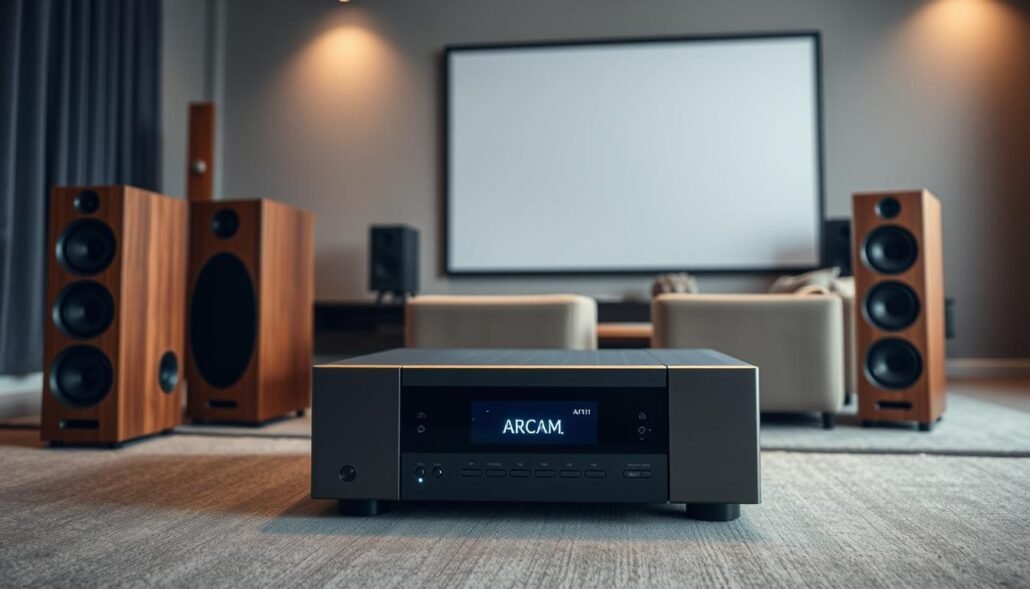
Arcam AVR11: why it’s frequently positioned as “best AV Receiver For Music”
The two-channel-first buyer wants excellent stereo imaging and natural tonal balance, yet still expects reliable Dolby Atmos playback for movies. The AVR11 delivers cleaner amplification, tighter control at low volumes, and refined overall sound quality.
Expect engineering choices that favor audio purity over flashy streaming features. That means you pay for measurement, parts, and amp topology that improve music and two-channel performance.
- Best use: prioritize front L/R speakers and a quality amp path first.
- Upgrade path: add a center, surrounds, and heights later without sacrificing music fidelity.
- Tradeoff: streaming ecosystems may be simpler than value-focused competitors.
In short, if music is your main use-case, Arcam can be the smarter investment in a sound system. Confirm the AVR11 also meets 2025 video and HDMI switching needs so your music-first receiver doesn’t fall short for modern sources.
HDMI inputs, 8K capability, and video features that matter most in 2025
Right-sizing your video I/O starts with a clear count of what you actually use daily. Most homes have one or two high-bandwidth sources: a game console and a PC or disc player. That means a receiver with 2–3 true 8K-ready ports often covers real needs, not the headline total of every input.
How many 8K-ready ports you actually need for streaming, discs, and consoles
Think in terms of high-bandwidth sources, not total inputs. If you own one console and a 4K Blu‑ray player, two 8K-capable ports (or 4K/120-capable ports) are usually enough. Models like the Sony STR‑AN1000 and Onkyo TX‑NR6100 demonstrate that 6 total hdmi inputs with 2–3 8K ports meet most living-room setups.
Dolby Vision pass-through and why it still triggers purchases
Dolby Vision remains a buying trigger because it signals modern HDR pass-through, wide streaming support, and UHD disc compatibility. If you stream from services or own UHD movies, confirm the receiver negotiates Dolby Vision without black screens or format drops.
Multiple HDMI outputs for projectors, TVs, and Zone 2 setups
Multiple outputs solve real setups: TV + projector or a main display plus Zone 2. Note the gotcha: some units reduce output bandwidth when Zone 2 is active. The Onkyo TX‑RZ50, for example, can limit an output to 4K if the second output is used for Zone 2.
- Heuristic: prioritize enough hdmi inputs, then stable switching, then the right outputs for your displays.
- Practical tip: prefer 4K/120 support if gaming latency matters; 8K is bonus futureproofing.
- Brand note: Sony and Onkyo often advertise port counts; Denon and Marantz emphasize broad compatibility and ease of use.
Next up: channel planning so your hdmi choices match the speaker layout and system scale you plan to build.
Dolby Atmos, DTS:X, and channel planning for the best surround sound
Start with your room and listener positions; the right channel layout follows from how people sit and where speakers fit.
Match channels to space, not ego. A 5.1.2 layout gives clear height effects and simpler placement for many living rooms. It often delivers punchy surround sound without complex wiring.
Move to 7.2.4 when you need wider envelopment and better height steering. Extra channels add lateral surrounds and two more height speakers, improving object tracking and seat-to-seat immersion.
Choosing between 5.1.2, 7.2.4, and 7.4.4
7.4.4 is a premium setup: four subwoofers for uniform bass and four height channels for dense overhead imaging. Use it in dedicated rooms or when the receiver can process more channels and you plan external amps.
| Layout | Where extra speakers go | What it improves |
|---|---|---|
| 5.1.2 | Two height speakers only | Simple height effects; easy setup; good for most living rooms |
| 7.2.4 | Two side surrounds + four height positions | Wider envelopment; better object steering |
| 7.4.4 | Extra subwoofers + four heights | Bass consistency across seats; immersive overhead detail |
Height speaker options: in-ceiling vs upfiring vs on-wall
In-ceiling speakers give direct height energy and work best in dedicated rooms. They require cut-ins but deliver consistent Atmos imaging.
Upfiring modules suit rentals and TVs; they reflect sound off the ceiling. Results vary with ceiling height and surface, so test before committing.
On-wall heights help rooms with shallow ceilings where in-ceiling is impossible. They offer a balance between directness and ease of installation.
- Subwoofer planning: one sub is common; two improve seat-to-seat balance; four is premium when the system supports discrete calibration.
- Format support: keep both dolby atmos and dolby atmos dts:x compatibility for discs and mixed sources.
- Buy for the next step: verify your receiver can process the layout you plan to add later and use room correction as the multiplier that ties everything together.
Room correction showdown: Audyssey vs Dirac Live vs Anthem ARC Genesis vs Sony DCAC
A proper calibration routine can deliver bigger gains to sound quality than moving up a model tier. Tuning aligns speakers, subwoofer behavior, and crossover settings so the entire room becomes part of the playback chain.
Why calibration is the biggest multiplier
Audyssey (Denon/Marantz) offers a guided mic workflow that is quick and reliable for most users. It improves tonal balance and tightens bass without much setup time.
Dirac Live (Onkyo) demands more measurement effort but gives finer control and clearer imaging. CNET and pro reviews note its payoff when you invest the time.
Anthem ARC Genesis measures multiple points and focuses on real-world bass smoothing for better low-frequency impact across seats. Sony DCAC emphasizes speed and practical results for ES owners.
Setup difficulty vs results
- Easy: Audyssey — fast, guided, reliable.
- Advanced: Dirac — steeper learning curve, greater tuning depth.
- Focused bass: ARC Genesis — excels with multi-mic measurement.
- Quick wins: Sony DCAC — simple, effective for ES line.
When discrete subwoofer channels pay off
Multiple subwoofer outputs let the receiver calibrate each sub separately. That reduces cancellations and gives smoother bass across seats.
Buy discrete sub channels when you run more than one subwoofer or when the system covers many listening positions. Otherwise, choose the simplest EQ you’ll actually use — unused correction is wasted effort.
Streaming, multiroom, and everyday usability features shoppers compare
Most buyers use their receiver for music multiple times a week, so streaming support matters. Daily playback habits change what features matter: ease of use, ecosystem fit, and quick phone control beat headline specs for many users.
Spotify Connect, HEOS, DTS Play‑Fi, AirPlay, and Bluetooth transmit
Spotify Connect offers simple control from the app, while AirPlay fits Apple households. DTS Play‑Fi and Google Cast/HEOS work well when you need broader device compatibility across a multiroom setup.
Bluetooth transmit is a handy late‑night feature for wireless headphones. Denon and Marantz often include HEOS and TX options. Onkyo lists Play‑Fi, Spotify Connect, AirPlay, and a phono input on some models.
Voice assistant control and app ecosystems
Voice help handles basic playback and volume, but complex setup still needs the app or remote. Match a receiver to the voice ecosystem you already use for smoother daily control.
Phono inputs vs external preamps
Phono inputs let you plug a turntable directly into the receiver. Use them if you want simple vinyl playback. If a model lacks a phono stage — common on some Sony units — factor in an external phono preamp for better long‑term sound.
- Multiroom tip: choose a receiver that matches your home’s existing ecosystem to avoid streaming friction.
- Practical pick: pick features based on how you listen — cinema, gaming, or daily music — for the best fit.
Performance-by-use-case picks: home cinema, gaming, and music
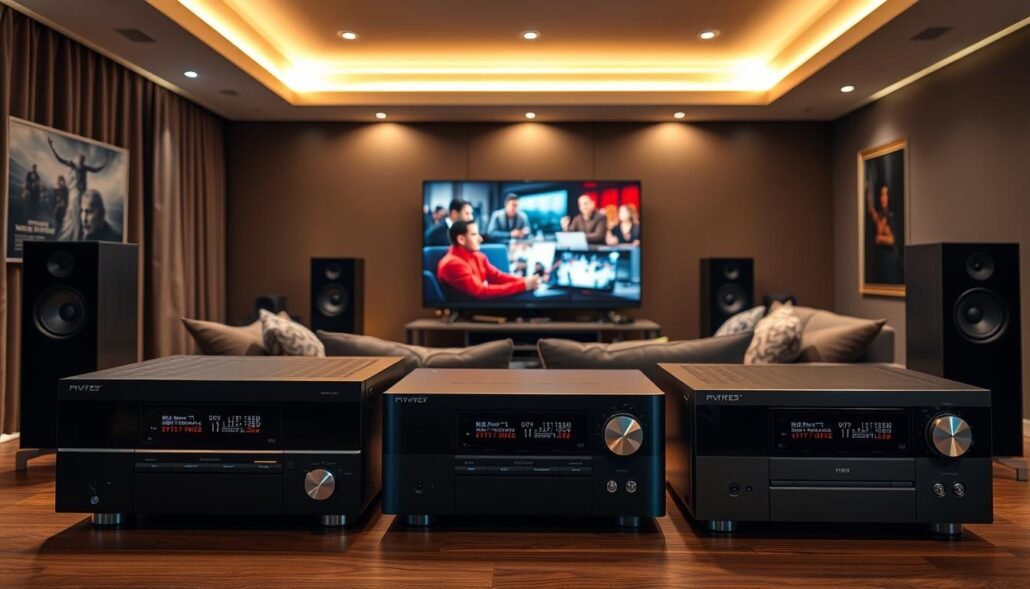
This short guide lists practical picks by use case so you can land on the one best receiver for your setup.
Best receivers for home theater impact and Atmos scale
Choose models with multi-channel processing, robust preouts, and strong room correction. The Denon AVR‑A1H and Marantz Cinema 50 work well for large home cinema builds and scaling multiple subs for true dolby atmos impact.
Best receivers for gaming: low latency, 4K/120, and stable HDMI handshakes
Prioritize HDMI behavior and 4K/120 support. Sony STR‑AN1000 and Denon AVR‑S770H handle fast switching and reliable HDR pass-through, so consoles stay responsive and tear-free.
Best receivers for music: stereo imaging, DAC performance, and clean amplification
Pick a unit that favors low noise and refined amp topology. Arcam AVR11 and Anthem MRX 740 deliver superior stereo clarity and measured gains from room correction. Expect fewer streaming extras, but better pure sound quality.
Tradeoffs: gaming-optimized models may omit phono inputs; music-first gear can skip some smart features and extra hdmi ports. Remember: good calibration and proper speaker/sub placement often improve performance more than small power bumps.
How to choose the right HDMI AVR brand for your room, speakers, and budget
Start by matching room size and speaker sensitivity to realistic power needs, not marketing claims.
Match watts per channel to speaker sensitivity and room size
Look past the top-line watts per channel number. Honest specs list power across 20Hz–20kHz at low THD and note whether the rating is 2ch‑driven or all‑channels‑driven.
As a rule: efficient speakers (90+ dB) need less power in small rooms. Low‑sensitivity speakers or large rooms need more amplifier headroom to stay clean at high volume.
Plan for growth with preamp outputs and upgradeable amplification
Preamp outputs are the single best future‑proofing feature. They let you add external amplifiers for extra channels or more power without replacing the receiver.
If you expect a 7.4.4 or multi‑sub system later, choose a unit with ample preouts and processor capacity today.
Checklist: hdmi inputs, number channels, room EQ, and streaming must-haves
- Count current sources and add one extra hdmi inputs for growth; confirm dual outputs if you run a projector plus TV.
- Verify powered channels vs processing channels so your target layout (5.1.2, 7.2.4) is achievable without external amps.
- Pick the room EQ you will actually run: Audyssey for quick setup, Dirac for detailed tuning, ARC Genesis for multi‑sub focus.
- Filter by streaming ecosystem, voice control, phono needs, and app quality to match daily habits.
| Decision point | Quick test | Buy/No‑Buy rule |
|---|---|---|
| Watts per channel | Check spec footnotes: 20Hz–20kHz, THD, channels driven | Buy if honest all‑channel figures exist; otherwise no‑buy for ambitious rooms |
| Preamp outputs | Count dedicated preouts and subwoofer outs | Buy if you plan external amps or multiple subs |
| Number channels vs processing | Confirm powered channels and processing headroom | Buy if processing supports your planned layout |
| HDMI inputs & outputs | Inventory sources + one spare; verify dual outputs for projector/TV | Buy if inputs meet current + growth needs |
| Room EQ & usability | Choose a calibration system you’ll run; test app and streaming features | Buy if ecosystem and EQ match daily use |
Final filter: match practical power and expansion needs to your budget, then pick the receiver that best fits daily streaming and control habits for your home.
Conclusion
Which brands are currently leading in HDMI AVR technology? The short answer: the makers that fix real problems—stable hdmi switching, reliable eARC, and clean Dolby Vision pass-through—win. Pick a receiver that makes daily use simple and sound better with good room correction.
Practical brand map: Denon for broad value and format support; Onkyo for connectivity and Dirac; Sony for gaming-focused HDMI 2.1 and setup tools; Marantz for premium multi‑sub surround sound; Anthem for ARC Genesis and performance; Yamaha for cinematic AVENTAGE builds and phono; Arcam for music-first listening that still handles dolby atmos.
Buy for your system, not the spec sheet. Verify hdmi inputs/outputs, planned channels, room EQ ecosystem, and the streaming features you’ll actually use at home. Shortlist 2–3 models, check compatibility with your TV, projector, and consoles, then choose based on calibration and expansion needs. The best receiver is the one that fits your room, speakers, and daily habits—without HDMI headaches.
FAQ
Which companies lead HDMI AVR design for Dolby Atmos, DTS:X, and HDMI 2.1 features?
Denon, Marantz, Yamaha, Onkyo, Sony, Anthem, and Arcam appear most often in 2025 roundups. Each focuses differently: Denon and Marantz blend format support and value; Yamaha emphasizes robust switching and build; Onkyo and Sony push 8K/4K/120 gaming features and streaming; Anthem targets audiophile room correction; Arcam favors two‑channel fidelity with modern Atmos capability.
What does “leading” mean for an AVR when judging HDMI switching, eARC, and HDR pass‑through?
Leading models reliably offer HDMI 2.1 switching or sufficient 4K/120 support, stable eARC for lossless Atmos from TV apps, and full HDR pass‑through including Dolby Vision, HDR10 and HLG. Leadership also includes firmware support, low‑latency game modes, and clean signal routing that preserves video metadata and audio bitstreams.
How many HDMI inputs and outputs should I expect from top receivers for a modern setup?
Expect at least five to eight HDMI inputs on midrange receivers, with two or more outputs for TV and projector passthrough. Flagship models often include six to eight 8K‑ready ports, while budget units may limit you to three or four. Match counts to your Blu‑ray, console, streaming box, and AV gear needs.
How important is watts per channel when picking a receiver for movies and music?
Watts per channel matter, but speaker sensitivity and room size matter more. Look past peak numbers and check continuous power at 8 or 6 ohms, distortion ratings, and headroom. A well‑matched 80–120 Wpc amp can outperform a higher‑rated unit if speaker load and room acoustics are optimized.
What surround layouts should I consider for Dolby Atmos and DTS:X performance?
Typical choices: 5.1.2 for a basic Atmos lift, 7.2.4 for fuller immersion, and 7.4.4 for large rooms and object‑rich mixes. Choose layouts based on room size, ceiling height, and whether you prefer in‑ceiling, upfiring, or on‑wall height speakers for vertical effects.
Which room correction systems matter most for real‑world sound quality?
Audyssey MultEQ (Denon/Marantz), Dirac Live (Onkyo/Arcam/optional Marantz), Anthem ARC Genesis, and Sony DCAC each deliver different tradeoffs. Dirac and ARC Genesis often provide the biggest measurable improvements, while Audyssey offers solid automated results with easier setup. Choose based on calibration depth and installer access.
Do receivers with multiple subwoofer outputs make a noticeable difference?
Yes. Multiple discrete subwoofer outputs let you time‑align and level each sub independently, smoothing low‑frequency response across larger rooms. This setup often yields tighter bass and fewer room nulls than a single sub output with SPL‑based EQ.
How do streaming features compare across leading manufacturers (Spotify Connect, AirPlay, HEOS, DTS Play‑Fi)?
Many top receivers support Spotify Connect and AirPlay; Denon/Marantz include HEOS, Onkyo offers broad Cast/AirPlay/Spotify Connect support, and some models add DTS Play‑Fi. Consider ecosystem integration if you already use multiroom gear or voice assistants for seamless control.
Which models are best for gaming with low latency and 4K/120 support?
Sony STR‑AN1000 and capable Onkyo and Denon 8K models are tailored for gaming with HDMI 2.1 features such as 4K/120, VRR, and ALLM. Ensure the receiver supports stable HDMI handshakes for consoles like PS5 and Xbox Series X and check firmware update history for ongoing compatibility fixes.
When should I choose an AVR with Dirac Live, Audyssey MultEQ XT, or Anthem ARC Genesis?
Choose Dirac Live if you want surgical room correction and are comfortable with a more involved setup or dealer calibration. Pick Audyssey for fast, effective results with mainstream tuning. Opt for ARC Genesis when prioritizing audiophile‑grade correction and deep customization for large systems.
Are phono inputs still common and important on modern receivers?
Many midrange and flagship receivers retain phono inputs for vinyl enthusiasts, especially Marantz and Yamaha models. If your turntable has a built‑in preamp, phono inputs are less critical, but native MM/MC stages provide cleaner integration for analog collections.
How should I match watts per channel to my speakers and room size?
Match amplifier power to speaker sensitivity and room volume. For small rooms with efficient speakers, 50–80 Wpc can suffice. For medium to large rooms or less efficient speakers, aim for 100–150 Wpc to ensure headroom. Always check continuous RMS ratings rather than inflated peak figures.
What video features still influence buying decisions: Dolby Vision, HDR, or multi‑HDMI outputs?
Dolby Vision pass‑through remains a key buying trigger because it preserves dynamic metadata. HDR10 and HLG support are baseline expectations. Multiple HDMI outputs help if you run a projector and TV or need a dedicated Zone 2 display, so count outputs against your planned layout.
How do preamp outputs and upgradeable amplification affect future‑proofing?
Receivers with preamp outputs for all channels let you add external amps later to power more speakers or boost headroom. This flexibility is crucial for phased upgrades, bi‑amping, or moving to larger multi‑sub systems without replacing the preamp/processor.
Which receivers deliver the best stereo music performance while still supporting Atmos?
Arcam AVR11 and Anthem MRX models are frequently praised for two‑channel purity. Marantz and Denon also tune for musical warmth while supporting full Atmos features. If music is a priority, look for models with high‑quality DACs, low noise floors, and clean preamp stages.
What checkpoints should I use as a final checklist before buying a receiver?
Verify HDMI input/output counts and 8K/4K/120 support, confirm eARC reliability, check room correction options, match watts per channel to speakers and room, ensure streaming and control features (Spotify Connect, AirPlay, voice assistants), and confirm preamp outputs for future upgrades.