If you want cinema-grade sound at home, the right central unit makes all the difference. This buying guide explains how a single component switches video, decodes formats, and powers speakers to deliver true theater sound.
We test models on sound, features, price, and real-world performance. Expect clear takes on brands like Denon, Sony, Yamaha, Onkyo, Marantz, and Anthem, plus standout models for budget and step-up buyers.
Look for 8K/HDMI 2.1 readiness, Dolby Atmos decoding, and robust streaming to futureproof your system. Calibration tools such as Audyssey and Dirac Live, honest power specs, and ease of setup shape our reviews.
This short guide helps you match room size, speaker layout, and content habits to the right unit. Start small and expand channels or subs over time while keeping the central hub in place.
Why an HDMI AV Receiver Is the Heart of a Modern Home Theater
For a tidy, high-performance home setup, one component handles switching, decoding, and system control. It keeps video sources and audio processing in a single place so your theater looks and works like a polished product.
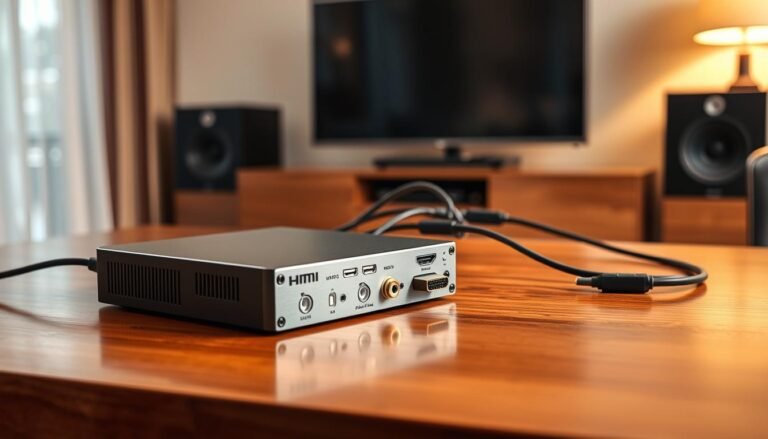
One hub for all sources: Connect streaming boxes, game consoles, and disc players and the unit routes video to the TV and sends decoded audio to speakers. That single HDMI cable to the TV cuts clutter and centralizes input selection and volume control.
Decoding and amplification: Modern units decode formats like Dolby Atmos and DTS:X, then amplify channels to create immersive surround sound. Built-in calibration and bass management keep levels balanced across seats.
- ARC vs eARC: ARC handles compressed streams; eARC supports uncompressed Atmos for better fidelity from TV apps and next-gen consoles.
- Compatibility: HDR formats and high-frame-rate gaming passthrough ensure players and consoles perform at their best.
- Ease of use: On-screen GUIs and setup apps make naming inputs, fixing lip-sync, and enabling CEC simple.
| Function | Benefit | Why it matters |
|---|---|---|
| HDMI switching | Multiple sources, one output | Add devices without rewiring and keep a single TV connection |
| Format decoding | Dolby Atmos, DTS:X | Immersive object-based sound for movies and games |
| eARC support | Uncompressed audio return | Full-bandwidth Atmos from TV apps and consoles |
| Network & I/O | Streaming, multiroom, extra zones | Futureproofs system for more speakers and subs |
When you want a streamlined home theater that’s easy to control and upgrade, a central hub delivers the connectivity and features that keep your system flexible and sounding great. Learn more about essential features you’ll want before you buy.
Key Features to Compare Before You Buy
Start by matching real-world performance numbers to the speaker layout you plan to use. That keeps purchases practical and avoids paying for unused options.
Channels and layouts
Choose a base system—5.1 or 7.1—and decide if you want Atmos height channels like 5.1.2 or 7.1.4. Larger homes or dedicated theaters may benefit from 11-channel processing for flexible speaker placement.
Watts and honest power specs
Look for power ratings measured across 20 Hz–20 kHz at low distortion and, ideally, with all channels driven. These figures show usable power, not marketing peaks.
Preamp outputs and subwoofer setup
Preamp outputs let you add external amps later for stronger fronts or extra zones. Multiple, discrete subwoofer outputs and separate EQ deliver smoother bass across seats versus a single linked output.
Video passthrough, ARC vs eARC, and room EQ
Check HDMI 2.1 bandwidth and how many 8K inputs a model offers—more inputs matter if you have multiple game consoles and media players. Dolby Vision and HDR10 passthrough keep the picture intact. ARC passes compressed tracks; eARC carries full, uncompressed Atmos from TV apps and consoles.
| Feature | Why it matters | Example |
|---|---|---|
| All-channels power | Realistic continuous output | Measured 20 Hz–20 kHz |
| Preamp outs | Upgradability with external amps | Front L/R, zones |
| Room EQ | Better in-room response | Audyssey, Dirac Live, Anthem ARC |
Match features to your needs and pick a system with room to grow. Good setup software and clear UI save time and frustration during installation.
Best Budget Pick Under $750: Denon AVR-S770H for 5.1.2 Dolby Atmos
If you want maximum bang for your budget, the Denon AVR-S770H packs modern video and immersive sound into a compact, easy-to-use unit.
The S770H offers seven powered channels with a discrete amp build that delivers clean 75 W per channel (8 ohms, 20 Hz–20 kHz, 0.08% THD, 2 ch driven). That honest power and the all-discrete design give better dynamics than many entry models.
Key connectivity and features:
- 5.1.2 Dolby Atmos support and virtual height modes (DTS Virtual:X, Atmos Height Virtualizer) for better immersion.
- Three 8K-capable HDMI inputs and Dolby Vision passthrough for future-proof video switching.
- eARC for full-bandwidth audio return from the TV and easy single-cable integration.
- Audyssey MultiEQ with Denon’s guided on-screen setup makes calibration approachable for new home theater owners.
| Spec | Detail | Why it matters |
|---|---|---|
| Power | 75 W/ch (2 ch driven) | Enough for small to medium rooms with efficient speakers |
| Channels | 7 powered (5.1.2) | True Atmos setups without external amps |
| Extras | Play‑Fi streaming, Bluetooth TX, MM phono | Late-night listening, streaming, and turntable support |
The S770H lacks preamp outs and amp matrixing, so external expansion is limited. Still, its user-friendly app and GUI, plus reliable build and thoughtful design, make it our favorite under-$750 pick.
Recommendation: Pair with efficient speakers and a quality sub to maximize bass and clarity in a typical living room or compact dedicated theater.
Step-Up Value Under $1,250: Denon AVR-X2800H with Height Flexibility
If you have a medium-size room and want clearer dynamics, the X2800H is a sensible upgrade. It adds headroom and smarter features without forcing external amps.

The unit delivers 95 W per channel (8 ohms, 20 Hz–20 kHz, 0.08% THD, 2 ch driven) across seven powered channels. That extra power helps drive a wider range of speakers with more authority than entry-level models.
Streaming, DACs, and daily usability
The X2800H includes HEOS streaming, Bluetooth RX/TX, and 192 kHz/24-bit DACs for serious music playback. Use the Denon app and voice assistants for quick setup and on-the-fly adjustments.
Height speaker placement and room tuning
Flexible processing supports in-ceiling, on-wall, or upfiring modules and improves spatial accuracy for Dolby Atmos layouts. Audyssey MultEQ XT brings finer room measurements for more precise calibration.
- Three 8K-capable hdmi inputs with Dolby Vision and eARC.
- MM phono stage for vinyl and wide file support including WAV and DSD.
- No preamp outs, but excellent value for 5.1.2 home theater setups.
| Feature | Benefit | Why it matters |
|---|---|---|
| 95 W/ch, 7 powered | More headroom | Drives varied speakers in medium rooms |
| HEOS & Bluetooth | Flexible streaming | Easy music playback and wireless headphones |
| MultEQ XT | Finer room tuning | Cleaner, balanced sound across seats |
Pair the X2800H with efficient, timbre-matched speakers and careful height placement to get the best theater-like immersion in your home.
Best Upgradeable Value: Onkyo TX-RZ50 with Dirac Live and 11-Channel Processing
Onkyo’s TX‑RZ50 balances expansion and real-world value for enthusiasts who plan to grow a system over time. It ships with nine powered channels and full 11.2 preamp outputs, so you can start with a 7.1.2 layout and add amplification later for 7.1.4 Atmos.
The unit delivers measured 120 W per channel (8 ohms, 20 Hz–20 kHz, 0.08% THD, 2 ch). That power and stable performance suit both movies and music listening in medium to large rooms.
- Connectivity: Six 8K-capable hdmi inputs and dual 8K outputs make multi-source setups simple, with eARC for lossless audio return.
- Streaming suite: Chromecast, AirPlay, DTS Play‑Fi, Spotify Connect, and Sonos Port integration provide broad music options and native Sonos control.
- Dirac Live: Advanced time and phase correction tightens imaging; using a calibrated mic (for example MiniDSP) and taking multiple positions improves results over the stock mic.
| Spec | Detail | Why it matters |
|---|---|---|
| Channels | 9 powered, 11.2 preouts | Scales to 7.1.4 with extra amps |
| Streaming | Chromecast, AirPlay, Play‑Fi, Sonos | Flexible music control and network integration |
| Power | 120 W/ch (2 ch driven) | Clean dynamics for movies and music |
Tip: Place the calibration mic at ear level and run several measurement points to let Dirac Live build a robust correction. Use the app for speaker assignment, input control, and network setup to speed installation.
Bottom line: The TX‑RZ50 is the best upgrade path if you want strong onboard power, comprehensive preamp outputs for future growth, and top-tier room correction. For a deeper hardware review, see the Onkyo TX‑RZ1100 writeup here.
Best 11-Channel Value: Sony STR-AZ5000ES for Big Rooms and Wireless Surrounds
For large rooms that demand headroom and flexibility, the Sony STR-AZ5000ES earns its keep with full 11-channel processing. It supplies 130 W per channel (8 ohms, 20 Hz–20 kHz) and 11 preouts, making it a true workhorse for dedicated theater installs.
The build is tank-like, with a heavy chassis and a robust power supply that supports sustained dynamics and musical clarity. Sony backs that design with a five-year warranty, underlining long-term reliability.
Advanced DCAC calibration uses 3D mapping during setup to localize speakers precisely and create immersive envelopment across seats. On-screen guidance walks you through detailed measurements so the complex setup is manageable.
- Flexible speaker options: supports wired 11-channel layouts, wireless surround modules, and phantom surround modes when physical speakers aren’t possible.
- Connectivity: six 8K-capable inputs and eARC support cover modern gaming and streaming needs.
- Expansion-ready: 11 preouts plus a discrete sub channel let you add power amps or extra subs for smoother bass and room tuning.
For large home theater rooms or open-plan living spaces seeking true 7.x.4 immersion, the STR-AZ5000ES combines scale, control, and authoritative sound. It’s a top value when you need an 11-channel solution that stays musical and powerful under load.
Best 9-Channel Choice with Bass Control: Marantz Cinema 50
Marantz balances refined musicality with practical power in a package built for upgradeability and tight bass control. The Cinema 50 supplies nine powered channels with 11.4 processing and a measured 110 W/ch specification for strong dynamics in medium to large rooms.
Bass control is a highlight: four discrete subwoofer outputs let you place subs across seats and smooth room response. That multi-sub approach cuts seat-to-seat variance and delivers deeper, more even low end for movies and music.
Upgrade and connectivity: Eleven preamp outputs support future amplification for a 7.4.4 setup, and an optional Dirac Live upgrade brings higher-level room correction when you want it. HEOS streaming and voice-assistant support make whole‑home streaming simple.
- Setup: Best-in-class guided GUI walks through connections, speaker tests, and Audyssey MultEQ XT calibration.
- Formats & gaming: Six 8K-capable inputs, Dolby Vision passthrough, ALLM, and eARC cover modern home theater needs.
- Extras: MM phono input for vinyl rounds out the Cinema 50 as a music-friendly hub.
In short, the Marantz Cinema 50 is a balanced choice for enthusiasts who want warm, musical sound, smart bass management, and clear upgrade paths without paying premium price for fringe features.
Top Sound Quality Focus: Anthem MRX 740 with ARC Genesis
Anthem’s MRX 740 prioritizes sound purity and headroom for listeners who demand precise dynamics. This sound-first model pairs high-current amplification with measured engineering to deliver authoritative, clean output for serious theater setups.
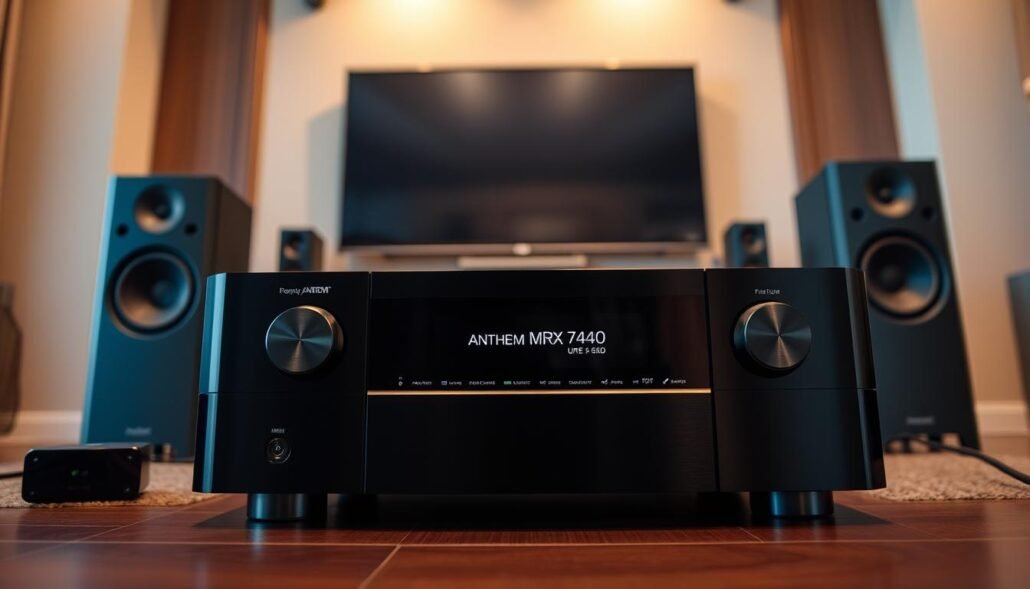
- High-current amplifier design: 140 W/ch (2 ch driven) across seven powered channels for robust dynamics and low distortion.
- Anthem ARC Genesis: advanced room correction that tames bass modes and tightens speaker integration for improved audio imaging.
- Power amp matrixing lets you reassign internal amps (all but center) for custom layouts or to work with external power.
The MRX 740 is 8K-capable with seven inputs, supports eARC for uncompressed tracks, and offers 11 preamp outputs plus a discrete sub channel to expand to larger Atmos layouts.
No phono stage is included, because the design is optimized for digital sources and pure home theater fidelity. Pair this unit with high-performance speakers and outboard amps to realize its full quality and performance potential in a dedicated theater room.
Great Midrange Alternatives to Shortlist
If you want solid cinema sound without premium pricing, these midrange models deserve a close look. Each balances core features and real-world performance, so pick based on the content you play most.
Onkyo TX-NR6100 — balanced streaming and Atmos
Why it stands out: Seven channels at 100 W each, Dolby Atmos and DTS:X decoding, plus six inputs with three 8K-ready ports.
Extras: phono input and broad streaming support (Google Cast, Play‑Fi, Spotify, Sonos, AirPlay, Bluetooth) make it great for mixed music and movies.
Onkyo TX-RZ50 — step-up with Dirac Live
This step-up adds Dirac Live calibration, more 8K inputs, and two-way Bluetooth. It’s a better fit if you plan room correction or future expansion.
Yamaha RX-A4A — cinematic sound and phono
With 110 W in stereo and robust build quality, the Yamaha delivers a cinematic signature and one of the best built-in phono stages in class.
Sony STR-AN1000 — gaming and precise calibration
Sony targets gamers and HDR fans with HDMI 2.1 features (4K/120, 8K support) and DCAC IX calibration using multi-position mapping for tighter imaging.
| Model | Key spec | Best for |
|---|---|---|
| Onkyo TX-NR6100 | 7×100 W, 3×8K inputs, phono | Streaming + Atmos on a budget |
| Onkyo TX-RZ50 | Dirac Live, 6×8K inputs | Calibration and expandability |
| Yamaha RX-A4A | 110 W (stereo), phono in | Cinematic sound & vinyl lovers |
| Sony STR-AN1000 | HDMI 2.1, DCAC IX | Gaming and HDR-focused setups |
Quick buying tips: decide whether you favor blockbuster nights, vinyl listening, or competitive gaming. Check number of 8K ports, calibration workflow, and which streaming services are native to each unit.
All choices work well in mixed-use living rooms, but ergonomics and calibration depth vary. Shortlist by price, ports, and the correction tools you prefer to get the best match for your home theater needs.
Surround Sound Formats and Music: Dolby Atmos, DTS:X, and Stereo Performance
Immersive movie sound and faithful music playback demand different treatments from your home theater system. Dolby Atmos and DTS:X both place sound objects in 3D space for convincing height and surround envelopment. Each format can create a sense of vertical motion and precise effects when height speakers are present.
When Virtual:X and Atmos Height Virtualizer make sense
Virtual height modes simulate top channels when you can’t install in-ceiling or up-firing speakers. They work well in rentals or minimalist living rooms and add dimension over plain 5.1 setups.
Balancing movies and music listening in shared rooms
For two-channel music, prioritize soundstage, imaging, and tonal balance. Some models favor warm, musical playback; others push cinematic dynamics.
- Room correction: apply separate profiles for movies and music when possible.
- Keep dialog clarity and lip-sync optimized for TV while using pure/direct modes for critical listening.
- Audition with concerts, action scenes, and dialog-heavy shows to judge overall quality.
| Area | Movie Priority | Music Priority |
|---|---|---|
| Height rendering | Physical top speakers preferred | Often bypassed for stereo purity |
| Processing | Object decoding (Atmos/DTS:X) | Direct / stereo modes for fidelity |
| Room EQ | Multi-channel profile | Two-channel profile or bypass |
Connectivity and Streaming Essentials for Today’s Systems
A seamless streaming setup makes a home theater feel effortless every night. Modern units pair network features with easy control so watching or listening is quick and reliable.
Streaming ecosystems and mobile control
Many models include HEOS (Denon/Marantz), Chromecast, AirPlay, Spotify Connect, and DTS Play‑Fi. Native streaming reduces the need for extra players and keeps the app experience smooth.
Bluetooth TX/RX and private listening
Bluetooth transmit/receive modes let you send audio to headphones for late-night listening or accept audio from phones for quick handoffs. They are a handy fallback when Wi‑Fi is unavailable.
- ARC vs eARC: eARC carries full-bandwidth Dolby Atmos from TV apps; ARC is limited to compressed streams.
- Gaming best practice: Connect consoles to the TV for low-latency video and use eARC to send lossless audio back to the system.
- Multiroom works with HEOS, Chromecast, and AirPlay to group other speakers across the home.
| Feature | Why it matters | Quick tip |
|---|---|---|
| Native streaming | Fewer devices, simpler setup | Use built-in apps when possible |
| Bluetooth TX/RX | Private listening & easy handoffs | Enable TX for wireless headphones |
| eARC | Uncompressed Atmos & DTS:X | Use TV 2.1 ports and enable eARC |
App-based control and voice assistants simplify volume, input, and playback. Note Denon/Marantz are moving to “Powered by HEOS” with a refreshed app and improved quality-of-life features. For pro tuning, select models offer Dirac Live ART as an optional upgrade.
Setup reminders: confirm service compatibility, check Wi‑Fi strength, label inputs, use CEC cautiously, and keep firmware current to avoid day‑to‑day connectivity issues.
Room Size, Speaker Pairing, and Subwoofer Strategy
Room volume and seating layout are the starting points for any sensible speaker and subwoofer plan. Measure the room and note where seats sit relative to walls. That simple step informs how much power and what speaker type you need for even coverage.
Matching watts to real speaker demands means considering sensitivity and impedance together. A speaker rated low sensitivity needs more power to reach dynamic peaks. Choose efficient speakers if your power budget is modest. For low-sensitivity designs, pick an amp with high current and honest power specs (20 Hz–20 kHz at low distortion).
Why multiple subs help
Two or four subwoofer setups reduce peaks and nulls across rows of seating. Multiple subwoofer outputs with separate calibration yield smoother bass and better seat-to-seat consistency.
For example, units offering discrete subwoofer channels let you apply independent EQ to each sub. The Marantz Cinema 50’s four discrete outs are a real-world example of how this improves in-room performance.
Practical setup tips
- Place subs front and rear or midwall to spread modes and reduce deep nulls.
- Set crossover and phase per sub, then fine-tune with room EQ rather than just cranking volume.
- Aim to match receiver watts per channel to speaker sensitivity and impedance to avoid clipping during dynamic peaks.
- In apartments, favor sealed subs, isolation pads, and balanced levels over raw SPL to keep bass tight and neighbor-friendly.
- Always audition a speaker pair in your space to confirm tonal match and dynamics with your chosen system.
| Factor | Advice | Why it matters |
|---|---|---|
| Room size | More volume → more headroom | Prevents clipping and preserves dynamics |
| Speaker sensitivity | Higher sensitivity → less power needed | Better for modest power budgets |
| Multiple subs | 2–4 subs with independent EQ | Smoother bass across seats |
Plan for growth: pick a main unit that can handle extra channels and subs later. Careful calibration and bass management usually beat a louder single sub. That approach preserves clarity and gives consistent home theater performance across listening positions.
Setup, Calibration, and Control Tips to Maximize Performance
Good mic technique and patient adjustment turn a capable system into a great home theater. Start with multi-point measurements around your main seats to capture how the room behaves and average out peaks and nulls.
Mic placement and measurement
Place the mic at ear height on a stand and avoid walls or reflective surfaces. Run sweeps in quiet conditions and use the supplied microphone with each maker’s app or software.
For the Onkyo TX-RZ50, use the Onkyo Controller app and the included mic for Dirac Live. Sony’s DCAC IX uses a stereo mic and multi-position mapping; the STR-AZ5000ES benefits from extensive 3D mapping. Audyssey on Denon/Marantz is guided and user-friendly. Anthem ARC Genesis runs on desktop for advanced control.
Manual tweaks and daily control
Accept auto-EQ when it’s close, then refine crossovers, trims, and distances manually for dialog clarity. Set mains to “small” and move bass to subs unless you have huge mains.
- Save profiles for movies, music, and late-night listening.
- Use dynamic volume or night modes to tame loudness swings without killing dialog.
- Keep firmware and the control app updated for stability and improved performance.
| Action | Why it helps | When to repeat |
|---|---|---|
| Multi-point sweep | Average room anomalies | New furniture or moved speakers |
| Manual crossover tuning | Smoother bass integration | After adding subs |
| Save profiles | Quick scene switching | Daily use |
Tip: Label inputs, customize remote shortcuts, and fine-tune CEC for predictable daily control. Re-run calibration after major changes—patient setup yields bigger perceived quality improvements than most hardware swaps.
Conclusion
Use these final picks and practical checks to lock in the right home theater hub for your room and budget.
Our buying guide highlights tested winners: Denon AVR‑S770H (budget), Denon AVR‑X2800H (step‑up), Onkyo TX‑RZ50 (upgradeable with Dirac Live), Sony STR‑AZ5000ES (11‑channel value), Marantz Cinema 50 (9‑channel with four subwoofer outs), and Anthem MRX 740 (sound‑first).
Match room size, speaker plan, and content priorities to channel count and features. Weigh honest power, preamp outputs, and discrete subwoofer control for long‑term growth. Verify 8K/HDMI 2.1 needs, Dolby Vision passthrough, and eARC for TV gamers.
Final step: shortlist two or three models by price and must‑have features, then confirm calibration options (Audyssey, Dirac Live, ARC Genesis, DCAC IX) before you buy for best sound and performance over the years.