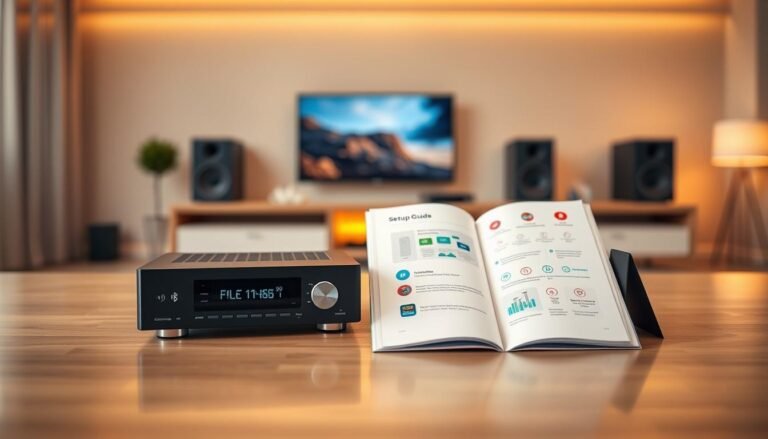
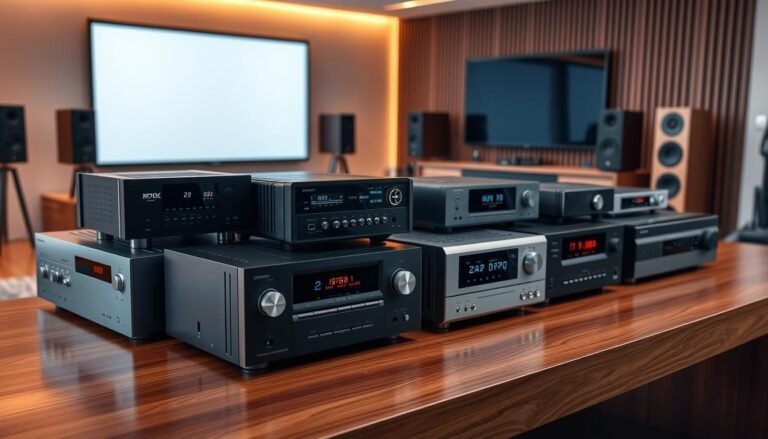
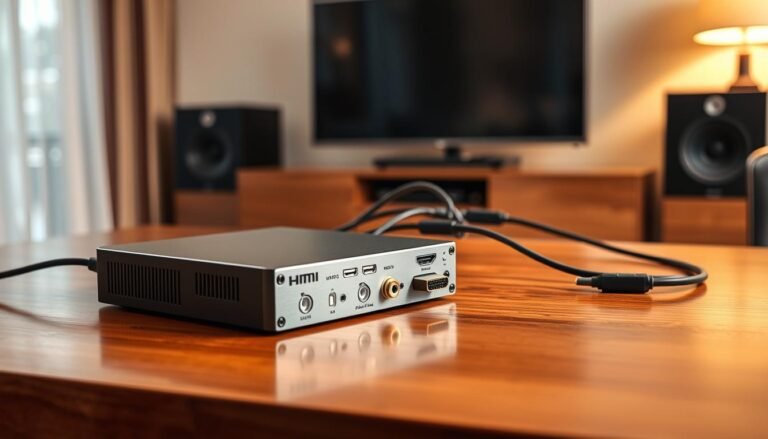
This guide helps U.S. buyers pick the right receiver for compact home theater setups. We balance slim form factors, enough power, and modern HDMI video support so your apartment or bedroom system sounds immersive without taking up space.
Quick hands-on context: highlights include the Marantz NR1711 and Cinema 70s as slim 7.2 Atmos-capable picks, Sony STR‑DH590 as a budget 5.2 unit, Marantz NR1510 for HEOS and phono fans, and Cambridge AXR100 for stereo-first listening. Onkyo, Yamaha, and Sony also offer strong alternatives with extra streaming, Dirac, or HDMI 2.1 perks.
What matters most: clarity and calibration beat raw wattage in tight spaces. We cover channels needed for layouts, HDMI 2.1 gaming needs, streaming and phono support, sub outputs, and key formats like Dolby Atmos, DTS:X, Dolby Vision, and HDR10+.
The article flows from search intent and room definitions to specs, full reviews, setup tips, and final picks so you can choose a compact model with the right features today.
Small rooms, big sound: what this 2025 roundup covers
This 2025 roundup focuses on compact AV gear that brings rich, room-filling sound without oversized cabinets.
Who benefits: apartment dwellers, condo owners, small living rooms, bedrooms, and multipurpose home offices that need theater-like audio in tight footprints.
What we test: slim Atmos/DTS:X AVRs, budget 5.2 units, music-first stereo amps, and compact alternatives with advanced calibration and streaming suites.
- We compare HDMI 2.1 video paths (4K/120, 8K) and eARC for lossless TV audio.
- We check Wi‑Fi, Bluetooth, multiroom streaming, voice control, and room correction tools.
- Real-world notes cover Atmos handling, dialog clarity at low volumes, and bass in confined spaces.
Brands cited include Onkyo (TX‑NR6100, TX‑RZ50) and Marantz (NR1711, Cinema 70s). The Onkyo TX‑NR6100 shines in Dolby Atmos and broad streaming support, while the TX‑RZ50 adds Dirac Live and more 8K inputs. Marantz slim models bring HEOS and modern HDMI readiness.
| Model | Key feature | Connectivity | Best use |
|---|---|---|---|
| Onkyo TX‑NR6100 | Dolby Atmos balance | 8K HDMI, Google Cast, DTS Play‑Fi | Theater-style in apartments |
| Onkyo TX‑RZ50 | Dirac Live calibration | More 8K inputs, higher power | When tuning beats brute power |
| Marantz NR1711 / Cinema 70s | Slim chassis, HEOS | 8K/60, 4K/120 readiness | Multiroom and compact home theaters |
Each review weighs value at price, balancing sound, features, and ease of use. Quick-look charts and deeper dives help you decide fast or dig into details.
Search intent and who this guide is for
This review is commercial in intent: readers are comparing models to decide which compact receiver fits an apartment or bedroom home theater today.
Audiences include:
- First-time theater buyers and renters with limited space.
- Gamers who need HDMI 2.1 video paths and low latency.
- Vinyl fans seeking phono inputs and music-first listeners who prefer stereo options.
We focus on practical criteria: breadth of connectivity, ease of setup, room calibration tools, streaming integration, and the total ownership experience.
Budget matters. We recommend sensible choices at different price tiers to avoid overpaying for unused features in tight layouts.
The article uses objective, review-style sections that synthesize specs with real-world notes on dialog clarity, bass control, and setup. Expect balanced guidance that weighs music and movies equally so your home theater experience suits both listening and watching in compact spaces.
What counts as a “small room” for a home theater receiver
A compact listening area changes how you choose equipment. In this context, a small room typically runs between 100 and 200 sq. ft., with seating about 6–10 ft from the screen. These layouts are common in bedrooms, dens, and modest living areas in U.S. homes.
Typical square footage and seating distance
At 6–10 ft the listener is close enough that clean first watts matter more than headline output. Shorter distances reduce the amplifier power needed to reach comfortable listening levels.
Why power ratings and speaker sensitivity matter
Speaker sensitivity and impedance determine how loud a pair will play with limited power. Bookshelf or satellite models rated around 86–90 dB reach target levels with less amplifier power.
Room gain can boost low frequencies in tight spaces. Two small subs run at lower levels often deliver smoother bass and less boom than one large sub.
- Thermals: slim chassis need good ventilation—avoid constantly overdriving an amp to prevent heat buildup.
- Channels: a 2.1 or 5.1 system usually fits best; 7.2 works only if placement and seating allow.
Ultimately, the goal is balanced sound with clear dialog at modest volumes, not max SPL. Let the room size guide the number of speakers, amplification, and calibration approach for a reliable system.
Key specs that matter in compact spaces
When space is tight, certain specs matter far more than headline features. Focus on items that improve day-to-day listening and viewing without wasting money on unused extras.
Channels and formats
Channels: choose stereo/2.1 for music-first simplicity, 5.1 for a modest surround footprint, or 7.2 only if placement and seating allow.
Format support: Dolby Atmos and DTS:X add height and immersion. In compact setups, these formats deliver perceptible depth at moderate volumes through height virtualization or compact up-firing modules.
HDMI, eARC, and video pass-through
Prioritize enough hdmi inputs for consoles, streamers, and a cable box. eARC outputs preserve lossless audio from the TV. If you game, look for 4K/120 or 8K pass-through to keep video latency low.
Streaming, wireless, and assistants
Integrated Wi‑Fi, Bluetooth, and platforms like HEOS, Chromecast, or AirPlay simplify streaming. Voice assistant support (Alexa, Google) makes daily control easier in multipurpose spaces.
Power, impedance, and thermal needs
Small areas benefit from stable amps that deliver clean power into 8Ω or 6Ω loads. Slim chassis must ventilate well to avoid thermal throttling.
Tip: dual subwoofer outputs help smooth bass at low listening levels and lower distortion.
| Model | HDMI highlights | Streaming |
|---|---|---|
| Marantz NR1711 / Cinema 70s | 8K/60, 4K/120, eARC | HEOS, Wi‑Fi, Bluetooth |
| Sony STR‑DH590 | 4K/60p, ARC | Bluetooth |
| Onkyo TX‑NR6100 / TX‑RZ50 | Multiple 8K-capable inputs | Broad streaming, Dirac on RZ50 |
Best receiver for small rooms? Our top picks at a glance
Quick reference: the compact models that deliver the most useful mix of connectivity, tuning, and room‑friendly power.
Marantz NR1711 — a slimline 7.2 unit with Dolby Atmos/DTS:X, HEOS, and 8K/4K120 readiness. Ideal for small living rooms that want immersive formats without a big footprint.
Sony STR‑DH590 — budget 5.2 choice with essential HDMI and Bluetooth. Solid value when Wi‑Fi and phono aren’t needed.
Marantz NR1510 — music‑first 5.2 with HEOS and a phono input. Great on a compact media console for streaming and vinyl.
Cambridge Audio AXR100 — stereo‑first option, 100W/8Ω and multiple inputs. Excellent musicality and clean sound in tight setups.
Premium and alternatives: Marantz Cinema 70s adds HDMI 2.1 and advanced HDR; Onkyo TX‑NR6100 balances Atmos and streaming while TX‑RZ50 brings Dirac Live. Yamaha RX‑A4A and Sony STR‑AN1000 fit cinematic or gaming needs.
| Model | Strength | Ideal use |
|---|---|---|
| Marantz NR1711 | Slimline Atmos | Apartment theater |
| Cambridge AXR100 | Stereo musicality | Music-first console |
| Sony STR‑DH590 | Value | Bedroom media corner |
Marantz NR1711 review: slim 7.2 Atmos performance for compact homes
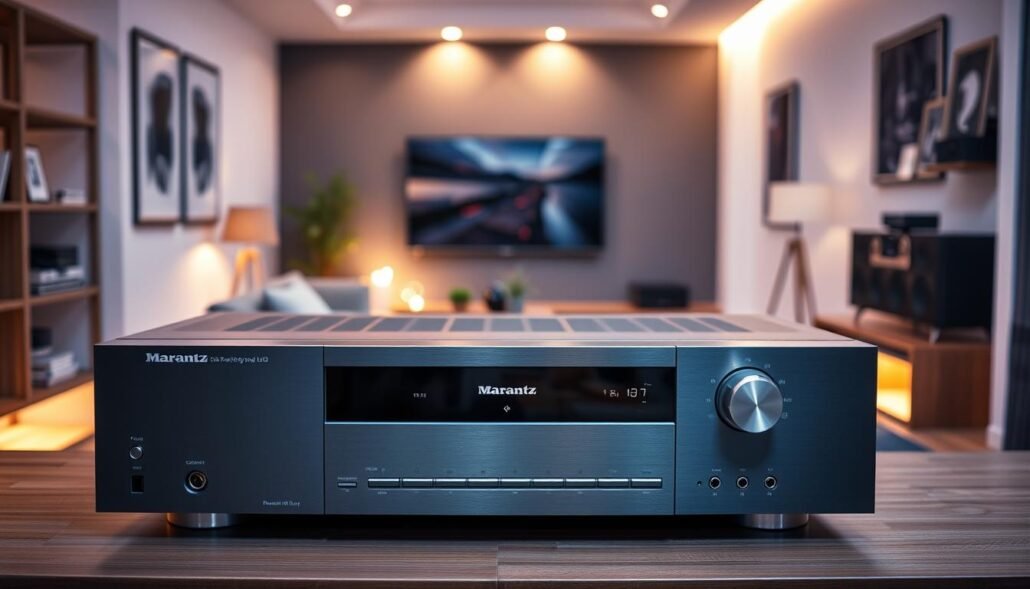
The NR1711 packs modern video and immersive decoding into a slim chassis that fits tight entertainment centers. It is a 7.2ch unit rated at 50W x 2 into 8Ω (20Hz–20kHz, 0.08% THD, 2ch) with higher reserve into 6Ω. The compact dimensions (17.3 x 14.8 x 4.1 in) make placement simple on a media console.
Why its 50W x 2 spec works in confined layouts
Short listening distances and bookshelf or satellite speakers mean clean first watts matter more than big numbers. At typical seating distances the NR1711’s power drives dialogue and dynamics without strain.
Tip: choose speakers with moderate sensitivity (86–90 dB) and use room correction to maximize clarity rather than chasing wattage.
Dolby Atmos, DTS:X and video readiness
The unit decodes Dolby Atmos and DTS:X, and adds Atmos Height Virtualization plus DTS Neural:X for flexible setups with fewer speakers. Video passthrough handles 8K/60 and 4K/120, and it supports HDR10+, Dolby Vision, HLG, and Dynamic HDR.
Connectivity and ecosystem
- Six HDMI inputs and one HDMI output with eARC/CEC for lossless TV audio.
- Phono MM input, three analog inputs, USB, and dual subwoofer outputs to smooth bass at low levels.
- HEOS multiroom, Wi‑Fi, Bluetooth, AirPlay 2 and major streaming services for easy playback.
Practical note: the shallow 4.1‑inch height fits tight racks but allow ventilation above and behind the unit to avoid heat buildup. Typical small-home layouts run 5.1.2 or 7.2 with compact speakers; using two small subwoofers helps even low-frequency response at modest volumes.
Sony STR-DH590 review: budget-friendly 5.2 for small living rooms
The STR‑DH590 aims to deliver straightforward surround performance and essential video passthrough in an affordable package.
Where it shines and where it compromises
Value and basics: This 5.2 channel receiver gives solid surround audio and covers HDMI essentials at a low price. It supports 4 HDMI inputs and one HDMI output (ARC) with 4K/60p (4:4:4) pass-through and HDR10, HLG, and Dolby Vision.
Connectivity notes: The unit has optical, coaxial, and analog inputs plus dual sub outputs. Bluetooth handles streaming, but there is no Wi‑Fi and no phono input, so turntables need a preamp.
- Formats: DSD, Dolby Digital, DTS‑HD Master Audio deliver convincing surround without Atmos.
- Power: Rated 145W/6Ω (1kHz, 1ch) and 90W/6Ω (2ch), it gives clean output with 6–8Ω speakers; avoid low-impedance loads to limit heat.
- Use case: Good for first home theater setups, 4K/60 console play, and budget-conscious movie nights.
Bottom line: If price and straightforward setup matter most, the STR‑DH590 is a pragmatic choice that covers core inputs and decent audio performance without extra streaming bells.
Marantz NR1510 review: compact 5.2 with HEOS and phono for music-first setups
The NR1510 is a slim 5.2 model tuned with music in mind. It pairs a dedicated phono MM input and HEOS streaming with modest power that suits near-field listening on bookshelf speakers.
The unit puts out 50W per channel into 8Ω (60W/6Ω spec) and covers core HDMI needs with five inputs plus one output supporting ARC/eARC and 4K/60 HDR with Dolby Vision and HLG.
Connectivity is practical: a front HDMI and USB make quick hookups simple. Dual sub outputs tame low end in tighter spaces and Hi‑Res Audio plus TuneIn internet radio broaden listening options.
- Music-first sound: clear mids and airy highs that favor stereo listening and vinyl playback.
- Streaming and multiroom: HEOS, Wi‑Fi, Bluetooth, AirPlay support Spotify and other services.
- Use case: ideal in a compact home where mixed music and TV duties matter more than full Atmos arrays.
Cambridge Audio AXR100 review: stereo-first sound quality in a slim profile
Cambridge Audio’s AXR100 leans into clean stereo power rather than multichannel tricks, making it a strong choice when clarity and musical detail matter most.
When a powerful 2.1 beats entry Atmos in tight setups
Why 2.1 wins: a focused two-channel layout with a sub delivers tighter imaging and more natural audio at moderate volumes. That matters in near-field listening where tone and vocals take priority over surround effects.
The AXR100 is a 2.1 stereo unit rated at 100W/8Ω. Its low THD target gives clean, dynamic playback with efficient bookshelf speakers without needing excessive volume.
Connectivity is practical: two optical, one coaxial, three analog RCAs, a front USB, headphone jack, FM/AM tuner, Bluetooth and a phono MM input. A built-in preamp lets you connect turntables directly and the subwoofer output completes a 2.1 setup.
It can drive two pairs of speakers for A/B listening or an alternate zone. Trade-offs include no Wi‑Fi and no HDMI, so pair the amp to a TV via optical or add a streamer for network playback.
Recommendation: Choose the AXR100 if you want rich stereo imaging, solid bass via a sub, and a slim chassis that fits tight media furniture while prioritizing music over multichannel bells.
Marantz Cinema 70s review: premium slimline Atmos with modern video
If HDMI 2.1 video and multi-output flexibility top your wish list, the Marantz Cinema 70s aims to deliver in a space-saving package. This model targets buyers who want current and future video paths without a bulky chassis.
HDMI 2.1, Dolby Vision/HDR10+, Dynamic HDR in tight spaces
The Cinema 70s supports 6 HDMI inputs with 8K/60 and 4K/120 handling, HDCP 2.3, and HDMI upscaling to 8K. It also decodes HDR10+, Dolby Vision, and Dynamic HDR to keep video sources looking their best.
What you gain over NR-series in features, not raw power
Power specs mirror the NR line (50W/8Ω, 70W/6Ω), but Marantz adds three HDMI outputs (including ARC/eARC), a refined UI with a round LCD, and 2‑zone multiroom outputs.
Practical benefits: HEOS streaming, Wi‑Fi/Bluetooth, and voice assistant support make daily control simple. The 7.2 channel layout with dual sub outputs helps smooth low end at modest volumes.
- Video stack: 8K/60, 4K/120, HDR10+, Dolby Vision, Dynamic HDR, and HDMI upscaling.
- Outputs: three HDMI outs with eARC and multi-zone capability.
- Streaming: HEOS, Wi‑Fi, Bluetooth and voice assistants for hands-free use.
Choose the Cinema 70s when cutting-edge video capability and multiroom features matter more than chasing higher wattage in a slim home theater receiver.
Compact alternatives to consider in 2025
Consider these four models when your priority is tailored performance, modern HDMI paths, or advanced room correction in limited spaces.
Onkyo TX‑NR6100
Profile: a balanced 7‑channel option with strong streaming and multiple 8K HDMI inputs.
Why it matters: 7x100W, Dolby Atmos/DTS:X decoding, phono input, and Google Cast plus DTS Play‑Fi make it a versatile home theater amplifier with wide connectivity.
Onkyo TX‑RZ50
Profile: higher power and Dirac Live correction.
Dirac Live helps smooth bass and tighten imaging in compact listening areas. Six 8K inputs and voice assistant support add video and smart-home flexibility.
Yamaha RX‑A4A
Profile: cinematic voicing with a strong phono stage.
At 110W (stereo) and seven HDMI ports, it favors music and movies. Check the chassis depth if you plan to fit it into shallow cabinets.
Sony STR‑AN1000
Profile: gamer-friendly HDMI 2.1 routing and advanced DCAC IX calibration.
7.2 channels, 4K/120 pass-through, and multiple HDMI outputs make it a solid pick when latency and video features matter most.
| Model | Highlight | Key strength |
|---|---|---|
| Onkyo TX‑NR6100 | 7x100W, Dolby Atmos | Streaming ecosystem and multiple 8K HDMI inputs |
| Onkyo TX‑RZ50 | 120W, Dirac Live | Calibration that improves small-room performance |
| Yamaha RX‑A4A | 110W (stereo), 7 HDMI | Cinematic tuning and solid phono stage |
| Sony STR‑AN1000 | 7.2, HDMI 2.1 | 4K/120 paths and DCAC IX calibration |
Channels vs room size: choosing 2.1, 5.1, or 7.2 for your layout
Match the number of channels to your floor plan to avoid cluttered speaker placement and poor imaging.
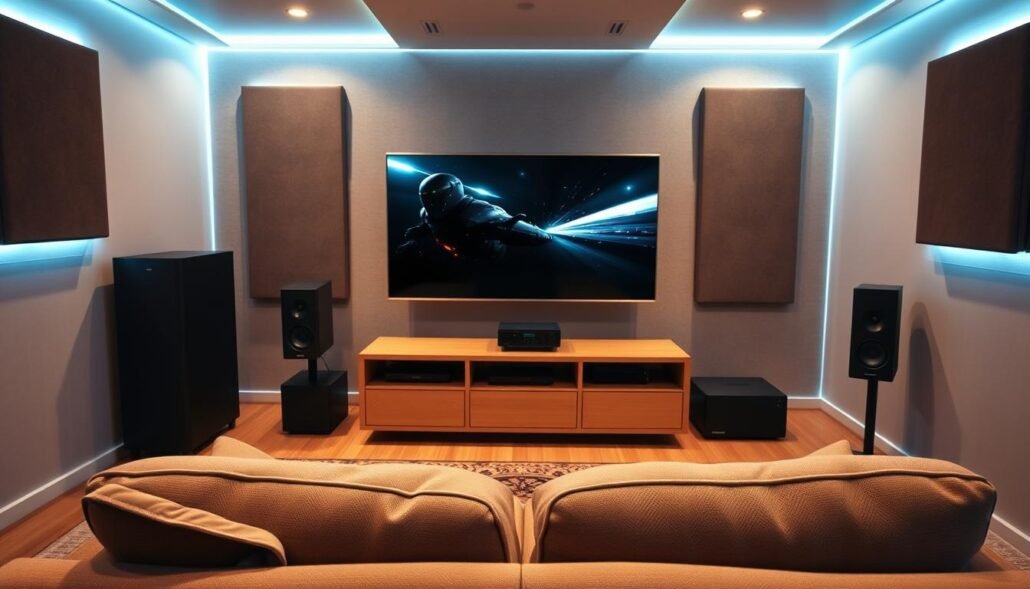
2.1 suits ultra-compact spaces and music-first setups. Use two compact speakers and a sub for tight seating distances. This keeps dialog clear and bass controlled without many cabinet footprints.
5.1 is the sweet spot for most small living areas. It adds rear surround presence while staying practical with placement options around sofas and furniture.
7.2 works only when seating and speaker placement avoid crowding. The extra surrounds and dual sub outputs can smooth bass and widen immersion—but only if the layout supports them.
- Match channels to layout: let furniture, wall reflections, and listening position guide the number channels you choose.
- Practical speaker choices: compact satellites or small bookshelf speakers plus a sub deliver clear dialog and tidy bass in tight areas.
- Height options: use height virtualization modes when ceiling or placement makes physical height speakers impractical.
- Calibration over channel count: good setup and room correction usually improves a system more than adding more channels.
- Dual subs: in a 7.2 setup, two subs placed thoughtfully can reduce peaks and nulls so bass stays even at low volumes.
Speaker and subwoofer pairing for small rooms
A thoughtful match between satellite or bookshelf speakers and subwoofer can dramatically improve sound quality in tight setups.
Compact satellites vs bookshelf speakers
Compact satellites look discreet and take up little space. They give broad surround feeling but can lack midrange weight.
Small bookshelf speakers deliver fuller mids and better stereo imaging at modest volumes. Choose bookshelf if music and vocal clarity matter most.
Dual subs and placement tips
Two small subwoofers improve seat-to-seat consistency and let you run lower levels without rattling walls. This reduces peaks and nulls in a compact rectangular room.
- Prefer compact sealed subs to control low-end extension and avoid boom.
- Try asymmetrical placement or a front-and-side layout to reduce room modes.
- Match speaker sensitivity to your amplifier—aim for ~8Ω loads in slim AV units so the amp drives the speaker easily.
Setup note: use the receiver’s crossover and distance settings to blend subs and satellites. Proper crossover and delay keep bass tight and make the whole home audio system sound cohesive.
Setup and calibration tips to maximize small-room performance
A few targeted setup steps will improve your system more than buying higher-power gear. Start with seating and speaker geometry and then apply room correction carefully. These moves boost clarity and steady bass in near-field home theater arrangements.
Seating, speaker height, and reflection control
Place the main seat at about 0.6–0.8 times the room length to avoid strong bass nulls and keep imaging coherent.
Set tweeters near ear height and aim the LCR speakers at the primary seat. Use rugs, curtains, and soft furnishings to tame first reflections and improve dialog clarity.
Room correction: Audyssey, Sony DCAC, and Dirac Live basics
Audyssey offers app-assisted tuning and target curves that smooth frequency response for everyday listening.
Sony DCAC IX (used in the STR‑AN1000) adds multi-position measurement, manual height settings, and screen/room parameters for precise alignment.
Dirac Live (found in the Onkyo TX‑RZ50) focuses on time and bass correction to tighten imaging and reduce room modes.
- Run multiple mic positions during calibration, then verify with dialog clips and bass sweeps at moderate volume.
- Start with a crossover near 80–100Hz for small speakers, then fine-tune distance and small EQ changes for clearer voice reproduction.
| System | Measurement style | Strength |
|---|---|---|
| Audyssey | Single/multi-point with target curves | Easy smoothing and balanced sound |
| Sony DCAC IX | Multi-position with manual height settings | Flexible height and seating presets |
| Dirac Live | Time and frequency domain correction | Precision imaging and bass control |
Tip: Make incremental changes after calibration. Small crossover and distance tweaks often yield clearer dialog and tighter bass. In many cases, a careful setup outperforms costly hardware upgrades over the years.
Connectivity checklist: HDMI inputs, ARC/eARC, streaming, and phono
Count your devices first and match them to available ports. Confirm how many hdmi inputs you need for game consoles, disc players, and streamers. Models here range from four (Sony STR‑DH590) to six (Marantz NR1711, Cinema 70s, Onkyo TX models) with some units offering extra 8K-capable jacks.
Video paths matter: prioritize eARC on the HDMI output to send lossless audio from a modern TV back to the system. If you own a PS5 or Xbox Series X, check 4K/120 or 8K pass-through on the model you pick.
Keep at least one optical or coaxial digital input for legacy TVs or CD players. Verify outputs too—dual subwoofer outputs are helpful and multiple HDMI outputs (Cinema 70s, STR‑AN1000) make TV plus projector setups easier.
Decide on the streaming stack: HEOS, Chromecast, AirPlay 2, and Bluetooth vary by model. If you plan to play vinyl, confirm a built‑in phono MM input; otherwise budget for an external preamp.
| Model | HDMI inputs / outputs | Notable connectivity |
|---|---|---|
| Marantz NR1711 | 6 in / 1 out (eARC) | Phono MM, HEOS |
| Sony STR‑DH590 | 4 in / 1 out (ARC) | Bluetooth only, no phono |
| Marantz Cinema 70s | 6 in / 3 out (eARC) | HEOS, 3 HDMI outs |
Budget to premium: finding the right price-to-performance
Spend with intention: identify whether speakers, calibration, or modern HDMI features will change your daily experience most.
Where to spend first: invest in quality speakers and a compact subwoofer. Upgrading speakers yields the biggest jump in perceived performance and clarity in tight spaces.
When to upgrade the system vs amplifier or HDMI
Room correction (Dirac Live, advanced DCAC) is worth the premium when untreated acoustics blur bass and imaging. The Onkyo TX‑RZ50’s Dirac option and extra 8K inputs justify higher price if tuning matters.
If you game at 4K/120, buy HDMI 2.1-capable gear. Otherwise, a strong 4K/60 HDR pipeline often covers TV and streaming needs.
- Platform value: HEOS, Chromecast, and AirPlay 2 reduce the need for standalone streamers and simplify streaming control.
- Build and noise: prioritize quiet operation and good thermal design—Yamaha RX‑A4A emphasizes solid construction and a stout phono stage.
- Practical tip: avoid overbuying wattage; choose clean amplification and ventilation over headline power numbers.
| Budget area | When to spend | Why it matters |
|---|---|---|
| Speakers & sub | First priority | Largest impact on clarity and bass |
| Room correction | Mid to premium | Tightens bass and imaging (Dirac/DCAC) |
| HDMI 2.1 | When gaming at 4K/120 | Low latency and future-proofing |
Best receiver for small rooms? Final picks by use case
This shortlist ties each model to a clear use case so you can pick gear that suits your layout and habits.
Best overall slimline: Marantz NR1711
Why it stands out: a 7.2 chassis with HEOS, Dolby Atmos/DTS:X support, dual sub outputs, and wide HDMI support (8K/4K120). It balances compact size with flexible outputs and strong streaming options.
Best budget small-room AVR: Sony STR-DH590
Why it fits budget builds: a 5.2 avr with four HDMI inputs and Bluetooth. It covers core surround duties and keeps setup simple when price and basic connectivity matter most.
Best music-centric small room: Cambridge Audio AXR100
Why music lovers choose it: a 2.1 stereo model delivering 100W, a dedicated phono input, and a clean analog path that favors vocals and instruments in near-field setups.
Best modern feature set in slim chassis: Marantz Cinema 70s
Why it’s modern: 7.2 layout with HDMI 2.1, three HDMI outputs, HEOS streaming, and a rich HDR suite. It suits upscale compact theater builds that need future-proofed video and multiroom options.
Best gaming-centric compact setup: Sony STR-AN1000
Why gamers pick it: HDMI 2.1 bandwidth with 4K/120 and DCAC IX calibration. Multiple 8K paths and low-latency video make it a strong choice for console-heavy apartments and condos.
Quick note: match each model to your room size, speaker type, and primary use—music, gaming, or movie playback—rather than chasing specs alone.
Conclusion
Conclusion
Choosing channels, a clean amp, and careful calibration makes a compact system sound far bigger than its footprint.
Prioritize HDMI/eARC and the streaming features you will actually use. Avoid paying for unused inputs or formats; that saves cash and simplifies setup.
Top 2025 picks: slim Marantz models deliver feature-rich Atmos and modern video, the Sony STR‑DH590 covers low-cost 5.2 needs, and the Cambridge AXR100 shines for stereo musicality. Onkyo, Yamaha, and Sony alternatives work well when Dirac, extra HDMI paths, or gaming features matter.
Check speaker sensitivity, consider dual subs to smooth bass, and allow ventilation in shallow cabinets for reliable thermal performance. Each recommended receiver can deliver big, engaging sound and modern video in compact U.S. home theater builds when paired and set up correctly.
See our broader AV receivers guide for more comparisons and buying notes.
FAQ
What defines a “small room” for choosing an AVR?
Small rooms are typically 100–250 square feet with seating distances under 10 feet. In these spaces, speaker placement, room reflections, and bass control matter more than high wattage. Choose compact amps and speakers with good sensitivity and consider room correction to tame bass and reflections.
How many channels should I pick for a compact living room?
For most small layouts, 2.1 or 5.1 systems cover music and movies well. 2.1 (stereo + subwoofer) gives great music performance and less setup complexity. 5.1 adds surround immersion without needing height channels; 7.1/7.2 or full Dolby Atmos works if you want overhead effects and have careful placement.
Do I need lots of power (watts per channel) in a small room?
No. You rarely need high wattage in a small room. Efficient speakers (high sensitivity) and an AVR that delivers clean, stable power at moderate levels (30–80W per channel) are better. Thermal management and headroom matter more than advertised peak watts.
Is Dolby Atmos worth it in a small space?
Yes, but choose implementation wisely. Dolby Atmos upfiring modules or compact ceiling speakers work well when ceiling height and room layout permit. Early-reflection effects are more obvious in close quarters, so calibrated setups and virtualization modes can provide convincing height cues without bulky hardware.
How important is HDMI 2.1 and eARC for small-room AVRs?
Very important if you plan to game at 4K/120Hz or use a single HDMI path for modern TVs and soundbars. eARC ensures full-resolution bitstreams from TV apps. If you mainly stream music or watch 4K/60 content, HDMI 2.0 with reliable eARC still performs fine.
Should I use one subwoofer or two in a small room?
One high-quality subwoofer often suffices, but two smaller subs can smooth room modes and deliver more even bass at low volumes. In tight spaces, careful placement and phase alignment matter more than adding SPL.
Are slimline AVRs like the Marantz NR1711 effective in apartments?
Yes. Slim models such as the Marantz NR1711 balance features, low-profile chassis, and enough power for compact rooms. They often include multiroom streaming (HEOS), modern HDMI, and dual sub outputs while fitting into tight furniture spaces.
Which audio formats should an AVR support for future-proofing?
Prioritize Dolby Atmos and DTS:X for immersive sound, plus passthrough for Dolby Vision and HDR10+. Look for HDMI specs that support the video formats you use and eARC for high-bitrate audio from TVs and game consoles.
How do room correction systems help in small rooms?
Room correction—Audyssey, Dirac Live, Yamaha Parametric EQ, or proprietary systems—measures room response and applies filters to reduce comb filtering, bass peaks, and nulls. In small rooms, correction significantly improves clarity and bass accuracy even with modest speakers.
Can I connect a turntable and streaming services to a compact AVR?
Yes. Many compact AVRs include a phono stage for turntables plus built-in streaming via Wi‑Fi, Bluetooth, HEOS, Chromecast, or AirPlay 2. Check inputs and network features to match your music sources.
What’s the best speaker type for a small home theater?
Bookshelf speakers or compact satellites paired with a powered subwoofer give great balance between size and performance. Choose speakers with good midrange clarity and place them to minimize early reflections. Floorstanders can work if space allows, but they require more careful placement.
How does impedance and speaker sensitivity affect AVR choice?
Lower-impedance speakers demand amps with stable current delivery. High-sensitivity speakers need less power to reach listening levels. In small rooms, matching a modest-power AVR to efficient speakers often yields the cleanest results without excess heat or distortion.
Are there budget AVRs that still perform well in small rooms?
Yes. Models like the Sony STR-DH590 provide solid 5.2 performance at a lower price, sacrificing some streaming features and advanced HDMI when compared to premium lines. Prioritize sound quality, connectivity you need, and whether room correction is included.
What should I prioritize: HDMI features, room correction, or better speakers?
Spend first on speakers and room treatment, then on room correction or an AVR with calibration. HDMI features (e.g., 2.1, eARC) matter if you game or use the TV as a hub. For music-focused setups, invest in speakers and a phono input if needed.
How can I reduce reflections and improve clarity in a small room?
Use soft furnishings, rugs, curtains, and absorption panels at first-reflection points. Speaker toe-in, proper height, and listener position away from walls reduce comb filtering. Calibration and bass traps help control low-frequency buildup.